Wait a minute … why didn’t I bring my 7 weight? (Ken Lindsay)By Ken Lindsay
Guest Contributor
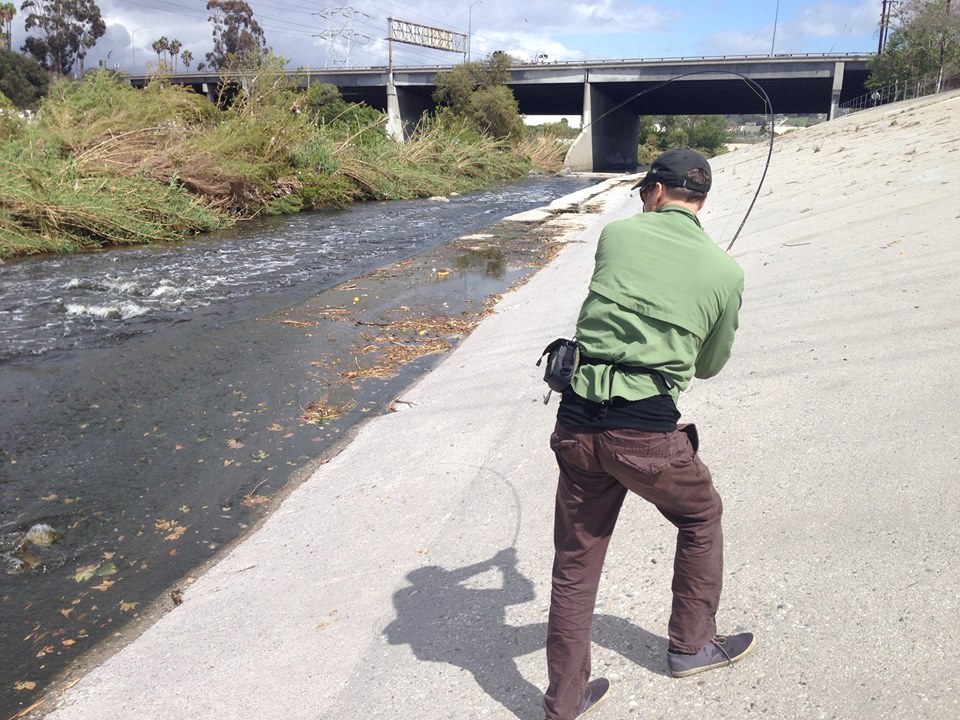
I went down to the River today for a couple of hours and ran into a Fishermen’s Spot customer, Keith Mosier, who was fishing it for the first time too.
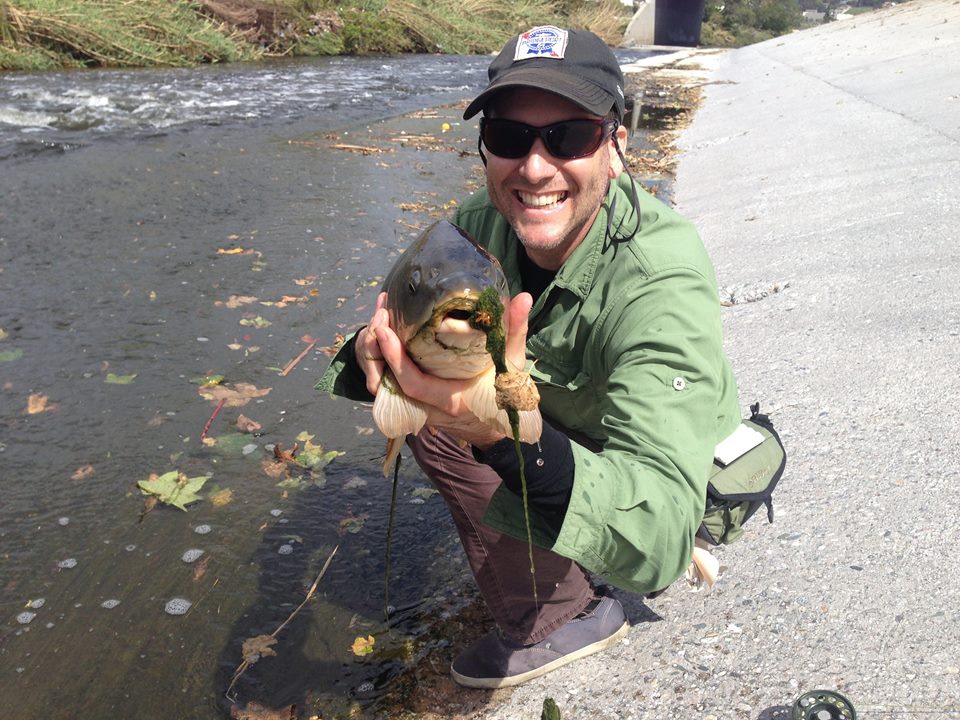
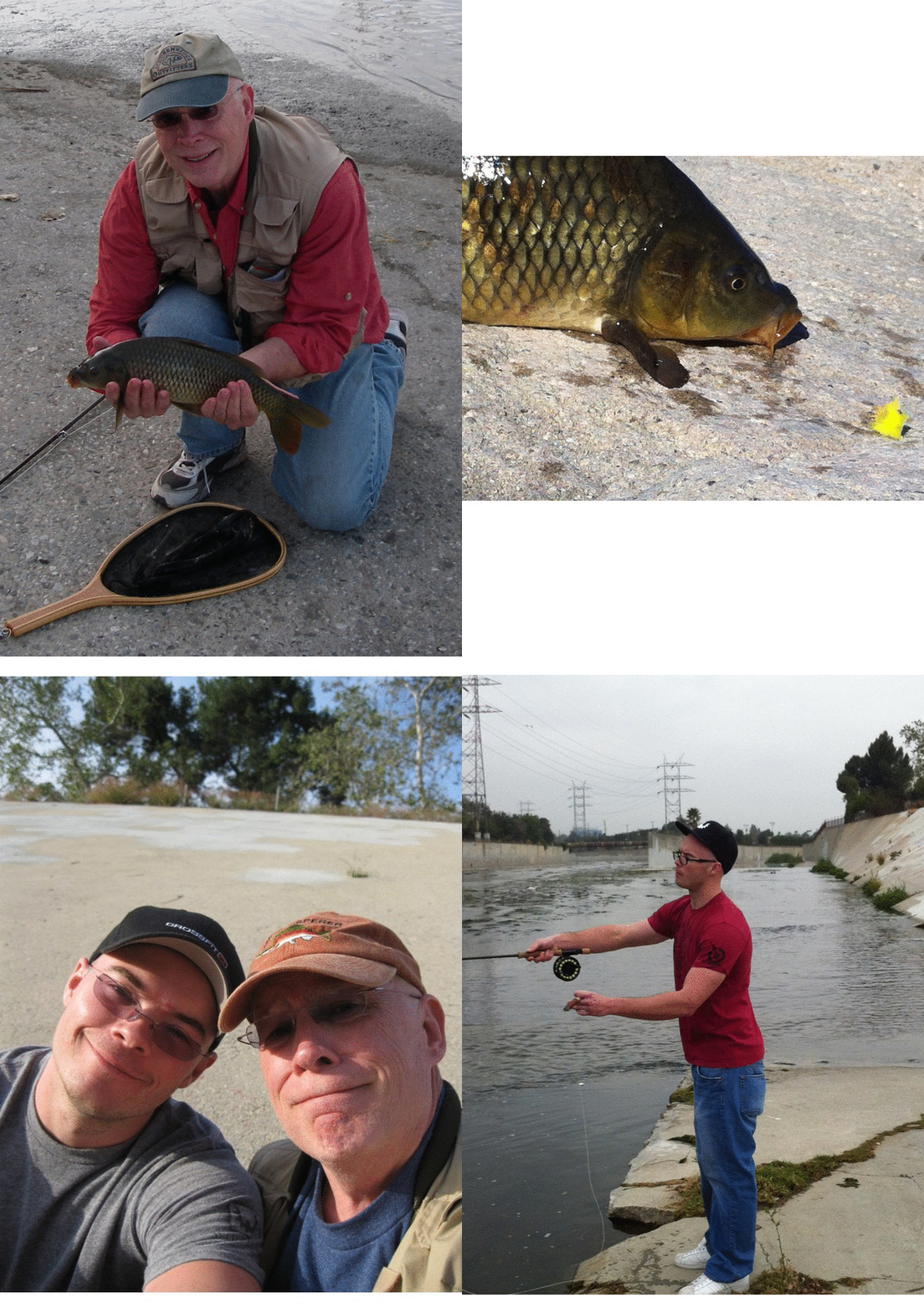
I had a tough time hooking fish but, the one I did hook was big and broke me off on 2X. Keith Mosier nabs his first L.A. River carp. Oh, yeah! (Ken Lindsay)
Keith told me about a group of feeders that he had found and we went to take a look. They were tanks!
Keith graciously let me have a shot at them but I could get no love. He stepped back in and immediately hooked a nice one that took him down stream about 50 yards but he finally was able to land his first carp on a fly and I was on hand to take some pics.
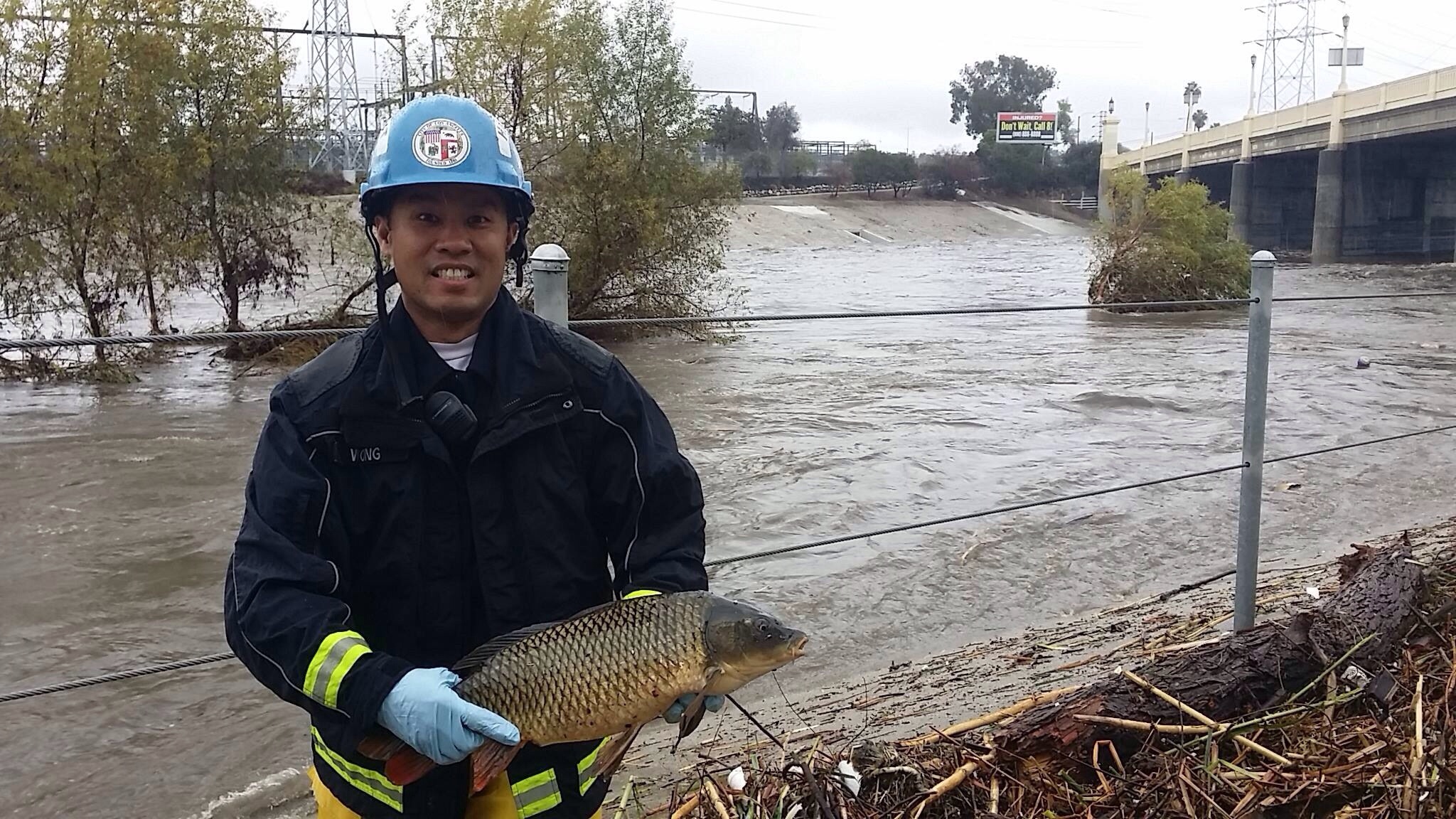
Howard Wong saved this and three other carp from a sidewalk demise during our recent storms. (LAStormwater)
Here’s a typical beauty shot, seen in fly-fishing mags in shops across America. But, this isn’t catch and release. It’s a true lifesaver as L.A. environmental Compliance Inspector Howard Wong rescues this sweet carp and three others from their waterless perch atop the bank, where they were washed up during our recent powerful storms.
Without Howard, we would be four fish short in the river. Thank you!
My wife, daughter and I try to get on the river regularly, usually every other weekend. We fish a quarter mile stretch below the 2 freeway. I have a 6wt for the carp and 3wt for the bass. I have caught quite a few carps, with the largest at 8 pounds.
The bass, however, keep eluding me.
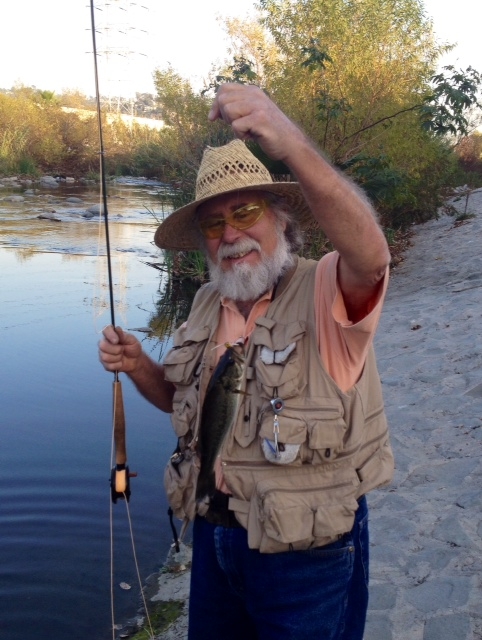
Green sunfish are one of the pllars of the L.R. River ecosystem, and fun to catch as well. (B. Roderick Spilman)
I have tried to entice them with wooly buggers, crayfish, poppers, grasshopper/cricket patterns and large elk hair, but to no avail. I’m nearly sure they are mocking me, because, every time we go, as it’s nearing 5 in the afternoon, they begin to jump at regular intervals right in front of the reeds. I can see them clearly when they jump. They are unmistakably bass (1 to 2 pounds). I know where they are. I cast upstream and let the fly float down to them. Nothing. I try to drop a fly on top of them. Nothing. I roll cast. Nothing.
One time, I noticed that there were rises in the middle of the river, just as the sun had set. I cast an elk hair a little upstream and gave it a few little tugs. Sure enough something snapped it up. I pulled it in, and, in the fading light, thought I had caught a blue gill. When I grabbed it, however, I realized that it was a little green sunfish.
I easily slipped off the barbless hook and cast again. Bam! Another one.
This went on for half an hour and then the rises completely stopped. None of the fish was bigger than 6 inches, but it was fun just to catch something. The activity literally lasted for no more than half an hour, while the bass were still jumping long after. It dawned on me that what cormorants and mergansers were feeding on were sunfish. The bass must also be feeding on the sunfish.
If this is true, the sunfish are one of the pillars of the L.A. River ecosystem. Anyway, now, when I don’t catch a more noteworthy fish, I catch a couple of sunfish and I can say that I haven’t been skunked.
Got an L.A. River fishing story you’d like to tell? Email it, along with a picture, to me at lariverflyfishing@gmail.com
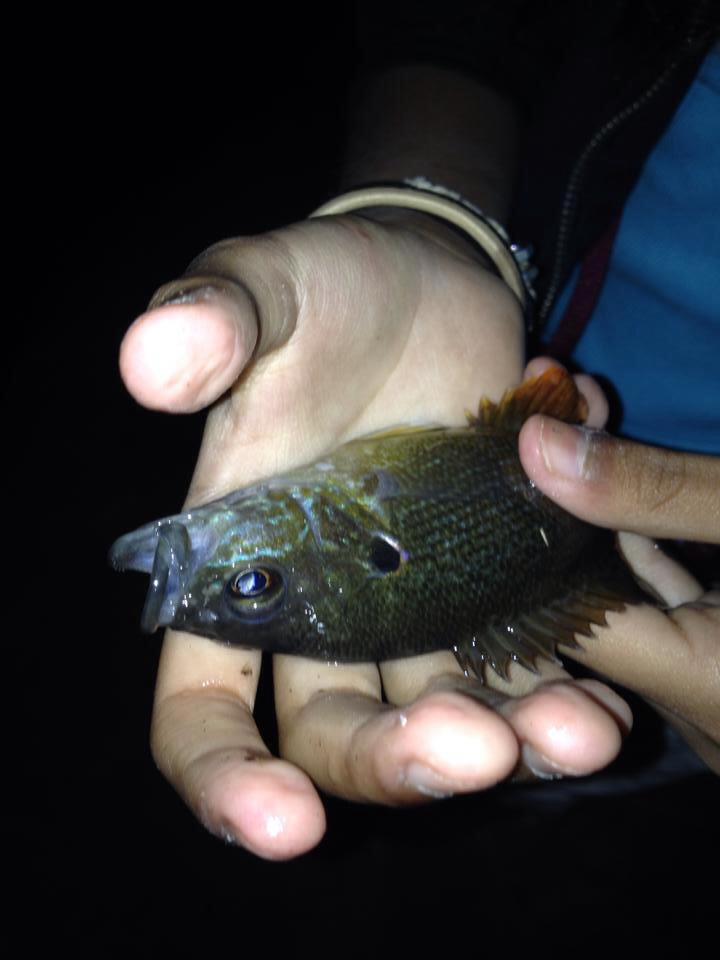
Seeing is believing: Catching a Largemouth Bass can make your whole day. (photos by Roland Trevino)
By Roland Trevino
I went fishing with my dad at the L.A. River this weekend. He was using a 4-wt. rod with a yellow popper and casting above the tail-out of a large pool. On his first cast he got a short strike that broke the water.
After a couple of casts, and a nice splash, he hooked into a real fighter.
At first, we thought he had hooked a large Green Sunfish, but after a short battle, he landed this little Largemouth Bass!
Got an L.A. River fishing story you’d like to tell? Email it, along with a picture, to me at lariverflyfishing@gmail.com
The Terminator Glo-Bug in chartreuse has captured many a wary carp. (Jim Burns)
Update: May 29, 2015
Summer carp journal
Saturday, May 23, 4:30-7:30, overcast, 70, 12 pound tippet. One carp charged and then turned away from a swimming nymph, rust brown dubbing with lighter rabbit tail (size 8).
Tuesday, May 26, 2:30-5:30, overcast, 70, 2X tippet. After rejections on bead head black wooly worm with red yarn tail and bead head swimming nymph with crazy orange dubbing and lighter rabbit tail. (size 8) hooked up on a carp dragon (Orvis). Carp eventually got free because I didn’t set hook deep enough. Saw about 50 pass me in the water, few feeding. Saw the white one again.
Thursday, May 28, 2:30-5:15, clear, 81, 3X tippet. Fish swam up to all of my flies, except the squirmy wormy. That means tortilla fly on red hook, terminator glo bug in chartreuse and orange, all got mighty big looks, but ultimate rejections. Saw the white boy several times, and there were lots and lots of carp. Also, again, “muddling” by one really aggressive fish, but it’s hard to see which way the fish goes through the mud. Also, chummed with two cans of corn to pretty negligible results. The tortilla fly is a dead ringer for canned corn. Didn’t make any difference.
Commenter Steve recently asked me: I’ve been down to the river several times and seen some beautiful and fishy waters, I have had no luck whatsoever hooking up with carp there. Any tips? Should I be sight fishing only, or should I toss my glo-bug in riffles, etc, “trout-like” spots? Are you moving around a lot or focusing on a particular spot for a while?
Great questions. Hope that my response will lead to more catches for more fisherman.
Catching carp on the river is tough, no doubt about it. Follow these seven tips:
1. Don’t be in a hurry.
2. Your best bet is to spend some time in a section and, yes, look for fish.
3. Once you’ve found them, check out their behavior.
4. If they’re swimming quickly upstream, they won’t feed.
5. If they’re circling quickly, ditto.
6.If they are jumping out of the water, forgetaboutit. What you want are fish close to the bottom (you’ll be able to see them) that are actively feeding. If you see bursts of mud coming up from the bottom, they’re feeding.
7. Target a single fish. Throw your Glo-Bug (chartreuse is good) upstream about six feet. The fish are also super-spooky. If the egg passes above their heads, add a bit of weight. You have to basically float it past a two-to-three foot feeding cone. Don’t let the line touch their head or sides. Immediate spook results.
Since late summer, Los Angeles City Councilmember Gilbert Cedillo has asked rallies of river supporters “Who stands against us?” He was speaking, of course, of the city’s bid to get a billion-dollar makeover for 11 miles of the Los Angeles River. That potential makeover has been extensively covered in the media and on this blog. Now it seems some members of the San Fernando business community don’t see the issue as many local, state and national politicos and environmental advocates do.
In a letter last week posted by the United Chambers of the San Fernando Valley on its website, the group said it seeks to delay the Los Angeles River restoration and to extend the Army Corps’ feasibility study.
Specifically, the group believes its voice has not been heard by the U.S. Army Corps of Engineers and asks both the city and the county to request that the corps re-study its plan in light of objections that include:
Los Angeles Mayor Eric Garcetti, who grew up in the valley, spoke to the group at its Ninth Annual Mayor’s luncheon last month. During his 20-minute speech he referenced the Los Angeles River once, and didn’t go into the revitalization push, which has included his recent visit to Washington to discuss the matter with, among others, President Obama. He did, however, emphasize the need to capture rain water by removing concrete.
“The largest natural aquifer reservoir — or manmade, second largest in the state — is called the San Fernando Valley, but it’s pretty dry. We have to clean it up, and we have to figure out a way to unpave our city, to recycle our water,” he said.
According to its website, UCSFV has 21,000 member businesses that provide 387,000 jobs to the area.
The board reads like a who’s who of the wealthy and powerful, and includes Jacque McMillan of the Metropolitan Water District of Southern California.
“To say they weren’t represented wasn’t true,” Army Corps Spokeswoman Kristen Stopeck said. “This isn’t a done deal. The great thing is that they are interested in being part of this discussion — and still have time to weigh in.”
Pushing for the billion-dollar restoration option, from left, are councilmembers Cedillo, LaBonge and O’Farrell. in the center, back, is California State Assemblymember Jimmy Gomez (D., 51st District) (Jim Burns)
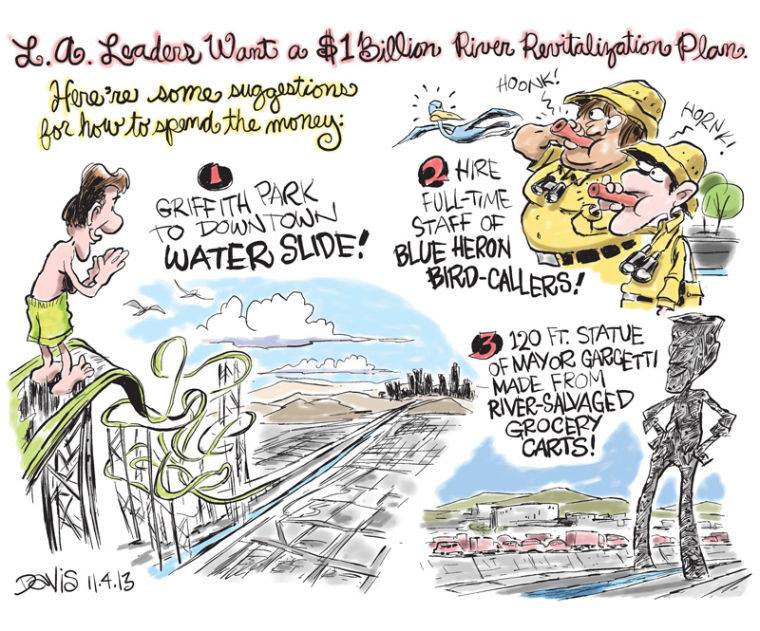
In preparation for what could be remembered as an historic city council vote, three councilmembers made their case poolside for the most expensive restoration of the Los Angeles River at over $1 billion. It was a continuation of a public relations campaign over the summer to convince Washington to open its strained pocketbook in favor of a local project with considerable political capital.
The press conference, strategically held at Downey Pool, close to both the river and Los Angeles State Historic Park, presaged the first time since 2006 that the city would declare its priority publicly. Ironically, its partner, the U.S. Army Corps of Engineers, didn’t attend.
“I think you’re going to see an unprecedented push and an unprecedented effort of collaboration. We are dead serious about this, and we are aspiring to work together, to collaborate, to pool all the resources, working with the state, but also preparing to go to Washington, working with the Army Crops of Engineers to get the biggest package that we can for the city,” said newly elected Councilmember Gil Cedillo.
He, together with council colleagues Mitch O’Farrell and Tom LeBonge, made it clear that the city wants the federal government to spend $1 billion over the next several years to restore the Los Angeles River to at least a semblance of what it once was, as will be outlined in the Corps’ Los Angeles River Ecosystem Restoration Feasibility Study (ARBOR), which cost $10 million and seven years to complete.
Even though the actual study, along with its four restoration alternatives, won’t be released by the U.S. Army Corps of Engineers until Sept. 20, politicians and river advocates are lining up in support of the most expensive plan. After ARBOR’s release, there will be a 45-day public comment period and a public meeting on Oct. 17. Although a month away from the report’s official release by the Army Corps., the broad outline has been available for weeks.
A few hours later, the Los Angeles City Council voted unanimously “to endorse a Los Angeles River Ecosystem Restoration Feasibility Study alternative that results in the most expansive ecosystem restoration.”
Last week, Los Angeles Mayor Eric Garcetti sent a letter to Washington advocating for the same thing.
“The ARBOR study Alternative 20 will begin to reweave the city and the watershed together,” said Lewis MacAdams, who established Friends of the Los Angeles River, and is now considered the “grandfather” of the current restoration effort. “It will bring the river together with the mountains, and it will bring the people together with the habitat, miles of concrete will be destroyed. It would begin to payback with this billion dollars all the work that’s been done to destroy the L.A. River.”
MacAdams recounted how, as an old-time Army Corps of Engineers fighter, he was surprised to be invited to a teleconference between the L.A. District and the national headquarters in Washington a couple of months ago. He went on to say he was shocked when I saw what was going to become the proposal of the L.A. district, Alternative 20.
By contrast, Alternative 13., said to be favored in Washington and the least expensive of the plans, has a projected cost of just under $450 million to pull concrete and make other habitat changes along the 11 miles of the river from downtown to Griffith Park.
“We’re Los Angeles. We deserve a $1 billion investment in the Los Angeles River. We’re going to fight for this,” O’Farrell said.
Also, last week Rep. Adam Schiff (D.–Burbank) held a press conference to demand a Taylor Yards health assessment from MetroLink. Elysian Valley residents have forced changes to the agency’s maintenance facility, which appears in the lower-right frame, but a health assessment measuring the amount of diesel particulate matter in the air and its effects hasn’t yet occurred.







 Posted with Blogsy
 lariverflyfishing