A recent White House carp eradication story caused much more of a stir in China than it did in the U.S. (Courtesy Weekly Times Now)
This fun read from Bloomberg’s Adam Minter explains how the Chinese view President Obama’s pledge of over $50 million to eradicate carp from the Great Lakes: with hungry amusement.
Wild carp is No. 1 on the Chinese dinner menu, according to Minter, and they find it odd that we don’t want to eat this fish as well.
The story earned its own Twitter tag, #Asian Carp on an American Rampage, and received over 85,000 hits.
If you were wondering if today’s weather in the low 60s would stop the spring spawn, the answer’s a definite “no.” Unless it’s raining tomorrow, considering going to the river to see one of the coolest things we’ve got going on in L.A.: spawning carp running up the river. We watched dozens and dozens and dozens of beautiful gold and sometimes rust fish going absolutely nuts.
Anyone who’s fished the spawn know that it’s not easy, but here are some tips:
— don’t go after jumping fish. They won’t strike.
— do get those egg flies out. Tie a bunch in chartreuse. That’s the color.
— don’t expect the fish to strike in fast, running water. Look for the slow pools.
— do let your egg hit bottom, in front of the fish you’ve targeted.
— don’t let your line foul under seaweed. You’ll get broken off (happened today).
— do get excited that you can fish the L.A. River right now.
— don’t play the fish too tightly(happened today as well!). This is not a San Gabes trout. These are big, frickin’ fish.
— do bring your camera. It’s that amazing.
See you on the river, Jim Burns
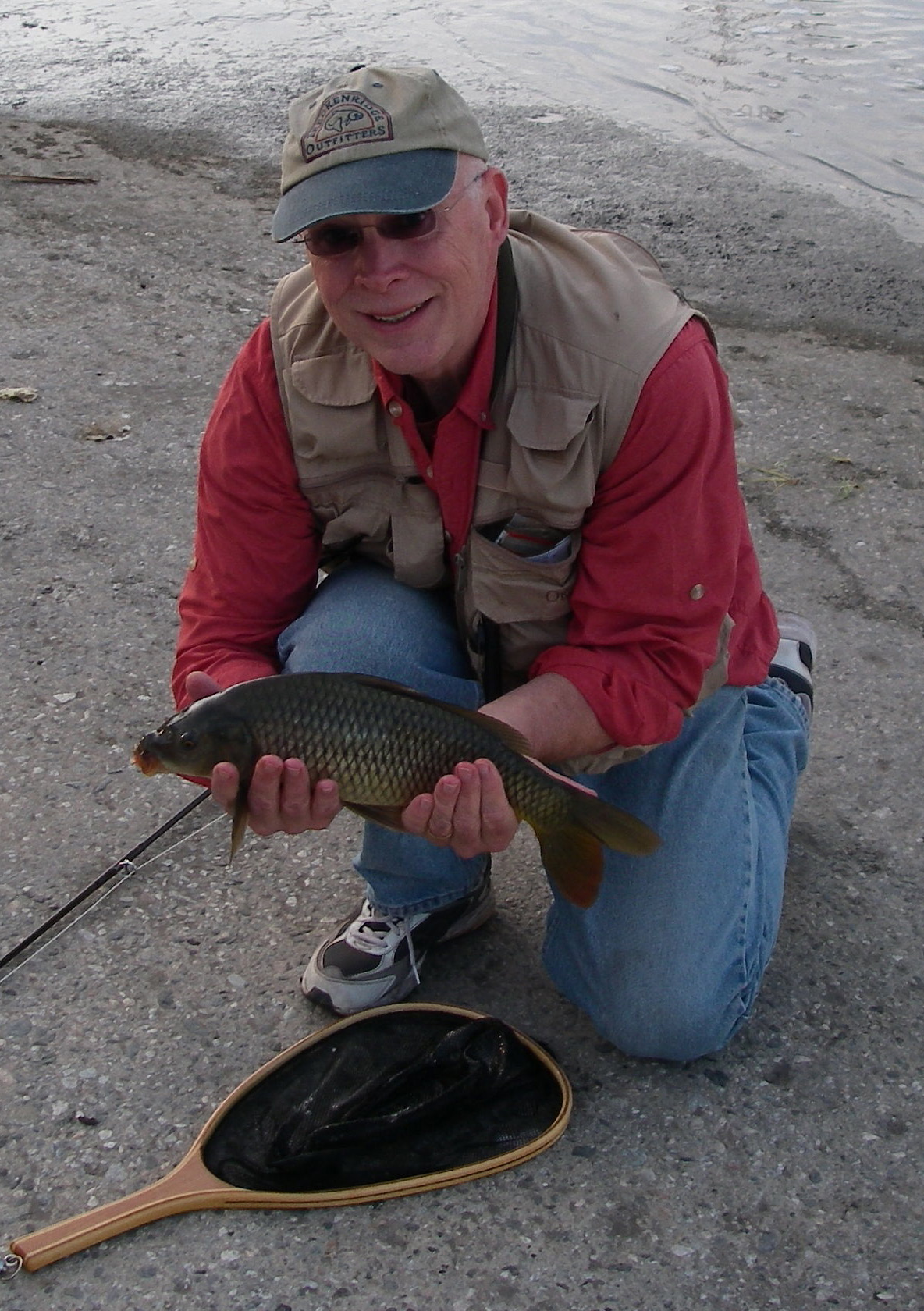
Oh man, nothing like springtime carp fishing! (Jim Burns)
If you think the only “boil” happens with calico bass in the Pacific, get down to the river, right now. (Jim Burns)
Tie up some extra-fatty egg flies in chartreuse. And don’t forget to use sexy red No. 6 Gamakatsu Octopus hooks. (Jim Burns
How many guys carry their own scale? Jim Graves does!
The title says it all: The newspaper America either loves or hates, depending on political affiliation, has sanctioned catching carp with a fly rod. Best quote is that it’s like soccer: No. 1 sport in the world, yet, just catching on in America. Take a look at the piece, written by Chris Santella.
Lots of action on our own river, Friday. We spotted at least 30 fish.
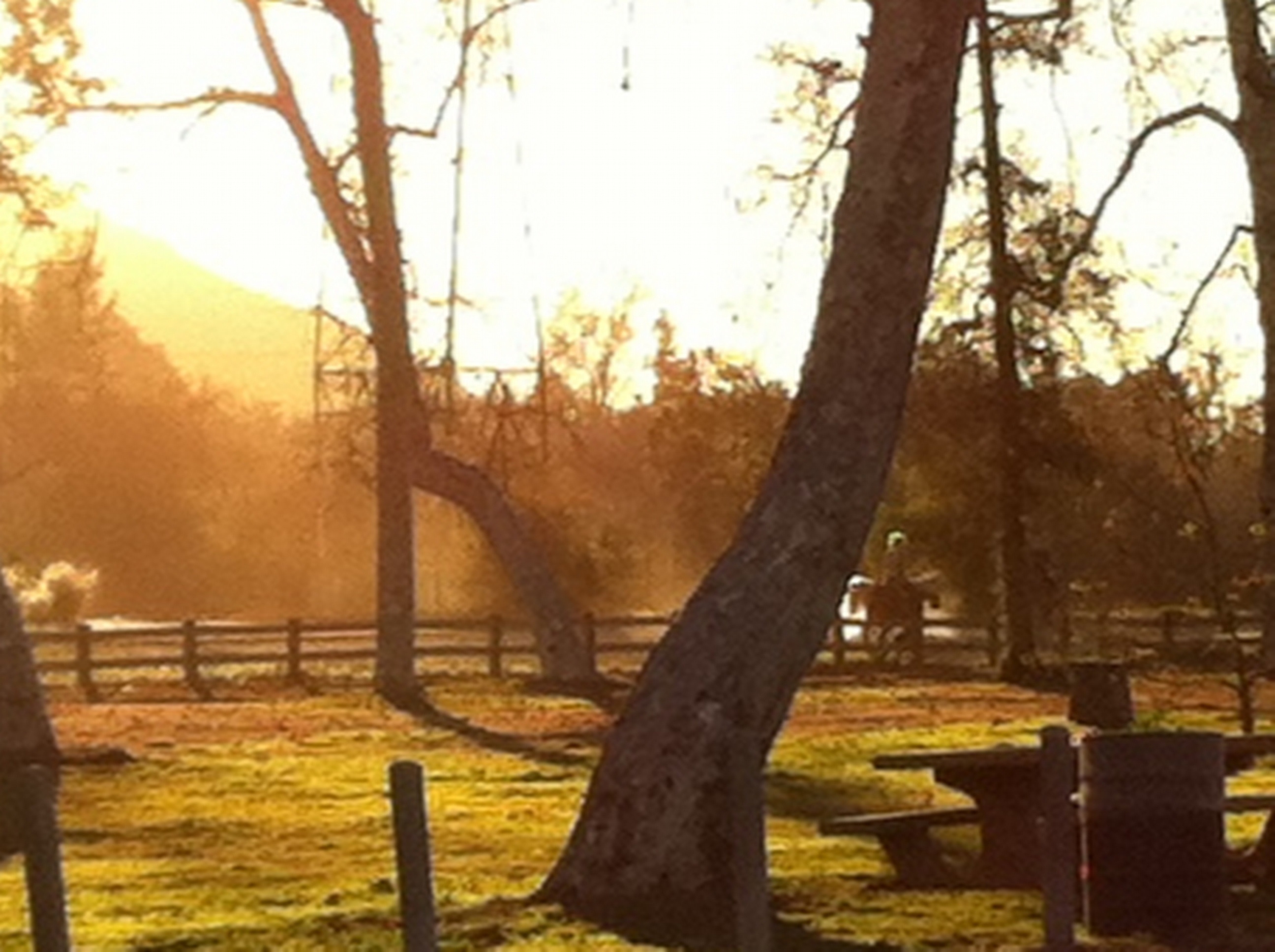
As riders and their horses enjoy this idyllic January scene close to the L.A. River, others are not so fortunate. (Jim Burns)
Every once in a while, you have one of those days, days of insight, days when whatever glasses you usually wear are plucked off and replaced by the new.
And, I have to add, insight — the new — is not always wanted.
Let me explain. Friday, I finally got some time off, so I tied on a new bread fly, hoping not to get skunked. Readers of this blog have followed my fruitless progress, so far.
I was excited. I mean growing up in Chicago, I still can’t believe it when the January weather graces us with Santa Ana wind-warmed temperatures in the 80s. Plus, would you rather fish the glorious L.A. River, or be working? (That’s a rhetorical derrrrr).
Stopped at the freeway entrance on my way, I pulled out my wallet to give a couple of bucks to a homeless woman. If you live near Pasadena, you’ve probably noticed that their numbers seem to be increasing. I debated for so many years whether to give/not give that now whenever I see someone in need, I give what I can.
As I handed her the money, she launched into a rant about how the guy in front of me had given her coupons to Union Station, but she didn’t want to go, because there you had to play the “boy-girl game,” and that she wasn’t out here begging for money because it was such a good time. Anyway, engrossed in what she had to say, I missed the light. In L.A. that’s a major offense, but nobody honked. As I waited for the next green, we talked more and she explained how her friend had contracted scabies at the city-run shelter and she’d taken her to the doctor.
But it was the next part that got me: “You people,” she said accusingly, and I can’t remember what else she said, but I do recall vividly how she looked at me. Maybe you can see it in your mind’s eye.
To the homeless, I now had a moniker. “You people.” From my perspective, they were/are “you people,” so I suppose it cuts both ways. Anyway, I couldn’t shake our conversation, and it rolled around in my mind, still does.
Once parked near the river, I spend the rest of the afternoon searching for carp. Several hours elapsed without a sighting, when, suddenly, I came upon a pool of a half-dozen who spotted me almost as quickly as I saw them. Like trout, carp have excellent eyesight. Picking one up, you’d think that their eyes focus only on the bottom. Not so.
Frustrated after about 10 minutes of casting to likely spots they might have fled, I turned to the concrete bank, calling it quits. About 10 yards in front of me were clothes drying on the chain-link fence, a faded but functioning bicycle, a pair of tennis shoes, a sleeping bag covered by a makeshift tarp. I stopped. The passing water was calm, as was the setting sun, calm, even the repetition of traffic on the I-5, calm. But interiorly I hardly was, as not one, but two residents emerged from the tent, not seeing me in my sheltering thicket.
“You people.”
For a moment, I felt all sorts of emotions, from fear (Would I be attacked?), to stupidity (Why would I be attacked?), to anger (Hey, I’m just trying to fish here, gimme some space.), to empathy (It must be awful to live out here.), to aversion (How am I going to get back to my ride?).
“You people.”
Eventually, I moved quietly to another hole in the fence and climbed through, dipping my nine-foot rod.
Wonder Bread: A loaf of Classic White will costs you $4.50 (Jim Burns)>
With a day off and perfect L.A. winter fishing weather, my son and I hoped to follow up on a thread that’s been going around and around on this blog — the bread fly — so we headed down to the rio, armed with a freshly baked and newly purchased loaf. That’s really the first rub of this story. Wonder Bread will now set you back $4.50!
Our strategy was simple: chum one, chum all.
L.A. River carp are tough to catch, period, so why not chum for them? Previous comments here have shown that our comrades in other states will fish their bread flies while bird fanciers are carbo-loading ducks, geese and other waterfowl on the water. The idea is carp swim under the feeding fowl to munch their fair share of the treats, while the feathers on top continue feasting. Sounded like stealthy fun.
That mid-morning, armed with “classic white,” we approached the most likely fishing hole, one where the current doesn’t drag the bread toward Long Beach in a few seconds. We set up the rods and started rolling gummy bread balls.
After a few misfires, our aim got better as we tossed the white morsels away from the constant current in the pool. Excited as schoolboys with a snow day, we waited for the inevitable rise, the inevitable feeding frenzy. Carp enjoying a free meal, and one that would allow us to place our newly tied bread flies right in front of them.
Problem: Nothing happened, or rather what did happened wasn’t what we wanted, the story of so many science experiments.
After a few minutes of Wonder Bread chumming, lots of creatures did show up, eating the sandwich morsels kids used to love. Unfortunately, they were winged, instead of finned.
Watching sea gulls hover, then swoop down on a tasty inch-round ball gave me new respect for them. Not quite eagles zeroing in on mice, but their aim from 10 feet up was dead on.
Not to be outdone, the thin line of mallard ducks flapped up as well, and about that time, we did see two suspicious water circles, hugging the bank, too funky for a decent cast. That was it …
Cursing the fact that we were landlocked, having left the waders at home, we tried chumming three different spots with even worse results: no fish, no birds, no nada.
No bread-induced chum boil of carp.
No big fish bending rods to the water.
No spinning reels with whining line chasing a fast shadow.
Which brings me to my New Year’s fly fishing resolution: Spend more time on the three above points.
A couple of weeks ago, we got on a roll trying to figure out what, exactly, carp are munching on in the L.A. River, and how we fly fishers can use that knowledge to best advantage.
First, we agreed about carp and crayfish, with McTage writing:
Crayfish, crawdaddy or mudbug, whatever you like to call them, they’re alive and well in the L.A. River.
“If there are crayfish, they are on the diet, guaranteed. Crayfish are high on their list of favorites just about everywhere.”
And so it is on our river.
Next, Sean Fenner widened the discussion, commenting that:
“They eat anything they can find. In the L.A. River, they live mostly on crayfish, tilapia and other carp eggs when they spawn, worms, other insects, and their favorite, BREAD. In my opinion, that’s why the Glo-bugs work so well. I also tie a fly that I call the Tortilla, and they seem to jump all over it. People are always down there feeding the ducks, and the left over bread makes for a great meal.”
Now, I haven’t tried fishing during duck feeding time, mainly because of the legendary Duckman, who supposedly kept the Griffith Park Rangers on speed dial, and was always ready to call them in when he saw a fisherman poaching “his” territory. This is most likely ancient history (2007), as I haven’t heard of park rangers anywhere near the area. In fact, one told me that because of budget cuts, they no longer patrolled our water. And now that there’s been a pilot kayaking program on the water, official attitudes have changed, big time.
But … back to the story. After agreeing that Glo-bugs were a potent carp fly, commenter Gregg Martin went on to write:
YOUR DAILY BREAD: The second fly, from left, is bread of duster wool, the second, fourth and fifth are loosely spun and packed, while the first and third are created with a dubbing loop. (Courtesy Gregg Martin)
” We use bread ties in a local park greatly, casting a SUNKEN fly next to the ducks and geese eight inches under an indicator blind. It’s hot when they’re on it! This sure-thing lasts only a couple of weeks, and then they seem to become jaded by our flies. Mine is a spun and packed wool duster material fly on a weighted size 4 M3366 hook, or similar, or the same material spun in a dubbing loop and brushed out. Or, white glo-bug yarn. My son uses a white or flesh colored bunny leech and does well with that, actually no matter what with that.”
Also, he wrote in an e-mail, that the bread fly tied with wool floats like a cork! Martin found this out, to his chagrin, one day with new ties tightly spun on the Mustad 3366. They wouldn’t sink. So now he packs a few of those, but also some that are less tightly spun, with the wool packed over a shank full of .030 lead. His boys use a dubbing loop with wool or Glo-bug yarn over lead as well. He wrote that they often use often a std. wire TMC #4 200R.
Which brought us full circle to McTage, writing:
“Yeah, I have a park here where they feed the ducks like crazy and I have tried a time or two to take advantage of the urban bread-hatch. Not my fault if somebody else is accidentally chumming them in, right No luck though, I have always tried something on top, will try something wet next time.”
Me, too, after I get some time to tie this recipe up. Hopefully, the water will be still enough and the dreaded Duckman won’t lift a feather to stop me.
Nothing like catching that first fish on a new reel. (Courtesy David Wratchford)
Update: May 29, 2015. three outings, no carp in the net.
Summer carp journal
Saturday, May 23, 4:30-7:30, overcast, 70, 12 pound tippet. One carp charged and then turned away from a swimming nymph, rust brown dubbing with lighter rabbit tail (size 8).
Tuesday, May 26, 2:30-5:30, overcast, 70, 2X tippet. After rejections on bead head black wooly worm with red yarn tail and bead head swimming nymph with crazy orange dubbing and lighter rabbit tail. (size 8) hooked up on a carp dragon (Orvis). Carp eventually got free because I didn’t set hook deep enough. Saw about 50 pass me in the water, few feeding. Saw the white one again.
Thursday, May 28, 2:30-5:15, clear, 81, 3X tippet. Fish swam up to all of my flies, except the squirmy wormy. That means tortilla fly on red hook, terminator glo bug in chartreuse and orange, all got mighty big looks, but ultimate rejections. Saw the white boy several times, and there were lots and lots of carp. Also, again, “muddling” by one really aggressive fish, but it’s hard to see which way the fish goes through the mud. Also, chummed with two cans of corn to pretty negligible results. The tortilla fly is a dead ringer for canned corn. Didn’t make any difference.
Commenter Steve recently asked me: I’ve been down to the river several times and seen some beautiful and fishy waters, I have had no luck whatsoever hooking up with carp there. Any tips? Should I be sight fishing only, or should I toss my glo-bug in riffles, etc, “trout-like” spots? Are you moving around a lot or focusing on a particular spot for a while?
Great questions. Hope that my response will lead to more catches for more fisherman.
Catching carp on the river is tough, no doubt about it. Your best bet is to spend some time in a section and, yes, look for fish. Once you’ve found them, check out their behavior.
If they’re swimming quickly upstream, they won’t feed. If they’re circling quickly, ditto. If they are jumping out of the water, forgetaboutit. What you want are fish close to the bottom (you’ll be able to see them) that are actively feeding. Throw your Glo-Bug (chartreuse is good) upstream about six feet. The fish are also super-spooky. If the egg passes above their heads, add a bit of weight. You have to basically float it past a two-to-three foot feeding cone. Then — bam — listen to your reel whine!
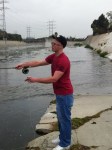
A few days ago, with a half-hour to kill, I put a line in my favorite spot at the river. With trout, that’s usually enough time to hook up, but not with carp. At least, that’s the way it rolls on our river, and for moi.
California Dreamin’: Could we ever be legally kayaking in the river and watching jumping carp? (Courtesy Weekly Times Now)
But I did get to see one jump way out of the pool, then come down in an inelegant belly flop.
Last year, when I started carping, I’d see this and think “Oh, man, am I ever gonna hook that sucker,” but not anymore. Jumping carp are interested in something, but not eating a fly.
So … why do they jump? Fun? Recreation? Boredom?
I checked the bible — “Carp on the Fly” by Barry Reynolds and friends — to find this passage. Italics are mine:
“Shallow-water hell raisers are exactly that: carp that are making a spectacle of themselves by leaping, splashing, and thrashing in the shallows. These fish seem utterly oblivious to the dangers they may face by drawing attention to themselves.
Often, there is a reason for this, particularly in the spring when carp are spawning. As you might expect, spawning fish are usually not very interested in your fly — they have other things in mind.
True, but this happened in June — no spawn on.
But at other times, these hell raisers are carp that are smashing through schools of baitfish and they’re a very good target for a small streamer.
False for the L.A. River. I’ve never seen a school of baitfish on it.
So … what causes this behavior? Here’s an answer from a carp fishing forum based in Georgia:
“Carp actively break the surface of the water for two reasons. Both reasons are due to water quality/lack of oxygen. If the ph factor is too acidic or the dissolved oxygen count is too low carp come up to seek more comfortable conditions. Carp normally stay and feed and roam on the bottom. When they are on the surface they are almost impossible to catch.”
Sounds good, but who knows (except for that last part, which is true, true!)
I put together this poll from various answers found on the Web. Any fish biologists out there care to clear up this mystery?
Question: exactly how much time have you wasted this week (it’s not over yet …) “browsing” the Web?
I’d have to answer “lots.” Always on the snoop for info about our river, I came across the new (to me, and copyrighted this year) The LA River. According to a press release, “The Los Angeles River Revitalization Corporation (LARRC), set up by the City of Los Angeles and funded through the Community Redevelopment Agency, has launched a comprehensive, state-of-the-art website at http://www.thelariver.com. It contains hundreds of maps, user guides, photos, development activities, information about the Corporation, a store, and more.”
There apparently is no limit on the number of carp you can take from the L.A. River. But ... who determined this? Certainly not the California Dept. of Fish and Game. (Courtesy http://www.thelariver.com)
Fair enough. Take a look and you’ll see that the site breaks the river into three fishing spots: Lake Balboa, Glendale Narrow and the Long Beach Estuary. Earlier this year, fisher-friend David Wratchford and I wondered about the estuary, and what might lurk to be caught there. Then, we wondered about the legality of fly fishing those waters.
Now we read on this new site:
“Today, although fishing in the river is not an officially-sanctioned activity, since it is currently illegal to walk in the river channel below the bike paths, officials rarely cite the many anglers regularly seen along the soft-bottom sections where fish are to be found.”
True, it’s a far cry from the infamous days when the Duckman had the Griffith Park rangers on speed dial, and would not hesitate to contact them when he saw folks with poles angling the perfumed waters.
Yet, you have to wonder how any elected official can have his cake and eat it, too. How can fishing not be officially sanctioned (in fact, illegal, according to a release given out to the press earlier this year from Councilperson Ed Reyes office), yet turn up on a publicly funded Web site under “Fishing the L.A. River?”
Access to the river means just that. It’s time to officially saction fishing in designated areas of the river. No more double speak!
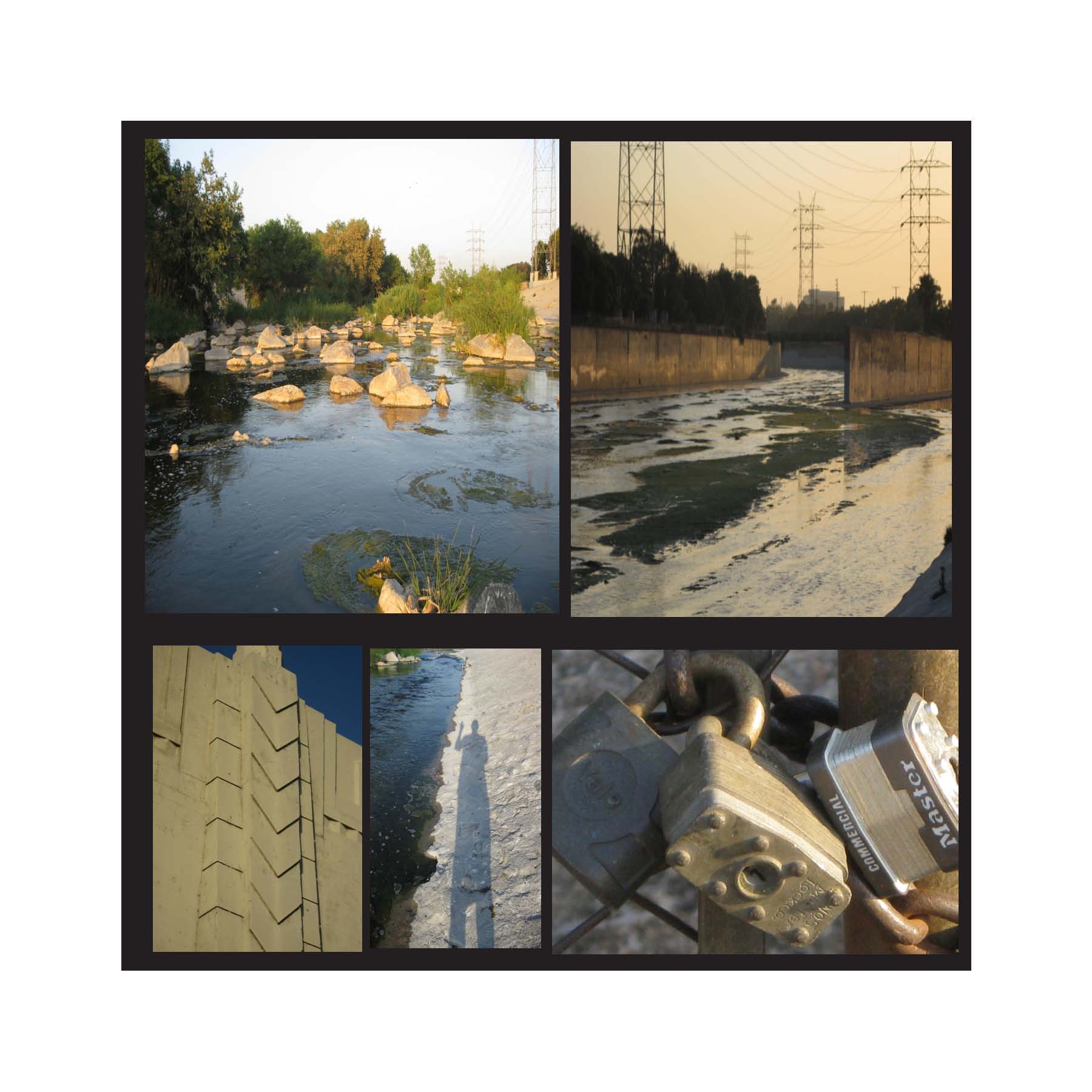
From top left, clockwise, the tranquility of carp-filled pools, at the beginning of Glendale Narrows. Once you get past the city locks, you can see self-shadows and nifty bridge architecture. (Jim Burns)






 No luck though, I have always tried something on top, will try something wet next time.”


 lariverflyfishing