A recent post on this site stirred up the pro-con constituencies about suction dredge mining, with the arguments basically boiling down to habitat vs. access. Although the petition was directed at the California Department of Fish and Game, the U.S. Forest Service has just posted this on its site:
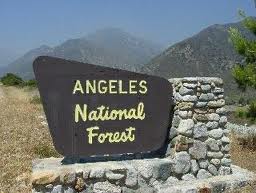
All mining operations (location of mining claims, prospecting, and mining, including panning, sluicing, and dredging) under the 1872 Mining Law are prohibited within withdrawn areas of the Angeles National Forest. Public Law No. 578 (1928 withdrawal) withdrew areas from entry and location under the mining laws. There is no provision in PL 578 which provides for even a limited right to enter the withdrawn lands to prospect. Therefore, National Forest System lands within the East Fork of the San Gabriel River are not open to prospecting or any other mining operations.
When I called for comment, the Arcadia office was closed (at 4:30 p.m., Wednesday), but without further reporting on this topic, looks to be a win for fishing habitat.
Once electric Red Cars delivered passengers all over L.A., which is celebrated in this riverly mural.(Barbara Burns)
This from Lewis MacAdams, founder of Friends of the River:
Dear River Lovers,
Last week State Senator Kevin de Leon introduced a bill (SB 1201) into the State Senate that would significantly widen access to the Los Angeles River.
Authored by Friends of the Los Angeles River in collaboration with the Environmental Law Clinic at UCLA, the Bill would amend the 1915 Los Angeles County Flood Control Act, which limits the County Department of Public Works role on the River to flood and stormwater control, to add recreation and educational purposes to its mandate.
The Bill would also establish a State Los Angeles River Interagency Access Council whose members would include the State Department of Fish and Game, the State Lands Commission, and the California EPA, chaired by the Secretary of the Natural Resources Agency, to coordinate the actions of State and local Agencies with responsibilities for River access.
We strongly urge you to write or e-mail Alfredo Medina in Senator De Leon’s office (alfredo.medina@ sen.ca.gov) in support of the SB 1201 immediately And as soon as you do that we want you to join FoLAR. If you like what we do on the River, in advocacy, science and education, if you’ve gone on one of our river walks, or taken part in our River Clean-Ups, and our river walks, then send us $50 for a one-year membership. For almost 25 years, we have been the voice of the River. the Voice of the River Users, your voice on the Rio de Los Angeles.
It might be time to gas up the buggy ( even at a predicted summer $5 a gallon), and get up to Northern California for some salmon fishing. Peter Firmite’s recent article in the San Francisco Chronicle quotes fishery experts as saying there are more chinooks swimming in the ocean now than at any time since 2005. A two-year commercial fishing ban on the fish ended last year, which may account for their increase.
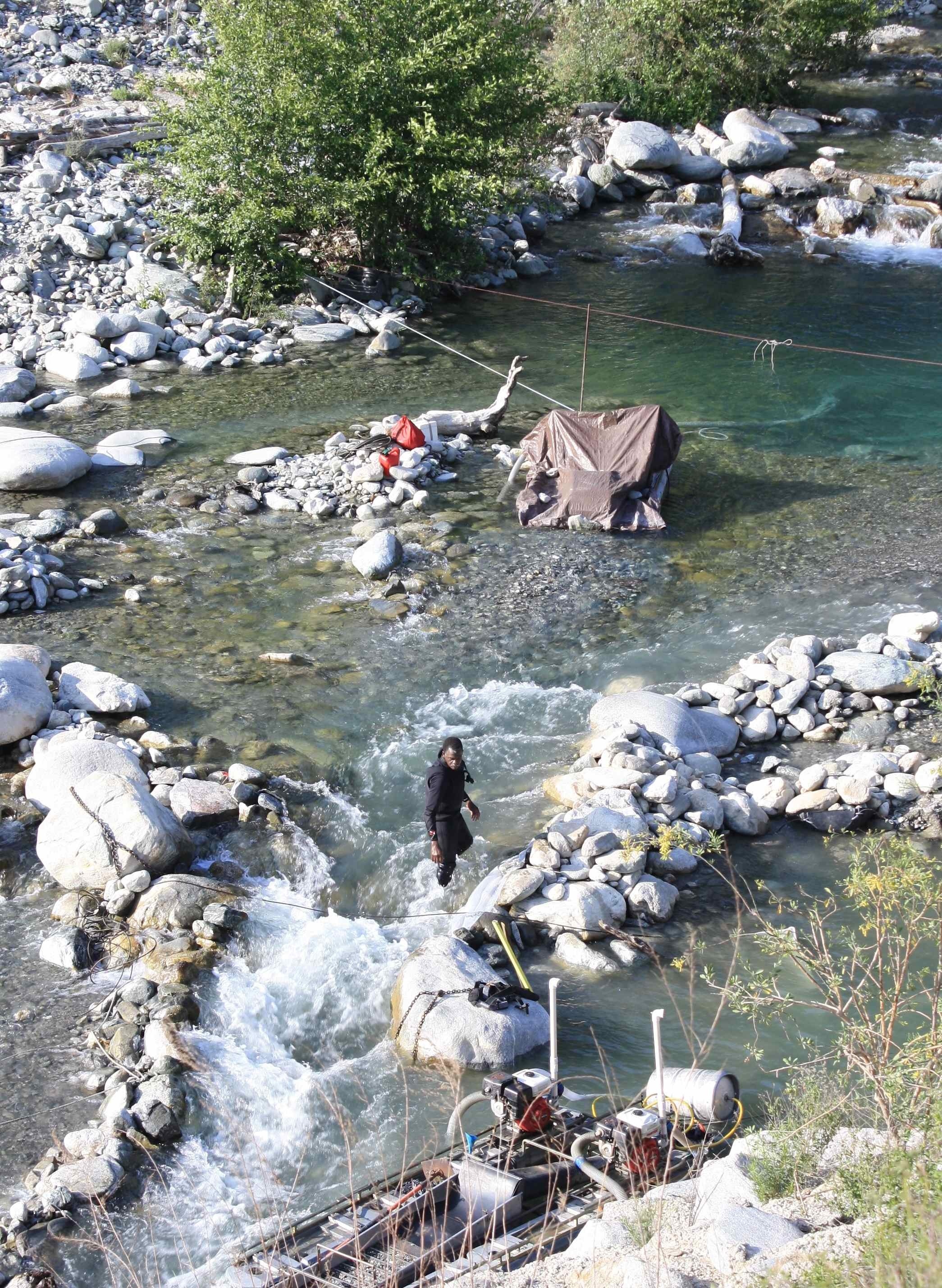
Yesterday afternoon I learned that the state Fish and Game Department is considering regulations that would reopen streams to suction dredge mining all across California including on the East Fork of the San Gabriel, pictured below back when it was open previously. The draft regulations are open for public comment until 5 p.m., Monday. I have attached a fact sheet from Steve Evans of Friends of the River on the situation. Please distribute this information and the urgent call to make comments far and wide:
Suction dredging – a mining practice that requires a gasoline-powered motor to run an underwater vacuum to suck up large amounts of gravel and sediment from the river bed to collect gold – harms water quality, as well as fish and wildlife and the habitat these wild creatures depend on.
The California Department of Fish and Game (CDFG) recently issued revised suction
dredge mining regulations and is seeking public comment on them by 5 p.m. March
5. Unfortunately, the revised regulations will cause serious water quality
problems and harm fish and wildlife on many of our rivers and streams, including
the East Fork San Gabriel River.
The revised regulations propose to reopen the East Fork below its confluence with
Cattle Canyon to suction dredge mining-induced noise, water pollution, habitat
degradation, and conflicts with other recreational visitors. Please send an email
TODAY to the CDFG urging the agency to withdraw the revised regulations and
to specifically close the East Fork to suction dredge mining. In addition, the CDFG
should start over with new regulations that fully protect water quality, threatened
and endangered species and their habitat, and other recreational activities.
BACKGROUND
Suction dredging – a mining practice that requires a gasoline-powered motor to run
an underwater vacuum to suck up large amounts of gravel and sediment from the
river bed to collect gold – harms water quality, as well as fish and wildlife and the
habitat these wild creatures depend on.
Unfortunately, revised regulations recently issued by the California Department
of Fish and Game (CDFG) will allow this destructive practice to restart in the East
Fork San Gabriel River and other waterways throughout California that are already
impaired by mercury pollution or sediment, provide sensitive habitat for threatened
and endangered fish and wildlife, and offer important non-motorized outdoor
recreation opportunities.
For years, suction dredge miners were literally allowed to take over the East Fork
downstream of Cattle Canyon for the pursuit of gold. This led to conflicts with other
recreational visitors, disturbed river habitat and water quality, and possibly harmed
the Santa Ana sucker, an endangered native fish found primarily in the San Gabriel
River in the Angeles National Forest. A statewide moratorium on suction dredge
mining was imposed by the California Legislature in 2009. But the new revised
regulations threaten to return motorized suction dredge mining to the East Fork
and other waterways throughout the state.
The newly revised regulations require CDFG to issue mining permits where mining
would otherwise be illegal, including the East Fork. A 1928 federal law withdrew
the public lands along the East Fork from mining to protect its watershed and water
quality. Mining on the East Fork is also inconsistent with Wild & Scenic protection
of the river, proposed to protect its endangered fish habitat, water quality, and
outstanding recreation values.
Less than three weeks ago, CDFG issued new revised regulations for public comment
with a deadline of 5PM, March 5, 2012. In addition to the unusually short comment
period, it will be difficult for the public to comment in any meaningful way on the
revised regulations because the revised EIR that justifies the new regulations will
not be available for public review until after the March 5 deadline.
The revised mining regulations will harm rivers and streams throughout California,
from the Klamath River in the north to the East Fork San Gabriel River in the south.
Please help us convince CDFG that the East Fork San Gabriel River and other
ecologically sensitive and water quality impaired rivers and streams in California
should simply be off-limits to the destructive affects of suction dredge mining. Send
an email TODAY to CDFG urging the agency to prohibit suction dredge mining on
all forks of the San Gabriel River in the Angeles National Forest, and withdraw the
revised regulations and start over with a regulatory program that fully protects
water quality and threatened and endangered species and their river habitat, and
Native American cultural values.
Remember, the deadline for comments on the revised regulations is 5 p.m. on
Monday, March 5.
To view a copy of the revised regulations, visit http://www.dfg.ca.gov/suctiondredge/. For
more information, contact Steve Evans at Friends of the River, phone: (916) 442-
3155 x221, email: sevans@friendsoftheriver.org.
SAMPLE EMAIL OR COMMENT LETTER
Suction Dredge Program
California Department of Fish and Game Northern Region
601 Locust Street
Redding, CA 96001
Email: dfgsuctiondredge@dfg.ca.gov
Re: Suction Dredge Program Revisions to Proposed Amendments
Dear Department of Fish and Game:
I am concerned that the revised regulations allow destructive and harmful suction
dredge mining in the East Fork San Gabriel River. This river supports endangered
native fish and other recreational uses that are often incompatible with suction
dredge mining. It also harms water quality in a river that contributes significantly to
the local water supply. In addition, a 1928 federal prohibits mining on this river to
protect its water quality and watershed values.
Water quality and fish and wildlife in the East Fork and other rivers and streams in
California must be protected from the adverse impacts of suction dredge mining.
The revised regulations simply do not provide sufficient protection for these
sensitive resources. I urge the CDFG to withdraw the revised regulations and
propose new ones that prohibit suction dredge mining on the San Gabriel River in
the Angeles National Forest and that fully mitigate all significant impacts, cover the
state’s costs to administer and enforce the program, and meet all other laws and
regulations.
Recreational and commercial mining is not a legitimate activity in California if
it is done at the expense of the state’s fish, wildlife, water quality, human health,
and state-protected beneficial uses of the San Gabriel River and other rivers and
streams.
Could this sign soon include "national recreation area"? (Courtesy Forest Camping)
Darn, you must be saying to yourself, I loved paying $30 a year for the right to park my car on public lands to go fishing. Well, according to this article in the Los Angeles Times, the unpopular fee is about to join such other relics of the past as the Edsel, 8-track tape players and the same newspaper’s Food section (Today was its last issue …).
In other words, California fly fishing just got a little bit less expensive!
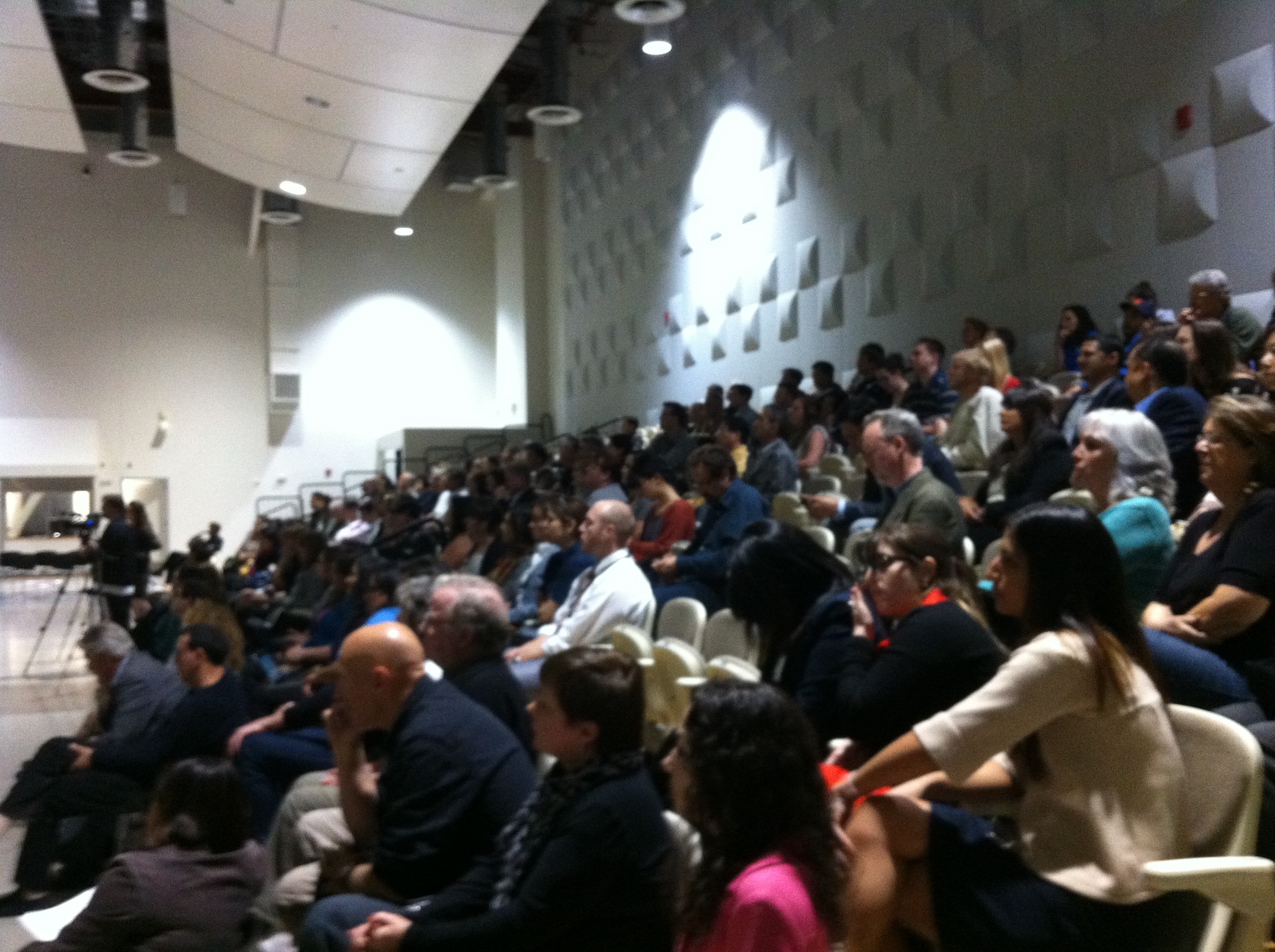
About a hundred attended the City of L.A.'s River Update event Thursday evening. (Jim Burns)
“The River Study is moving. For the first time, it made it to the President’s budget,” Carol Armstrong said to a group of about 100 participants at the River Update event, held this evening at the L.A. River School.
Armstrong, the point person for the city’s many river projects, went on to explain how Councilmember Ed Reyes, Nancy Steele of the Council for Watershed Health, Lewis MacAdams of Friends of the Los Angeles River and others went to Washington to talk to legislators about the important of funding the U.S. Army Corps of Engineers L.A. River Ecosystem Restoration Feasibility Study. The study is key to virtually all future plans to restore the river to a more natural state. Begun in 2006 with the city as the local partner, it looks at the 10-mile stretch of soft bottom that stretches from Glendale Narrows, plus Headworks Reservoir in Burbank, through downtown to First Street. This area, part of which is across from Griffith Park, is the most popular with fly fishers looking to hook carp. Besides having a soft bottom – as opposed to concrete – it contains what the Corps calls “ecological value” and has the most water in it year around.
Although only $100,000 will come from the 2013 federal budget, the Los Angeles Dept. of Water and Power contributed $1 million, as did the leadership of the Army Corps, committing $350,000. When completed in 2013, the study will have cost almost $10 million.
In 1995, political restoration activities began with the county, which led to the City Council’s approval of the Los Angeles River Revitalization Master Plan in May, 2007, created with $3 million from the Department of Water and Power’s deep coffers. The plan contains many items, including revitalizing the river, greening adjacent neighborhoods and creating value through economic opportunities
As Josephine Axt, the Army Corps lead planner told the audience, don’t expect any real result until June, 2013. Still, the funding was good news for river advocates.
How many guys carry their own scale? Jim Graves does!
The title says it all: The newspaper America either loves or hates, depending on political affiliation, has sanctioned catching carp with a fly rod. Best quote is that it’s like soccer: No. 1 sport in the world, yet, just catching on in America. Take a look at the piece, written by Chris Santella.
Lots of action on our own river, Friday. We spotted at least 30 fish.
Yesterday was a great day to fish for trout in So. Cal., but I wasn’t expecting to see this mating dance. In fact, I’ve never seen this behavior before in our local watershed. At first, I thought that maybe a snake had taken a fish, and was rolling over and over to try to get it swallowed. Then, as the action came nearer to me, I was astonished to find the commotion was a pair of amorous native trout. Watching this miracle of nature make me want to redouble my own personal efforts to protect this region, and to restore it to what it once was. Take a look for yourself. (Be sure to hit “full screen” so that you can see the fish all the way through.)



 A recent post on this site stirred up the pro-con constituencies about suction dredge mining, with the arguments basically boiling down to habitat vs. access. Although the petition was directed at the California Department of Fish and Game, the U.S. Forest Service has just posted this on its site:


 lariverflyfishing