


This slideshow requires JavaScript.
Bugs

Los Angeles Flood Control, open thy gates!
The dog days of summer have brought us more than just heat and a freakish rain storm: the bill opening the river to recreation and education is now law. I’m surprised by the lack of MSM coverage of this important event.
See you on the river, Jim Burns
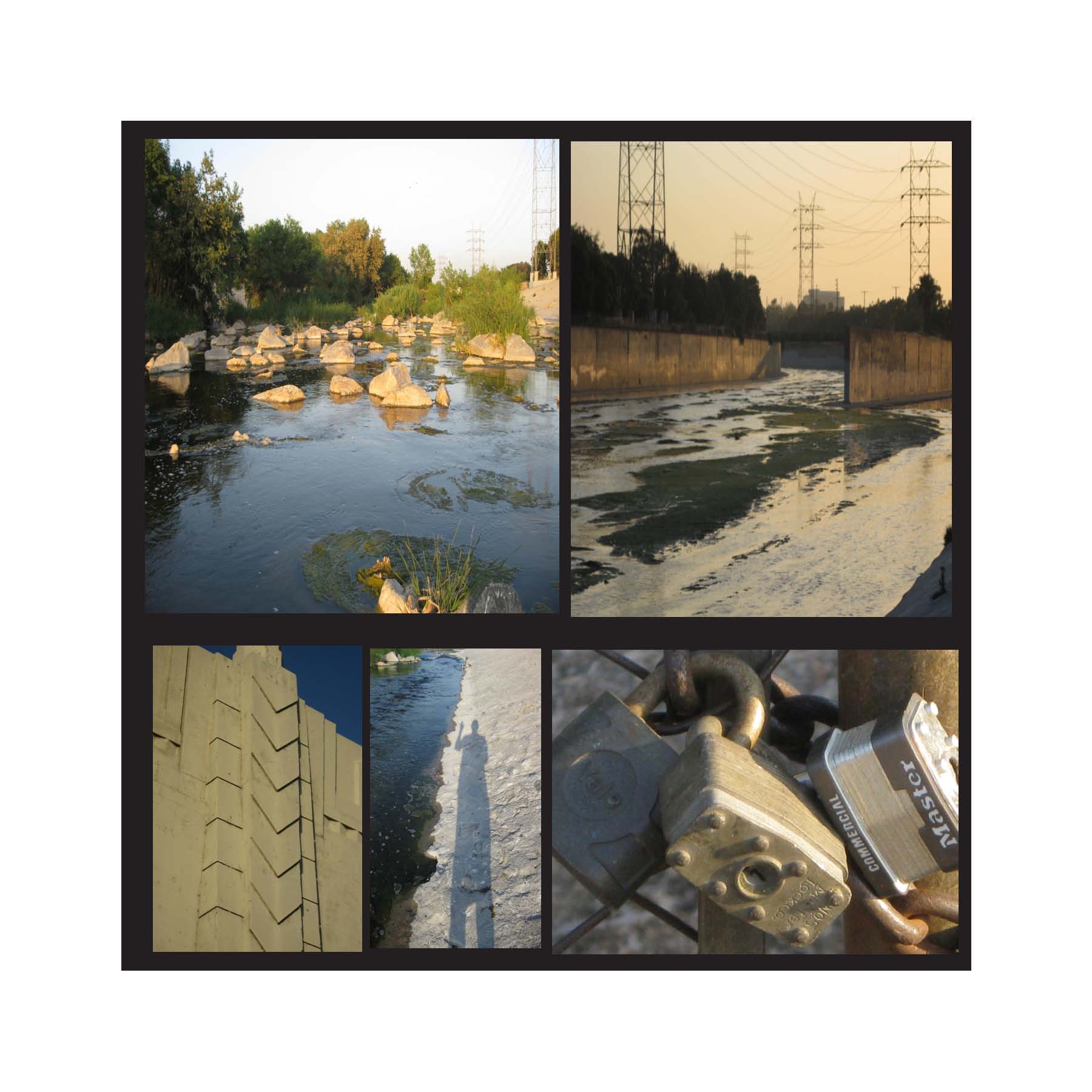
This message from our friends at FOLAR:
“You probably read that SB 1201 is now at the desk of the Governor.
On our website, it shows how citizens can ask him to sign the bill.
Would you mind circulating the contact info to the fishing community?
” See you on the river, Jim Burns

Author Thomas McGuane describes fly fishing better than most, and he certainly got it right with his musings about “20-fish days” in “The Longest Silence.” Of course, he wrote about stripper bass in Atlantic Ocean boils, yet the sentiment for all fisherman — from stream, to river, to broad-horizon ocean — remains the same: longing to catch lots and lots.
It’s a wonderfully greedy obsession and one my son and I tested last week over a couple of days in California’s Golden Trout Wilderness. First, topo map in hand, we plied the eastern approach. From Lone Pine off the 395, you take a left at the only stoplight in town, then watch for signs (virtually non-existent) to Horsehoe Meadow Road, drive up the dreaded “Z” (don’t slip off the edge …), park and walk. From town to your destination is probably two-to-three hours.
By the way, speaking of signs, you won’t see one anywhere in town to announce the GTW, which doesn’t open until July. Very strange. And most of the locals seemed bent on driving tourists (many French and Austrians there to hike nearby Mt. Whitney) away. Seriously, Lone Piners, what’s up?
Sounds much worse than it actually was, however, because once we arrived at 10,000 feet, our reward was 50 goldens over the day.
“Take one on your first cast,” I said to Will, and sure enough his grin as he pulled the first one out of the water said the rest. I was lucky enough to nab No. 50 in late afternoon, exhausted from the day’s hiking and catching.
The next day, we approached from the south, bunking in Kernville. This was essentially car fishing, with no topo map required. We quit after a couple of hours with only 27 caught and released. Low water in each spot didn’t deter us. After a scant rain year, you can’t expect the flows you crave.
Nope, they’re not big fish, so if any of you want to laugh, go ahead. The biggest fish was around 12 inches, which is a whopper by golden standards. But, I ask you, isn’t this one of the most beautiful species on the planet?
With the right rod in hand, small fish become bigger fish. On a dry, they run, fight, dive and try to get your flouro tied multiple times around that poorly placed log or shock of river vegetation. With the wrong rod, you’ll think you’re pulling up sardines from the party boat. I used my 2-weight Orvis full flex, matched to a small Battenkill reel, overlined with a 3-weight line.
Any attractor pattern does the trick with these seemingly starving fish, but don’t forget your terrestrials. Grasshoppers float for days and were a blast to fish. They also proved a great way to keep the tiniest fish off the hook.
The massive 300,000-acre GTW sits on the Kern Plateau and is accessible from at least three directions. On its eastern edge from Lone Pine, off Hwy. 395; from the south, accessible from the Sequoia National Park around Mineral King, itself a 30-plus mile adventure on a one-lane, dead-end road; or going north from Kernville.
In other words, if you are in reasonably good shape, you can day-trip to some great waters and be home in time for a steak dinner at McNally’s Lodge, north of Kernville on M-99.
The Golden Trout is considered a heritage fish, and by catching six different forms of California native trout from their historic drainages and photographing them in situ, you can receive a colorful, personalized certificate featuring the art of fish illustrator Joseph Tomelleri, according to the DFG Web site. The certificate will show six full-color images representing the trout you caught, along with their dates and locations. So far, the DFG has sent out about 150 certificates.
Remarkably, three of the trout native to the state’s waters are within the area. Besides the California Golden (technically known as the Golden Trout Creek golden trout), there’s also the Little Kern Golden Trout and Kern River Rainbow.
“Common names abound for the golden trout of the Kern River drainable,” writes Robert J. Behnke in is authoritative “Trout and Salmon of North America.” “This can be confusing because they tend to either pinpoint a fish to a particular stream, such as ‘Volcano Creek golden trout,’ or encompass a diversity of forms under one name, such as ‘California golden trout.’ The dozen or so common names for what are really two subspecies (aguabonita and whitei) of rainbow trout reflects the passion that so many have for this pair of jewel-like fish.”
Certificate aside, the Goldens we were after end up on many a fly-fisher’s bucket list for good reason: their jewel-like beauty. And, although they were once transported to Cottonwood Lakes, then to Arizona and beyond, the only place they naturally occur is right here, where they evolved in isolation from other trout.

As I said, they are a feast for the eye, with two red stripes, one on the belly, the other along the lateral line, running to the mouth and under the gill. Also, look for large black spots – up to 10 – that run laterally as well. Put these together with a predominately yellow-gold color and there’s little reason for their cousins to enter the beauty contest.
This general description will also come in handy when trying to decided if you’ve landed a pure golden or a hybrid, created through breeding with hatchery rainbows. Remember, these very distinct markings mean you’ve got a golden in your net.
David Lentz, who is California Department of Fish and Game’s native trout conservation coordinator, said that the small size is because of 140 years of habitat degradation from livestock.
“Continued livestock use results in shallower, wider, warmer water,” he said. Waters in their natural state would be both narrower and deeper, which, in turn, would mean fewer goldens that were bigger. The largest section of interconnected meadows for grazing lies in the South Fork of the Kern area. Sections are now being rested for eight-to-nine years at a time to regain this natural habitat. Some environmentalists have argued that the best way to prevent lifestock from grazing in the upper South Fork watershed is to get goldens listed on the Endangered Species Act, according to Behnke.
See you on the river, Jim Burns
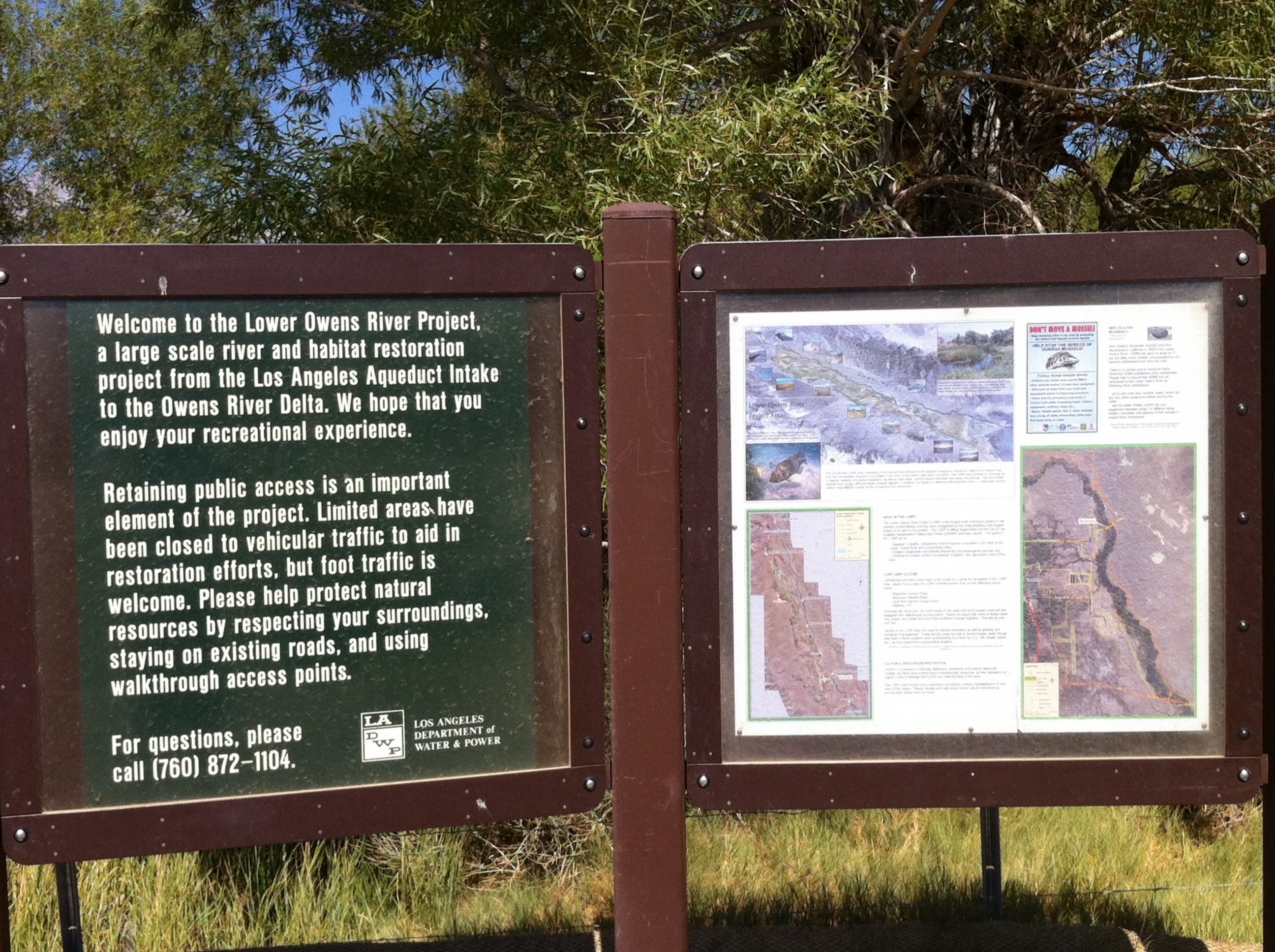
Stoked by a warm-water fishing article that recently appeared in Cal Fly Fisher mag, my son and I stopped in Lone Pine over the weekend to check out the lower Owens. After all, I’d fished the ponds behind Bishop for bass and panfish, and this piece sang the praises of throwing a bass bug into the river’s hot summer waters.
After a two-minute ride from town we found, yes, more water flowed; the weather was unseasonably hot as blazes; and we did spot a good-sized bass near a bank.
But now for that all-important cast … bonk. Only the croak of an insistent bull frog kept us smiling.
The looming LORP problem for the fly fisherman remains terrible access. If you’re a tule, you’re really a happy camper surrounded by lots of your tule friends, but if you’re struggling through them, fly rod in hand, feet in the muck leading to where you might find the river’s edge, it’s just not so good. Casting? No way. The only casts we got in were right next to the road.
Last summer, reporter Louis Sagahun from the Los Angeles Times penned:
“The largest river restoration ever attempted in the West — intended to support a cornucopia of wildlife and outdoor activities — has left a 62-mile stretch of the Lower Owens so overrun with cattails, cane and bulrushes that it may take decades to bring them under control.”
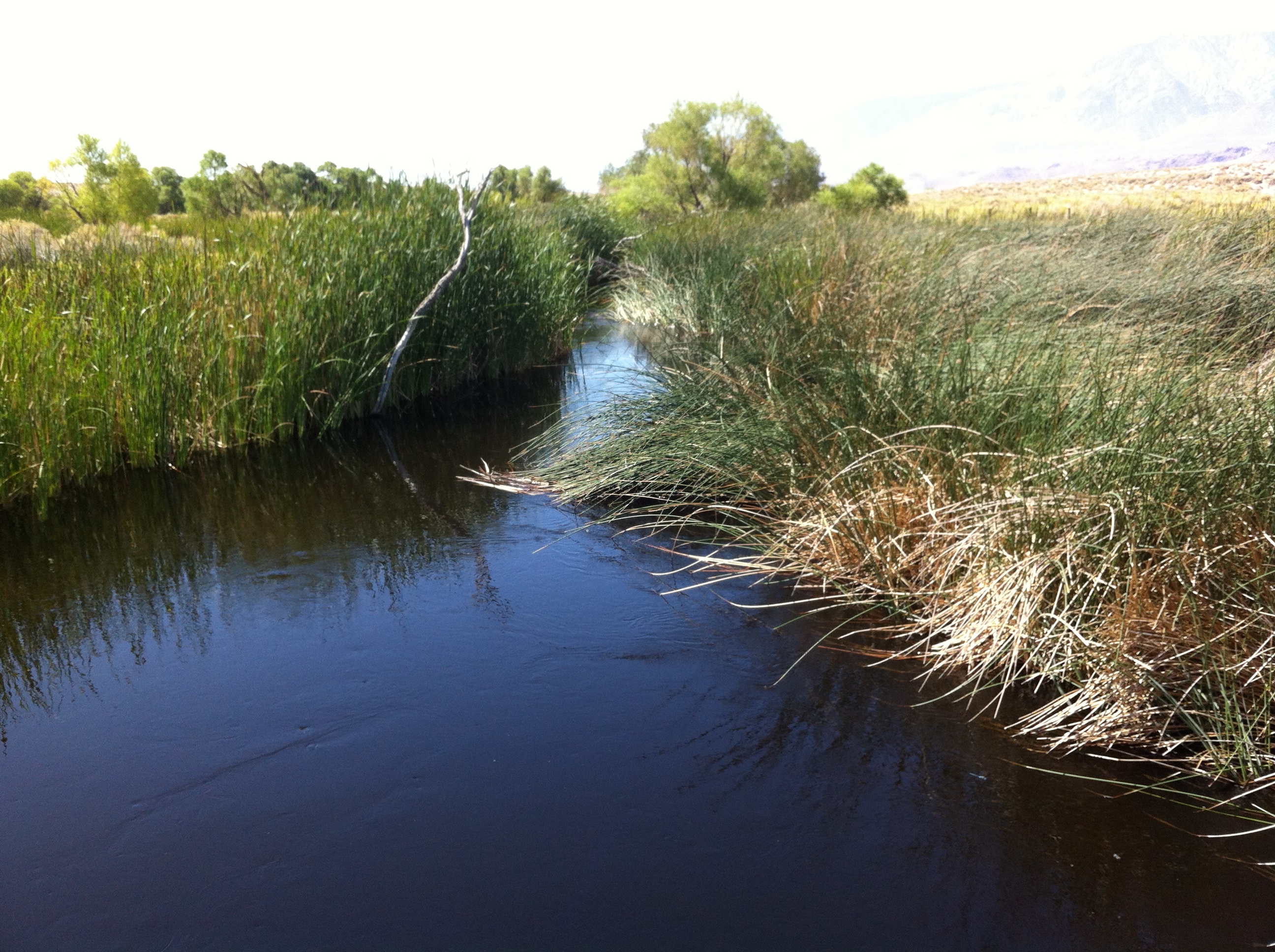
He was writing about the Lower Owens River Project, LORP for short, that began about six years ago when L.A. Department of Water and Power began putting more water into the river that it had diverted to Los Angeles Aqueduct since 1913.
It’s a shame to have the restoration project in full swing, as evidenced by the nifty explanatory signage about the project and a new, shiny access gate, and not be able to fish. Anybody got a lawn mover?
I’d skip this one until there’s a solution, possibly like the disabled fishing platform on the ponds outside Bishop.
See you on the river, Jim Burns

If you missed last night’s PBS Newshour segment about keeping exponentially breeding Asian carp out of the Great Lakes, take a look here. The news clip views like something from a sci-fi novel: loathsome predators a la Terminator; an electric river barricade similar to the great Scottish wall in Doomsday ; food of the future, as in Soylent Green(OK, not that bad!). Turns out, according to the piece, America is the only country where we don’t eat carp, and the citizenry is generally creeped out by the idea. But … that could change.
It really does make me wonder exactly what a carp dog tastes like. Here in the L.A. River, I’ll just keep throwing them back, but if I get to Chicago, I’ll take mine with mustard and mayo.
See you on the river, Jim Burns

I got to spend several hours on the river this morning, and all I have to show for it is this photograph of a toad. The one carp I spotted saw me first, and even though he eventually came back for another look, he decided the odds of swallowing my bread fly were next to zero. But the good news is this little guy, who was around five-to-six inches long. I saw him lazing in some slow water, surrounded by hundreds of tiny mosquito fish. This is the first toad I’ve seen down there, so my question is, Western Spadefoot Toad, Western Toad, or something completely different?
See you on the river, Jim Burns
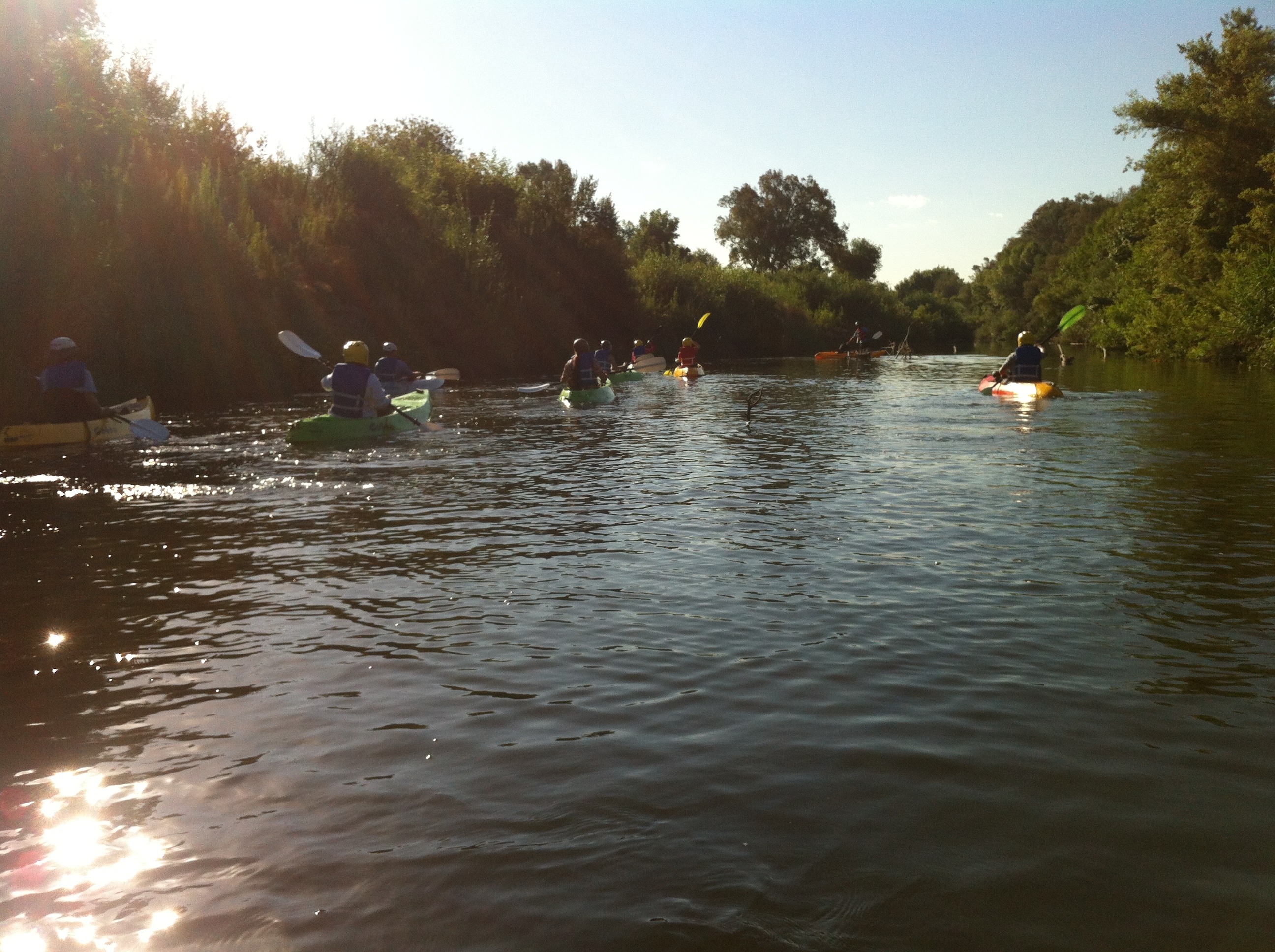
At 7 a.m. on a Friday in the Valley, most early-bird go-getters think about what they’ll do after work. First though, they’ll chug, chug, chug down surface streets to a freeway; then hear the buzz, buzz, buzz as the digital world insistently wonders why not take those eyes off the freeway and get a load of this. A mug of very hot coffee, a few harsh words for other drivers and in due time, they’ll be in their parking spots at the office. That’s life in the Friday fast lane.
But as our group of truant workers donned hard hats, snapped on life jackets and sat our butts just right in kayak bottoms, the workaday world couldn’t have been farther away.
“Usually I’d be at my desk, answering emails and drinking coffee,” one of our group of seven said.
Exactly.
During the two hours we spend on the river, our three corpsmen kept us in line. They taught us not to be afraid of the water (tested and safe, thank you very much); they helped us not to slip and fall during each of three unexpected portages; they rescued at least a few of us from errant willow-branch overhangs and ill-placed sandbars. And they made us feel at home for those two glorious hours as we paddled along, hearing “river right” to spot a white heron just reaching flight, or a mallard honking the right of way over our elongated, colorful crafts.
The real magic happened once our group of seven couldn’t see/hear the freeway. All became country quiet.
“People think it’s somewhere in Louisiana,” said one of our guides, “because of the plastic bags.”
True, there was some trash, but as another floater commented, not nearly what we expected.
Hey, there’s a certain thrill to kayaking around a drowned shopping cart. And an authenticity to this very-urban river that’s just beginning to heal from years of our neglect.
Bottom line: Go and experience this yourself. It’s worth the $50.
Prediction: Five-year contract in hand, the Corps going to make this tour an L.A. “must do.”
See you on the river, Jim Burns

Yesterday, L. A. River Tours (a.k.a. L.A. River Expeditions) received its tour operator license from the U.S. Army Corps of Engineers for this summer season of boating. The program will be expanded in terms of the number of people it serves, but apparently not in terms of new areas of the river, which should again be the Sepulveda Recreation Basin.

 lariverflyfishing