NEXT! Two-time Carp Throw Down champ David Wratchford congratulates this year’s winner in the wading division, Amy Barder McMahon.
San Diego’s third annual Carp Throw Down is in the books with the team of John Hendrickson and Dustin Sergent snagging both first place in the boat division, as well as most fish caught, with three carp and two catfish.
“Like always, it’s fishing—you never know what the insect, weather, and water conditions are going to be until you get out there,” organizer The Fly Shop’s Matthew Austin said. “The competitors who succeeded all came in with a plan of attack, adapted, and persevered.”
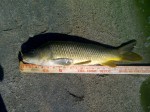
Difficult fishing conditions made for little top-water action, but Amy McMahon made the best of it, to take first place in the wading division with a 23-inch carp, dethroning two-time wading division champ David Wratchford.
“Little did I know when I set out to start the hunting expedition that I would be one of only two waders to bring one in,” McMahon said. “I was fishing with some very skilled fishermen with amazing long distance casting skills so I felt very humbled to have won. ‘Even a blind squirrel finds an acorn every now and then’ is an expression that comes to mind as I think about my success in bringing one in.”
Other winners included:
Biggest trash fish, a 19-inch Channel Cat, Jason Tinling
Biggest carp, 27 5/6 inches, Jake Ness
Second Place Boat, 24 1/3 inches and and 27 5/6 inches, Jake Ness and Chuck Griffin
Second Place Wade, 18 inches, Dylan Moore
Four years ago, this blog started out as an experiment, really, and it’s hit this landmark today. Through it, I’ve learned a lot about the politics of the city I love, made lots of new friends, been skunked and humbled more times than I can count, and occasionally watched as my fly line exploded down the river.
And, today’s my birthday!
So, thank you all. I really appreciate your contributions and readership. Best birthday present a guy could have.
PADDLE UP: The L.A. Conservation Corps guides a group through still waters and overhanging willows. (Jim Burns)Fly-fishers, grab your egg patterns.
Kayakers, adjust your life vests.
Birders, shine your binocular lenses.
because …
once again water recreation is going live in the Glendale Narrows in Elysian Valley and in a portion of the Sepulveda Basin. Hats off to councilmember Mitch O’Farrell, the Mountains Recreation Conservation Authority and the U.S. Army Corps for keeping it afloat (haha) this year.
The dets for May 26 through Sept. 1, sunrise to sunset:GA-RUMP: So is this a Western Toad or a Western Spadefoot Toad? (Jim Burns)
— Flyfishing/traditional fishing are both super-fun, and don’t forget to bring your kids along. You will need a fishing license for each rod, but it’s well worth the money. Remember this is the only time of the year that you can legally fish the river. Check out this story I wrote for KCET for details.
— Tickets to explore one and a half miles of the Sepulveda Basin Recreation Area with LA River Expeditions go on sale tomorrow at noon. I donned a life vest a couple of years back and had a blast.
— In Glendale Narrow, rent a kayak at Marsh Park through L.A. River Kayaks. Or paddle through our very own rapids with L.A. River Kayak Safari by booking here.
Twenty-five-inch steelhead trout caught in the Los Angeles River near Glendale, in January, 1940. (Courtesy family of Dr. Charles L. Hogue)Every so often, news stories come along that seem to tell the story, but, when enveloped in a larger context, turn out to be a shadow of the actual truth. Reading yesterday’s Los Angeles Times, old school (in paper!), I found environmental writer Louis Sahagun’s “Searching for the elusive steelhead trout,” to be in need of context and rebuttal.
Those newshounds among you know that Vox, formed by some former Washington Post staffers, thrives on its policy of “understanding the news.” Context in this digital age is king.
If I’d never fly-fished or reported on the L.A. River, I would have read Sahagun’s piece and asked “Why would anyone attempt a fish study in this toxic waste water?” and probably had a very good laugh at the photograph of the fool from Trout Unlimited with a sock attached to his line, and snickered at the abandoned shopping cart shot.
But, as it stands, I have a platform to cry foul on this piece. I started lariverflyfishing some four years ago with the tagline “fishing for carp, waiting for steelhead,” and have amassed over 1,000 followers and 46,000-plus hits as of this writing.
For those of you who actually do enjoy recreational fishing in Glendale Narrows, you know this story doesn’t begin to tell the broader context of our river.
And for those of you who participated in the latest clean-up efforts, you know that if Friends of the Los Angeles River, the organization that has organized clean-ups for the past 25 years, had gotten a piece of this area, the junk would have been removed.
FOLAR released “State of the River: The Fish Study” six years ago. This singular Los Angeles River study combed four areas for fish, a Glendale site, Newell site, Figueroa site and a Riverside site. The seine nets captured carp, tilapia and sunfish in significant numbers. Because of this study I realized an LARFF contributor had really caught a legend when he recently captured a largemouth bass, because only one appeared in the study, as compared to nearly 250 tilapia.
The most telling lack of context in the Times piece is not mentioning that this study was funded to complete the work begun in 2008. As the study says:
“These coastal and estuarine species will not be A steelhead rendered on the Guardians of the River gate. Once these oceangoing trout ran up the river. Time for them to return.
discussed further here, but will be present and of
concern when work extends to the lower Los Angeles
River. It is becoming increasingly apparent also that
coastal lagoons in and near the mouths of central
and Southern California rivers are very important to
at least one of the two anadramous species known
to have occurred in the Los Angeles River system,
steelhead trout. Thus, they are also important to their
ability to return, spawn, and establish a population.”
A piece that continues to get hits on LARFF is one I originally wrote for California Fly Fisherman magazine. Although events have moved forward significantly since I penned “Will steelhead ever return to the L.A. River” in 2012, most of it remains sound, including this quote from the river’s noted poet:
“Maybe next time they rechannelize it, they do it to the specifications of the steelhead,” mused Lewis MacAdams. “Have a panel of steelhead, fins up, fins down. Let the steelhead decide the shape of the channel. I’ve always felt that what we were doing was calling things home. You know, ‘it’s OK to come back’. There is something to that.”
THE EYES HAVE IT: craw daddy fly posed on a piece of found river glass. (Jim Burns)
The river looked beautiful today, baking sun shimmering on the Glendale Narrows. I haven’t had a chance to fish this fall, so I headed to my favorite spot for carp, across from Betty Davis park. It’s fun to watch the riders gently walk their horses toward the stables, which are almost adjacent to the park. Their hooves land with little dust clouds in contrast to the thick, green grass and voluptuous sycamores inside the park. Plus there are plenty of holes in the fence that separates the park from the river. This is, after all, the terminus of the soft-bottom section before the river is corseted by concrete forming a “Y,” as it heads deeper into Burbank.
I was anxious to plop my craw daddy fly with its heavy eyes into the water. I could already see hungry carp in my mind’ eye, and just where I would put the fly in, so it would gently ripple into my favorite pool on the river.
Only one problem: between the last time I was here and today, our river guardians had come in and changed the subtle flow of the river, stripping foliage, so that the water into the side channel increased. Just like that, my sweet spot had disappeared. Just like that, the carp I’d watched so vividly in my mind were, in reality, just a mirage.
Which, if you’ll indulge me, is the problem of our age: What was solid yesterday is quicksand today. What appears to be terra firma during daylight, folds into the shadows of the moon at night.
What will our outlaw river, a place of ragged fence openings, sudden danger, and equally friendly encounters, become?
At Thursday night’s USACE public comment meeting, almost every person who spoke, echoed the one before, 20-20, a vision of the future with Alternative 20, and its billion-dollar makeover of 11water miles. A few concerned themselves with flood safety, the reason we Angelinos asked for the Corps help some 80 years ago. No one argued for the other three lesser alternatives.
This blog has received only one comment that questions the entire endeavor, wondering if there would even be a river without its concrete girdle.
So, it would seem that if the voice of river advocates is heard by the local Corps, it will switch its tentative choice from 13 to 20. It also seems that locally, the top brass is as enthusiastic about 20 as are the mayor,vocal councilmembers, elected officials in adjacent cities, a smattering of state representatives, and a few powerful allies in Washington, itself.
Mayor Eric Garcetti noted Thursday night with some 4,500 names of signees to his petition for 20 scrolling on a screen as he spoke to the standing-room-only crowd at the River Center, “I can’t remember the last time that many people agreed on anything.”
If we were to score the river’s political will versus everything from voter apathy (15 percent), to Congressional approval rating (9 percent), the people have already won. In this time where precious little rings with optimism, the river’s song has captured many of us, and called for us to be better than we were.
Will Washington listen?
I’d like to know that someday the hole I love will actually still be there the next time I’m on the water.
Could the Los Angeles River ever resemble water inside Yosemite National Park? Time to cast your vote. (Jim Burns)
All right, so where are we on the eve of the first possible U.S. government default in history? And by “we,” I actually mean the people who would dare to reimagine the Los Angeles River, which would be, for the city of Los Angeles, a great healing of an old wound.
— As Congress’ inability to agree on compromises that would reopen the partially shut-down government and raise the looming debt ceiling continues, Americans give Congress an 11 percent job approval rating, down eight percentage points from last month and one point above the worst rating in Gallup history. (press release)
–The U.S. Army Corps of Engineers Los Angeles District today announced it will close its regulatory offices due to the absence of available federal funding. Regulatory offices will be unable to evaluate individual permit applications, Pre-Construction Notifications for Nationwide Permit or Regional General Permit authorizations, or requests for jurisdictional determinations until after current year funding is received and the offices reopen. (press release)
— Mayor Eric Garcetti, who recently visited Washington to push for Alternative 20, the most expensive of the Army Corps restoration projects at over $1 billion, has an online petition he is urging Angelinos to sign. The city would have to bear around $500 million, as the Corps partner. The rest would be federal money.
— If you want to officially comment on the various river options, you’ve got until Nov. 18.
— You can show up and speak up Thursday at the ARBOR Study public hearing, from 5:30 p.m., at the river center, 570 W. Ave. 26, Los Angeles. Should be a fun time.
— p.s. I was in Mammoth Lakes over the weekend and was anxious to show my wife a great fishing spot my son and I discovered (photo above) over the summer. Lots of gorgeous brookies. The only problem: it’s in Yosemite Park, which is closed because of the partial government shutdown. Does that lead to pessimism on my part? NO, not by a long shot. I want the big bucks for our river, even if we have to wait until the approval rating is at 12 percent.
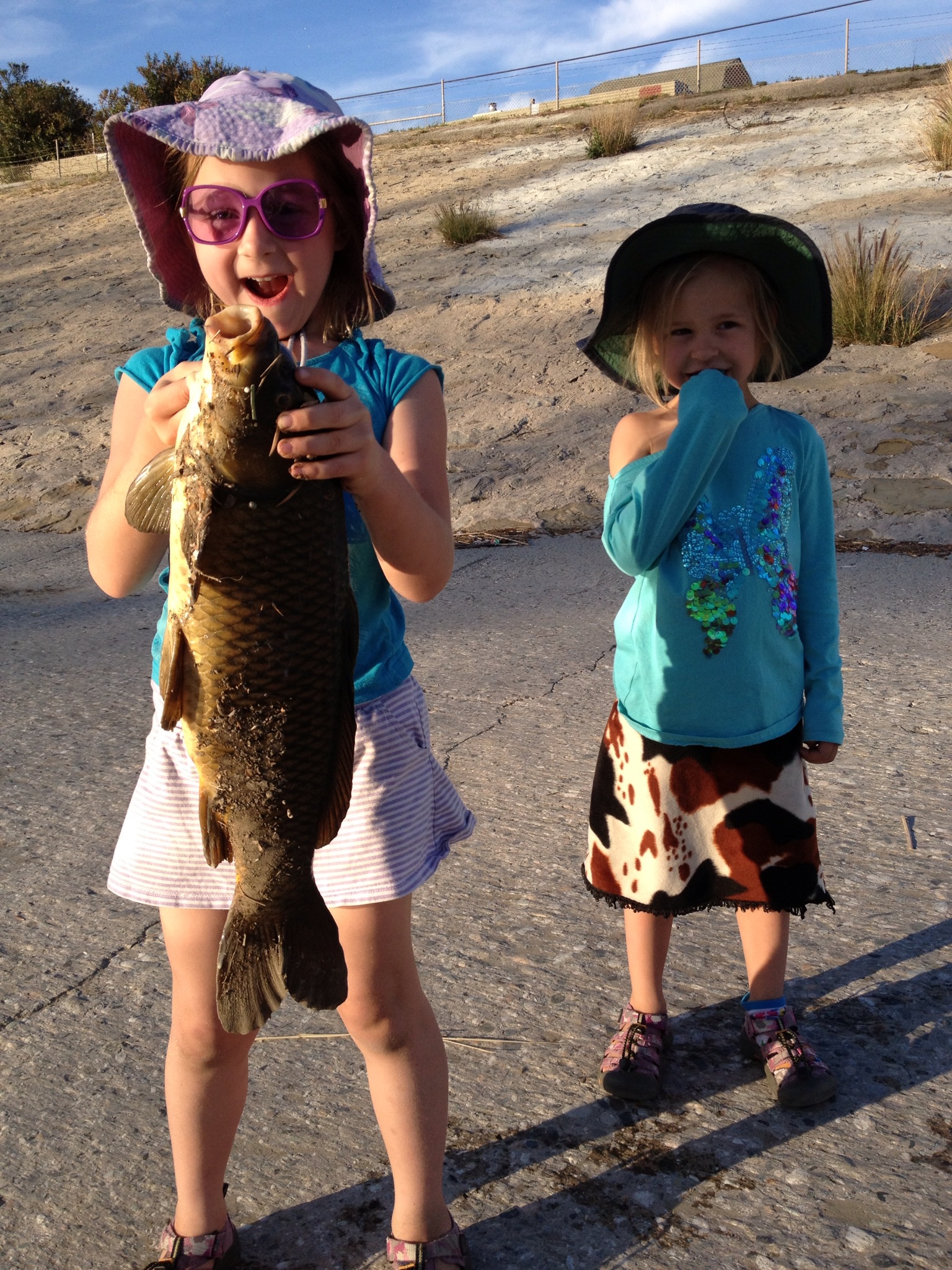
SAY “CHEESE”: Wihelmina, age 5, holds the fish, while father Peirce takes the snap and sister, Ursula, age 4, looks on. (Peirce)
Tomorrow is the big day for the long-awaited release of the ARBOR study and its four alternatives to remake the L.A. River. It’s also a chance for you to weigh in, by reviewing the alternatives, then going to the Corps’ website to comment.
I began this blog as an obscure homage to our river and its fish some two and a half years ago, but this summer traffic spiked to just shy of 35,000 hits. Even I’m pretty amazed (in a good way!) at the buzz and comments lariverflyfishing has received. I’d like to think it’s because of my stylish reporting, but, in truth, it’s because a flood of big federal money is coming and people are excited by what the future could hold. As I wrote last month:
“At stake is how much money the federal government is willing to put into implementing an ecosystem
restoration that could possibly remake the Los Angeles River into a vital part of the city. Last week, the
Los Angeles City Council made it officially known that it wanted to see the biggest package possible, that’s
$1 billion (Alternative 20), which would be spent on the river from Glendale Narrows to downtown, an
11-mile area. There are three other “best buy” alternatives that will be spelled soon-to-be-released report,
each with a lesser price tag.”
Interest from many has been very keen as well. We’ve had the L.A. Weekly weigh in on what it says is the conflict between the Los Angeles Army Corps and higher-ups in Washington, D.C.; we’ve had powerful pols wax poetic about the river’s perfumed waters, with both Supervisor Zev Yaroslavsky and Rep. Adam Schiff (D, Burbank) putting some eloquent thoughts down on digital paper. Even the lifestyle mag Sunset featured a spread in its print version.
So, amid all the excitement, the day finally arrives tomorrow when Angelinos can sound off about the direction they believe the river should go. My hope is that along with the inevitable commercialization, some areas will be left as sanctuaries for wildlife as well as for those who want to be among them. I hope fly fishing — fishing, in general — will remain a viable option; and that the many birds nesting in Glendale Narrows will be given the habitat they need not only to survive, but to thrive. And, let’s get the lead out and do some kayaking. There have been some wonderful stories about kids who dipped a paddle for the first time in our river. I advocate a multi-use, multi-purpose river that is safe during the dry season, with adequate signage, parks and, importantly, law enforcement patrols, one in which a single legal jurisdiction calls the shots.
And, I hope as well that the river reclamation by residents who live close by its banks will continue. Many were amazed at the positive hyper-local response to the Los Angeles River Pilot Recreation Zone. When gangs are forced out, families come in.
As we all move forward into the uncertain future, one thing is sure: change, the river will. Let’s make it the right change.
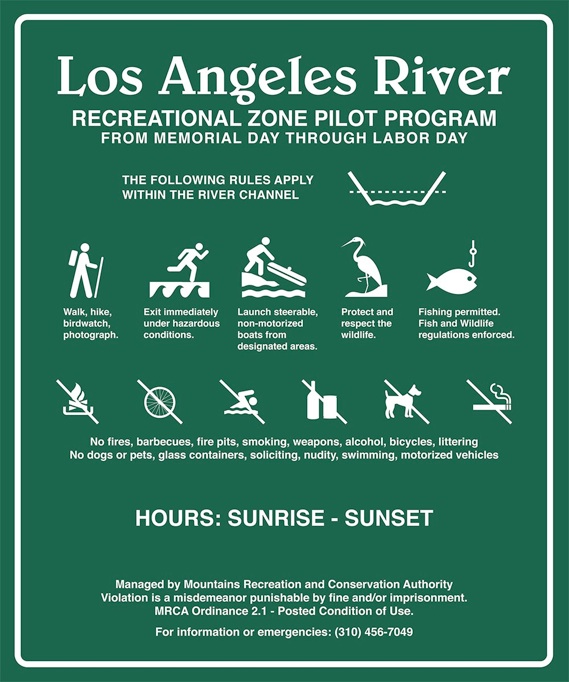
Signs such as this one inform visitors to the two-and-a-half mile stretch of water (Courtesy MCRA)
For Immediate Release (from the MRCA)
Los Angeles River Pilot Recreation Zone Season to End on Labor Day
Hugely Successful Summer Program Allowing Kayaking and other
recreational activities on a 2.5 Mile Stretch of the River Will Close at
Sunset on Monday, Sept. 2.
The Mountains Recreation and Conservation Authority
(MRCA) announced today that the Los Angeles River Pilot Recreation Zone will be
closing for the season as planned at the end of the Labor Day weekend, on Monday
Sept. 2.
The popular 2.5 mile Los Angeles River Recreation Zone in Elysian Valley near
downtown Los Angeles stretches from Fletcher Drive south to MRCA’s Egret Park. The
Recreation Zone has been managed by the MRCA for 14 weeks since it opened
to the public on Memorial Day. Rangers will officially close the river access at sunset on
Labor Day. Signs will be posted “Closed for the Season,” access points will be closed
off, and other fixtures in place for the duration of program will be removed.
By all measures, the pilot recreation zone was a success,” said MRCA Chief Ranger,
Fernando Gomez, an expert kayaker who is certified in swiftwater and low-angle
rescue, and who organized and led many of the public programs offered by the MRCA.
“People really enjoyed themselves on the river this summer. In addition to all the
kayakers, we saw a big increase in family activity and more people coming close to the
river and getting a new perspective.
“We hope to work with the City of Los Angeles, the Los Angeles County Flood Control
District, and the Army Corps of Engineers to offer the program again next year,” added
Gomez.
Under permits issued by the MRCA, the kayak operators Los Angeles River Expeditions
and Los Angeles River Safari provided guided trips to the public. Several thousand
park visitors toured the river through these services or as independent kayakers. In
addition, MRCA rangers provided kayak tours for teenagers from Los Angeles City
Recreation and Parks Recreation Centers throughout the city, as well as “Junior
Rangers” from the MRCA River Unit, Ballona Unit, and the Compton Junior Posse.
_________________________
I’ll only add that Gomez told me that MRCA didn’t give one fishing ticket during the season. Whether through leniency or compliance, I’m not sure.
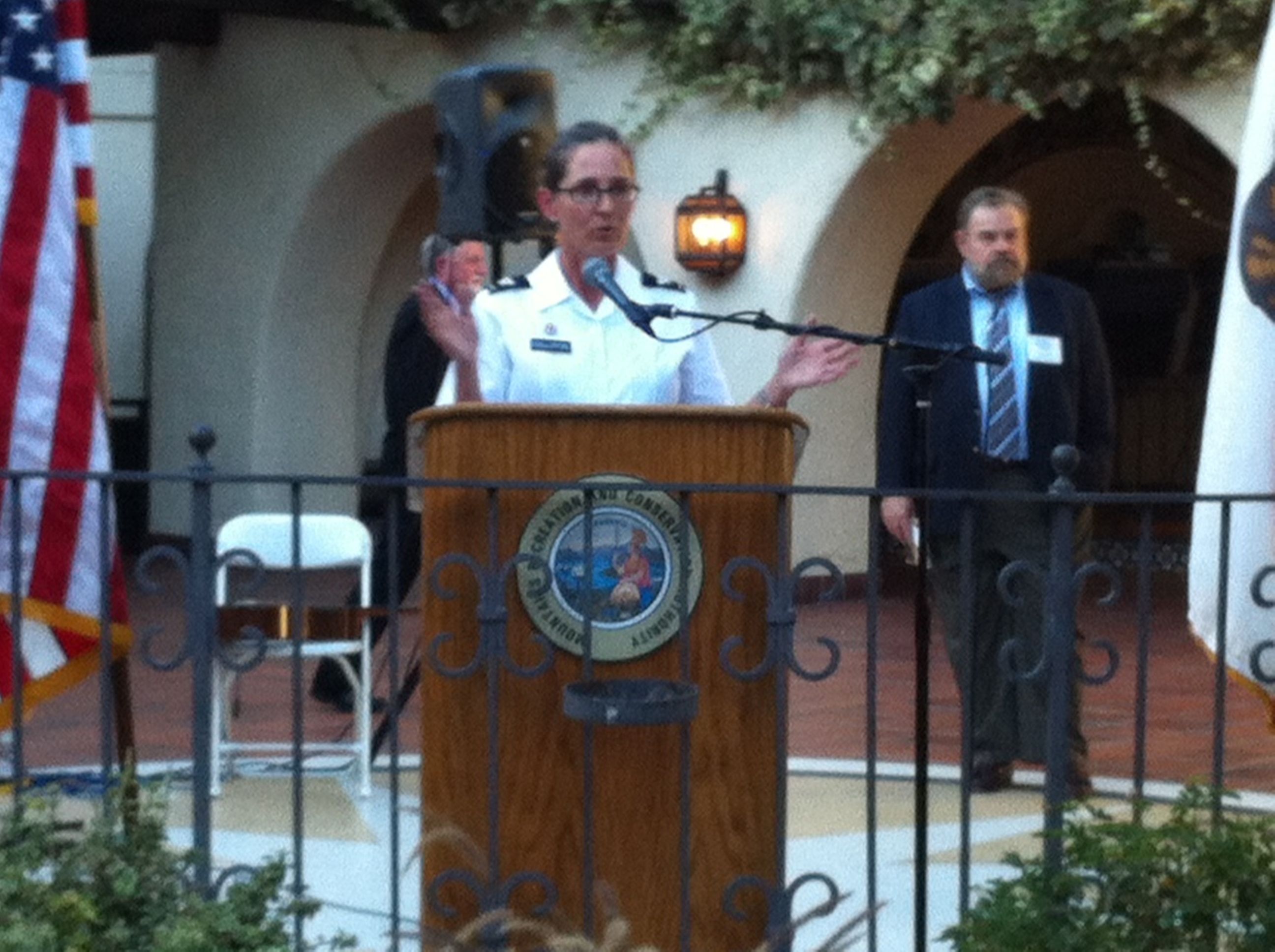
Col. Kim Colloton emphasizes a point yesterday at the Los Angeles River Center. She is the first female commander to occupy the U.S. Army Corps top job in L.A. (Jim Burns)
In an unprecedented first, river advocates threw a party to welcome the first U.S. Army Corps female district commander to Los Angeles. Spanish guitars played as guests from a multi-pronged coalition of community groups, private enterprise and government officials sipped sangria to welcome Col. Kim Colloton at the Los Angeles River Center plaza.
The river center is a stronghold of advocacy groups, which include Friends of the Los Angeles River and the Arroyo Seco Foundation. The audience and speakers included two Los Angeles city councilmembers, the mayor of Burbank, and representatives of local cities, the state and the federal government.
“This has never been done before,” said Lewis MacAdams, founder of FOLAR, and, until recently, a longtime self-proclaimed “enemy” of the Corps. But MacAdams, along with others, increasingly see the Corps as part of the solution, not the problem.
“It’s going to get more challenging as the interest gets wider, as more and more people view the river as an asset toward open space, and renewal, and improvement of the city,” Alejandro Ortiz, FOLAR chairman said. “You would wonder if the Corps of Engineers is the ideal partner. At first thought, you might think it’s not, but as it turns out the Army Corps of Engineers is the guiding light toward salvation. And salvation has a name. It’s Option 20.”
At stake is how much money the federal government is willing to put into implementing an ecosystem restoration that could possibly remake the Los Angeles River into a vital part of the city. Last week, the Los Angeles City Council made it officially known that it wanted to see the biggest package possible, that’s $1 billion (Alternative 20), which would be spent on the river from Glendale Narrows to downtown, an 11-mile area. There are three other “best buy” alternatives that will be spelled soon-to-be-released report, each with a lesser price tag.
“Just from my short month here in my new job, and by this synergy that I have felt and seen tonight, I can feel that we are united in a vision to protect, restore and maximize this river’s benefits for future generations,” Col. Colloton said to the crowd of around 200.
The crowd found out that the long-awaited ARBOR study, which names four possible paths to ecosystem restoration, will be available for public comment on Sept. 13. There will be an email box to make it easy for people to voice their opinions on the Corps’ website. How much money is spent must be voted on and approved by Congress.
Does lightening strike twice? Well, for this year’s Carp Throwdown on Lake Henshaw in San Diego County over the weekend, it sure did.
Just like last year, David Wratchford once again captured the wading division with 97 points. And the boat team of Dustin Sargent and John Hendrickson snagged first place with 102 points.
The winners walked away with an Orvis H2 saltwater 6 weight and a Yeti cooler, respectively.
Wratchford also got the prize for “best trash fish,” which includes everything in the lake, excluding carp.When’s the last time you heard of a bass being considered as a trash fish? In Wratchford’s case, it was a catfish, and he won a Galvin T-5 reel for his efforts.
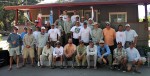
Everyone else, well, you can tell from these photographs, snapped by Bernard Yin, had the swag of enjoying this fab tournament.
If you can’t get enough, consider participating in the Carp-Ocalypse in Seattle, Aug. 10-11.







 lariverflyfishing