If you were wondering if today’s weather in the low 60s would stop the spring spawn, the answer’s a definite “no.” Unless it’s raining tomorrow, considering going to the river to see one of the coolest things we’ve got going on in L.A.: spawning carp running up the river. We watched dozens and dozens and dozens of beautiful gold and sometimes rust fish going absolutely nuts.
Anyone who’s fished the spawn know that it’s not easy, but here are some tips:
— don’t go after jumping fish. They won’t strike.
— do get those egg flies out. Tie a bunch in chartreuse. That’s the color.
— don’t expect the fish to strike in fast, running water. Look for the slow pools.
— do let your egg hit bottom, in front of the fish you’ve targeted.
— don’t let your line foul under seaweed. You’ll get broken off (happened today).
— do get excited that you can fish the L.A. River right now.
— don’t play the fish too tightly(happened today as well!). This is not a San Gabes trout. These are big, frickin’ fish.
— do bring your camera. It’s that amazing.
See you on the river, Jim Burns
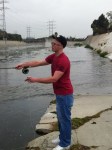
Oh man, nothing like springtime carp fishing! (Jim Burns)
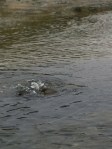
If you think the only “boil” happens with calico bass in the Pacific, get down to the river, right now. (Jim Burns)
Tie up some extra-fatty egg flies in chartreuse. And don’t forget to use sexy red No. 6 Gamakatsu Octopus hooks. (Jim Burns
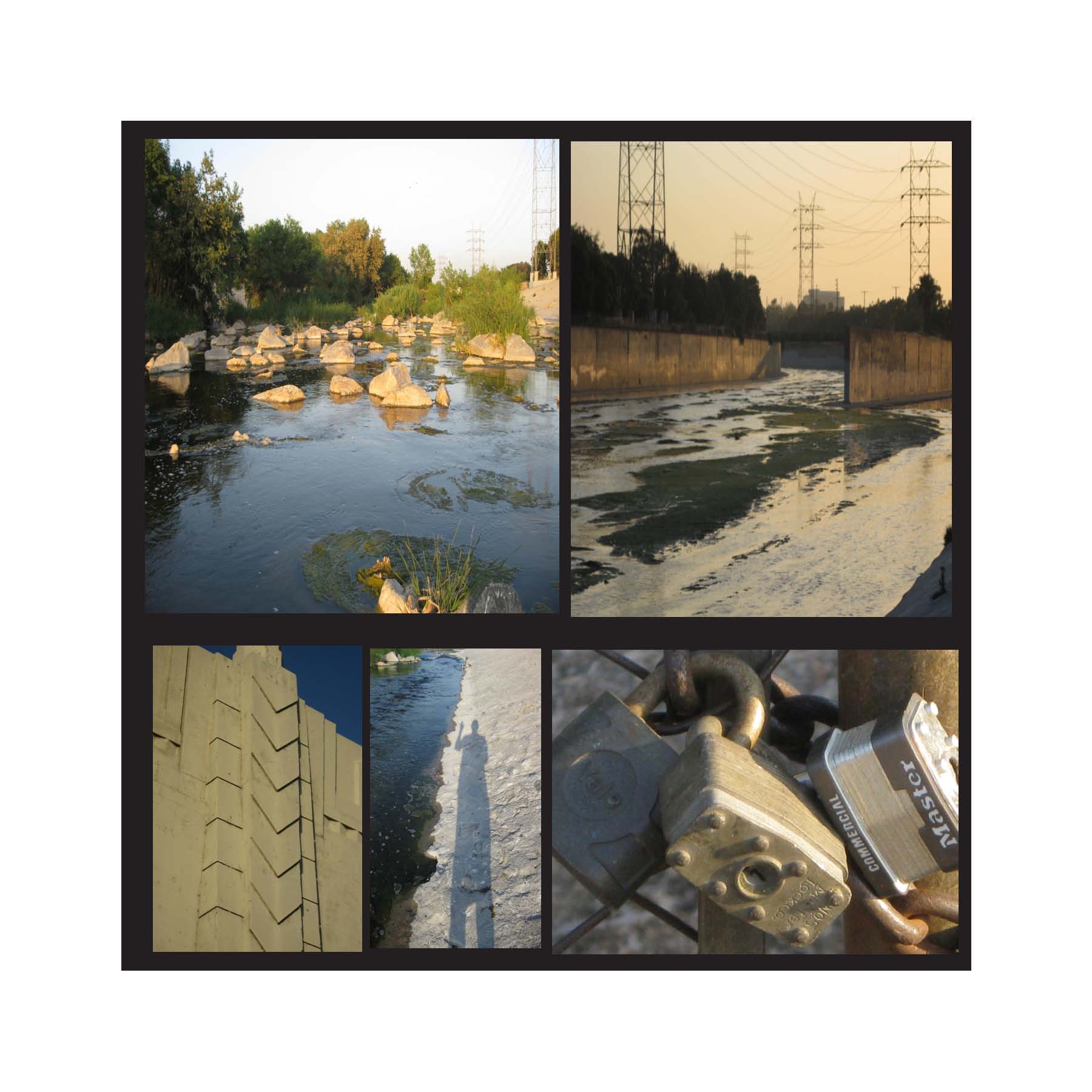
From top left, clockwise, the tranquility of carp-filled pools, at the beginning of Glendale Narrows. Once you get past the city locks, you can see self-shadows and nifty bridge architecture. (Jim Burns)
Dear Senator Kevin de Leon:
I strongly support the bill (SB 1201) that I understand would significantly widen access to the Los Angeles River.
The Los Angeles River is the whole reason I became an environmental and fly fishing blogger. I’d been assigned a story on carp fishing in the river by Richard Anderson, publisher of California Fly Fisher, a bi-monthly publication that is carefully read among the fly fishing community. As I’d never actually been to the river, my first step was to find access to the water. This turned out to be no easy task, and I can still clearly remember driving around the Atwater Village area of Los Angeles with my son. We zigzagged through parking lots, truck depots and all manner of what seemed possible entrances, only to find dead-ends, walls and barbed wire fencing.
Finally, we found an entrance tucked almost invisibly between the I-5 freeway and a golf course. I later learned that this entrance is known as Steelhead Park.
I spent weeks researching that first piece, gleaning lots of information about the river, its fish and its restricted access. For example, I learned that Griffith Park rangers as well as Los Angeles Police Department officers were charged with ticketing anyone who strayed off the bicycle paths. Obviously, those fishing were actually doing so illegally.
In a short two years, recreational access has increased, largely thanks to the work of river advocate George Wolfe, FOLAR, a mostly cooperative city, and a vastly changed U.S. Army Corps of Engineers. But we must go further.
When lives are not in danger from floodwaters, vast stretches of our 51-mile jewel should be open to the public. And, the public should be able to enjoy the access without the trepidation I first experienced.
Today, my blog www.lariverflyfishing.com reached its 10,000th hit, so I feel it is an apt celebration to make this letter to you public, in the hope that others will also write to you to support your efforts.
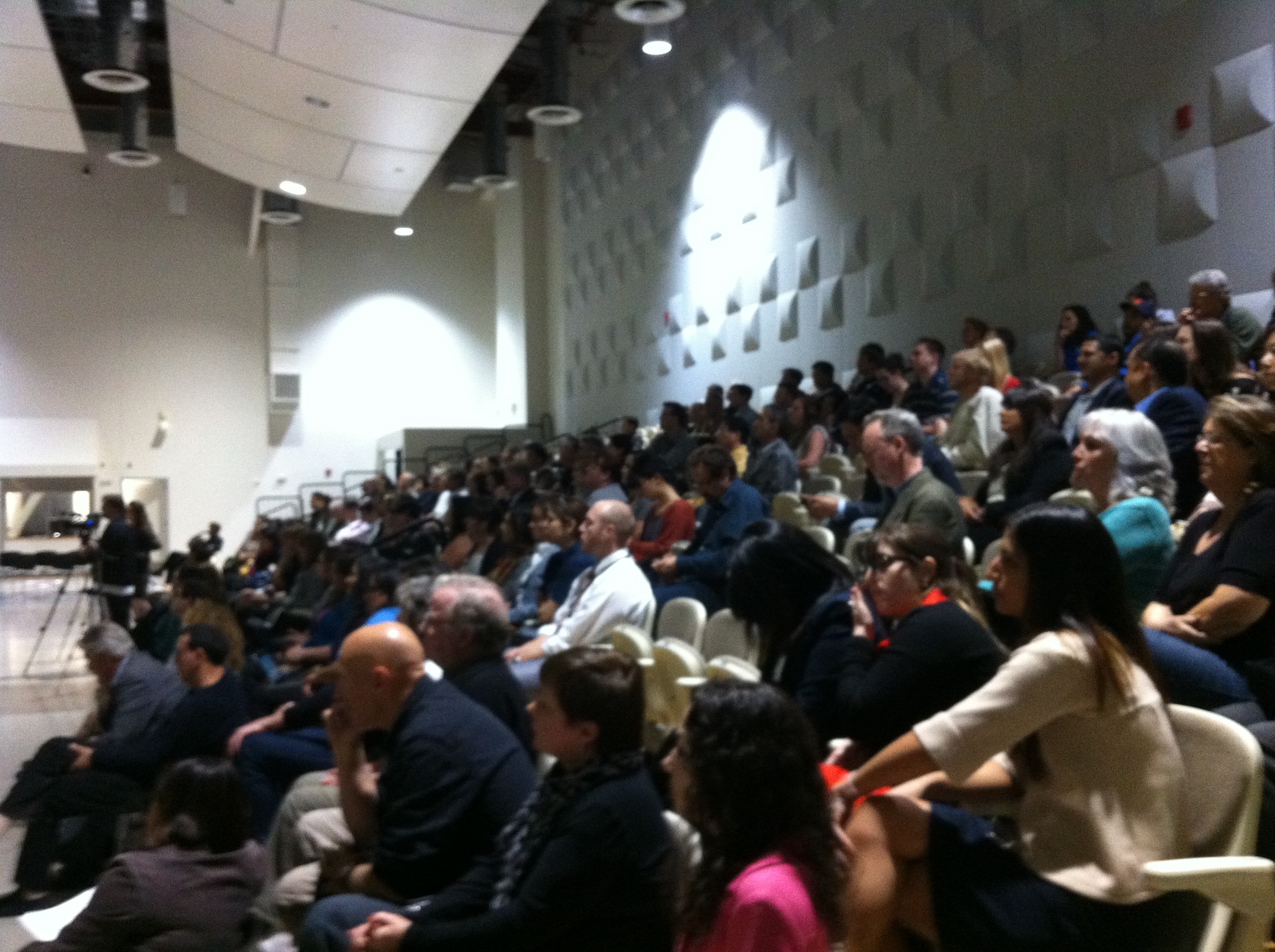
About a hundred attended the City of L.A.'s River Update event Thursday evening. (Jim Burns)
“The River Study is moving. For the first time, it made it to the President’s budget,” Carol Armstrong said to a group of about 100 participants at the River Update event, held this evening at the L.A. River School.
Armstrong, the point person for the city’s many river projects, went on to explain how Councilmember Ed Reyes, Nancy Steele of the Council for Watershed Health, Lewis MacAdams of Friends of the Los Angeles River and others went to Washington to talk to legislators about the important of funding the U.S. Army Corps of Engineers L.A. River Ecosystem Restoration Feasibility Study. The study is key to virtually all future plans to restore the river to a more natural state. Begun in 2006 with the city as the local partner, it looks at the 10-mile stretch of soft bottom that stretches from Glendale Narrows, plus Headworks Reservoir in Burbank, through downtown to First Street. This area, part of which is across from Griffith Park, is the most popular with fly fishers looking to hook carp. Besides having a soft bottom – as opposed to concrete – it contains what the Corps calls “ecological value” and has the most water in it year around.
Although only $100,000 will come from the 2013 federal budget, the Los Angeles Dept. of Water and Power contributed $1 million, as did the leadership of the Army Corps, committing $350,000. When completed in 2013, the study will have cost almost $10 million.
In 1995, political restoration activities began with the county, which led to the City Council’s approval of the Los Angeles River Revitalization Master Plan in May, 2007, created with $3 million from the Department of Water and Power’s deep coffers. The plan contains many items, including revitalizing the river, greening adjacent neighborhoods and creating value through economic opportunities
As Josephine Axt, the Army Corps lead planner told the audience, don’t expect any real result until June, 2013. Still, the funding was good news for river advocates.
How many guys carry their own scale? Jim Graves does!
The title says it all: The newspaper America either loves or hates, depending on political affiliation, has sanctioned catching carp with a fly rod. Best quote is that it’s like soccer: No. 1 sport in the world, yet, just catching on in America. Take a look at the piece, written by Chris Santella.
Lots of action on our own river, Friday. We spotted at least 30 fish.
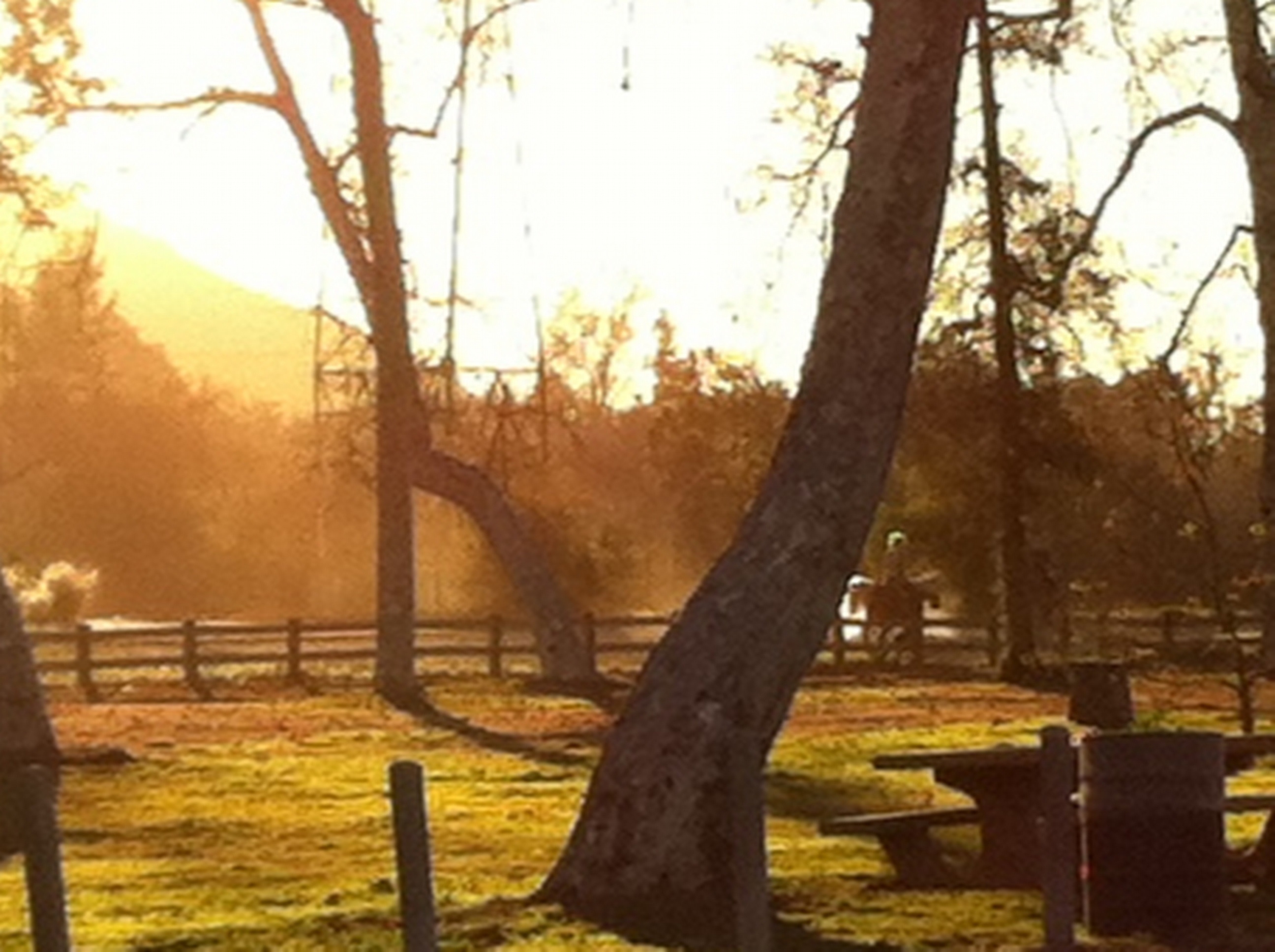
As riders and their horses enjoy this idyllic January scene close to the L.A. River, others are not so fortunate. (Jim Burns)
Every once in a while, you have one of those days, days of insight, days when whatever glasses you usually wear are plucked off and replaced by the new.
And, I have to add, insight — the new — is not always wanted.
Let me explain. Friday, I finally got some time off, so I tied on a new bread fly, hoping not to get skunked. Readers of this blog have followed my fruitless progress, so far.
I was excited. I mean growing up in Chicago, I still can’t believe it when the January weather graces us with Santa Ana wind-warmed temperatures in the 80s. Plus, would you rather fish the glorious L.A. River, or be working? (That’s a rhetorical derrrrr).
Stopped at the freeway entrance on my way, I pulled out my wallet to give a couple of bucks to a homeless woman. If you live near Pasadena, you’ve probably noticed that their numbers seem to be increasing. I debated for so many years whether to give/not give that now whenever I see someone in need, I give what I can.
As I handed her the money, she launched into a rant about how the guy in front of me had given her coupons to Union Station, but she didn’t want to go, because there you had to play the “boy-girl game,” and that she wasn’t out here begging for money because it was such a good time. Anyway, engrossed in what she had to say, I missed the light. In L.A. that’s a major offense, but nobody honked. As I waited for the next green, we talked more and she explained how her friend had contracted scabies at the city-run shelter and she’d taken her to the doctor.
But it was the next part that got me: “You people,” she said accusingly, and I can’t remember what else she said, but I do recall vividly how she looked at me. Maybe you can see it in your mind’s eye.
To the homeless, I now had a moniker. “You people.” From my perspective, they were/are “you people,” so I suppose it cuts both ways. Anyway, I couldn’t shake our conversation, and it rolled around in my mind, still does.
Once parked near the river, I spend the rest of the afternoon searching for carp. Several hours elapsed without a sighting, when, suddenly, I came upon a pool of a half-dozen who spotted me almost as quickly as I saw them. Like trout, carp have excellent eyesight. Picking one up, you’d think that their eyes focus only on the bottom. Not so.
Frustrated after about 10 minutes of casting to likely spots they might have fled, I turned to the concrete bank, calling it quits. About 10 yards in front of me were clothes drying on the chain-link fence, a faded but functioning bicycle, a pair of tennis shoes, a sleeping bag covered by a makeshift tarp. I stopped. The passing water was calm, as was the setting sun, calm, even the repetition of traffic on the I-5, calm. But interiorly I hardly was, as not one, but two residents emerged from the tent, not seeing me in my sheltering thicket.
“You people.”
For a moment, I felt all sorts of emotions, from fear (Would I be attacked?), to stupidity (Why would I be attacked?), to anger (Hey, I’m just trying to fish here, gimme some space.), to empathy (It must be awful to live out here.), to aversion (How am I going to get back to my ride?).
“You people.”
Eventually, I moved quietly to another hole in the fence and climbed through, dipping my nine-foot rod.
Twenty-five-inch steelhead trout caught in the Los Angeles River near Glendale, in January, 1940. (Courtesy family of Dr. Charles L. Hogue)
It may be a ridiculous notion to think the Los Angeles River could ever support a resident steelhead population. In fact, it may be ridiculous to contemplate that this gritty icon of shoot-‘em-up movies like “To Live and Die in L.A.” will ever shed its miles of concrete, flood-control skin in favor of a sustainable habitat. Yet, talk to the various players in the multi-year, multi-million dollar reconstruction drama and a common theme emerges: steelhead restoration. Whether it’s actually feasible or not, the steelhead has become a symbol of the river’s potential rebirth. In the years to come, whether flapping fins or flummery will triumph, remains to be seen.
Problems abound with a restoration effort of this size, 51 miles through a morass of cities, from the San Fernando Valley to the port of Long Beach. Those reading these pages outside of Los Angeles must wonder if steelhead ever swam in the river to begin with. The answer, which is ironic even to those of us locals who regularly ply the water for carp, is “yes.”
“The southern steelhead Distinct Population Segment goes from the Santa Maria River in San Luis Obispo County down to the Border. Say 50-75 years ago, the size of that population run was about 30,000 adults,” said Trout Unlimited’s Chuck Bonham, who will be the new director of the Department of Fish and Game, if his appointment is confirmed by the state senate. If you pull out a map and take a look at the enormous area he’s talking about, it’s obvious that even during the heyday, there weren’t a lot of fish.
Today, those numbers have plummeted in the area and are at zero in the river, itself. Southern California Steelhead have been on the Endangered Species list since 1997. To be put on it, a species must be viewed by scientists as imminently in danger of becoming extinct.
Although anecdotes (and the iconic picture above) point to the last steelhead being pulled from the Los Angeles River in 1940, activist and poet Lewis MacAdams, one of the three founders of FOLAR, has kept that mythology alive. The river mantra is his: “When the steelhead return, we’ll know our job is done.”
In 1995, political restoration activities began with the county, which led to the City Council’s approval of the Los Angeles River Revitalization Master Plan in May, 2007, created with $3 million from the Department of Water and Power’s deep coffers. The plan contains many items – revitalizing the river, greening adjacent neighborhoods and creating value through economic opportunities – and includes more than a dozen references to steelhead. Key among them are “… ideally, developing fish passages, fish ladders, and riffle pools to allow for restoration of steelhead trout habitat.”
“It was a recognition by the design team and the city that fish habitat would be good and to strive for it as a goal,” said Ira Artz, the project manager at Tetra Tech, the environmental engineering and consulting firm responsible for the plan. According to the plan, “the long-term vision for the river involves restoring a continuous, functioning riparian ecosystem along the river corridor.” Improvements should include:
— Decreasing water temperature through shade
— Improving water quality
— Creating an unimpeded path from the ocean to the headwaters, along with areas to rest and to spawn
— Inducing a natural flow regime of high and low-flows
Two of the four have improved incrementally as of this writing, water quality and pathways.
Steelhead aside, getting any project shovel ready faces a myriad of political hurdles. According to city documents, the river flows through seven U.S. Congressional districts, 10 city council districts, approximately 20 neighborhood councils and 12 community plan areas. On top of that with about 10 million people, L.A. is the nation’s second largest urban region, and Long Beach down the road is one of the world’s busiest ports. It also happens to be where the river exits to the ocean.
Yet, there are the beginnings of a solution if you look north to one of the L.A. River’s main tributaries, the Arroyo Seco. If fact, the founding of the city in 1781 took place at the confluence of these two bodies of water. As part of the restoration plan, Confluence Plaza was inaugurated in the shadow of the I-5 freeway earlier this year.
“Historically,” Tim Brick, managing director of the Arroyo Seco Foundation, an environmental group, said in his offices at the River Center, “the Arroyo Seco had a really rich trout culture, including steelhead. And there are lots of historical references to steelhead on the Arroyo Seco and, really, in the L.A. river system. Brick is a “money where your mouth is” kind of guy, who recently with the help of CDM corporation and a $2 million grant from the state’s Water Resources Control Board, spearheaded the return of 300 minnowlike native Arroyo Chub to a newly restored native habitat. “We view the re-establishment of the Arroyo Chub as the first step toward the re-establishment of steelhead in the L.A. River.”
Wendy Katagi, CDM’s environmental planner, who worked with Brick on the restoration project, naturally agreed. “We should focus on doing steelhead recovery in the upper watershed. They miraculously hang on, these populations. The best thing we can do is create and mimic natural stream morphology elements through whatever is needed. Then the likelihood of species recovery goes way up.”
Moreover, Gordon Becker, a senior scientist with the Center for Ecosystem Management and Restoration, based in Oakland, Calif., spent months – if not years – analyzing Department of Fish and Game stocking records, field notes and surveys from the 1920s into this century for all of Los Angeles County. His study, published in 2008, speaks to the small number of fish currently present.
A steelhead rendered on the Guardians of the River gate. Once these oceangoing trout ran up the river. Time for them to return.
Unfortunately, it’s virtually impossible to provide an estimate for the number of steelhead in streams of L.A. County, according to Becker. The surveys he reviewed were not population estimates, which is what one would need to say anything at all about abundance.
“Essentially,” he continued in an e-mail, “steelhead in the county are opportunistic at this point. In some years, successful spawning may occur in Malibu Creek, or Arroyo Sequit, or Zume Canyon Creek, or Topanga Creek, but we can’t describe the situation as a steelhead ‘run’ of any particular size. It is my opinion that supplementation will need to be pursued if we are to have a real run in a SoCal stream in the future.”
Today, the city’s point person for the massive river project is Carol Armstrong. After serving in the Peace Corps in Thailand and witnessing firsthand the toll Asian development took on the environment, she enrolled in the University of Southern California’s Sustainable Cities program and received her PhD.
She coined “riverly,” which you’ll hear at most meetings about the subject. She explained another of her creations, Steelhead Fred, while standing next to the bike lane overlooking the river at three-acre Marsh Park, which is a “detention park,” meaning it’s designed to partially fill with water during heavy rain. As she looked across the river toward the San Gabriel Mountains, sporadic afternoon two-wheel traffic filled this newly opened stretch of the bike path, another sign of the river’s rebirth and its increasing connection to the community.
“Environmentalists say ‘we will not have accomplished L.A. river revitalization until the steelhead trout returns,’ so we came up with Steelhead Fred, the steelhead trout, and we ask developers and project proponents, all of them, is it riverly?”
Currently, consensus is that the most riverly project to finish is the U.S. Army Corps of Engineers L.A. River Ecosystem Restoration Feasibility Study that began in 2006 with the city as the local partner. It looks at the 10-mile stretch of soft bottom that stretches from Glendale Narrows, plus Headworks Reservoir in Burbank, through downtown to First Street. This area, part of which is across from Griffith Park, is the most popular with fly fishers looking to hook carp. Besides having a soft bottom – as opposed to concrete – it contains what the Corps calls “ecological value” and has the most water in it year around.
The Corps controls the concrete. So without the study, which would then possibly lead to an actual project, okayed by Congress, no concrete will be exchanged for terracing or plantings, or improving fish passage. It will remain what it was constructed to be – a flood conveyance channel with the aim of getting high-flow water from point A to point B as quickly as possible. Currently, completing the feasibility study will cost $2.6 million, according to Armstrong, and it’s nowhere to be found in President Obama’s 2012 budget, even though it’s a No. 1 priority of the Urban Waters Partnership Program. Recently, Councilperson Ed Reyes, the river’s chief and most dogged proponent, was in Washington asking President Obama to fund the study.
Josephine Axt, the Army Corps planning division chief, is a civilian, a PhD. biologist and rides her bike to work, changing into appropriately conservative work attire, picked from a closet inside her office. “There’s a lot of functionality that we can restore that then might create conditions that would be conducive to fish,” but she stresses that the goals and objectives for the long-awaited study were established some years ago and they’re not to bring back fish.
“To me, if steelhead come back or not, it’s not the measure that I hope the restoration study is measured by. To me, it’s much more about habitat in general.”
Paradoxically, of the 240 potential river projects, not one deals specifically with steelhead restoration.
“We know steelhead won’t be back tomorrow,” continued Armstrong, “but each and every thing we do should build to a place where it’s possible. And by looking at it now, it’s not absurd, but there’s a reason that we do what we do. It’s respecting life, bringing life back … .”
And nature’s clock continues to tick – albeit slowly. About a quarter-mile up from the Figueroa Street Bridge, lie slabs of concrete that the river has started to reclaim. The water’s going underneath the channel there and taking out the concrete. Eventually the river will have to be rechannelized, one way or the other.
“Maybe next time they rechannelize it, they do it to the specifications of the steelhead,” mused Lewis MacAdams. “Have a panel of steelhead, fins up, fins down. Let the steelhead decide the shape of the channel. I’ve always felt that what we were doing was calling things home. You know, ‘it’s OK to come back’. There is something to that.”
Wonder Bread: A loaf of Classic White will costs you $4.50 (Jim Burns)>
With a day off and perfect L.A. winter fishing weather, my son and I hoped to follow up on a thread that’s been going around and around on this blog — the bread fly — so we headed down to the rio, armed with a freshly baked and newly purchased loaf. That’s really the first rub of this story. Wonder Bread will now set you back $4.50!
Our strategy was simple: chum one, chum all.
L.A. River carp are tough to catch, period, so why not chum for them? Previous comments here have shown that our comrades in other states will fish their bread flies while bird fanciers are carbo-loading ducks, geese and other waterfowl on the water. The idea is carp swim under the feeding fowl to munch their fair share of the treats, while the feathers on top continue feasting. Sounded like stealthy fun.
That mid-morning, armed with “classic white,” we approached the most likely fishing hole, one where the current doesn’t drag the bread toward Long Beach in a few seconds. We set up the rods and started rolling gummy bread balls.
After a few misfires, our aim got better as we tossed the white morsels away from the constant current in the pool. Excited as schoolboys with a snow day, we waited for the inevitable rise, the inevitable feeding frenzy. Carp enjoying a free meal, and one that would allow us to place our newly tied bread flies right in front of them.
Problem: Nothing happened, or rather what did happened wasn’t what we wanted, the story of so many science experiments.
After a few minutes of Wonder Bread chumming, lots of creatures did show up, eating the sandwich morsels kids used to love. Unfortunately, they were winged, instead of finned.
Watching sea gulls hover, then swoop down on a tasty inch-round ball gave me new respect for them. Not quite eagles zeroing in on mice, but their aim from 10 feet up was dead on.
Not to be outdone, the thin line of mallard ducks flapped up as well, and about that time, we did see two suspicious water circles, hugging the bank, too funky for a decent cast. That was it …
Cursing the fact that we were landlocked, having left the waders at home, we tried chumming three different spots with even worse results: no fish, no birds, no nada.
No bread-induced chum boil of carp.
No big fish bending rods to the water.
No spinning reels with whining line chasing a fast shadow.
Which brings me to my New Year’s fly fishing resolution: Spend more time on the three above points.
A couple of weeks ago, we got on a roll trying to figure out what, exactly, carp are munching on in the L.A. River, and how we fly fishers can use that knowledge to best advantage.
First, we agreed about carp and crayfish, with McTage writing:
Crayfish, crawdaddy or mudbug, whatever you like to call them, they’re alive and well in the L.A. River.
“If there are crayfish, they are on the diet, guaranteed. Crayfish are high on their list of favorites just about everywhere.”
And so it is on our river.
Next, Sean Fenner widened the discussion, commenting that:
“They eat anything they can find. In the L.A. River, they live mostly on crayfish, tilapia and other carp eggs when they spawn, worms, other insects, and their favorite, BREAD. In my opinion, that’s why the Glo-bugs work so well. I also tie a fly that I call the Tortilla, and they seem to jump all over it. People are always down there feeding the ducks, and the left over bread makes for a great meal.”
Now, I haven’t tried fishing during duck feeding time, mainly because of the legendary Duckman, who supposedly kept the Griffith Park Rangers on speed dial, and was always ready to call them in when he saw a fisherman poaching “his” territory. This is most likely ancient history (2007), as I haven’t heard of park rangers anywhere near the area. In fact, one told me that because of budget cuts, they no longer patrolled our water. And now that there’s been a pilot kayaking program on the water, official attitudes have changed, big time.
But … back to the story. After agreeing that Glo-bugs were a potent carp fly, commenter Gregg Martin went on to write:
YOUR DAILY BREAD: The second fly, from left, is bread of duster wool, the second, fourth and fifth are loosely spun and packed, while the first and third are created with a dubbing loop. (Courtesy Gregg Martin)
” We use bread ties in a local park greatly, casting a SUNKEN fly next to the ducks and geese eight inches under an indicator blind. It’s hot when they’re on it! This sure-thing lasts only a couple of weeks, and then they seem to become jaded by our flies. Mine is a spun and packed wool duster material fly on a weighted size 4 M3366 hook, or similar, or the same material spun in a dubbing loop and brushed out. Or, white glo-bug yarn. My son uses a white or flesh colored bunny leech and does well with that, actually no matter what with that.”
Also, he wrote in an e-mail, that the bread fly tied with wool floats like a cork! Martin found this out, to his chagrin, one day with new ties tightly spun on the Mustad 3366. They wouldn’t sink. So now he packs a few of those, but also some that are less tightly spun, with the wool packed over a shank full of .030 lead. His boys use a dubbing loop with wool or Glo-bug yarn over lead as well. He wrote that they often use often a std. wire TMC #4 200R.
Which brought us full circle to McTage, writing:
“Yeah, I have a park here where they feed the ducks like crazy and I have tried a time or two to take advantage of the urban bread-hatch. Not my fault if somebody else is accidentally chumming them in, right No luck though, I have always tried something on top, will try something wet next time.”
Me, too, after I get some time to tie this recipe up. Hopefully, the water will be still enough and the dreaded Duckman won’t lift a feather to stop me.
AHOY, MATEY: Councilmembers Tony Cardenas, front, with Ed Reyes, far rear, enjoyed a day on the river. (Jim Burns)
I heard on NPR last week that our own Councilman Ed Reyes traveled to Washington to bend President Obama’s ear about the need to fund a study critical to the river’s re-imagining. Although it’s an opinion piece, Jim Newton, from the Los Angeles Times, puts the Reyes trip into perspective.
From the piece:
”The Corps is supposed to be completing a study of the river that analyzes the effects of ripping out large chunks of the concrete, but that work is years behind schedule. Until it’s finished, Reyes’ river project can’t be completed, and he’s now trying to force that work forward. His latest thought: President Obama, as commander in chief, could order the Corps to accelerate the study.
Will the president issue an order to help a Los Angeles city councilman complete a local riverfront project? Reyes thinks he might.”






 No luck though, I have always tried something on top, will try something wet next time.”
 lariverflyfishing