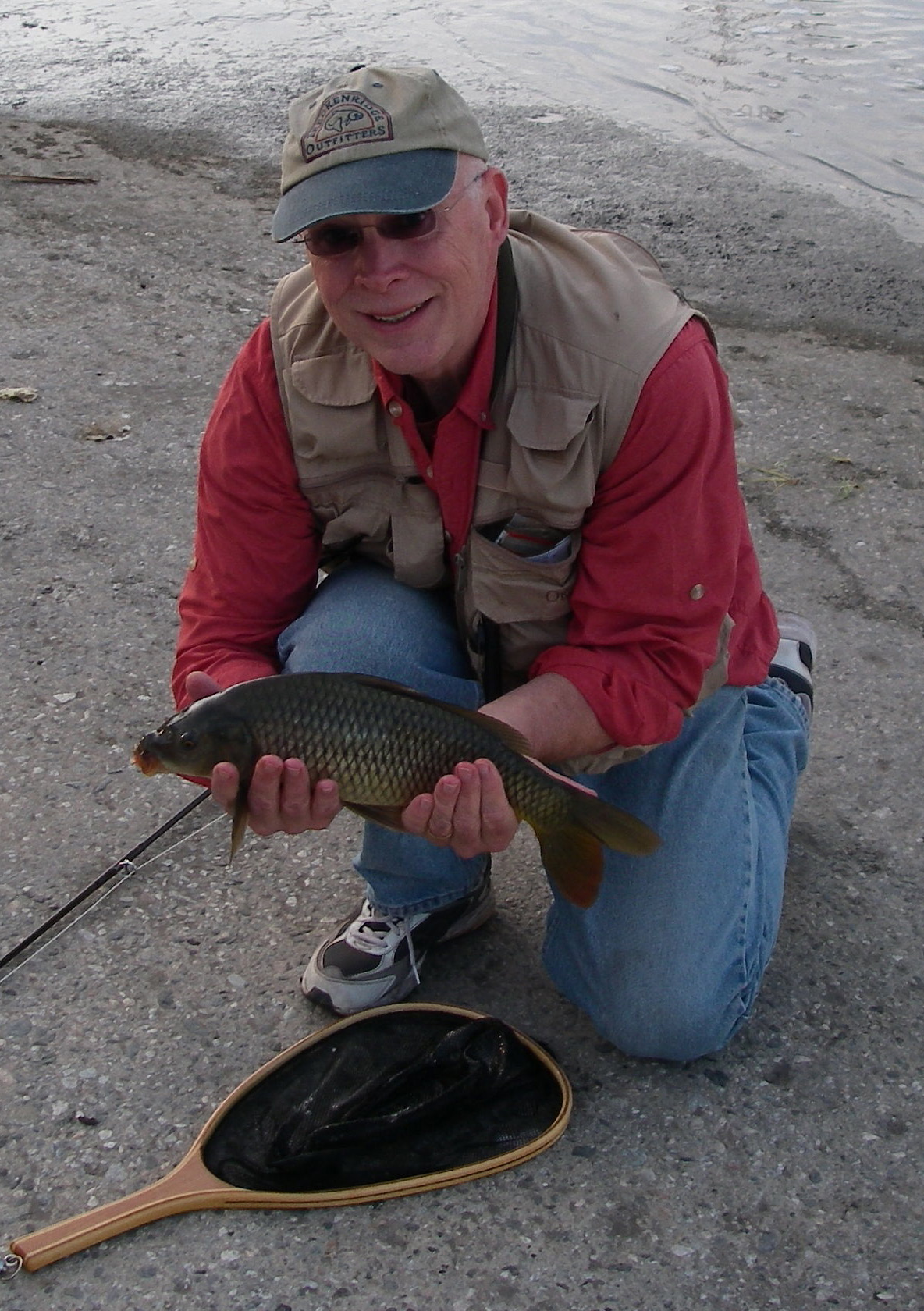
Nothing like catching that first fish on a new reel. (Courtesy David Wratchford)
Update: May 29, 2015. three outings, no carp in the net.
Summer carp journal
Saturday, May 23, 4:30-7:30, overcast, 70, 12 pound tippet. One carp charged and then turned away from a swimming nymph, rust brown dubbing with lighter rabbit tail (size 8).
Tuesday, May 26, 2:30-5:30, overcast, 70, 2X tippet. After rejections on bead head black wooly worm with red yarn tail and bead head swimming nymph with crazy orange dubbing and lighter rabbit tail. (size 8) hooked up on a carp dragon (Orvis). Carp eventually got free because I didn’t set hook deep enough. Saw about 50 pass me in the water, few feeding. Saw the white one again.
Thursday, May 28, 2:30-5:15, clear, 81, 3X tippet. Fish swam up to all of my flies, except the squirmy wormy. That means tortilla fly on red hook, terminator glo bug in chartreuse and orange, all got mighty big looks, but ultimate rejections. Saw the white boy several times, and there were lots and lots of carp. Also, again, “muddling” by one really aggressive fish, but it’s hard to see which way the fish goes through the mud. Also, chummed with two cans of corn to pretty negligible results. The tortilla fly is a dead ringer for canned corn. Didn’t make any difference.
Commenter Steve recently asked me: I’ve been down to the river several times and seen some beautiful and fishy waters, I have had no luck whatsoever hooking up with carp there. Any tips? Should I be sight fishing only, or should I toss my glo-bug in riffles, etc, “trout-like” spots? Are you moving around a lot or focusing on a particular spot for a while?
Great questions. Hope that my response will lead to more catches for more fisherman.
Catching carp on the river is tough, no doubt about it. Your best bet is to spend some time in a section and, yes, look for fish. Once you’ve found them, check out their behavior.
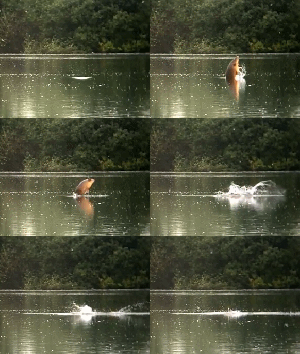
If they’re swimming quickly upstream, they won’t feed. If they’re circling quickly, ditto. If they are jumping out of the water, forgetaboutit. What you want are fish close to the bottom (you’ll be able to see them) that are actively feeding. Throw your Glo-Bug (chartreuse is good) upstream about six feet. The fish are also super-spooky. If the egg passes above their heads, add a bit of weight. You have to basically float it past a two-to-three foot feeding cone. Then — bam — listen to your reel whine!
Kathleen Dean Moore (courtesy photo Nye Beach Writers' Series)
The now-defunct Discover Magazine published this snippet in a 2003 article on returning salmon. Both Moore and her husband, Jonathan, shared the byline.
“Looking out over the gravel beach, the blue inlet, the whitewashed rocky islands, the floating loons and soaring gulls, I am beginning to understand that the stream the scientists are studying is not just a little creek. It’s a river of energy that moves across regions in great geographic cycles.
“Here, life and death are only different points on a continuum. The stream flows in a circle through time and space, turning death into life across coastal ecosystems, as it has for more than a million years. But such streams no longer flow in the places where most of us live.”
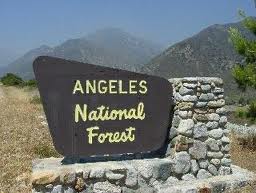
Could this sign soon include “national recreation area”? (Courtesy Forest Camping)
UPDATE: President Obama created the newest national monument on Oct. 10, 2014, by setting aside 346,000 acres in the San Gabriel Mountains.
Los Angeles’s natural resources have been on fire lately, with a burn that isn’t whipped up from a blistering fall Santa Ana. In June, the Urban Waters Federal Partnership chose the L.A. River as one of seven polluted city waterways to clean up, then the U.S. Army Corps of Engineers allowed a pilot kayak and canoe program on the river in August. And now the National Park Service is determining whether our own San Gabes might be suitable for a national recreation area.
According to its website, “The National Park Service (NPS) prepared the Draft San Gabriel Mountains and Watershed Special Resource Study to determine whether all or part of the study area is significant, suitable, and feasible for designation as a unit of the national park system. Congress authorized this study in 2003.
“The study area covers approximately 700,000 acres of land in the greater Los Angeles metropolitan region, including urban communities, local and regional parks and open space, and 415,000 acres of the Angeles National Forest.”
While stopping short of recommending national park protection, the NPS suggests four alternatives:
— expand the current Angeles National Forest to include the area
— turn the vast watershed into a national recreation area
— partner with other agencies to create something else
— or don’t budge.
In our era of downsized America, don’t think the last option might not appeal. After all, California is in the midst of closing 70 state parks to save money, and the national park system remains woefully underfunded. The department’s annual budget is $2.9 billion and includes some 28,000 full-time employees and over 2 million volunteers. President George Bush campaigned on a promise to wipe out an estimated $5 billion backlog in park maintenance projects, which had swelled to $9 billion by 2009, according to CNN, and was reduced by $1 billion through American Recovery and Reinvestment Act of 2009 funds.
Michael Kellett, director of the New National Parks Project, told the liberal website Remapping Debate that he would like to see more federal land be made into national parks and be brought under the umbrella of NPS protection, a change he thinks might actually save the tax payers money.
Lovin’ the East Fork of the San Gabriel River at sunset (Jim Burns)
“What is missing from the conversation of the costs of new parks,” he said, “is that we are already paying to manage these lands and that it would probably be cheaper to make them national parks,” because many places adjacent to parks or that could be potential parks are already federally owned. Many are national forests, which are owned by the public but are logged, mined, or otherwise used by private business for small fees. The government maintains the roads and infrastructure of these areas and charges businesses for a permit to used the lands.
In her story, KPCC reporter Kitty Felde tells us that at least two major dems are on board:
Democratic Sen. Barbara Boxer said she was “pleased the National Park Service is taking the next step toward preserving the unique natural resources of the San Gabriel Mountains and Puente Hills,” while Democratic Rep. Judy Chu said she was, “glad to see that the study has incorporated many of the comments voiced by the public, local stakeholders, and members of Congress.”
So … why don’t you get your opinion on the record? The public comment period kicks off at the El Monte Senior Center (odd place for a kick off …) Saturday, Oct. 29, and runs through mid-December.
Got Fish? You want to have caught plenty before filling out the survey. (Jim Burns)
Spurred on by an article in the current California Fly Fisher magazine, I spent most of Friday hiking and fishing on the East Fork of the San Gabriel River. Richard Alden Bean’s enticing article made me do it.
“The East Fork is a truly wild river in its upper sections and has recently been added to both the Wild Trout Program and the Heritage Trout Program of the California Department of Fish and Game,” he wrote.
This was good news, if for no other reason than I’ve got a golden trout and squat else toward my plaque. As the DFG website says, “By catching six different forms of California native trout from their historic drainages and photographing these fish you can receive a colorful, personalized certificate featuring the art of renowned fish illustrator Joseph Tomelleri.” Your specific prey, according to Bean, is the coastal rainbow trout.
But …
First off, I loathe Friday, Saturday and Sunday fishing in the San Gabes, because what you end up with is people, people and more people. You’ve got your hikers, your waders, your drinkers; you’ve got your families with young children and water-wading dogs trying to help a fisherman by pointing at the one fish in the pool before pawing at the splash. I mean I’m very happy all sorts of different folks use the water on the weekends … just not so happy to be confined to using it with them, due to that little thing called making money (Remember the adage, “You’ve either got time, or money.”).
Long story short, I got Friday-skunked on the East Fork, and it’s never a fun feeling. As I tramped out near dusk, I vowed to come back soonest, but I wonder if readers of this blog wouldn’t share some inspiration in the meantime.
Which is your favorite fork?
Don't you just hate getting skunked? (Jim Burns)
Do you prefer the West with its accessible bike path and easy downhill ride back to the parking lot? Its fishable access ramps?
Or, do you like the East Fork, known for its pack-station appeal, and winding path to the fabled “Bridge to Nowhere”?
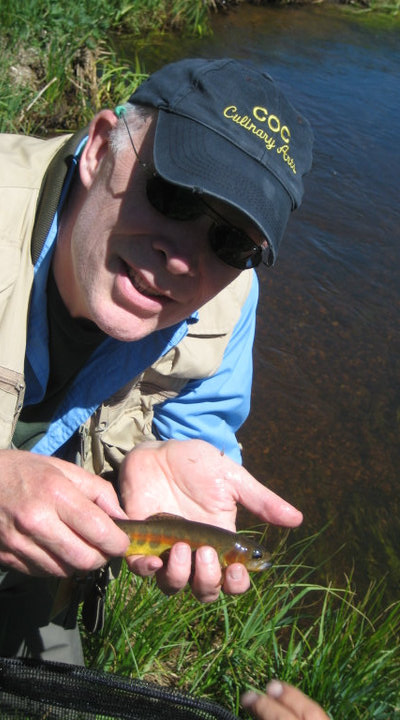
Golden Trout: The state fish is small, but beautiful (Courtesy Guy Jeans).
Last summer, a friend and I caught dozens, and dozens, and dozens of Golden Trout, all in one glorious day. Some days on the water produce memories akin to what used to be called a “Polaroid moment,” living for a long while in one’s memory. That was one of those days, when the weather is perfect, the company, just right, and the fishing, downright fantastic.
So it was with keen interest I read Louis Sahagun’s recent piece in the Los Angeles Times about ranchers rights within the Golden Trout Wilderness and the fate of our state fish. The GTW is a massive 300,000-acre area that sits on the Kern Plateau and is accessible from at least three directions. On its eastern edge from Lone Pine, off Hwy. 395; from the south, accessible from the Sequoia National Park around Mineral King, itself a 30-plus mile adventure on a one-lane, dead-end road; or going north from Kernville.
Remarkably, three of the trout native to the state’s waters are within the area. Besides the California Golden (technically known as the Golden Trout Creek golden trout), there’s also the Little Kern Golden Trout and Kern River Rainbow.
“Common names abound for the golden trout of the Kern River drainage,” writes Robert J. Behnke in his authoritative “Trout and Salmon of North America.” “This can be confusing because they tend to either pinpoint a fish to a particular stream, such as ‘Volcano Creek golden trout,’ or encompass a diversity of forms under one name, such as ‘California golden trout.’ The dozen or so common names for what are really two subspecies (aguabonita and whitei) of rainbow trout reflects the passion that so many have for this pair of jewel-like fish.”
The goldens my friend and I were stalking end up on many a fly-fisher’s bucket list for good reason: their jewel-like beauty. And, although they were once transported to Cottonwood Lakes, then to Arizona and beyond, the only place they naturally occur is right here, where they evolved in isolation from other trout
Size does matter, of course, but a 10-inch fish here is a monster, with the average running around 5-to-7 inches. They are a feast for the eye, with two red stripes, one on the belly, the other along the lateral line, running to the mouth and under the gill. Also, look for large black spots – up to 10 – that run laterally as well. Put these together with a predominately yellow-gold color and there’s little reason for their cousins to enter the beauty contest.
This general description will also come in handy when trying to decided if you’ve landed a pure golden or a hybrid, created through breeding with hatchery rainbows. Remember, these very distinct markings mean you’ve got a golden in your net.
David Lentz, who is California Department of Fish and Game’s native trout conservation coordinator, said that the small size is because of 140 years of habitat degradation. “Continued livestock use results in shallower, wider, warmer water,” he said. Waters in their natural state would be both narrower and deeper, which, in turn, would mean fewer goldens that were bigger. The largest section of interconnected meadows for grazing lies in the South Fork of the Kern area. Sections are now being rested for eight-to-nine years at a time to regain this natural habitat. Some environmentalists have argued that the best way to prevent lifestock from grazing in the upper South Fork watershed is to get goldens listed on the Endangered Species Act, according to Behnke.
Meanwhile, you can volunteer for hands on projects to restore this fragile habitat through the Golden Trout Project.
I was in a mope when I hiked down the canyon trail for some Friday afternoon fishing. No doubt about it, a mope, plain and simple. As I descended, feet feeling enervated, annoyed by the insistent biting flies, I forced a smile at those returning from the water, all bathing suits and youthful laughter, all optimism and camaraderie. Some would say “hi,” others would look up at me shyly, maybe not knowing if they should speak first. But I would have none of it. I felt old and alone. Like I said, a mope, or as Winston Churchill famously called his depressed moods, “the black dog.”
Local high school students Tommy, left, and Charles fly fish for the first time (Jim Burns).
Where was my best fishing buddy? I asked the trees, bitterly (he moved north and we’ve since stopped talking)
Where was my best fishing dog? (died of cancer this summer)
Where was the general fun in life at all, the life I’ve always so enjoyed?
With these dark thoughts swirling like threatening ravens among the trees, I barely heard the footsteps behind me.
“Oh great, some more happy people,” I muttered, not looking around.
And so separated by perhaps two dozen yards, the three of us walked down the rock-strewn trail, me in the lead, the other two out of sight, but thudding along behind.
We were all going to the same place, which irritated me all the more. After all, if you can’t be nice to the ones leaving your refuge, how could you possibly be chatty with those who are invading it?
And — inevitably –when we all stopped together under the shade canopy of a dozen thick trees, the blazing summer light turning to smokey lounge, one of them asked the question.
“Hey, are you fishing down here?”
The teen couldn’t have been more than 16, a big, overgrown kid, like a pup tripping over his own paws.
About to answer, trying to at least be civil, suddenly his friend came along, holding an ocean pole, looming over the trail, about to be hung up on every tree, bush and snagging obstacle. He looked at me, embarrassed, spying all the junk on my vest — the thermometer, the nail nippers, the golden hemostat — and my four-piece fly rod that I’d yet to attach.
“Kinda big for down here,” he mumbled. “We were just looking for something to do.”
My tight lips relaxed. I thought how silly it is to be a middle-aged man, thinking middle-aged thoughts, when life flows each day with such unstoppable exuberance. Still reluctant, I couldn’t help but half-smile.
As we walked on, past an ornery barking dog protecting his master’s property by the side of the creek, I really wondered if I would share the spots I’ve found over these past several months. After all, it’s called “hot spotting” for a reason: your fantastic fishing hole from last month is now dead as a bat because some yahoo has fished it out.
Watching them navigate the path, I suspected these high schoolers would most probably do exactly that. But the sight of that out-of-place pole, and their faces, which it would be a cliché to call “shiny,” spoke otherwise.
And as we walked and chatted, a wonderful thing happened: I came back to myself.
Check out the red cheek on this trout from the San Gabes. (Jim Burns)
Soon, I’d tied a double surgeon’s knot to secure a length of super-skinny tippet to their tuna-tugging line. And I’d gifted them with a tiny bead-head nymph, the kind I knew the trout here loved to chase.
By afternoon’s end, Tommy, the bigger of the two, was learning how to cast a fly line. From the way he finessed my fly rod, I could easily squint my eyes and see an excellent fisherman down the road. And the smiling Charles caught a trout, only to release it back into the water on his own, no coaching from yours truly.
“It’s great down here,” Charles said, ” but people trash it.”
“Yes, they do,” I replied, as Tommy put some of it in my vest.
I left before them, but walking back up the trail, I thought maybe I should have stayed to guide them up. After all it does split confusingly at places, and Tommy had related the story about how their first outing here ended with getting lost and rangers having to come in after the gates closed.
Gut check … go back? I’d left to get some quiet time for myself, but also to give them time to be together without an adult around.
After puffing up the side of the canyon for 30 minutes, I sat in my car, wondering. After a time, I thought maybe I’d take a quick run back down … hadn’t they said they had to be back by twilight?
Then Charles popped into view, carrying that big tuna pole. Anxiety relieved. We both smiled and waved, and I wondered if Tommy would indeed talk his dad into doing some fly pole shopping before they headed out to Waterman the next day.
This life we have. This precious life we share with others.
Cut and paste: A pair of painted scissors show exactly where to cut the concrete. (Courtesy PeakWater.org)UPDATE
UPDATE: “Damnation” is a documentary well worth watching.
What a week for dam-busters. First, news of the bulldozers marking out space to begin the destruction of Elwha Dam in Washington, and now, closer to home, graffiti artists have painted a large pair of scissors and a dotted line on Matilija Dam, near Ojai, Calif.
Take a look at the reporting from the Los Angeles Times, then look for yourself at the amount of work dedicated to razing this old timer. It seems all sides are in agreement that it’s time to pull out the dynamite, but a lack of federal dollars stands in the way.
UPDATE: “Damnation” is a documentary well worth watching.
Don’t we all love to get good news? I relish, for example, when a friend rings me up with something cheery to say, or, I check my bank account to find I’ve got a couple of hundred bucks stashed that I thought I’d spent, but didn’t.
California Fish & Game biologist Doug Killam holds an 88-pound Pacific chinook salmon. It’s hoped the removal of the Elwha Dam in Washington state could result in even bigger fish. (Courtesy California Department of Fish and Game)
As far as the environment goes, I’m always on the lookout for positive stories. Most news is depressing, scary, messy. So today’s piece in the L.A. Times outlining the largest dam removal in our history made me smile. According to the article by Kim Murphy, after almost 100 years, salmon will now be free to swim up 70 miles of their traditional home waters, the Elwha River, instead of being stopped at the dam.
“Now,” of course, is relative, in that the project involves removing not one, but two, dams along the river that runs through Olympic National Park. Then there’s the matter of dealing with the removal of 24 million cubic yards of sediment. Apparently, the number is akin to a football field as high as the Empire State Building times 11.
Sound familiar? Closer to home, we’ve been watching the sediment removal debate revolve around Pasadena’s Devil’s Gate Dam, which is close to the Jet Propulsion Laboratory. I’ve written in this space before about the suspect nature of Brown Mountain Dam, farther up the Arroyo Seco and its impact on returning steelhead to this mountainous region.
To quote the Times article about the Elwha River: “The effort is the largest dam removal project ever undertaken in the United States. It comes at a time when the nation’s 80,000 dames, many of them aging and backed up with choking silt, are increasingly suspected of having outlived their usefulness.”
The best news would be to get moving on bringing down Brown Mountain Dam. The Los Angeles River and its tributaries deserve to be returned to their natural state.
How to protect wild spaces in urban places is mandate of Urbanwild Network. (Courtesy Urbanwild Network)
How do we protect and preserve some of the last remaining urban wilderness areas in Southern California? That’s the objective of the recently formed Urbanwild Network, which has its roots in the unnecessary destruction of a pristine oak woodland in Arcadia.
Two representatives of this new organization, Christle Balvin and Mary Barrie, will make a presentation on the lost Arcadia woodland and show other rural sites that are threatened by L.A. County’s need for additional sediment dumps.
All are welcome. Beverages, plates and utensils will be provided. Bring a dish serving 6-8 people.
Gather Saturday, Sept. 10, at 5:30 pm; dinner at 6 p.m.; program at 7 p.m., at Eaton Canyon Nature Center, 1750 North Altadena Drive in Pasadena.
Directions: From the 210 Fwy in Pasadena, take Altadena Drive north 1.5 miles to theintersection with New York Drive. About 500 feet after the intersection, turn right at the sign intothe park.











 lariverflyfishing
