Deep Creek can’t conquer the summer winds

HANDY MAP: The National Forest Service helps you to get oriented once you finally find Deep Creek. (Jim Burns)

UPDATE: Take Deep Creek off your fishing radar until the drought ends. You’ll find little water and few fish. Also, because this is a protected area, if the native fish die out, that will also be the end of this once beautiful water because it won’t be stocked. Don’t add to their stress by catching them.

Weather and fate are tied together.

Two winters ago, So. Cal. was literally awash in water, and so was Deep Creek, high in the mountains above San Bernardino. Those 18-plus inches helped to carry this once-cherry spot back to the near-top of many an anglers’ list. My last visit was May, 2011, which I chronicled here.

So wondering what our sub par rainfall for the year just ended (6.97 inches, June 30) did to the place, yesterday I jammed the hour and a half from my house to Lake Arrowhead, thinking that “lucky Monday” would apply, even in summer. Any fly fisher can tell you that Mondays are the best time to avoid all those other folks, some with waders on, lots without, who want to hike, swim, bike, laze, and generally cavort on our public lands. But sometimes that Monday luck runs out.

Sure enough,  on a hot, windy gust the “whhhhiiiiinnnneeee” sound of a dirt bike engine greeted me, as I managed to find a parking spot among the dozen cars and one RV at the end of the road. It was just shy of noon as I rolled down the windows, ate a home-packed lunch, then — because I’m an optimist — inaugurated my new waders, even though the mercury was fast approaching 90 degrees F.

Thusly cocooned, I trudged past a nice grandfather and family, boots feeling way too big and clumsy for the heat. From his lawn chair in the shade, he looked me up and down, saying, “You think there’s enough water to catch a trout?”  He quickly realized I was on my way in and didn’t have a clue.  I grimaced, hoping he hadn’t just inadvertently given me one.

After spending about four hours systematically working my way around the semi-circle of water that surround the Splinters Cabin, down to the beginning of the canyon, all I can say is, unfortunately,  Deep Creek’s done for the season. The water is fishable, true, but the fish are few, small and not ready to believe your newly tied midge is anything but a bunch of wire and fixings. Also, true, that on the last hole I lost a nice fish because I forgot that a log has two sides, and I was on the wrong one. Equally true, I fished a 7-weight leader for the little guys, which he easily broke with the log’s help.

For the rest of this long, hot summer, if you are more of an optimist than I, a party of three young guys who I think had just escaped from a scene in “Sucker Punch” told me that they’d spotted large fish much deeper in the canyon. I was done after losing the only good fish of the day, and didn’t follow their advice. Instead,  I stripped off the waders and had a great time splashing my bathing-suit way back to the car, almost as free as a child until “whhhhiiiiinnnneeee” again reached my ears on hot, gusts,  while I panted my way over the last hill.

From dirt, to pock-marked asphalt, to the mountain-lip-hugging Highway 18, I couldn’t shake that eerie sound memory of straining machine, amplified by the wind. Then, suddenly, my fear realized, I saw plumes of smoke rising hundreds of feet from the distant San Bernardino valley. Scattered orange cones closed the 18. I stopped in front of a CHPS officer who told me how to thread my way onto the 138, to connect with the 15, then home. Tiny Arrowhead-adjacent Crestline was under a voluntary evacuation. Officials would later dub the brush fire, “the Panorama Fire,” which has burned 75 acres as I write and is still burning.

As Henry Wadsworth Longfellow reminded us long ago, “through woods and mountain passes, the winds, like anthems, roll.”

See you on the river, Jim Burns

Bummed out at the Thienes Avenue Gateway

What’s wrong with this view? No fish on the line. (Jim Burns)

Hoping to find a new fly-fishing spot for readers of this space, as well as for moi, I ventured into unknown territory today — the San Gabriel River. Not the East Fork, nor the West Fork, but the actual river in El Monte, off Peck Road.

Locals told me about Thienes (pronounced “THE-na” by the peeps), that guys were hooking up there. So, anxious to do the same, I ventured over today, and got my hopes way up, because it’s such a beautiful spot right off the Emerald Necklace bike path that connects the Rio Hondo and San Gabriel cycling lanes within the San Gabriel Valley. I mean, this could be urban fishing at its finest: safe place to park your cark; painted totems to greet you; an ornate gate; a spot that looks a bit like a bus shelter for respite from the sun; a smoothly paved bike lane; and then the pristine river.

You can cast into the water as far as you can muster it, from one long walkway that separates two sections of the river. Believe me, if you’re practicing your cast, I’d much rather do it here than any casting pond I’ve been to. Also, people were really friendly.

Only one problem: I got skunked, using a 5 weight overstrung with a 6-weight line, Globugs and a red San Juan worm. Did I wish I’d brought a Woolly Bugger? Oh, yeah. I could see hundreds and hundreds of fry swimming around, and there appeared to be excellent habitat for game fish — reeds, water shaded by trees, even a waterfall. But — zippo, at least for today.

Thienes Park features a beautifully crafted entrance gate. (Jim Burns

So, for those of you who already know this spot, please share the wealth. Next time, I’d like to have a fish on.

See you on the water, Jim Burns

A&F Conservancy christens Rosemont Preserve in La Crescenta

OPEN SPACES: The area at the end of Rosemont Avenue in La Crescenta is a mix of private property, flood control access and now eight acres purchased by the Arroyos & Foothills Conservancy. (Jim Burns)

Saturday was a good day in La Crescenta, Calif., at least for those who care about open space in our congested Los Angeles basin.

The Arroyos & Foothills Conservancy officially opened its latest acquisition, the 7.75-acre Rosemont Preserve. The land is situated behind a gate  at the mouth of Goss Canyon, which is then backed by an additional 300 acres  maintained, according to conservancy press materials, as mostly wilderness over the decades by private landowners. The gate will remain locked to control access to the property.

Scheduled to appear during the fete was  L.A. County Supervisor Michael Antonovich, who spearheaded $350,000 in grant money to acquire the now-protected acreage. Donors made up the additional $100,000, which included  contributions of $250 from assembly members Mike Gatto (D-43rd district) and $500 from Anthony Portatino (D-44th district).  According to Gatto’s office, he also helped to raise $10,000 toward the purchase. The sale price of $450,000 was under market value. The real estate site Zillow estimates one home situated on over two acres at the top of Rosemont Avenue at about $883,000.

Preserving the land secures habitat for a range of wildlife, including mule deer, mountain lions, bobcats, bears, coyotes and Arroyo toads, as well as at least 31 bird species, according to the conservancy.

Although it is a win for the area’s wildlife and for groups, most likely school children and volunteers who can access the property through the conservancy, the location remains problematic, at least for neighbors who fear for their serenity because of the newly acquired access. Indeed,while early guests arrived, one resident whose home is next to the gate asked for reassurance from John Howell, executive director and general counsel.

‘X’ MARKS THE SPOT: Local heavies, volunteers and donors were on hand to inaugurate the Rosemont Preserve in La Crescenta Saturday. (Jim Burns)

“They are understandably concerned. It’s been shut off forever. They are concerned about just opening the gates, having it be an open space. It’s not, it will be controlled access,” he said during an interview earlier in the week. “But probably more telling, more significant than that in terms of having it be controlled access is that there’s a neighbor to the north who owns 212 acres.

“So the worst thing that could happen, you know, is announce it, here it is, then a week later she’s got people on her property. She’s got webcams. The first words out of her mouth when I first met her were, ‘I just want you to guarantee that nobody’s going to come on my property. Period.’ So, we’re going to try to turn that negative into a positive.”

Apparently, neighbors had a hand in nixing another plan for the property, to turn it into a school in 2005. The owners of La Canada Preparatory then eventually sold to A&FC during negotiations that first began in 2007.

The next steps for the conservancy, the neighbors and property owners in the area will be about public access.

” It’s a two-step thing: save it and acquire it, and then what do you do with it then?” Howell said.  ” Steward it, husband it and have it be a resource to the community. So we’re going kick off something called the Rosemont Society, which will be (composed of) folks who want to participate on a volunteer basis to help us manage the property.”

BYOB (that’s bag) to begin in Pasadena, July 1

FILL ‘ER UP: By the end of the last Friends of the River Clean Up Day, this baby was a whole lot fuller. (Jim Burns)

Beginning of rant:

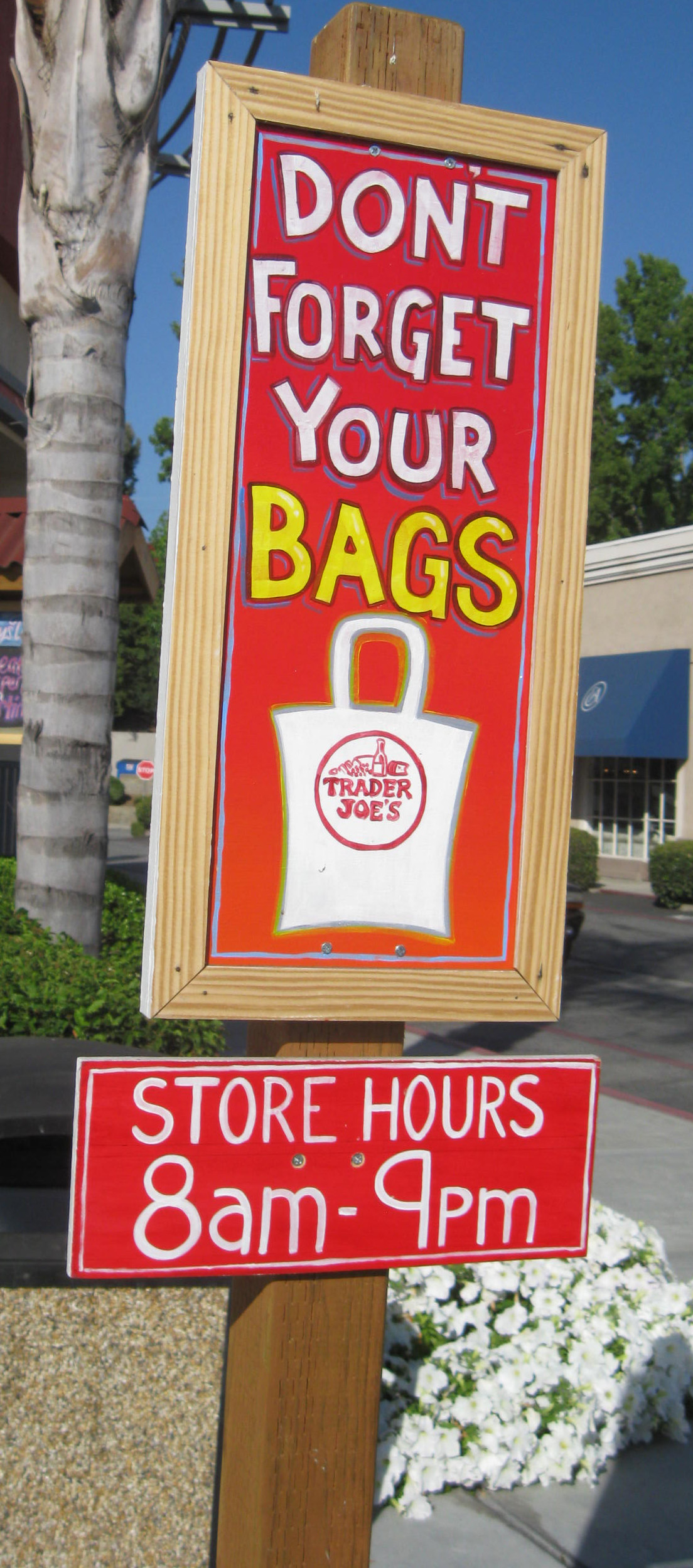
If I didn’t fish, I probably wouldn’t care about plastic bags or banning them. But, hey, I do fish, and enjoy plying our urban waters as often as I can. And that’s why I support the Pasadena single-use plastic bag ban that goes into effect July 1. Here’s some background on the decision.

You can say all you want about the evils of the nanny state, but here’s a personal review of how well our waters have fared  without our Uncle Nanny:

— item, 1998, West Fork weekend overrun overwhelms me. How much trash can anyone actually leave in a river? Take a look at these recent, enlightening photos from West Fork San Gabriel Conservancy.

— item, 2007, used throwaway diaper floats by, blind-pooping me in the leg, on Bouquet Creek. Admit to gag response.

— item, 2010, Hanging out on the L.A. River with new-found, grade-school kids who want to learn to fish. No child should have to play near trees fouled by dozens, and dozens and dozens of filthy plastic bags. Drove home truly pissed off.

So, if you’re an urbanite who is equally pissed off about the bag ban, I suggest you go down to the L.A. River, or to any of our beaches, or to the mountains and pick up some of the junk that’s been left behind. For some reason, cleaning up after others when you’re supposed to be enjoying yourself brings it home.

And if you’re a libertarian fly fisher, come up with a better solution than the ban. Not theory, somehow based on the Constitution, but something that might actually decrease the junk floating around the Southland.

Meanwhile, I’ve been hoping that either the city or local business will give bags away for a day, as the Department of Public Works folks did in La Canada last year. No word as of this writing. Once you’ve got your own bags,  just keep them in your car. It took me about three months to get tired of walking into the store sans bag. That’s what my wife calls  “training” … She’s right!

Now, about those plastic bottles …

End of rant.

See you on the river, Jim Burns

Quick Mends: San Gabriel wild trout get into the summertime swim

This slideshow requires JavaScript.

Visit North Atwater Creek Pocket Park (if you can find it …)

Bird’s eye view: Inside a storm drain, safe for kids, one of the many improvements made at the North Atwater Creek Pocket Park. (Jim Burns)

When I first began exploring the L.A. River, problem No. 1 was finding it. My son and I encountered lots of barbed wire fences, dead-end big box parking lots, and industrial parks, all situated basically on the river, and all with no access granted. That was two years ago, and even though I now have my favs that get us to the carp, the river is basically an insider’s secret.

So, too, are the pocket parks scattered around its concrete banks. The first time I heard about the Yoga Pocket Park in Atwater Village, I thought someone was pulling my downward dog-facing legs … not so. The originators of this tiny green space — I believe the lead was Northwest Trees, but can’t swear to it — were afraid that a more traditional exercise park, based on stations for strenuous physical exercise, would bring gangs.

Today, walking north from the golf course in Atwater Village, through Steelhead Park (another hard-to-find spot, but from the golf course parking lot, head toward the freeway and you’ll see it), you’ll see North Atwater Creek Pocket Park after about 10 minutes of hoofing. Check out the waters here as well …

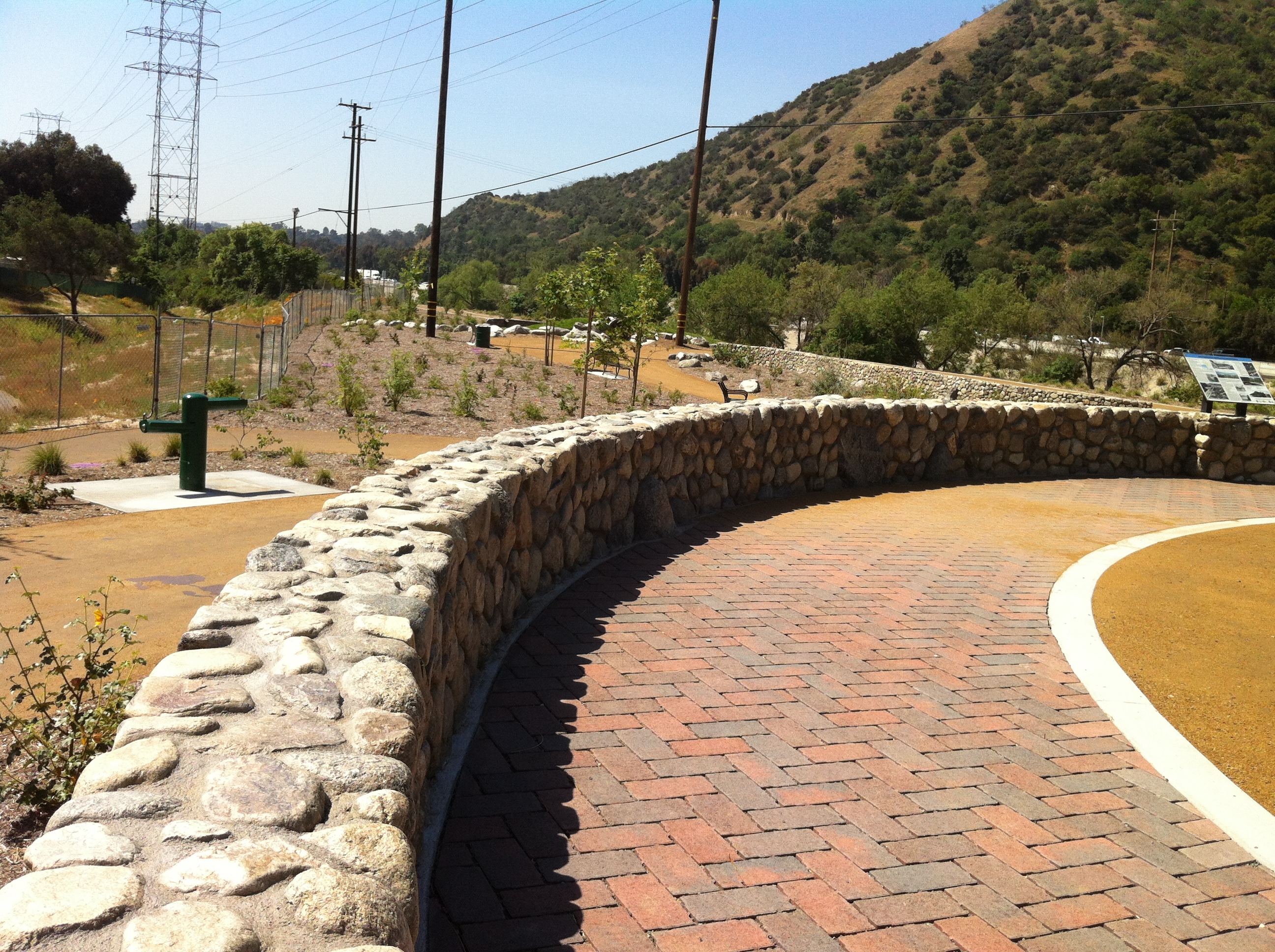
Open for about eight weeks, the park shows what the river will eventually become: neighborhoods connected instead of rejected; green grass instead of broken asphalt; good vibes instead of creepy. Take a look at the pics below to get a feeling for the place. And, fishermen, there’s a working water fountain, in case you’re thirsty.

This beautiful natural wall and brick work pull your eye toward Griffith Park. (Jim Burns)

Was it worth the $4 million that came primarily, according to city info, from the settlement of two Clean Water Act enforcement actions? Yes, yes, it was. Bring your rod and check it out. And if you have kids, bring them as well.

See you on the river, Jim Burns

How to clean your fly rod cork


Quick mends: Los Angeles bans plastic bags

Soon plastic bags will be verboten in Los Angeles, which joins unincorporated areas in L.A. in the ban. (Barbara Burns)

Well, folks, today Los Angeles became the largest city in the country to approve a ban on plastic bags at supermarkets. Read the whole story here. Now comes a four-month environmental review, followed by the actual ordinance. Large supermarkets will then have six months and smaller markets four to phase the bags out, according to the Los Angeles Times.

The paper quoted Councilman Ed Reyes, who has focused on efforts to revitalize the Los Angeles River:

“Let’s get the message to Sacramento that it’s time to go statewide,”

See you on the river, Jim Burns
Name this butterfly …

Please, name that butterfly! (Jim Burns)

Springtime has definitely hit the San Gabriel Mountains. Monday (the best time to fly fish to avoid the weekend rush) walking down to and around my favorite canyon, there were critters aplenty. A 4-foot-long Striped Racer slithered just in front of my booted feet, giving me a good scare; what I think was an Eastern Fox squirrel jumped onto a thick tree trunk to inspect me (He found me lacking …); and I spotted a pair of what I believe were Yellow Warblers, mistaking their coloring and size for distant Monarch butterflies appearing and disappearing in the forest canopy.

A fellow hiker cautioned me in the tree shadows: “Look,” she said, “can you believe it?” And there on the ground were a half-dozen or more of this butterfly. But, the question is, what’s it’s name? My handy Pocket Naturalist Guide (which you can get at the Audubon Center at Debs Park) lists the distinctive orange Monarch, the Painted Lady, The Cloudless Sulphur and three others, but none has those amazing horns. If you know what it is, please post the answer.

Meanwhile, for fishing our streams, stick with dries only, and tie on some stealthy 7x tippet to your light leader. Any lighter-weight rod will do, but if you’ve got a 2, 3, or 4 in your arsenal, take it. Also 9 foot is a bit much for our water, with its tight canyons and brush. Eight foot, six inches or shorter is a better choice.

Rainbows and browns were going nuts on just about everything I threw in. Keep the sizes small, 16 or better, but I’ll tell you it’s

This brown got fooled by a lot of elk hair caddis on a size 14 hook. (Jim Burns)

amazing to see a small fish latch on to a fly half its size when you toss a 10 or bigger! Ants are everywhere, so casting a parachute ant should bring good results. Unfortunately, the annoying small black flies have made a comeback, and I spotted a hatch of something tiny and gray-mosquito-colored coming off the water as well, so dark colors are a good bet.  Also, pale or light green are perennial favorite colors. And you won’t catch just minnows. There are plenty of bigger fish in our mountains. Please ALWAYS release the fish you catch in areas that won’t be stocked. These are naturals and once they’re gone, so will be our opportunity to enjoy this beautiful resource.

See you on the water, Jim Burns

Pack trash out … all the way out

ImageTramping through the San Gabriels today with my son was a wonder: we caught 16 trout, rainbows and browns, in a half-day’s work. I even foul-hooked a rainbow, which is certainly nothing to brag about, but was fun all the same.

But the point of this post is, please, don’t trash the wilderness. I walked through some brush, only to be snagged by old line that someone had left carelessly near a stream. Attached to it was an old-school wet fly, around a No. 4, so I guess I’m a fly richer, but that could have also tagged me in the eye. Not cool.

I also found a discarded spinning reel (!), more line at another part of the stream, and a Sports Chalet receipt that didn’t looked great against the wildflowers. I mean, come on, if we want to keep our resouces safe and sacred, we can’t treat them like a public toilet.

Remember: pack it in, pack it out.

And, if you are fishing in areas that don’t get stocked, please release your catch. One hole I’ve fished for many seasons with success contained only two small trout. I doubt that my other friends fell prey to cranes or other feathered pros. If you take out the fish, they are gone, Period. Once the fish are gone, what’s the point of our sport?

Sorry for the rant, but as you prepare to get out there for a fantastic season of fly fishing, let’s respect what we have. Please repost.

See you on the river, Jim Burns