Brrr, it’s cold out there, and even colder in the many fishable canyons of So. Cal’s San Gabriel mountains. Here’s how to have some fun:
1. Play hooky any Monday, Tuesday, Wednesday or Thursday. Skip Friday and forgettabout the weekend. There are always several thousand people who have the same idea at the same time. Crowds = lousy fishing.
2. Dress warmly in layers. Long underwear is a blessing this time of year.
3. Take it easy on the way down. Watch for gravel, sand and rocks that might give way. They will. Count on it.
4. Start with dries and move to nymphs. I know what you’re thinking: no hatch = no surface action. You might be surprised. Of the 10 fish I caught on my recent canyon adventure, two were on dries. Pick the usual suspects. Parachute Adams and his friends.
5. When you do reach into your fly box for a nymph, give that beadhead yellow sallie a try. I know it’s an underused Stone Fly, but the other eight fish I caught were all on this fly. Must be the legs.
6. Smaller is better. Even with all of our rain, flows are down. Size 14-16 or above, please.
7. Pack a lunch and extra water.
8. Bring a friend, someone who will make you laugh at some of those tiny trout you’re bound to hook.
9. Don’t wear hiking boots on slippery rocks. Just because the water’s cold, any rock in the water is still as slippery as it is in summer.
10. Turn your cellphone off. Keep your camera on. I know, you’re saying that there’s no service up there anyway. True, but it’s the principle.
11. Post your pics, so we can all see how good you look grippin’ ‘n’ grinnin’.
12. Keep an extra water and energy snack in the car.
Baker’s dozen: Get down. Get tired. Get silly. Get grateful. Repeat.
See you on the river, Jim Burns
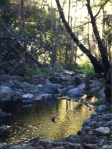
The canyons are full of quiet, beautiful, “fishy” spots. (Jim Burns)
This brown got fooled by a lot of elk hair caddis on a size 14 hook. (Jim Burns)
This little rainbow got snapped quickly and then went back in the frigid stream water. (Jim Burns)
After two years of work, Assemblyman Mike Gatto (D-Los Angeles) has found a new partner in the fight for green transportation and domestically produced alternative energy. Building on an idea of Gatto’s, the California Energy Commission (CEC) has announced that it will fund preliminary research on the potential of using California’s roadways to generate green electricity.
The research will focus on the large-scale energy-harvesting capabilities of piezoelectric materials, which are currently used in everything from lighters to smart phones. The research stems from a bill authored by Gatto, AB 306, which passed the legislature in 2011 with bipartisan support but was vetoed by Governor Brown because of a lack of funding for the project. In the veto message, the Governor encouraged Gatto to work through the CEC’s grant process to obtain funding for the project, and a year later, the assemblyman has successfully secured the funding.
“I am excited to see movement on this important research,” said Gatto. “California is the car capitol of the world. Just think how much energy we could create if we can harness some of the wasted energy produced by cars and trucks as they rumble down the roads.”
The science of piezoelectric roads works as follows: When a car or truck passes over pavement, the pavement vibrates. By placing relatively inexpensive piezoelectric sensors underneath a road, the vibrations can be converted into electricity to power roadside lights, call boxes, and neighboring communities. It may sound like something out of science fiction, but this technology has been used for years in sonar, and is used every day in touch-screen phones to convert pressure into electrical impulses. There is no extra energy needed for the car to transverse piezoelectric highways, because the sensors are located in the pavement itself.
Several countries have experimented with a road-based version of piezoelectric technology, including Israel, which has already placed this technology under some of their highways. In 2009, the East Japan Railway Company installed piezoelectric flooring in their Tokyo railway station. The energy generated by passing pedestrians is sufficient to power all the displays in the station. More recently, Italy has signed a contract to place the technology under a stretch of the Venice-to-Trieste Autostrada and a dance club in San Francisco has piloted the technology under their dance floor to run their lighting. Then-Mayor Gavin Newsom worked on piloting the technology in pedestrian walkways in downtown San Francisco.
“Now, California can join the ranks of nations who are actively seeking uses for this exciting new technology,” said Gatto. “Thirty years ago, very few people would have believed that black silicon panels left in the desert could generate ‘solar’ power. And just ten years ago, people were skeptical when you described a Bluetooth device. This technology is very real. I’m glad the state is taking steps to keep California on the cutting edge of energy policy and I’m very pleased the CEC has embraced the possibility.”
The Energy Commission should complete initial research on the technology by the end of January, 2013 and will determine, based on their findings, if a small-scale-test project will be conducted by the State.
Mayor Antonio Villaraigosa announces two major solar projects while at Occidental College. (Jim Burns)
Los Angeles Mayor Antonio Villaraigosa announced the creation of two large solar projects today while at Occidental College.
“Today, we’re signing the largest solar contract in the history of the DWP,” Villaraigosa said. “Our contract with the K Road-Moapa Solar Project will provide 250 megawatts of solar power. That’s enough energy to power over 113,000 homes.”
K Road will develop the solar arrays on the Moapa River Indian Reservation in southern Nevada.
The contract with the Copper Mountain Solar Project will send up to an additional 210 megawatts to Los Angeles, enough to power another 76,000 homes. These two projects join the city’s other major solar projects, the Adelanto Solar Project, Kern County and the Feed-in Tariff program, which provides a financial incentive to homeowners who install on-grid photovoltaic systems.
The mayor chose Occidental College because of its new $6.8 million, 1-megawatt solar array, a project whose innovative design takes a distinctively liberal arts approach to green power with its blending of technology and art, according to the college.
With the almost-completed hillside array as a backdrop, he told a group of around 50 that the city’s goal for renewable energy use is 33 percent by 2020. Los Angeles gets about 40 percent of its energy from coal.
“We’re the only public utility that I know of in the entire state that isn’t just talking about a goal, but we have a real plan to get there. The fact that we’re at 20 percent and will be at 25 (percent) by 2015 is indicative of the milestones necessary to get to 33 (percent).”
Sierra Club President Allison Chin lauded the contracts as well as Villaraigosa from the podium.
“The Moapa Solar Project will be a boost to the Paiutes and the Sierra Club’s ongoing efforts to replace coal with clean energy in southern Nevada. The Pauite families are suffering from high numbers of asthma attacks, heart conditions and even cancer that’s associated with coal pollution,” she said.
The Sierra Club and the Moapa Band of Paiutes, located near the Reid Gardner plant, have called for its closure, but in August the federal Environmental Protection Agency green-lighted NV Energy to continue operations, as long as it installs controls to reduce the air pollution.
Cellphones take on a whole different identity in a landfill! (Courtesy Treehugger)
John Voelker, aka Robert Traver, did a whole lot in his life, ranging from lawyering, to writing the best-selling novel, “Anatomy of a Murder” in the late 1950s. And he loved fly fishing.As you can see, he wrote in an age when the telephone was a stationary object. Once you’ve read his excellent testament, please take a moment to fill out the survey.
Do you leave your cellphone at home when you fish? (Then how do you shoot your “grip ‘n’ grin” hero shots?).
See you on the river, Jim Burns
Testament of a Fisherman
“I fish because I love to; because I love the environs that trout are found, which are invariably beautiful,
and hate the environs where crowds of people are found, which are invariably ugly; because of all the
television commercials, cocktail parties and assorted social posturing I thus escape; because, in a world
where most men spend their lives doing things they hate, my fishing is at once an endless source of
delight and an act of small rebellion; because trout do not lie or cheat and cannot be bought or bribed or
impressed by power, but respond only to quietude and humility and endless patience; because I suspect
that men are going along this way for the last time, and I for one don’t want to waste the trip; because
mercifully there are no telephones on fishing waters; because only in the woods can I find solitude without
loneliness; because bourbon out of an old tin cup tastes better out there; because maybe someday I will
catch a mermaid; and, finally, not because I regard fishing as being so terribly important but because I
suspect that so many other concerns of men are equally unimportant — and not nearly so much fun”
Author Myrtle Reed was known for her stinging bon mots.
Early Twentieth-Century author Myrtle Reed penned a number of best-selling romances during her time, now all but completely forgotten. “Old Rose and Silver,” from which I excerpted this Earth Quote, centers around how a group of characters interact in a small town. Thanks to a group of volunteers, you can read it for free on Kindle. Known for her witticisms and bon mots, the following description aptly portrays how many of us feel about the river right now:
“The river itself portrays humanity precisely, with its tortuous windings, its accumulation of driftwood, its unsuspected depths, and its crystalline shallows, singing in the Summer sun.
Barriers may be built across its path, but they bring only power, as the conquering of an obstacle is always sure to do.
Sometimes when the rocks and stone-clad hills loom large ahead, and eternity itself would be needed to carve a passage, there is an easy way around.
The discovery of it makes the river sing with gladness and turns the murmurous deeps to living water, bright with ripples and foam.”
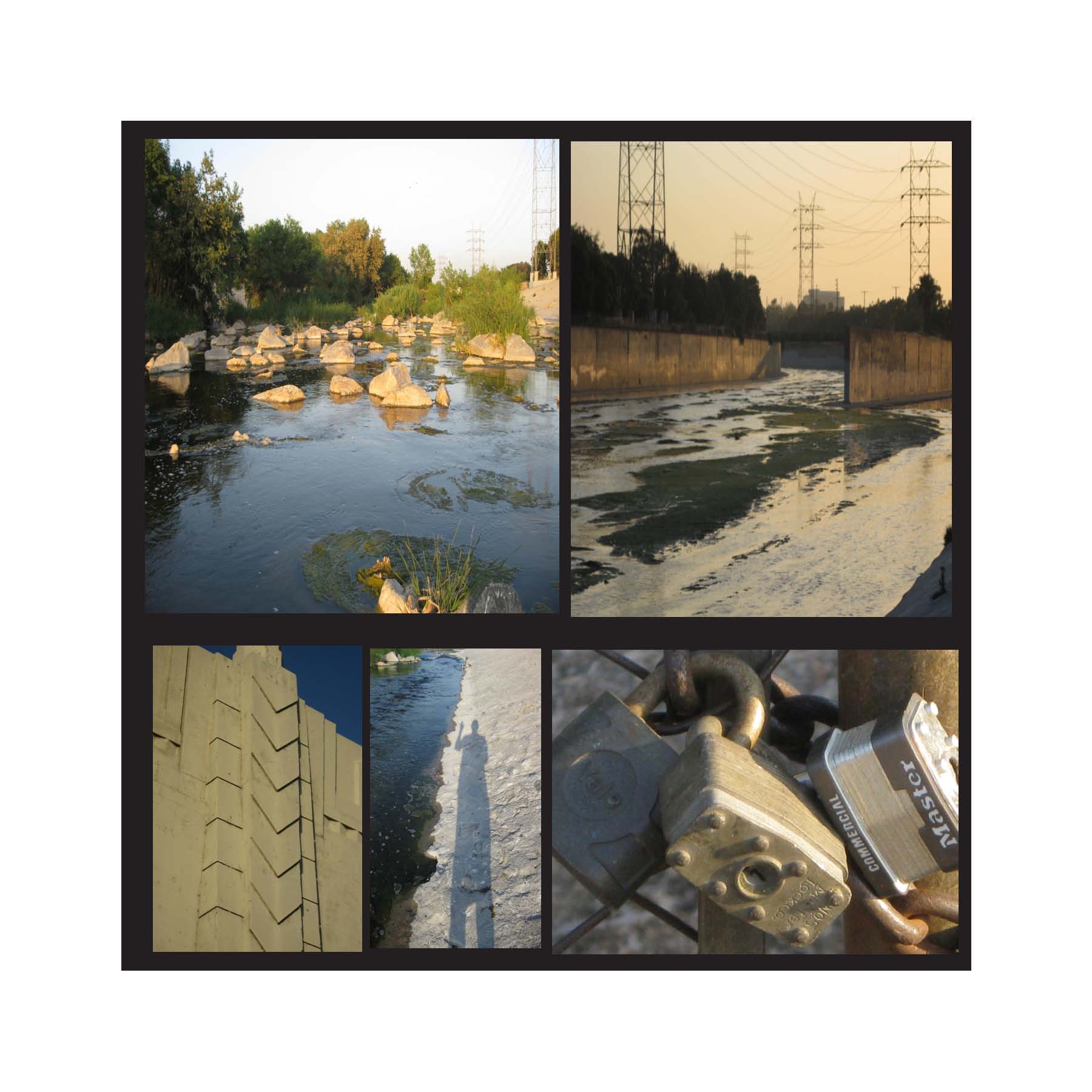
From top left, clockwise, the tranquility of carp-filled pools, at the beginning of Glendale Narrows. Once you get past the city locks, you can see self-shadows and nifty bridge architecture. (Jim Burns)
The Buddhists say that the curse of the human realm is change. And if you live long enough, you tend to agree with them.
Of course, even if you haven’t lived a long time, only a fool won’t recognize that change comes in two flavors: good and bad. Maybe some would quibble with me and argue change can be neutral, but those changes aren’t the ones any of us remember. A neutral change is akin to no change. Most of us see the world in Manichaean terms — a big word for good versus evil. Change is flavored by one side or the other.
Maybe that’s a tad too much philosophy for a Monday morning, perhaps a shadow of tomorrow’s election, but change felt palpable on the river this weekend, and I wondered which flavor it would eventually be.
I took advantage of the 80-degree weather to explore three favorite fishy spots, looking for carp. One thing that doesn’t change — I often get skunked by these elusive fish. Water in the Glendale Narrows section is two-to-three feet deep in most spots. Consequently, fish see you as quickly as you spot them. And, at least on the fly, sight fishing is the best way to land one, and it has certain risks.
My boots scraped down the river’s rip-rap skin, close to the giant bunkerlike concrete abutments that once held electric Red Line tracks, jutting out from the old Glendale Avenue bridge. There, the wide concrete swatch of the river’s artificial bottom is entirely concrete, and as I watched the water’s constant flow, I realized this vista I’d taken for granted was vulnerable to change.
By now, if you follow “riverly” events, you know that clothier Miss Me has breathed new life into the stalled keystone environmental feasibility study with a substantial gift. As Molly Peterson reported for KPCC: “The Army Corps of Engineers study, nicknamed ARBOR (Alternative with Restoration Benefits and Opportunities for Revitalization), was $970,000 short of the $9.7 million needed to proceed.”
And the clothing company has offered almost $1 million to close that funding gap. The Corps lead planner Kathleen Bergmann recently told me that the money has to pass through some approval hoops. “We are moving forward on last year’s funds. While funds have been offered, we must receive permission to receive those funds, and sign an agreement. Congress has set up a very precise method for doing this, and must be notified as well. We are in the process of taking those steps to get approval to receive the funds.”
So green is green, and it’s great to know that the money is finally available, even given the ridiculous amount of time it’s taken to fully fund the study during the Great Recession.
“Remember that the fundamental purpose of the Study is to improve the ecosystem values in the LA River– and that means riparian habitat that is good for wildlife, including fish species,” said Carol Armstrong, director of the Los Angeles River Project office. “The Study will go public with its alternatives early next year. Once finished, it will recommend one of those as its recommended project, which will then go to Washington, DC, for approval by the federal powers-that-be. So, those alternatives are under development now. Basically we’re moving from Study to Project now that the Study is fully funded.”
I believe it’s a given that at least sections of concrete are on their way out. Since I began this post on a mystical note, look at the signs.
— The Paddle the River program, although only around for eight weeks a year, is in its second year, with a five-year contract. Now apparently, program leaders have aspirations to paddle the seven miles of Glendale Narrows as well.
— Gov. Jerry Brown signed SB1201 into law this year, which broadens the L.A. County Dept. of Public Works 100-year-old mission of flood control and storm water management to include education and recreation. Friends of the L.A. River and UCLA’s Environmental Law Clinic spearheaded the effort that was then introduced by State Senator Kevin de Leon.
— I haven’t heard of any tickets being issued to those plying the river’s bottom during the last few years.
— Also, I haven’t heard of LAPD harassment of activists since Jenny Price’s river tour was disrupted over a turf war some three years ago.
Add to all that Arroyo Seco Foundation Exec Tim Brick’s recent grant acquisition of over $3 million to improve the Hahamongna watershed above JPL in Pasadena. As he wrote me in an email, “A key goal of this project is to improve conditions for the trout and other fish in the Arroyo stream. The water intake facilities were not designed to protect the fish, but we want to change that by redesigning the facilities and improving the habitat there. This brief video shows the facilities and the area to be improved: Water Facilities in Hahamongna Canyon.”
It’s time for optimism, to see the change as very good. In other words, this puppy is going to happen, because after decades of inertia, the political will has arrived to bring in the bucks.
But am I the only one who gets a little nervous with big money?
As I trudged along in the autumn heat, marveling at this wonderful liquid behemoth, I wondered what the change would actually look like, and I felt that nagging bite of Manichaeism again. I want to be able to fly fish, enjoy the din of the I-5, ponder the eastern vistas of Griffith Park. I don’t want to buy souvenir T-shirts a la San Antonio’s River Walk stalls, although enjoying a crafted beer by water’s edge wouldn’t be all bad.
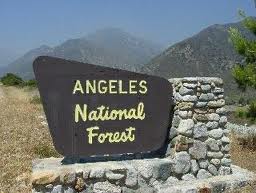
Could this sign soon include “national recreation area”? (Courtesy Forest Camping)
The only time I’ve been up to the East Fork of the San Gabriel River, I got the last parking spot, passed by a pretty rough crew, and — most importantly — got skunked. The last part is why I haven’t been back.
In today’s Los Angeles Times, Louis Sahagun pens a remarkably scary portrait of a river that’s facing real problems, both from budget cuts that make law enforcement difficult and from the interests of competing groups.
What I found telling is that of the players Sahagun interviewed, not one was a fly fisherman. Believe me, we’re out there in the Sab Gabes, but I think word is out that the East Fork needs some serious work before it once again becomes a local fishing destination.
Salon columnist Will Doig gets it right in his recent piece about urban waterways. If you want to find out what’s happening in cities across the country, give it a read. I know here in L.A. we are making real progress toward reclaiming our river.
FROM SALMON TO SARDINES, it’s time to share your story with the NWF to help celebrate the 40th anniversary of the Clean Water Act.
This just in from the National Wildlife Federation: It’s time to celebrate clean water thanks to the 40th anniversary of the Clean Water Act. We wanted to let you know that NWF has just launched a photo event called “Share Your Fish Tales” that we plan to continue through mid-October. Through the “Fish Tale” event our goal is to reach as many anglers and fishing families as possible and have them communicate through their fish pics and tales why clean water and fishing matter to them.
Here’s what is happening: Land Tawney has just kicked off the event with a personal blog on NWF’s website. He has shown his own Montana fish pics and told his fish tale and encouraged folks to do the same, by providing a link to post fish photos and short fish tales (200 words or less) on a dedicated Flickr site. As Land says, we not only want photos of you “gripping and grinning” with big fish, but photos of the waters they came from, and pictures of your child’s first fish and fishing experience.
Throughout September and early October, we plan to post guest blogs and otherwise share many of these pictures and stories, highlighting the importance of clean water to good fishing. We also want to share these messages with federal, state, and local decision makers. We welcome your groups promoting this message and this event through your own websites and blogs. As every angler knows, clean water and good fishing go hand in hand. To honor the passage of the Clean Water Act and to help renew clean water protections for our streams, lakes, wetlands, and bays, please help us raise the chorus of sportsmen voices in support of the Clean Water Act.







 lariverflyfishing