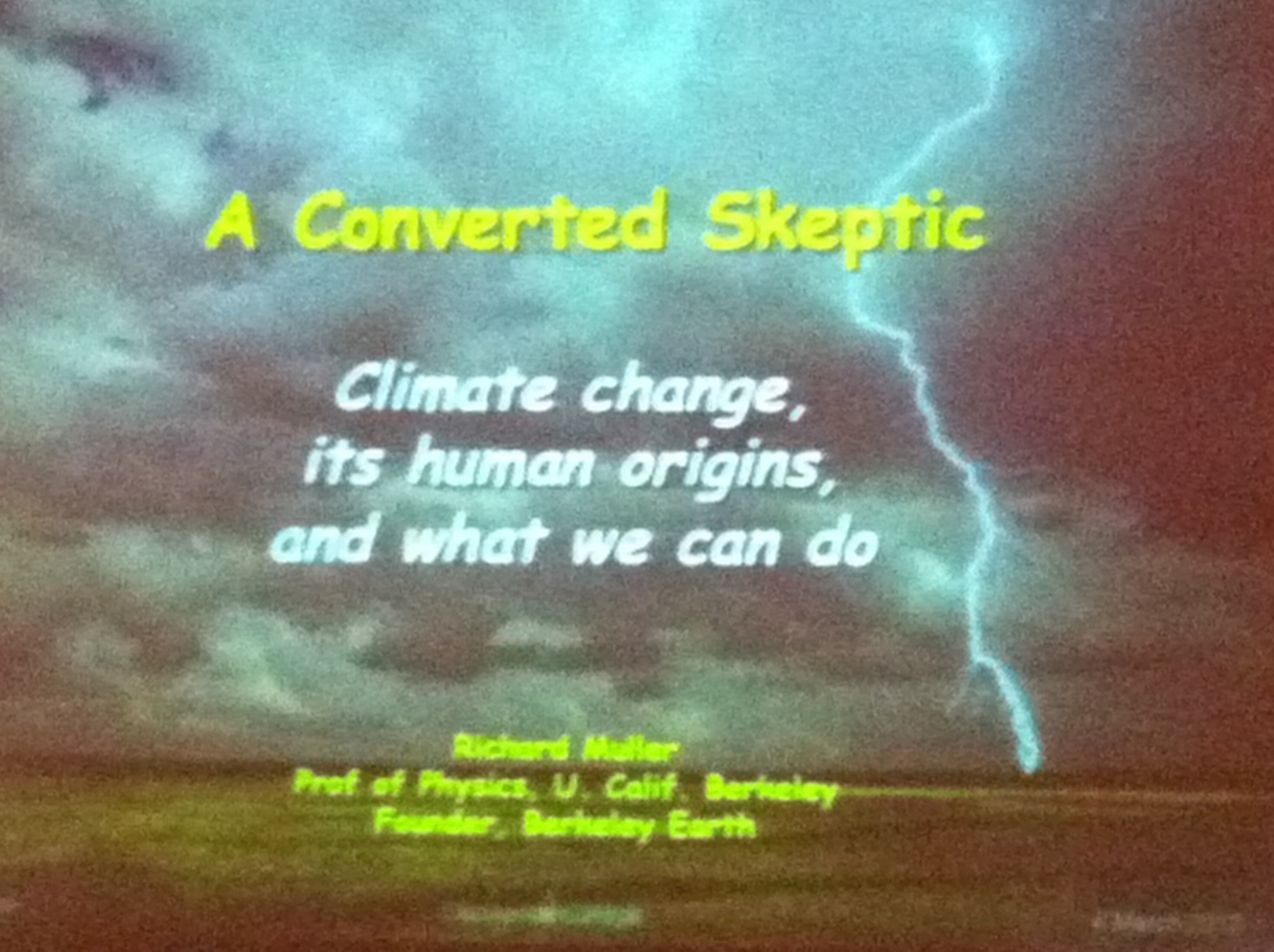
Physicist Richard Muller explains global warming to Occidental College audience

Lighting struck physicist Richard Muller, converting him from skeptic to believer about the human causes of global warming. (Jim Burns)

Activist physicist Richard Muller spoke at Occidental College today, explaining to a mostly student audience exactly why he became a “converted skeptic” about  the human causes of global warming.  In 2011, Muller testified to the U.S. House Science, Space and Technology Committee confirming an overall global warming trend, for which he later said: “Humans are almost entirely the cause.” But he also explained that his healthy initial skepticism came from reading untenable conclusions based on inadequate research.

His talk was both amusing and frightening. He repeatedly took former Vice President Al Gore to task, and reminded the audience of the little-known fact that a British judge would allow Gore to distribute his Oscar-winning documentary “An Inconvenient Truth” free to school children only if he included a list of nine errors, including that Greenland would melt, causing a massive ocean rise. Gore declined. He also reprimanded the Intergovernmental Panel on Climate Change for publishing in its fourth assessment report that the Himalayas would melt by 2030, which was not based on any science.

Muller blamed research “cherry picking,” as well as the politicizing of research contents as the culprits, and reminded the students to “remain objective.” He cited media reports as widely off the mark when it comes to global warming, saying that his own data show that there are no more hurricanes or tornadoes today than there were at the beginning of the century.

“This is something you all need to master,” he said.” How do you go about looking at a subject in a purely objective way? I would say that the thing that characterizes our civilization more than anything else was the discovery of objectivity. Remember that word and think about it.”

The professor of Physics at the University of California, Berkeley, and Faculty Senior Scientist at the Lawrence Berkeley Laboratory as well as the founder of Berkeley Earth is also the best-selling author of  “Energy for Future Presidents: The Science Behind the Headlines” (2012).

On the frightening side were graphs showing rapidly increasing carbon emissions from the developing world, notably China and India. Muller, who drives a Prius, said that it did no good in solving global warming because the average citizens in those countries can’t afford to buy one. Rather, Americans should embrace affordable examples. His dual saviors were solar energy and natural gas.

Muller endorsed controversial fracking — coaxing natural gas and oil out of rocks through horizontal drilling — as the way to get China off carbon-producing coal and into cleaner natural gas. As U.S. carbon emissions slow, he said, this was the most efficient way to stop the heating up of the planet.

See you on the river, Jim Burns

Earth Quotes: Charles McDermand

The best — and possibly the saddest — way to know what you’ve missed is by delving into the past. It seems almost nihilistic to look too closely, yet we must.

I remember years ago interviewing an old professor in Madrid who transported me back to a time when single, young men drank coffee and women, hot chocolate, both sexes beautifully dressed for the flirtation that naturally followed. As I listened with my tin ear for castilian Spanish, at first I thought how “modern” I was, and how silly, how sexist, it was to confine the sexes to different hot beverages. But as I walked home, a certain nostalgia overcame me to a point that my footsteps eventually just sort of scuffed along the pavement as I wondered at the clothes, the conversations, the intrigue that happened in those early years of the last century.

Can old books and IPads go together? (Jim Burns)

That day I became a true believer in remembering what we’ve lost, if for no other reason than to preserve that which deserves preserving today. Sure, this time, right now, remains a special one, full of hope and promise I believe outweigh all of the impending zombie apocalypses. Yet, reading Charles McDemand made me pine for a Sierra now vanished, for he wrote his classic “Waters of the Golden Trout Country” in 1944. McDermand penned his trampings along ranges few will travel, bringing his seven-foot fly rod, seven-and-a-half foot leader and “pack board” to dozens of rivers, streams and lakes. Here’s a sample:

“While ichthyologists have long argued over whether steelhead trout are a separate species or not, I had always considered them to be any rainbow trout which had gone out to sea and returned. Fresh from the plentiful food and the colorless habitat of the sea, they were always silvery, energetic fighters when re-entering fresh water. It had been my belief, and the belief of many a seasoned steelhead fisherman, that any of these trout, if landlocked in fresh water for a few months, would return to their usual brilliant coloration.

Now, at Lake Italy, I found my opinions shattered by the squirming, silvery evidence before me. This was a steelhead; there was no doubt about it in my mind. By no possible chance, short of wings, could it have journeyed from the seas through the miles of cataracts and actual falls descending from the Sierra. Obviously, someone had planted steelhead fry in Lake Italy. They had grown and remained silvery instead of reverting to a rainbow coloration. Accordingly, to me steelhead must be a separate and distinct species, not just any rainbow that has gone out to sea and returned.”

See you on the river, Jim Burns

Public comment opportunities, a possible L.A. River district and the ‘birdman’

Although obviously written by a child, the sentiment holds. (courtesy Mylariver.org)

The city will host two public meets to present the proposed Los Angeles River Recreational Zone Pilot Program the Glendale Narrows. Come on down and weigh in:

Saturday, Feb 23, from 9:30 a.m.-11 a.m., Dickerson Employee Benefits Conference Room, 1918 Riverside Drive, L.A. or the following Monday, at the Ad Hoc River Committee Meeting at 3 p.m. in City Hall, 10th floor. For courtesy parking, call (213) 473-7001

Meanwhile, the HUD-DOT-EPA Partnership for Sustainable Communities has awarded a community challenge planning grant worth more than $2 million to the newly formed Northeast Los Angeles Riverfront Collaborative. (Could somebody tell me who comes up with these names … geez). The aim is to use the bucks to “re-envision Northeast Los Angeles communities located along the L.A. River into a Riverfront District, focusing on community revitalization, environmental stewardship, sustainable civic engagement and economic growth for the entire city,” according to a press release from NELA RC.

If you want to weigh in on this one, simply go to its new website, http://www.mylariver.org, and complete the sentence “I want my river to be …” Of the 500 responses so far, one read “A nice safe place with no trash and have nice friends.” I penned one about fly fishing for carp, because my fear in all of this is that the fish will be eliminated by the Army Corps because they aren’t indigenous.

And Tony Taylor a.k.a “the birdman” has begun an online petition against any sort of river development short of turning it into a wildlife sanctuary. You can find it at http://www.change.org and of this writing has 15 signatures.

See you on the river, Jim Burns

With an eye to the Los Angeles River Recreational Zone Pilot Program

Bird's eye view: Inside a storm drain, safe for kids, one of the many improvements made at the North Atwater Creek Pocket Park. (Jim Burns)
Bird’s eye view: Inside a storm drain, safe for kids, one of the many improvements made at the North Atwater Creek Pocket Park. (Jim Burns)

The City of Los Angeles is busy presenting the proposed 2013 Los Angeles River Recreational Zone Pilot Program for Glendale Narrows with the second meeting occurring right now at City Hall. Unfortunately, I couldn’t attend, but will post when the final meeting is to occur, sometime next month. The idea is to get public comment on a plan to open up recreation within that approximately seven-mile stretch of our river.

I’ve read the pilot program and all you kayakers out there should be pretty excited. If passed, the proposal would mean that individual non-motorized boaters would be able to launch from North Atwater Park, Steelhead Park and Marsh Park,  from Memorial Day through Labor Day, when there is very little chance of a flood from torrential rain.  That also means you could be fly fishing from your kayak as well, because the proposal also calls for fishing, bird watching and hiking. Swimming would still be a no-no. And float tubes are just plain impractical because of low water.

Dept. of Fish and Wildlife regs would then apply in the river.

I really wonder what this would mean for the eradication of carp in the river, as the U.S. Army Corps views it as an invasive species, even though carp have been resident for decades.

From the report: On Aug. 28, 2012, Governor Brown signed Senate Bill 1201, which amended the Los Angeles Flood Control Act “to provide for public use of navigable waterways under the district’s control that are suitable for recreational and educational purposes, when these purposes are not inconsistent with the use thereof by the district for flood control and water conservation.”

Stay tuned and see you on the river, Jim Burns

Winter carp fly fishing ‘likes’ the L.A. River

Ah, the wile golden bonefish fell for a humble L.A. River egg pattern. (Jim Burns)

Look at it like this: It’s middle January; we just finished the worst cold snap in 20 years; and, presto, today temps are in the high 70s. That’s why the rest of the country hates us, folks.

And, the carp are going nuts on the river. Sure, you could book your ticket for Belize, hang with your buddies for a week at El Pescador and have a heck of a good time. All for about $1,100 for three nights, plus $500 in air fare.

Your inner bone fisherman is gonna like our river. Really. (Jim Burns)

Or … you could take your buddies down to the river and get into our own game fish for the price of some gas and a couple of tasty burritos.

See you on the river, Jim Burns

Quick Mends: Useful links update Sepulveda Basin habitat destruction

California State Senator Kevin De Leon props up crushed vegetation while touring Sepulveda Basin's South Reserve. (Courtesy Grove Pashley)
California State Senator Kevin De Leon props up crushed vegetation while touring Sepulveda Basin’s South Reserve. (Courtesy Grove Pashley)

Yesterday, a friend sent me an article from the Wall Street Journal entitled, “Los Angeles Reimagines its Waterway,” that contained both a snarky East-Coast-centric tone, as well as surface reporting (Notice that the title says “waterway,” not “river” …) But I was struck by two quotes that I think aptly reveal where we are today:

“By year’s end, the Corps and city engineers expect to complete a joint $10 million study that will offer a handful of options for restoring native habitat, likely creating wetlands along the river and potentially removing or reshaping some of the river’s concrete walls. The study examines an 11-mile stretch of the river on the city’s east side, where some resilient plants have survived in a narrow, muddy strip of so-called soft bottom at the center of the channel.”

And

“Last month, to the surprise of many San Fernando Valley residents, the Corps cleared more than 40 acres of trees and plants near the river northwest of the study area, in the Sepulveda Basin. While not related to the Arbor study, the action set off an outcry among local environmental groups and has raised concerns about the future of the Arbor study.”

According to the article, “State Sen. Kevin de León, one of several local officials who has demanded an explanation from the Corps, said the Sepulveda project “doesn’t bode well” for the future of efforts to revitalize the Los Angeles River’s natural landscape.”

So true.

I’ve spent literally two years and change fly fishing this area that the article refers to as a “narrow, muddy strip of so-called soft bottom at the center of the channel.” If you visit these pages, you’ll find pictures of the carp I and many others have so enjoyed catching. But now I wonder, how can you trust the Corps not to destroy all fishing in the river once work actually begins? The motto of this blog is “waiting for steelhead, fishing for carp,” but I now have to wonder if everything non-native has to be tossed out, and with warm water temperatures the rule, will there be any fish at all left in the river? Reintroducing steelhead, which were found in the river as late as the 1940s, is all but impossible. There is no way to construct a run to allow steelhead to reach the ocean.

And are trout really plausible given the river’s high water temperatures? Maybe, with a lot of habitat engineering, and lots and lots of cash money.

That leaves carp, which already thrive in the river, have been resident for decades and, for the sports fisherman, are a lot more cost efficient to catch than traveling to Belize to snatch a bone fish.

I think it’s a crazy policy that has every plant, fish and game species returned to the halcyon of days before Los Angeles was the city it is now. Pragmatic room must be made at the table for all types of activity on the river, which includes fishing.

Question: Exactly what will we be fishing for in the Los Angeles River in 2016?

For those of you following the important issues of the Corps clear-cutting 40+ plus acres of the Sepulveda Basin to suit its own desires, see the links below that come courtesy of Sepulveda Basin Wildlife.

Damage can be seen on the trunk of this native Oak at the South Reserve. (Courtesy Glenn Bailey)

Click HERE to read the entire Finding of No Significant Impact for the Vegetation Management plan.
Click HERE to read the letter sent to ACOE by the Sepulveda Basin Wildlife Areas Steering Committee.
Click HERE to read the ACOE’s response to the SBWASC letter.
Click HERE to see ACOE’s web page about this issue.
Click HERE to read Daily News article about clear cutting of South Reserve.
Click HERE to read L.A. Times article “Army Corps of Engineers clear-cuts lush habitat in Valley”, HERE to read follow-up article.
Click HERE to view YouTube video about the destruction.
Click HERE and HERE to see Encino Patch articles with additional photos.
Click HERE to read letter from San Fernando Valley Audubon Society about clear cut.
Click HERE to read KCET blog by Carren Jao.
Click HERE to read letter from State Senator Fran Pavley.
Click HERE to read letter from State Senator Luis de Leon.
Click HERE to view video entitled “Wildlife Refuge Meets Army Corps or Engineers” by a concerned citizen.
Click HERE to read an editorial by Charles Miller on the KCET blog.
Click HERE to read story in the LA Weekly.
Click HERE to read Congressman Brad Sherman’s letter to Colonel Toy.
Regional Water Board Investigation – click HERE for Encino Patch article.

Click HERE to find out about the history and wildlife of what used to be the South Reserve.

Click HERE to visit the San Fernando Valley Audubon Society’s web site that has recommendations as to who to send comments, and other links.

See you on the river, Jim Burns

Contact Brad Sherman about Sepulveda Basin habitat destruction

Here is a call to action to Brad Sherman, as well as independent action from another activist blogger. Please do copy/paste this letter and send it to the newly elected congressman.
See you on the river, Jim Burns

Quick Mends: Army Corps levels 43 acres of Sepulveda Basin habitat

This fly-fisherman just about set the river on fire! Maybe we should send this snap to "Ghost Hunters."
This fly-fisherman is staking carp, a non-native species of the Los Angeles River. Would all carp be killed in the river once reconstruction begins?

I was shocked to read this story in the Los Angeles Times today that begins: “An area that just a week ago was lush habitat on the Sepulveda Basin’s wild side, home to one of the most diverse bird populations in Southern California, has been reduced to dirt and broken limbs — by the U.S. Army Corps of Engineers.”

Read the entire story by Louis Sahagun here.

With the public comment period for the long-awaited ARBOR study coming up this spring, the Corps may have a public relations nightmare on its hands. In this historic moment, the pubic will weigh in on which of four alternative reconstruction plans makes the most sense. That plan will then be sent to Washington for approval and funding. Make no mistake, the river will be changed, no matter which plan moves forward. The Corps and the city of Los Angeles are partners in the redevelopment.

As one highly placed city official emailed me recently (in other words, before this happened), “Remember that the fundamental purpose of the Study is to improve the ecosystem values in the LA River — and that means riparian habitat that is good for wildlife, including fish species.”

Just last week, I walked part of the river with a Corps biologist, who told me that she studied maps from the late 1800s to see which plants were prevalent along the river during that time. Re-establishing those plants along the river will undoubtedly be part of all four alternatives.

Up until this happened, Sepulveda Basin was the beautiful place where environmentalists, river advocates, Los Angeles and the Corps had found common ground.  But with the Audubon Society calling for an investigation into the loss of habitat for 250 species of birds, as well as mammals, reptiles and fish, my guess would be the trust the Corps has been building within the community has been sheared by their bulldozer’s edge. Developing.

See you on the river, Jim Burns

Lariverflyfishing rings in New Year with 20,000th visit

2013-new-year