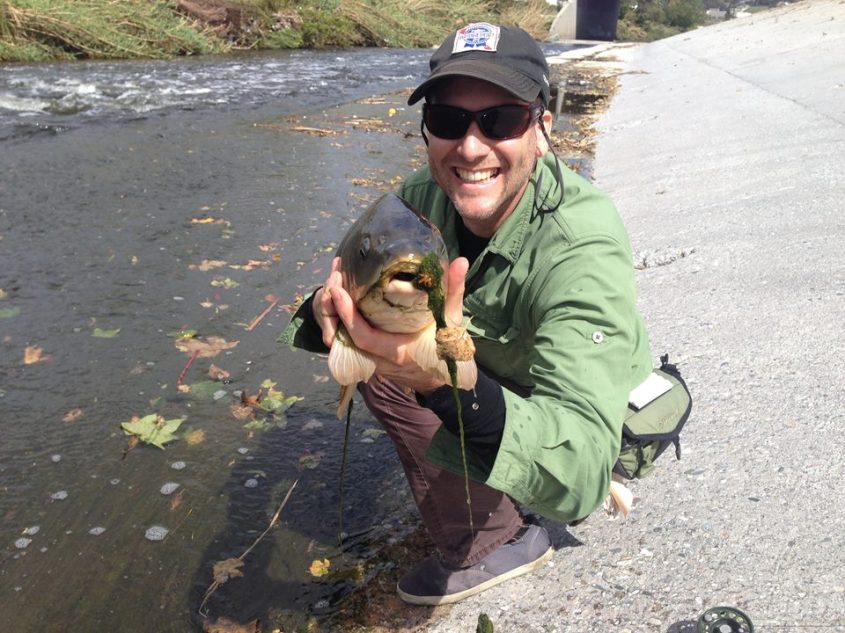
BLUE SKIES and bass are a perfect combo. (Nick Blixt)MEANWHILE, GRAPHITE RODS and lightning don’t mix. (Courtesy Field and Stream)
Nick Blixt caught this largemouth bass just in time, before the rain. Let’s hope it’s a good luck charm, and there are many left after these storms.
As I write, the rain is coming down hard, so here’s a reminder: Don’t look-ee-loo too close to the river. The water can come up on you very quickly. Also, I’ve heard predictions of lightning. If you are on the river and hear thunder or see lightning, immediately put your rod down and seek shelter. One of our bridges is an excellent place to ride it out. Just don’t forget your rod before you head home!
For a thorough three-part tutorial on fly fishing in weather, check this out.
Say goodbye to the Sixth Street Bridge and hello to its replacement project. (Courtesy FOLAR)
Goodbye 2015, and ‘tis the season for Top 10s. Read through, and you can see there’s plenty of contention about some topics, and for those of us who want healthy waters in which to fish, there’s still plenty of work ahead in 2016.
Noteworthy today is the fact that Congress, although finally getting more public laws enacted (113 this year as opposed to 72 last year, according to Pew) neglected the very important Klamath River dam removal deal.
No. 10 Last week, this site received its 100,000th view, which is incredibly gratifying for me. In 2010, my first post, “Glendale Narrows adventure No. 1” got 51 views – all year! This week, generous readers pushed the 2015 blog total to 32,500.
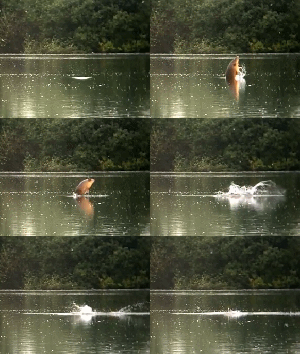
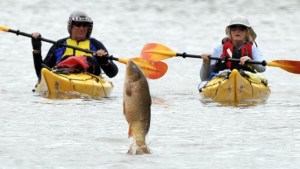
“Bet you can’t do this, hahaha!” (Courtesy Weekly Times Now)
No. 9 “Why do carp jump?” won this year’s most-viewed post. In the last 12 months, 1,125 readers read why these crazy fish do what they do, as well as taken the poll to post their own opinion. The all-time winner, however, “Holy mackerel, Dad caught a largemouth bass” snagged more than 2,900 views last year, with “jump” in seventh place. That piece was a landmark showing the popular game fish indeed lives in our river. By midsummer they came back again after last year’s rain made them scarce for the first half of 2015. In fact, look at the mega-largemouth John Tegmeyer caught yesterday.
No. 8 After the much-publicized death of Fred, the Great Blue Heron, last year, a collaborative effort among Friends of the L.A. River, Trout Unlimited and Berkley Conservation Institute brought fish line recycling tubes to three spots in Glendale Narrows. According to Robert Blakenship, look for a TU-sponsored water temperature survey next year.
Matus Solobic, two-time Off Tha’ Hook winner, shows off a sweet hog. (Jim Burns)
Foundation expedition with contributors Roland Trevino, his son Ansel, Roderick Spilman, found nary a smolt at the headwaters to the Arroyo Seco in the San Gabriel Mountains. Blame the drought, the Station Fire and neglectful, woefully underfunded forest management.
No. 6 “Off Tha’ Hook” celebrated its second year. It’s become a party down by the banks on Sept. 3, a Dept. of Fish and Wildlife “free day,” when no license is required to fish. Matus Solobic again took home first place and lots of bling. Best memory: the number of children fishing at least doubled over last year. I’m a sponsor for next year, so come on down. The entry fee will be reduced, according to FoLAR.
No. 5 Wild Steelheaders United, Trout Unlimited and CalTrout chose Long Beach’s Aquarium of the Pacific to host the Steelhead Science for Anglers event in November. A good antidote to the Klamath River congressional collapse is to watch what NOAA fisheries lists as West Coast wins for the year: both four and a half miles of restored steelhead habitat on Arroyo Sequit Creek in L.A. County and 34 acres of kelp forest habitat off Palos Verdes made the list.
No. 4 FoLAR completed its Long Beach Fish Survey– and moved up to the Valley, where biologists Rosi Dagit and Sabrina Drill lead a dozen volunteers in the fine art of seine netting in late November.
“This is a particularly enterprising survey, William Preston Bowling, FoLAR’s special projects manager told the Los Angeles Times. “But then, surprisingly few studies of fish in the river, natives and nonnatives alike, have been conducted. There’s a lot of learn out here.”
The haul of more than 3,600 fry tilapia thrilled the group, especially after the slim pickings from three trips to Long Beach that netted, by my count, under a dozen carp and other fish. There’s nothing more discouraging that seeing fish swimming at your feet and not being able to land them. The Long Beach segment is most certainly undercounted.
No. 3 President Obama signed into law (2014) the Los Angeles National Monument, but fishermen say “so what”?
I’m one of those tax payers who thought national monument status would quickly fix the West Fork of the San Gabriel River. Naïve, I know, but I’ll ask again: How can the West Fork be classified as a “wild and scenic river” when it is so battered and beaten down? If you want to see where it could end up, drive over to the East Fork. “Mad Max” is an exciting dystopian movie, but not what I want to find in the national monument. Two explainers, here and here.
No. 2 Congress green-lighted L.A. River habitat restoration plan – all $1.3 billion of it (2014), but what does that really mean? Yes, the same Congress mentioned at the beginning of this piece is ready to unload the coffers for Los Angeles, and it remains to be seen which vision of the new river will win out. If fish and fishing aren’t a major part of that vision, we will have lost out on one of the major urban recreational opportunities in the West this century.
No. 1 “Star-chitect” Frank Gehry outed as rehab river architect.
For those who believe the planning objectives from the Army Corps Los Angeles River Feasibility Study – 1. Restore valley foothill riparian strand and freshwater marsh habitat; 2. increase habitat connectivity; 3. increase passive recreation (meaning recreation compatible with restored environment such as fishing and kayaking) — this phrase, uttered to the Los Angeles Times, makes us very uncomfortable:
“I said, ‘Oh, you want me to be Olmsted,'” a reference to Frederick Law Olmsted, one of the designers of Central Park. “I told them I’m not a landscape guy. I said I would only do it on the condition that they approached it as a water-reclamation project, to deal with all the water issues first.”
Question to Mr. Gehry: Does “water reclamation” jive with the three objectives from the ARBOR Study? The renewed Los Angeles River must be a steelhead trout friendly habitat. Rainbow trout, the same species as steelhead, once planted in its renewed, restored water must be able to make their journey out to the ocean, if that’s what they choose.
OK, sorry about that, but take a look at this monster largemouth that John Tegmeyer pulled out of the water today. It’s enough to give a guy carpal tunnel!
STEELHEAD imagery abounds on the Los Angeles River, yet plans to reintroduce this endangered species aren’t included in the habitat restoration plan. (Jim Burns)
This in-depth piece on different visions and conflicts for renewing the Los Angeles River makes for an engaging read. Check out these quotes from “L.A. Remembers It Has a River” by Willy Blackmore in TakePart, the digital news and lifestyle magazine, and social action platform.
“There’s no keystone species for riparian habitat in Southern California—no iconic, ecologically significant animal whose health and abundance can stand in for that of the larger ecology. But Lewis MacAdams—who cofounded the river’s first dedicated environmental group, Friends of the Los Angeles River, in 1987—has said he’ll know his work is done “when the steelhead trout run returns to the Los Angeles River.” MacAdams and his organization have played a major role in bringing the city’s attention back to its central waterway, and while he has been critical of Gehry’s involvement, MacAdams has been supportive of the Corps of Engineers’ vision for the river.
“Yet the habitat restoration plan for the Glendale Narrows accounts for neither fish nor frog. According to the plan, the restored habitat would help the endangered least Bell’s vireo, a small brownish bird, but the question of steelhead, a member of the salmon family, is couched more in terms of maybe or someday.”
Lewis MacAdams is right!! I think that there is an iconic species for this river. If you bring back the steelhead, you solve many issues of the river in terms of ecology and beauty at the same time.
The current statement from Frank Gehry, that it is going to be a ‘hydrology project first, and then a beautification project’ seems to be the same level of logic that channelized the river in the first place – solving one problem. Also its a RIVER. Anyone who has been down into the Glendale Narrows can see that if you give it some freedom, it will naturally meander and create beauty that doesn’t need an architect to design or intellectualize it.
There are many examples of rivers that have been problems when cities built into their rain sheds. the South Platte through Denver always comes to my mind. It has hard edges and intersections with the city and has areas where it runs free and is natural. It also has monster carp and trout in these areas respectively.
Celeste WalterHabitat for what? Is it going to be sterile like a city park? Sounds like playing Jenga with half the levels of blocks missing from bottom. As a child I remember hiking with an elderly couple , the woman watched while I did my best to catch a tadpole. She told me tadpoles in the stream were evidence of the health of the stream and surrounding area. Is it different now?
Anyone who’s ever gone fly fishing has undoubtedly heard of Orvis, and the brand has become known for its range of gear and equipment for the outdoorsman. Be it fly-fishing, hunting or travelling, Orvis seems to have thought about everything there is to keep in mind, and with our growing reliance to our smartphones, they’ve also released a great app for fly fishers.
Over the past few years, the mobile app market has skyrocketed to unprecedented heights, much of its growth is due to the fact that mobile internet is among the fastest growing trends on the Internet landscape today, as more and more people use their phones to access information. Through dedicated apps, there’s no need to do Google searches for information you need, and for the outdoorsman, an app that puts all the information on knot-tying, fishing spots and fishing reports in one place is indispensible.
Orvis’s Fly Fishing App puts all of this information together, and more. It’s great for both beginners and advanced fisherman alike, as not only does it have hours and hours of instructional videos for the budding fisherman, but it also has fishing reports for over 300 of the top fly fishing destinations in North America, Central America, South America and the UK, with real-time updates sent directly to your device. This means that even the experienced fly fishers can use the app to explore spots they haven’t fished in yet. What’s more, renowned fly fishing author Tom Rosenbauer uploads podcasts to the app for all users to listen to, sharing tips and tricks for fly fishing as well.
“This is some real forward-thinking from ORVIS,” says Fly Fish America, “and one of the most useful and practical fishing apps we’ve used.”
While the app is free to download, certain content must be bought, but any in-app purchase will get you a $10 Orvis gift card.
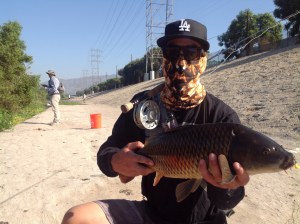
Keith Mosier nabs his first L.A. River carp. Oh, yeah! (Ken Lindsay)
A straight flush? That’s the topic environmental writer Louis Sahagun ponders in today’s LA Times, and the hypothesis being tested in this recent citizen science event: Can nonnative species survive in So Cal’s boom-or-bust water cycles?
For those of us who enjoy fishing them, the answer is “sure, hope so!” But as many of you can attest, the bass, also a nonnative, went away for many months following last winter’s storms.
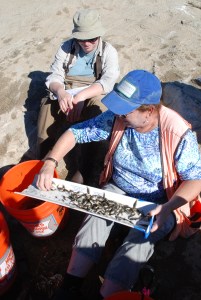
BIOLOGISTS Sabrina Drill (left) and Rosi Dagit inspect part of the tilapia haul. (William Preston Bowling)
By Rosi Dagit
Guest contributor
Looks like we captured 3,699 fish, the majority of which were juvenile tilapia under 1 inch. Based on the few larger (up to 3 inches) fish, most appeared to be redbreasted tilapia (Tilapia rendalli), but that is not yet verified with the voucher specimens. These fish can breed year around in warm waters, and it was quite interesting to find such young fish at this time of year, but water temperatures were 24-27 degree C. (75-81 degrees F.), which is pretty warm. They can reach up to 18 inches and live for up to seven years.
They are native to Africa, and are primarily herbivores that spawn in the substrate and guard their nests. They are considered to be competitors with native fish for food and spawning areas, and high densities of fish can negatively impact native aquatic vegetation.
In other areas, they have not survived strong flows or colder temperatures, so it will be really interesting to see if they make it through the winter El Nino.
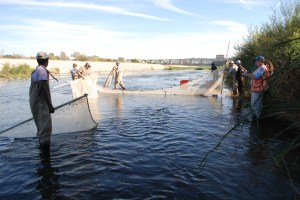
SEINE NETS yield more than 3,600 tilapia fry in Haskell Creek above Sepulveda Dam on Friday. (William Preston Bowling)
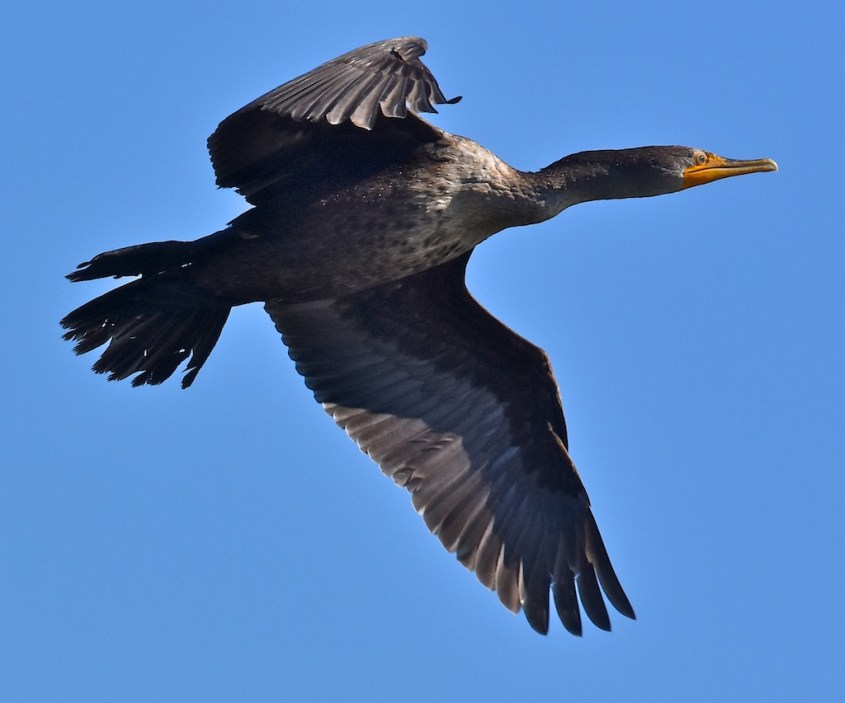
Cormorant (All images courtesy of the Natural History Museum of Los Angeles County)
By Charles Hood
Guest Contributor
With staff from the Natural History Museum in Exposition Park, I was at the Sepulveda Wildlife Reserve the day after the recent “fishing for science” derby. We were not trying to avoid the fishermen — quite the opposite — just a scheduling thing, that we got there a day too late.
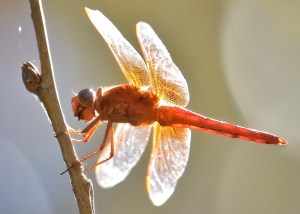
Dragonfly
Looking for fish in Haskell Creek is a pleasure and yet a unique frustration. We know more about the ecology of wolverines in Alaska than we do about the interactions of the fish in the L.A. River and its feeder streams.
For me, an English major turned birder, I still struggle even with basic identification issues. The little minnowy ones I call Gambusia or mosquitofish, but that’s only because that’s what everybody else says. Do we really know?
Tilapia
And I have eaten carp and tilapia, but am not sure I could tell all the different forms and color phases apart.
Yet as one looks into Haskell Creek upstream from the dam, other questions arise. How long do the fish here live? What is there “pecking order” or resource partition, species to species? What eats them? There is one Belted Kingfisher present here — why not more? (It may be a bit too closed in, in terms of tree canopy, or there may not be enough unrestricted perches. That’s just my wild guess. They may drive one another away: a dominant bird may lay claim to the best part of the creek and see any trespassers off straight away.)
Turtles too come into it. The main lake has a lot of Red-eared Sliders; what’s their role in taking (or not taking) fish from Haskell Creek? In the main lake we saw something that was new to me. A dead coot was floating in the lake while turtles investigated it on each side. Were they trying to scavenge the carcass, but perhaps blocked by the dense feathers?
Red-eared Slider
As the results from the fish survey on the 19th are tallied, we can make one small step toward answering these questions. It will be a long journey, one in which everyday observations from scientists and non-scientists alike have equal parts.
If any blog readers want to share thoughts or observations, do please pass them on: Charles Hood, chood@avc.edu. The museum is working on a book that will be an overview of urban nature, and if you would like to share a perspective or experience, please email me.
Here’s an updated message from organizer Rosi Dagit:
Alex and I will meet Bill by 7:45 and see if we can figure out how to open the gate – pending hearing back from MRCA. We will offload all the gear from my truck and stage it there either way.
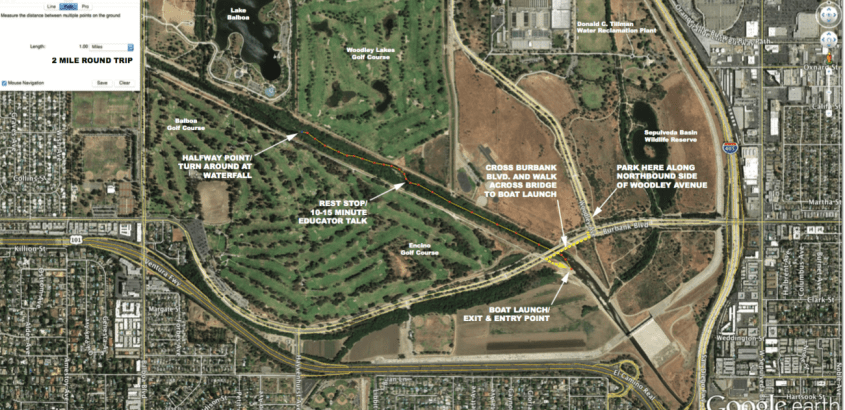
8 am Meet Bill at the corner of Burbank and Woodley, see attached map where it says PARK HERE
We can direct you back across Burbank to the kayak parking area. Parking here at the Reserve involves a lovely 15-20 minute hike along Haskall Creek, back downstream under Burbank Blvd, through the south reserve and across the river, to grandmother’s house, oops, across the river and back upstream to eventually get to the kayak boat launch area where all the nets will be staged.
We recommend that you bring your lunch, water, etc. in a daypack so that you can carry it over 1 mile and have hands available to help with rods, buckets, waders, etc. (Full details here)
If you get stuck in traffic or have problems please call me at 310.488.6381 so we can sort things out.
Thanks everyone for your patience while we got this all sorted out! Looking forward to a fun day in the river on Friday. Can’t wait to see what we catch!
Cheers, Rosi
You can also email FoLAR’s William Preston Bowling at web@folar.org for more information.










 lariverflyfishing
Lewis MacAdams is right!! I think that there is an iconic species for this river. If you bring back the steelhead, you solve many issues of the river in terms of ecology and beauty at the same time.
The current statement from Frank Gehry, that it is going to be a ‘hydrology project first, and then a beautification project’ seems to be the same level of logic that channelized the river in the first place – solving one problem. Also its a RIVER. Anyone who has been down into the Glendale Narrows can see that if you give it some freedom, it will naturally meander and create beauty that doesn’t need an architect to design or intellectualize it.
There are many examples of rivers that have been problems when cities built into their rain sheds. the South Platte through Denver always comes to my mind. It has hard edges and intersections with the city and has areas where it runs free and is natural. It also has monster carp and trout in these areas respectively.