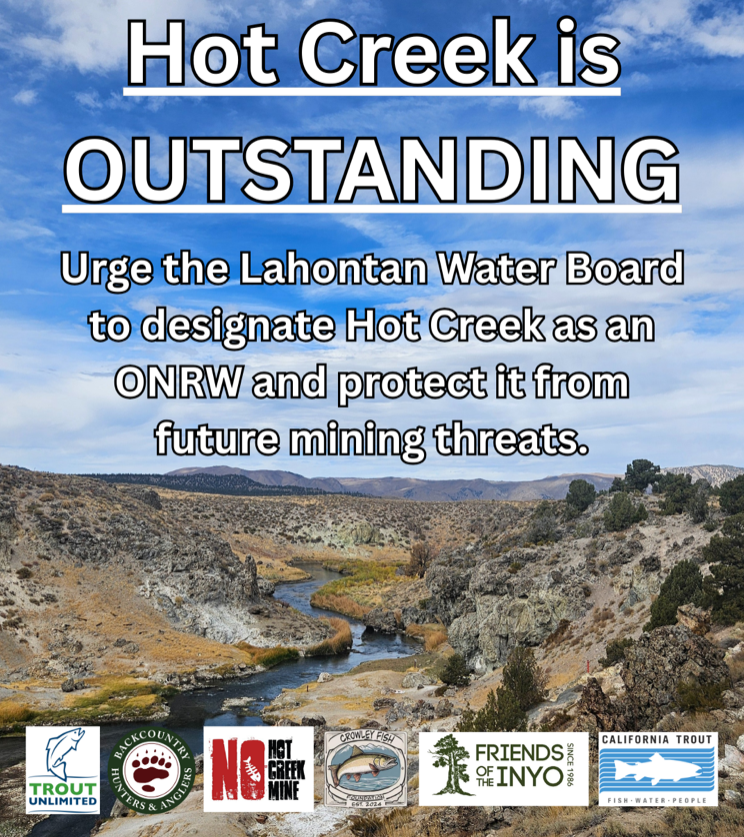
Hot Creek is a unusually productive stream, ecologically – its distinctive water chemistry and temperature regime influenced by the hydrothermal inputs up and down its length, combine to produce huge volumes of aquatic plant growth and macroinvertebrates, which in turn support one of California’s most famous wild trout fisheries, known for its impressive biomass (number of fish/mile).
But Hot Creek is threatened by gold mining. A proposal now before the Lahontan Regional Water Board would permanently protect the water quality in Hot Creek from being degraded by mining waste by designating it an Outstanding National Resource Water (ONRW).
We have until May 5 to urge the water board to make this critical designation.
In September of 2021, the Inyo National Forest approved a project that involves “exploratory drilling” for gold near Hot Creek, one of California’s most famous wild trout streams. The drilling site is located about one-third of a mile from the creek, in Mono County. In the wake of widespread public opposition and litigation by partner organizations, the Forest Service’s approval of the project was overturned in 2024.
But the threat of future mining near Hot Creek remains, especially given the federal government’s new emphasis on increasing mineral production on public lands.
Together, we can help to secure permanent protections for Hot Creekand its legendary trout fishery by submitting comments before May 5th to the Lahontan Regional Water Quality Control Board to designate Hot Creek as an Outstanding National Resource Water.
Even if it were not threatened by mining, Hot Creek deserves this designation, which is reserved for waters with the highest water quality characteristics and which prevents permanent degradation to water quality while protecting existing uses such as recreation, angling, and ranching.
This email is to notify you that the objection period for the subject project will start on Friday, March 7, and end on April 21. You are receiving this message because you have submitted comments on the project previously, and may be eligible to file an objection.
To learn more about the process and requirements for an objection, or to view the Environmental Assessment, the Comprehensive River Management Plan, or the Draft Decision Notice and Finding of No Significant Impact, please visit the project website >>HERE.
You may also contact me for questions.
Thank you for your interest in Piru Creek Wild and Scenic River.
Gary Seastrand Natural Resource SpecialistForest ServiceAngeles National Forest
Big Santa Anita Creek at Chantry Flat–I had heard the tales of rainbows and browns from “back in the day,” but I had never seen this idyllic stretch of incredible trout water for myself. I only took up local fly fishing a year ago, during the four-year fire closure of the area. I was eager to see it for myself last week when they reopened the area.
So, a friend and I spent a day scouting for Chantry Trout. I assume the weirs, across the stream at regular intervals, stamped with the date 1959, were built to control flooding around the 80 or so cabins in the canyon. I also know that these probably very quickly filled up with sediment, rendering them useless, much like the Brown Mountain Dam on the Arroyo Seco above JPL.
I also guessed that these dams would act as fish barriers. So while scouting, we made sure to walk as much of the stream as we could, thinking fish could be localized in one of these runs. We covered a lot of ground, from a half-mile above Sturtevant Falls all the way down to within a half-mile of the reservoir. We hiked seven miles. I am deeply sad to report: we found no fish in the stream.
I put my waterproof video camera in pool after pool, hoping and praying to see a little movement under a rock, a fry tucked up into a crevice. Nope. Nada. Zip. Zilch. We also tried flies, of course. And with ample experience fishing the streams of the Angeles and San Bernardino mountains, I can say with certainty–if there were fish there, we would have caught ’em, or seen ’em.
We did find hundreds, thousands perhaps, of frogs (and tadpoles visible underwater)–another observation that points to the absence of a healthy population of trout.
This was a total bummer, as the stream itself looks “incredible.” There is a surprising amount of water flow for this time of year–pool after pool of deep, cool, aerated water. Just perfect for our native rainbows. The flow was many times what we see this time of year in other creeks that manage to support fish, like the Arroyo Seco.
I had high hopes that with the recent high-water years, maybe some fish had survived the fire and repopulated, perhaps from the reservoir below, but it seems that’s not the case. Now, could there be some survivor fish in the reservoir and perhaps immediately upstream of it? Yes, it is possible, we did not make it all the way to the reservoir. But there are certainly no trout in most of the accessible water.
Perhaps we can convince the CDFW to repopulate the stream, stocking it with wild rainbows from nearby drainages (perhaps a rescue of East Fork San Gabriel fish is in order, before the rains come and destroy that stream?). Our mountain rainbows have their genetic roots in the Southern Steelhead runs of a hundred years ago, and keeping good stocks of those populations may help repopulate the endangered Steelhead if and when we are able to reconnect them to the ocean.
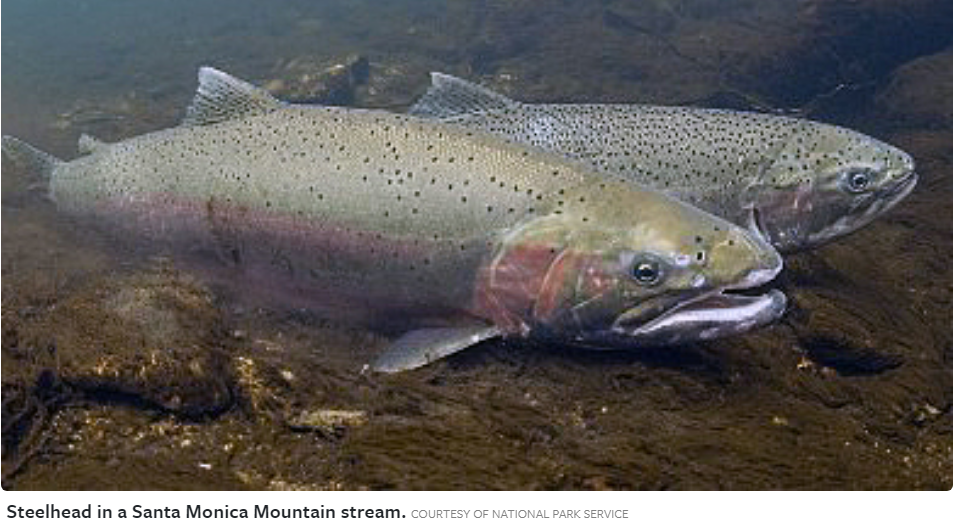
From Cal Trout: The evidence is undeniable: Southern California steelhead teeter on the brink of extinction. Southern steelhead serve as crucial indicators of watershed health and river ecosystem integrity. These fish play a role within the ecosystem that you, your family, neighbors and friends are also a part of. If one piece of the ecosystem changes or disappears this ripples throughout the rest of the ecosystem affecting every other species – plant, animal and human. Historically, Southern steelhead thrived, with tens of thousands of them swimming through Southern California rivers and streams. Today, it’s rare to see them in double digits. Their dwindling numbers stem from habitat loss, fragmentation, and the encroachment of urbanization. Please, Sign your name by April 4. CLICK HERE >>.
In 2021, conservation nonprofit CalTrout submitted a petition to the California Fish and Game Commission to fully protect Southern steelhead as endangered under California’s Endangered Species Act. Listing these fish as endangered would promote actions to protect them including removing obsolete dams, improving habitat, securing instream flow, and restoring watersheds. All of these actions would also benefit human communities. For example, improving aging infrastructure would reduce the risk of flooding and increase public safety and holistic watershed restoration would enforce and build strong relationships throughout the community.
In January, 2024, the California Department of Fish and Wildlife submitted a peer-reviewed species status report to the Fish and Game Commission. Their extensive review came to the same conclusion as CalTrout’s initial petition – the Commission found the petitioned action to list Southern steelhead as an endangered species under California’s ESA to be warranted.
I once watched plein-air painters try to capture the beauty surrounding this small community. After twin catastrophes, the town is asking for your help. (Credit: Alpine County Chamber)
On August 3, 2022, just over a year after the Tamarack Fire of 2021, the town of Markleeville sustained the impacts of heavy storm activity accompanied by mudslides and flooding. The damage ultimately closed Highway 89 north of Markleeville for an undetermined amount of time, and it remains closed. Until this access route is reopened, Markleeville’s small businesses have once again been brought to a standstill.
Therefore, we ask for the support of all who love Alpine County and the town of Markleeville. The town’s small businesses have faced incredible odds over the past three years, and they can use our help now more than ever before.
“Our businesses are the backbone of our community. Their resilience in the face of adversity should be recognized. Support for our businesses is the best vector for recovery, as we once again begin the recovery process.” JT Chevallier – Alpine County Economic Development Director
This is a really fun event, so if you haven’t taken out some trash of the river yet, this could be your year to come on down, meet other volunteers and get to know our communities better. I’ve included the dates and spots over the eight weeks below. Click the link you want to register for free.
See you on the river, Jim Burns
SITES CURRENTLY AVAILABLE
Click on a site to register and reserve your spot early.
Could ‘carp dogs’ become the hot dog of the future? (Courtesy Kunzler).
Ever wonder how the cellphone swallowed your life?
That, I can’t answer, but I can recommend that from sundown tonight through Saturday, you and your family uplug! Even if just for an hour, give it a shot.
All, To let you know that CalTrout received guidance from CA Fish and Game Commission (FGC) that this 12/15/2021 meeting would be a consent item for the Southern steelhead CESA listing petition, not geared for public comment. This follows the notice to FGC in November by CDFW that upon evaluation of the petition, they deemed it to contain sufficient scientific information to warrant action by the Commission.
CalTrout is implementing our petition campaign and building support for the February 16/17 2022 meeting where this will be heard by FGC, and public comment will be incorporated into the pre-meeting binder for Commissioners. We are recruiting letters of support from legislators, stakeholders and the public. Please watch your inbox for a call to action email which will be broadcast soon, and presentations scheduled on the CESA petition to So Cal fishing groups and others. We encourage any partner, individual or organization that supports this petition to comment. Please have comments in prior to Feb 2nd so they will be added to the pre-meeting information binder.
If you have questions, please contact Russell Marlow, CalTrout lead for the listing petition, at rmarlow@caltrout.org
Thanks,
Sandi
Sandra Jacobson, Ph.D.
Director, South Coast and Sierra Region
California Trout
Hi Fish Folks,
So the Fish and Game Commission hearing this Wed will be to accept the petition but the actual hearing to make the listing is not until 16-17 Feb.
However, there is some coordinated opposition that we might want to counter by attending the zoom meeting and providing public comment in support of accepting the petition to move it forward. Zoom link info below. Letters/emails submitted now will not necessarily get to the commissioners before the hearing but will be shared after, so not a super rush but still worth doing.
As is detailed in the DFW memo supporting the petition, populations are declining throughout southern CA, these genetically distinct fish are more temperature tolerant and exhibit so many different life history strategies that they are critical to the gene pool and most likely to be able to adapt to climate shifts. This means that southern CA fish could be the ones to keep steelhead going up the coast into the future. I know you all care about this as much as I do! Do whatever you can to get the word to the Fish and Game Commission! Feel free to spread the word!
thanks, Rosi Rosi Dagit
Senior Conservation Biologist
RCD of the Santa Monica Mountains
540 S.Topanga Canyon Blvd.
Topanga, CA 90290
Meeting of the California Fish and Game Commission Dec. 15, 9 a.m. Instructions for Participating in the Webinar and Teleconference
The California Fish and Game Commission is conducting this meeting by webinar and teleconference to avoid a public gathering and to protect public health during the COVID-19 pandemic, consistent with California Government Code Section 11133. The full meeting agenda is attached. The following provides guidance for how to participate in the meeting with different options based on the technology available to you, and whether you intend to give public comment.
Southern California steelhead Receive the Department’s 90-day evaluation report on the petition to list southern California steelhead (Oncorhynchus mykiss) as endangered under CESA. (Pursuant to Section 2073.5, Fish and Game Code)
Meeting Viewing Only (no public comment) Watch the Live Stream Webcast As always, the meeting will be live-streamed (also referred to as a live webcast) with full audio and video. If you simply want to observe the live stream of the meeting but do not wish to comment on any item, we strongly encourage you to view the webcast available at www.fgc.ca.gov<http://www.fgc.ca.gov>.
How to Join the Meeting (if you plan to provide public comment) Please note: When you join the meeting using any of the following options, you will be muted automatically. Your video will not be displayed when you join the meeting.
Option 1: Zoom with Computer Audio We highly encourage you to join the meeting on your computer via the link below and use your computer audio to participate. You can participate by launching Zoom in your Internet browser or downloading the Zoom app on your computer. Join Zoom (using your web browser, such as Google Chrome or Mozilla Firefox) Enter the meeting ID: 829 2427 1355 Meeting URL: https://zoom.us/join Join Zoom (using the downloaded app on your computer) You will be prompted to enter your email and name, then click “Join Webinar.” Webinar URL: https://us02web.zoom.us/j/82924271355
Option 2: Zoom via Mobile App Join using the Zoom app on your mobile device (phone or tablet). After you download the app, open the app, select the “Join” icon, enter the meeting ID number and your display name. Then enter your meeting password. Meeting ID: 829 2427 1355 Click here for more details about using Zoom on mobile devices.
Option 3: Teleconference Only If you are not able to join using your computer or mobile device, please join via phone. Phone number: +1 (669) 900-6833 or +1 (408) 638-0968 Meeting ID: 829 2427 1355
Option 4: Zoom with Phone Audio (This is not a preferred option for joining as there is the potential to create feedback) If you plan to join via computer and use your telephone for audio, join the Zoom meeting on your computer first, using the links in Option 1. For audio, use the “Call Me At” feature and enter your phone number to have Zoom call you.
Viewing Presentations If you join via Zoom on your computer or mobile device app (Options 1, 2, and 4) the presentations will be displayed. If you join via teleconference only (Option 3), you can view a PDF of the presentations in the meeting binder.
Technical Assistance For help in joining Zoom meetings, click https://support.zoom.us/hc/en-us/articles/201362193-Joining-a-Meeting. If you need additional technical assistance, please contact 805-801-3576 or it@agpvideo.com<mailto:it@agpvideo.com>. Making Public Comment If you join via Zoom on your computer or mobile phone app (Options 1, 2, and 4) use the “raise hand” feature to indicate that you would like to make a public comment. If you join via teleconference only (Option 3), press “*9” to virtually raise your hand to indicate you would like to make a public comment; if you press *9 again, you will lower your hand. Please see the meeting agenda for full instructions regarding making public comments.
Please note: When the moderator unmutes you to make public comment, you may need to unmute yourself as well. If you join via Zoom, you may be asked to join as panelists when it is your turn to speak.
The U.S. Forest Service announced in a media release this week that KORE Mining, Ltd. will begin exploratory drilling as early as Tuesday, November 30, in Long Valley.
“The public should expect that heavy equipment including a drill rig will be on the roads near Whitmore Hot Springs and Antelope Springs Roads,” the media release says.
Friends of the Inyo (FOI), together with the Center for Biological Diversity, Western Watersheds Project and Sierra Club, is suing the U.S. Forest Service for allowing KORE Mining’s destructive activities to proceed.
“This is a bad project for the community of Mammoth Lakes, Southern Mono County, and negatively impacts wildlife, including the imperiled bi-state sage grouse, and our recreational tourism economy,” FOI Executive Director Wendy Schneider said. “It provides no benefit to the people of Mono County.”
What can I do?
Mammoth Lakes area activists are organizing a peaceful protest this Saturday, Nov. 20, from Noon to 3 p.m. A Facebook page that provides details has been set up. You can access it by clicking here or on the button below.
“The goal of this protest is to bring awareness to community members in Mammoth Lakes and the Eastern Sierra about KORE Mining’s intentions to implement an open pit gold mine,” the protest Facebook page says. “We are encouraging folks to make signs and banners in preparation for the event.”
Friends of the Inyo supports this peaceful protest.
This small rainbow was caught last year before the Bobcat Fire destroyed the West Fork, closing it into 2022. Several hundred rainbows were transported to the Arroyo Seco for safekeeping. With water levels already very low, this is no time to divert more water for use by the City of Pasadena. (Credit Jim Burns)
UPDATE: The Pasadena City Council hearing has been continued until Monday, July 19, 4:30 p.m.
From Tim Brick, Arroyo Seco Foundation:
We need your help to save Arroyo Seco trout now!
The Arroyo Seco Foundation is working to restore conditions for steelhead in the front range of the San Gabriel Mountains. Yes, steelhead – the anadromous form of Coastal Rainbow Trout. We are collaborating with a variety of agencies and organizations on the LA River Fish Passage Program in downtown Los Angeles and on an assessment of watershed conditions in the mountainous reaches of the Arroyo Seco.
Pasadena has prepared an Environmental Impact Report on the Arroyo Seco Canyon Project (ASCP), which will increase water diversions from the Arroyo Seco stream, a major tributary of the Los Angeles River system that is critical to steelhead recovery prospects. ASCP will build a new five-foot dam and diversion facility to divert additional water from the Arroyo Seco stream for domestic use by the Pasadena Water & Power Department (PWP).
The National Marine Fisheries Service has declared the Southern California steelhead an endangered species and prepared a steelhead recovery plan that includes the Arroyo Seco and the Los Angeles River.
The goal of this recovery plan is to prevent the extinction of southern California steelhead (Oncorhynchus mykiss) in the wild and to ensure the long‐term persistence of viable, self‐sustaining, populations of steelhead distributed across the Southern California Distinct Population Segment (DPS). It is also the goal of this recovery plan to re‐ establish a sustainable southern California steelhead sport fishery.
While the Arroyo Seco was once home to a thriving population of rainbow trout and steelhead, steelhead have been blocked since 1920 from returning to their mountain home in the Angeles National Forest. Native Rainbow Trout have been present since then in the Arroyo Seco, although the Station Fire and the extended drought of recent years have made conditions difficult for those fish.
Based on survey techniques described by the California Department of Fish and Wildlife as inadequate, Pasadena’s ASCP EIR states that there are no fish in the Arroyo. Pasadena’s projections for water availability are based on historical weather and streamflow patterns and do not consider the likely impact of climate change. The design of the new dam and diversion structure do not provide for two-way fish passage around or through those facilities nor for an environmental flow to protect the fish and aquatic species during dry periods as required by CA Fish and Game Code Sections 5901 and 5937.
Throughout the environmental review, the Arroyo Seco Foundation has asserted that Rainbow Trout are still present in the Arroyo Seco and that Pasadena has done an inadequate job of finding and documenting them. The ASCP EIR was tentatively approved by a Pasadena hearing officer on January 6th, but ASF joined with the Pasadena Audubon Society and several individuals to block EIR certification by appealing the decision. The matter was then considered in March by the Pasadena Board of Zoning Appeals, which added a few new conditions to the EIR. ASF and PAS again appealed that decision and forced EIR certification to be considered by the Pasadena City Council. A hearing date for that matter has now been set for next Monday, July 12, 2021.
During the appeal period, the California Department of Fish and Wildlife (CDFW) announced that they had conducted a Rainbow Trout rescue program on the West Fork of the San Gabriel River after the Bobcat Fire last Fall. CDFW personnel translocated 469 native Rainbow Trout into the Arroyo Seco canyon in the area to be impacted by Pasadena’s ASCP program.
Faced with irrefutable evidence of the presence of many Rainbow Trout, Pasadena has not changed its position regarding the design and operation of the new dam and diversion structure that they plan to build. They state that when steelhead passage from the Pacific Ocean is restored, they will evaluate various ways to meet the requirements of the relevant sections of the Fish and Game Code.
The Fish and Game Code requirements for fish and passage and environmental flows, however, are not limited to steelhead trout. They apply to any fish as well as to other aquatic species that would be trapped by the PWP facilities. Clearly it will be difficult and expensive to retrofit the dam and diversion facilities at some distant point in the future when the steelhead return. This is the time to do it to protect the fish that are there now and to establish better conditions for the future.
We are disappointed in Pasadena’s cynical dereliction of its environmental responsibility. We believe that Pasadena and its Water & Power Department must be good stewards of the natural resources they exploit.
Send a Letter to Pasadena Mayor Gordo and the City Council Today
We urge you and your organization to send a letter to Pasadena Mayor Victor Gordo (vgordo@cityofpasadena.net) and the City Council this week urging them to require PWP to alter the design and operation of any new dam and diversion facilities to accommodate fish passage and to provide an environmental flow during critical periods as required by Fish and Game Code Sections 5901 and 5937.
Please contact tim@arroyoseco.org if you have any questions or need any further information.





 lariverflyfishing