Tag: San Gabriel Mountains National Monument

Stories keep me coming back

What do you make of it when you see an insect in your man cave? Not much. I spy all kinds of wiggling legs there, spiders (OK, arachnids) maybe a beetle or three, the odd brown ant.

But last night as I looked closer at that speck on the wall, it was … a mayfly! I mean a mayfly in late December when Santa is on his way, how crazy is that? I immediately texted a fishing buddy, who responded “L.A. City of Trout.” I fingered the “haha emoji,” to which he replied, “I’m serious! Spring creeks galore, back in the day.”

His typed words hit me. Back in the day, sure, Octogenarian Robert Richardson who has volunteered in the now-monument since the ’50s — you read that right — regaled me this fall with eyebrow-raising stories about pulling 18-inch trout from the West Fork, when there was a game warden up there who would catch poachers as they emerged from the shore, pitch black of night, waiting for them in his jalopy, necking with his girlfriend. When there was a size limit on keeping trout from Cogswell Dam, bigger than 36 inches (now, no fishing allowed)! His stories are jewels of a time we’ve lost, but then again …

Stories from Bernard Yin, rock-n-roller activist, mountains archivist and fly fisher extraordinaire, will keep you coming back to our steep slopes and deep canyons above the City of Angels, just to get a glimpse of what he sees, what he knows. Another deep source of knowledge, but gleaned from a different time than Robert’s tales. He and Rebecca Ramirez, his co-rocker and wife, put in so many miles scouting trout in our most beautiful wild places, as well as our dumpster dives.

Then, there are the miracles, themselves the making of possibly timeless stories, like the one in my man cave last night. Keep those especially close, for we need the optimism and strength drawn from experiences that skirt the boundaries of mere intellect. These are stories visited upon us, instead of told to us by another.

For I need the energy of miracle when I pick up what seems to be unending amounts of trash on the way to my fav off-the-track spot; I need that unexpected freshness to keep me in a good spot when I contemplate the graffiti spray-painted across rocks raised up more than 6 million years ago. I need it to not despise those who threw out the trash, the ones who defaced the forest, as well as those charged with protecting it, yet do little.

Nature is the key to what we are missing. It’s that simple. Go into it, breath it, embrace it, feel your own soul, calm and serene, as the miracle of peace settles upon you.

Oh, and don’t forget to fish! At the top, the left shot is from the West Fork and the right, from the East Fork.

See you on the river, Jim Burns


Larry Pirrone

When I first started fishing the West Fork I was returning from a long layoff from fishing local waters. I was just starting a new business and up the street was Alex Seimers fly fishing shop and Ray Bianco who got me back into fly fishing. Life was good. Then it started. A huge flush of mud released from Cogswell. Years later the stream was back and so was I. The Stream Born Fly Fishing club was still alive. I was catching fish on the WF again. I was catching two trout at a time on a two fly rig. Then it happened. The Center for Biological Diversity who could care less about human family fishing recreation helped kill off a load of trout. Who knows how we let this happen or why it happens. I am hoping that the fishing will get and stay healthy for me to recapture some of the good times. At 78 I don’t have a lot of time. How can we protect this great resource?


Jim Burns

Thanks for these great comments, Larry! What was the Stream Born Fly Fishing Club? As for protecting the WF, I think a lot of people have that same idea, but it is the “how” that hasn’t yet come into focus. John Tobin, Pasadena Casting Club’s former Conservation Chair, had this to say: “My big concern is the poor invertebrate recovery so far.  What are these fish eating, besides our flies?  I’ve turned over a few rocks and don’t see much yet.  We need an invertebrate survey.”

Scott Boller

Well said, Jim! Happy Holidays!


lariverboy

Jim,
What an honor to be mentioned. Having Rebecca by my side (and very much enthusiastic about the quest) and the added prod of CalTrout asking me to seek maximum clarity on these SoCal hills and their ever-persistent trout has kept me banging my shins and removing ticks for what seems to be forever and it is far from over. All in the name of locating even a tiny fish in a tiny trickle that has been “smote by God” as someone once said 😉 The Cogswell conversation is always entertaining. It is constantly manipulated and the entire region has these crazy moments of boom and bust. There’s little rhyme or reason except for the obvious one: if there’s some water then there’s some chance. I will bite my tongue with respect to the Bobcat Fire and the following winter’s muddy runoff. Simply mind-blowing how happy the WFSG was before that terrible volley of events. Gosh I could go on. 

As for age, time, etc. you know, a game I very often play is to challenge myself with the humor or irony of finding fish virtually roadside. This includes the access on the WFSG but there are a surprising collection of non-stocked trout populations; legal to fish for; within 500 feet of one’s parked car in So Cal. 

Scott,
I think the concern about invertebrate life as a food source is totally valid however it is not unheard of for a trout to make terrestrial’s a substantial percentage of their diet. Just throwing that out there for the sake of the discussion. Now, in the case of an area that is also denuded by fire then, sigh, yeah, we have very hungry fish and an ecosystem that needs some time to recover.

Larry,
Ray continues to appear from time to time at fly fishing events. His casting skills dazzle me and last time I saw him (less than a year ago) he sported some boots that even the Beatles would envy (with Cuban heel too by the way).

I am not intimately familiar with the center of biological diversity is actions of what you speak. There are a handful of moments in Southern California where they have influence the course of an ecosystem. I would be surprised if a deluge of silt or mud was intentional given how they are so fond of amphibians. Speaking of which, protections initiated by them for a particular So Cal endemic toad has actually done wonderful things to protect a few pockets of wild trout including some with primarily native genetics. * And not always resulting in an angling closure.

In closing …This last wet year has helped several local populations of trout get a breath of fresh water and if we have what amounts to an even “normal” winter, I think next year is going to be glorious in the “locals” and give us all some joy.

– Bernard

Dance of the rainbows on the East Fork

By Malachi Curtis, Guest Contributor

it was a pretty normal day on the East Fork for me. A few fish here and there, but not seeing any fish until they took my flies. When I came up on a spot that I had caught a nice one the weekend before, I saw these two fish swimming right in front of me, seemingly in their own world. I wasn’t moving particularly stealthily, but they didn’t seem to mind and came with three or four feet of me.

After a few minutes, they moved upstream and I continued on with the day. I was looking for other fish displaying similar behavior but those were the only fish I saw in the open that day.

I’m not too familiar with trout spawning, but as far as I could tell by some quick Google searches the earliest you normally see trout spawn is January, whereas this video was taken on Nov. 12. I know steelhead generally spawn a bit earlier so maybe this is their genetics kicking in here.

Either way super cool sight to see, and a good sign for the future of the population.

riverboy

Malachi – what great footage. 2023 has defied many rules. I have a report of RBT trying to jump a barrier in effort to “migrate” in early fall – prompted by an artificial dam release. I am always pondering this balancing act between seasonal behaviour and opportunistic behavior. You got to witness a curious moment – whatever they were up to. Stoked for you and a teeny bit envious 🙂

Volunteers needed on National Public Lands Day (Sept. 23) in Angeles National Forest

Do you love the Angeles National Forest? Would you like to find a way to help share that love and care for the forest for a few hours? If so, please volunteer to help forest staff and volunteer groups in one of three locations on the morning of Saturday, Sept. 23, on National Public Lands Day! Locations include Santa Clarita and Azusa, CA. Registration is required, as space is limited!

1. Azusa – The Angeles National Forest, Fisheries Resource Volunteer Corps, Pasadena Casting Club, East Fork’s Golden Preservation and San Gabriel Mountains Trailbuilders invite you to volunteer along the East Fork of the San Gabriel River from 8 a.m.-noon. Tasks include cleaning up litter, painting over graffiti, and restoring natural habitats by removing user-created dams. Lunch will be provided to volunteers between noon-1 p.m.
Registration & More Info:
https://www.eventbrite.com/e/celebrate-national-public-lands-day-in-the-east-fork-tickets-713994164767

Santa Clarita – The Angeles National Forest, National Forest Foundation, and Saint Francis Dam National Memorial Foundation invite you to volunteer at the Saint Francis Dam Disaster National Memorial & National Monument from 8:30 a.m.-noon. Tasks include picking up micro-trash, painting over graffiti, and clearing weeds. Lunch will be provided to volunteers from noon-12:30 p.m.
Registration & More Info: 
https://www.eventbrite.com/e/celebrate-national-public-lands-day-and-volunteer-in-your-backyard-tickets-690488057367
For questions, please call 626-574-5226 or email sm.fs.anfvolunteers@usda.gov.

Orvis Pasadena hosts Mayfly Project at Giveback Days free event Saturday

Orvis and its customers have raised more than $1 million in three years for many different organizations, including Trout Unlimited, Project Healing Waters and pet adoption groups. This year, their goal is to raise $500,000 in local stores. This free event will get you up to speed on the Mayfly Project, a nonprofit that matches fly-fishing mentors with foster children, as well as feature CalTrout ambassadors Bernard Yin and Rebecca Ramirez as they discuss the evolving San Gabriel Mountains National Monument. Sign up >>HERE.

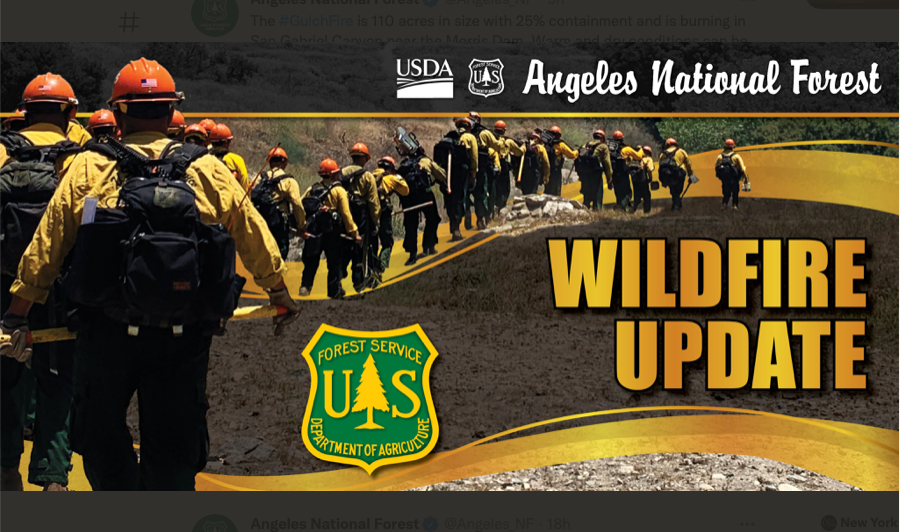
Gulch Fire means no East Fork access

From the U.S. Forestry Service (Tuesday, Aug. 30) 

The Gulch Fire is 110 acres with 25% containment and is burning in San Gabriel Canyon near the Morris Dam. The fire started at 11:26 a.m. on August 29, and is burning upslope west and northwest. Warm and dry conditions can be expected across the incident today with gusts pushing the fire northwest.

The Angeles National Forest is aggressively working to contain the Gulch Fire with 179 firefighters diligently working through the day and night alongside air support. Thank you to the Los Angeles County Sheriff’s Department and CHP Baldwin Park for their assistance on the Gulch Fire today.  

Due to the Gulch Fire and East Fire, there is no access to San Gabriel Canyon at this time. The fire danger level remains at “Very High” which allows for campfires and BBQs only in designated recreation sites (campgrounds and picnic areas).

While the cause of the Gulch Fire remains under investigation, 9/10 wildfires in the Angeles National Forest are human-caused. Visitors can help prevent wildfires in several ways:
–Please ensure that your campfires and BBQs are completely extinguished before leaving the area.
–Do not stop on the side of the road on or near dry brush.  
–If towing something, make sure your chains are not dragging on the pavement, as they can cause sparks that light dry grasses or brush nearby on fire.
–Fireworks are NEVER allowed in the Angeles National Forest or any other national forest.  

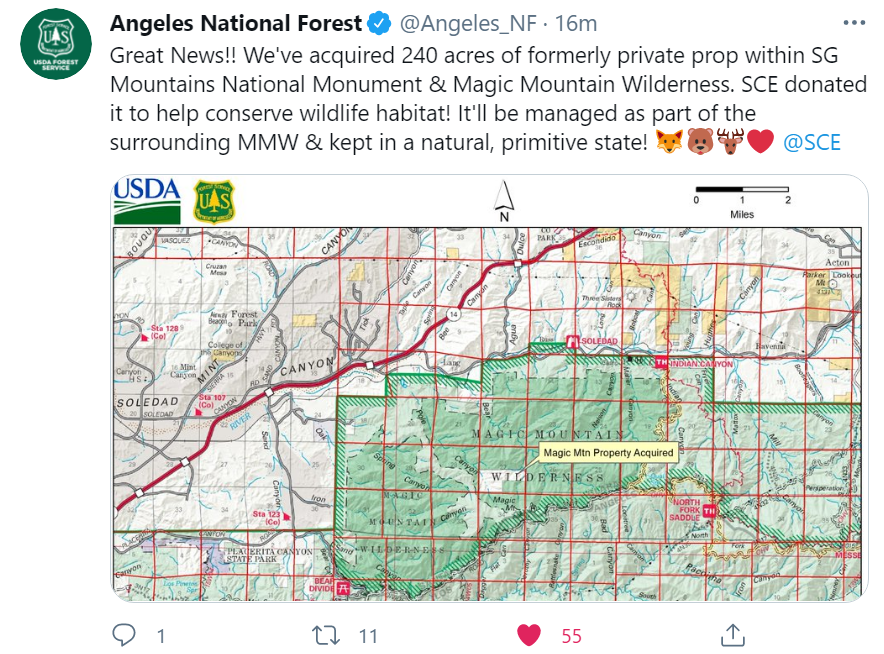
Our national monument just got bigger

Hands off San Gabriel Mountains National Monument, NGOs say

Just as millions joined women’s marches around the country in January to protest the election of President Donald Trump, now more than 100 hunting and fishing business owners and sporting organizations, and a California state congresswoman are reacting to the president’s executive order to review the Antiquities Act.

While the earlier protests were shouted into megaphones and emblazoned on signs, this one is quieter, in the form of a letter to Congress and a renewed attempt at legislation.

” We are writing in support of the Antiquities Act of 1906 and to request that it be used responsibly and in a way that supports the continuation of hunting and fishing in America,” begins the letter, signed by multiple companies across the country, including Abel,  Charlton and Ross reels in Colorado, but only one firm in California.

Four NGOs have lead the effort, Backcountry Hunters and Anglers, the National Wildlife Federation, Theodore Roosevelt Conservation Partnership and Trout Unlimited.

“The outdoor industry accounts for $887 billion in consumer spending and 7.6 million jobs, making it one of the largest economic sectors in the country,” said Jen Ripple, editor in chief of DUN Magazine and a Tennessee resident. “Much of this economic output depends on public lands. Tools for conservation like the Antiquities Act will help ensure that America’s public lands remain not only a great place to hunt and fish but also an important pillar of the hunting and fishing industry.”

Interior Secretary Ryan Zinke, currently in Bears Ears National Monument in Utah, must produce an interim report in June and make a recommendation on that national monument, and then issue a final report within 120 days.

According to NewsMax,  Trump said the protections imposed by his predecessors “unilaterally put millions of acres of land and water under strict federal control, eliminating the ability of the people who actually live in those states to decide how best to use that land.”

The land-controls have “gotten worse and worse and worse, and now we’re going to free it up, which is what should have happened in the first place,” Trump said at a signing ceremony marking the executive order.

Trump accused Obama in particular of exploiting the 1906 Antiquities Act in an “egregious abuse of federal power,” adding that he was giving power “back to the states and to the people, where it belongs.”

In December, shortly before leaving office, Obama infuriated Utah Republicans by creating the Bears Ears National Monument on more than 1 million acres of land that’s sacred to Native Americans and home to tens of thousands of archaeological sites, including ancient cliff dwellings.

Meanwhile, closer to home the San Gabriel Mountains National Monument, created by Obama in 2014, is one of 27 under review, which are mostly in western states. Last week, Rep. Judy Chu (CA-27) reintroduced the San Gabriel Mountains Foothills and Rivers Protection Act, according to Pasadena Now.

“President Trump has declared an open assault on our nation’s natural resources and outdoor spaces in favor of energy companies and oil exploration. Well I will not let him threaten our rivers, forests, wildlife, and outdoor opportunities in the San Gabriel Mountains. That is why I am proud to be reintroducing this bill to establish a National Recreation Area and expand monument designation boundaries, Chu said.”

At the time of its creation, some local conservation groups, including the Arroyo Seco Foundation, wondered why the national monument borders precluded some areas of the San Gabriel Mountains.

In an interview with Jeff Vail, supervisor of the Angeles National Forest and the national monument, that appeared in Sunday’s Pasadena Star-News, readers got a taste for what changes have occurred within the monument.

“The first year, we had five field rangers, last year, we had eight or 10 and this year we are upping that to 14,” he told columnist Steve Scauzillo. “We have a volunteer coordinator, Chris Fabbro. He has been in place now for close to two years. We have new positions, a partnership coordinator and conservation/education coordinator.”

According to Vail, last year Congress appropriated $33 million to his budget, while corporations have donated $5 million since 2014.

If you want to weigh in on why this national monument so close to 14 million Angelinos is important, comments may be submitted online after May 12 at http://www.regulations.gov by entering “DOI-2017-0002” in the search bar and clicking “Search,” or by mail to Monument Review, MS-1530, U.S. Department of the Interior, 1849 C Street NW, Washington, DC 20240.

According to the Interior Department, this is the first-ever formal comment period for Antiquities Act monuments.

See you on the river, Jim Burns