Tag: San Gabriel Mountains National Monument

And so it ends …

I began writing this blog when God was young — November, 2010. It sprang from exploring the LA River, then grew to include our national monument. Now that I’m in Oregon, I can’t provide the fresh reporting and content that made it fun for me and hopefully enjoyable to read for you. It’s time to say goodbye.
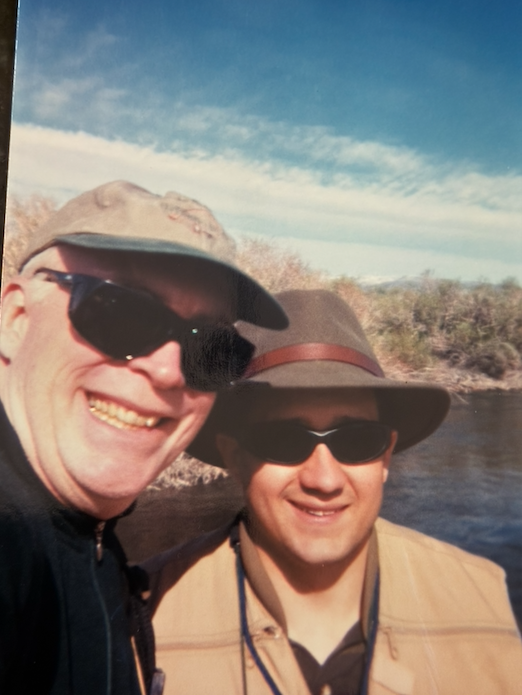
Oh, man, Dave and I had fish fever in the ’90s!

Along the way, I’ve made a bunch of friends: poets, photographers, cyclists, magazine editors, lots of fish lovers, a few dedicated biologists, one fellow dawn-patrol member, a lonesome cowboy, musicians, several tree huggers and even a few of the monarchical persuasion.

I’ve learned one thing: what you do is who you are. If you don’t do anything, but complain about a situation, you will be miserable, make your family, friends and acquaintances think you’re a total bore (or worse). And you’ll rob yourself of getting in on the greatest action of all: positive change.

I’ve met besties through the Friends of the Los Angeles River’s Off Tha Hook annual fishing throwback, inaugurated in 2014. Bob Blankenship, Karen Barnett and Bill Bowling, who together with Trout Unlimited South Coast chapter, continue to dream the impossible dream of removing some of the concrete from the lower river. It’s like the poet and activist Lewis MacAdams once said to me:
“When the steelhead return, we’ll know our job is done.”

The dude changed my life, and I barely knew him. But he was one of those people whose ideas are so potent they take on a life of their own.

Even here in the outdoor paradise of Southern Oregon, I think about the many times I spent exploring the forks of the San Gabriel, especially the West Fork. How many catastrophes has that water survived? Fires, mudslides, mountains of garbage, fishers who catch and keep above the second bridge. I knew that water like no other, knew its shade trees in summer, loved its talking winter waters, the cooling mists of its seasonal waterfalls.
So many guest contributors to thank, I don’t know where to begin: Roland Trevino, Mark Gangi, Freddie Wiedmann, Blake Karhu, Rosi Dagit, Bernard Yin, Keegan Uhl, Derek Flor, Malachi Curtis, Greg Krohn, David Del Rio, Analiza del Rosario, John Goraj, Patrick Jackson, Greg Madrigal, John Tobin, Jeff Williams, Charles Hood, Steve Kuchenski, Johnjay Crawford, B. Roderick Spilman, John Tegmeyer, Julia Spilman, Ansel Trevino, and Ken Lindsay. Some of them wrote multiple posts throughout the years. Thank you, all!

Then, there were the commenters. Of the more than 1,000 comments, some really got into deep explorations of our area, including moekhn, Jim Manoledes, TU’s Sam Davidson, Rivertoprambles, muddler5, PCC’s Scott Boller, Jessica Groenevelt, Capt. Joel Stewart. msangler, Ken Iwamasa, Larry Pirrone, Jack Train, Ken Uede, Omar Crook, Alex Brown, James Pogue, Bryan Rasmussen, paracaddis, Jane Herrmann, sublimedelights, Zino, Ryan Anglin, Trevor McTage Tanner, H. Carl Crawford, Al Q, Tim Brick, Janna Roznos, Izzac Walton, Celeste Walter, Fish Foo, Tilly, Gregg Martin, David Oh, Nicholas Blixt, paracaddis, Dianne Patrizzi, Fly Fishing God, Princess Hahamongna, and Lester Maypole.

Fifteen years and more than 330,000 views later, I can honestly say that many of the names on this page changed who I am and how I view the world. For there is no better starting place for learning to love nature than to see what gets lost in taming it. I think the point is not to doom spiral because of what we’ve lost, but rather to work like hell to try to keep what we have. In the coming years, that will be a particular challenge.
What would the world be without birdsong? Birding has become the No. 1 outdoor activity in Britain, even as we witness bird numbers crash around the globe. So what do you do? Where do you begin?

I started in my backyard with a couple of feeders, which I know my friends, the scrubjays, certainly appreciated when food gets scarce in winter snow. One will even call in my open office window to remind me, it’s time for more peanuts.

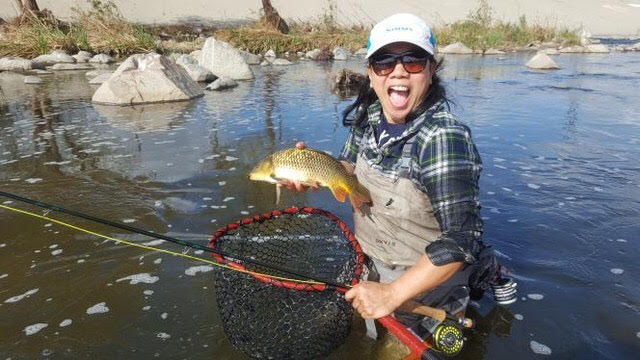
Where would the world be without fish? I’ve never worked in commercial fishing, but sport fishing so captured my heart that I’ve spend all this time documenting what it means to fish literally in the middle and on the edge of Los Angeles. And I can tell you one thing: given a chance, nature always comes back. May it be so in the future.

Finally, where would we all be without each other? That’s a scary thought, but many of our young folks don’t view society like their elders. Think about how apps have commoditized our mutual experiences. “Take me to the airport?” a big ask, has been replaced by Uber. Pay for play, instead of friendship reciprocity. What were once blind dates, set up by a friend, have become the domain of Tinder. And risking talking about your feelings with your friends, well, now that, too, is paid for with a human — and increasingly — an AI therapist. We must be careful to not let technology separate us from each other. It takes an effort to pull someone (including me) away from my cell. Make the effort. It begins with the loss of communication, but, really, it’s about the loss of trust, as young writer Clare Ashcroft, puts it so well in The New Critic.

I am convinced there is no antidote to trust loss quite like getting out of doors. Simple things, like remembering the vastness of a blue sky, the smell of recent rain, the chatter of birds that makes you wonder what to call them. Running waters hold a kind of magic, but only if you take the time to slow down, look and listen. Nature has its way of breaking down barriers. Take the time. Consider bringing a friend, especially a younger friend, on your next adventure. We really do need to learn to trust each other again, and the outdoors can teach us how to regain the bits we’ve lost.

For the last time, see you on the river, Jim Burns

RIP, a true visionary and friend, Dave Baumgartner.

Hey, get out there!

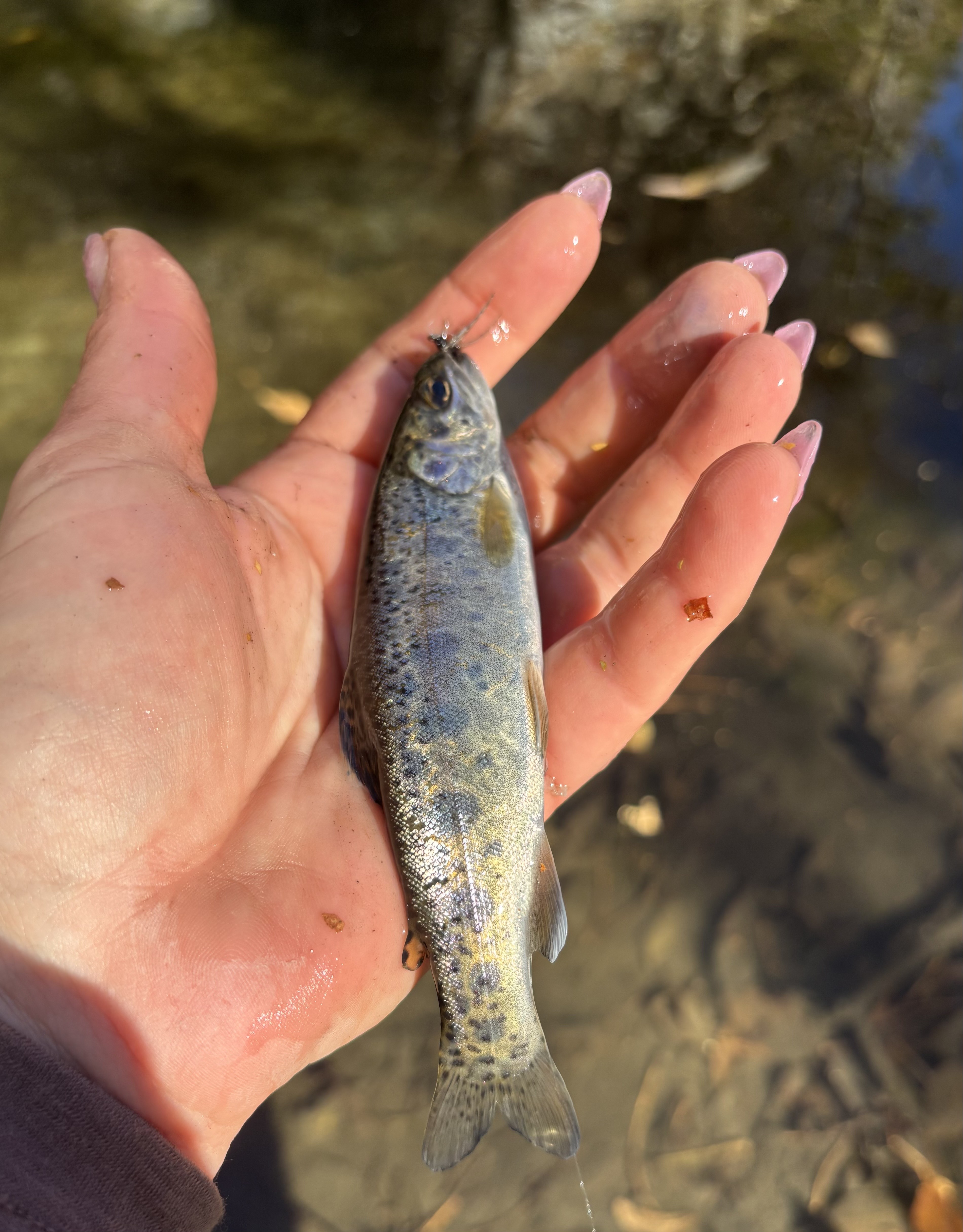
A better-than-average SoCal rainbow. It’s a great time to be on the water.  Good flows, lots of bugs, snakes are still “chilling” and fish are hungry. Remember  the West Fork is closed during the week again this year and open weekends. — Blake Karhu


Could the Gambler 500 be a quirky solution to our Monument’s monumental trash crisis?

Update: Local trout are still active

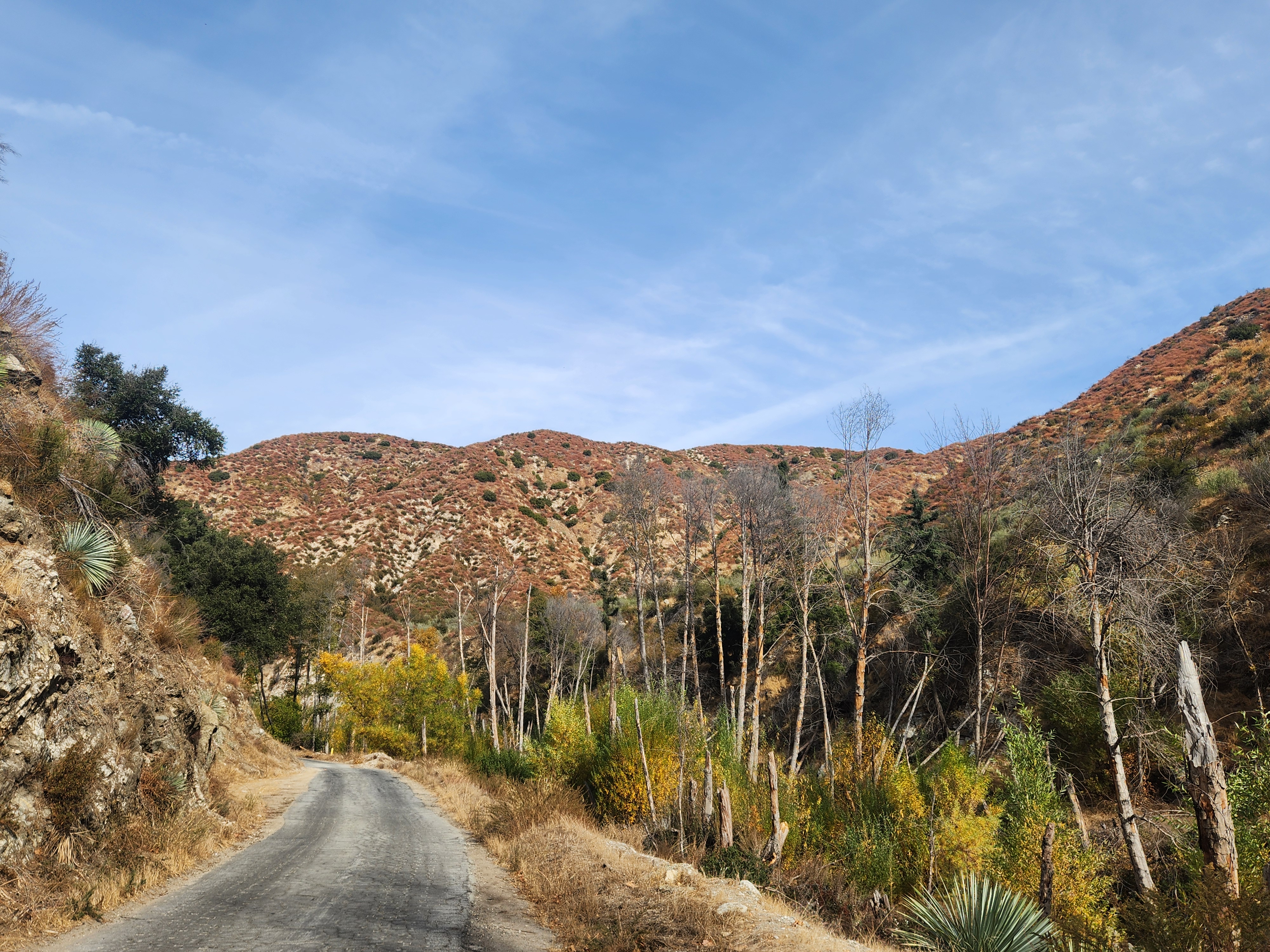
THE BOBCAT FIRE hit the West Fork San Gabriel hard in 2020, but the land is recovering.  Fall hillsides are red with native deerweed and riparian woodlands are regenerating. Dead trees are falling in the river making log jams and good fish habitat. Credit: Blake Karhu.

By Blake Karhu

Greetings SoCal fly fishers.  Our good friend and messenger of the local streams, Jim Burns, has relocated to fishier waters up north and he asked if I would share an update with you all.

We have been dealt a late arrival to cool winter temps this year and our local trout are still active.  So, if you like solitude and the contrasting late fall colors of our natural landscapes, then this is your last chance to get out there before real winter sets in and trout fishing is largely on hold until spring. 

After some of the highest flows in years, flows are now low and the early fall extreme heat wave was stressful for fish and aquatic insect populations.  The trout are cautious and your A-game is required for the bigger fish (“bigger” = larger than 9 inches in in most local streams). 

The good news is that after years of drought and fires, most of our watersheds are largely bouncing back as they naturally do following good rain years, so there are a lot of young trout in the streams too.  

Not to say that the fires are not destructive, especially if they are too frequent, and the Bridge Fire on the East Fork San Gabriel represents a once in a generation reset of that watershed.  Fishing may be on hold there for two or more years as the trout population recovers.  

Nymping is generally the way to go this time of year but dry flies can still get them, especially during the warmest part of the day.  Also, be gentle when catching and releasing fish as they prepare to spawn and don’t fish for spawning fish–we need all the spawning success we can get as local streams are no longer stocked.  Barbless/pinched barb hooks, wet your hands before handling fish, and keeping fish in the water as much as possible is key. 

Some good catch and release etiquette from CDFW >>HERE.

Good luck and enjoy our local natural treasures! 

Timothy

14h ago

I was just out at the West Fork today, after not fishing it for about 6 years. I’m happy to report that there was the least amount of trash and graffiti I have seen, probably since the late 90s, when I first learned to fly fish up there. The water was low, though not the lowest I have ever seen. Many of my old spots were gone. For example, the straight that runs from the West mountainside under the first bridge to join up at Bear Creek. That entire section, probably 75 yards, used to be fabulous. Caught many fish there.

On the West side of the bridge, the water split in two for about 20 feet and came together again to create a deep and productive pool. Not there anymore. I saw another young guy fly fishing there and he claimed he caught something, but I didn’t see any fish or any rises. It was ok enough for me to return soon.

I live in Riverside County now, so its about an hour drive for me. I have to compare that to the drive to Bishop and the Owens, which is three hours and much better fishing. I sincerely hope the river continues to recover and we see a return to the glory days, which to me ended with the drought in SoCal in the late aughts.

Public lands, our responsibility

You can check out American Fly Fishing mag>>HERE. My short story is in the current issue.

You never know what you actually miss about a place until you’re no longer living there. I spent about 40 years in SoCali, I think. And while I can tell you a lot of things I don’t miss about living there–the traffic being No. 1–I do miss the land, especially the San Gabriel Mountains National Monument. I spent years exploring its creeks, rivers and have so many special memories of the place. Many of those spots I chronicled on this blog.

Caught with a tenkara rod and reverse dry fly, this wild trout is a winter beauty. (Permission France Mer)

It’s super gratifying to get emails from readers who are looking for the same kinds of excitement I always found in those bone-dry hills. This week’s was from a young woman who just relocated from Montana! She wrote ” I’m … ready to drive 2-3h for the thrill of catching even small guys :).” She gets it.

Even here in Oregon, I’ve not found a thrill so big as being able to coax a small wild trout out of hole that’s not deep. I guess I’m the guy who says, “Hey, it’s a miracle!” about a seven-inch rainbow, instead of showing you just how dang big that sucker was from my last fishing safari. Just knowing that life continues on, if we only help it along a bit, is a thrill that kept me going back again, and again.

Here in Southern Oregon, this week, I was one of a few who volunteered to check hoop traps to see what was coming up the small streams. Our fish ID chart included Coho, Chinook, Steelhead and Cutthroat. This tiny creek ran next to a local high school, and the biology teacher there has lead a fish in the classroom project for something like the last dozen years. While in So Cal we call it “Trout in the Classroom,” here it’s called “Salmon in the Classroom.” Different name, same spirit. Those lucky students just need to walk out of their classroom to watch citizen science in action.

I also had to leave the Fisheries Resouces Volunteer Corps and miss the friends I made in that terrific organization. If you ever thought about volunteering, FRVC could use your help. Get more information >>HERE.

Check out what they did this year:

  • 13,646 lbs of trash removed
  • 195 recreational dams removed
  • 431 tags removed
  • 51 angler surveys recorded
  • 57 events and projects attended, plus countless patrols.

Can you believe that trash number? I can tell you that all the garbage is removed by people who care about the land. It’s all done by hand and takes a lot of work. A day of garbage collection in the San Gabes leaves you tired, possibly angry at the lack federal solution to stem the tide, but overall happy. While you’re toiling away wondering why some of your fellow Angelinos just toss away their pizza box and El Pacificos, instead of getting jaded, you can find hope in kindred spirits.

The fact FRVC only logged 51 angler surveys is a bit disturbing. If you go out to the West Fork, don’t forget the angler box is just above the first bridge. Take a few minutes to log your catch.

See you on the river, Jim Burns
FRVC President passes away

It is with much sadness and a heavy heart that I share with you all that Dave Baumgartner has passed away.  He had been battling cancer since December 2021.  His goal was to stay as active in our forests as long as possible, which he did without complaining.  Dave was trail building in April and was out on patrols in May!  He lost his battle on June 1.

Dave had a wonderful life that he lived to the fullest, filling it with adventures and good people!  He spent every day possible volunteering, working or recreating in the Angeles and San Bernardino mountains these past 13-14 years.  He never tired of exploring our mountains, being on patrol with fellow volunteers, or telling his stories and sharing Dave’s Fun Facts! 

He appreciated all of our FRVC volunteers!  Whether you were regulars on his patrols, worked with him occasionally in the field, at an event or on administrative items, were trained by him or didn’t have the opportunity to meet him, he knew that you all are the life of FRVC. 

Dave’s request is that we all work together keep FRVC growing strong.  I did promise Dave that I’d remain active in FRVC to not only continue to do the things I loved in our organization, but also to honor him and the work he has put into FRVC.   

The Forest Service has offered to hold a Celebration of Life later this year.  I will provide details when we have a firm plan. In lieu of flowers please donate to your favorite charity or add a photo or memory >>to Dave’s History.

Thank you all for your support! 

Jane Baumgartner

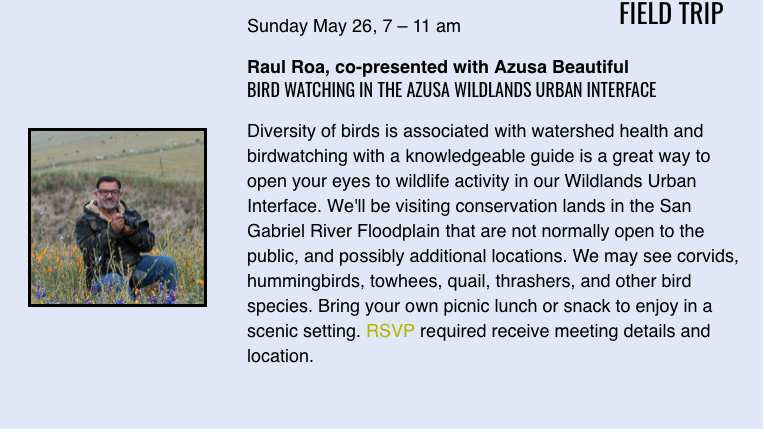
Get to know the Monument: WCA adds free field trips this summer

The Watershed Conservation Authority (WCA) is offering a series of Zoom talks and field trips to explore natural and cultural resources in the Wildland Urban Interface where development meets the San Gabriel Mountains. WCA will be sharing the work of collaborators from different fields who contributed studies to inform WCA’s priorities for acquisition of conservation land in the Wildland Urban Interface, that delicate zone where development has occurred in areas that are dominated by natural processes. The goal of the events is to promote dialogue about these priorities and the role of conservation in the foothills Wildlands Urban Interface. CHECK IT OUT HERE >>

These events are free and open to the public. Please remember to RSVP to save your space and receive meeting details.

Inside the Monument: Spring wild trout spawn

By Miguel Lizarraga

Returning to the moving waters where my father first introduced me to the art of fly fishing three decades ago feels like a journey through time, each ripple on the surface a memory stirred.

What once was a simple father-son outing has now transformed into a pilgrimage of sorts, as I witness the fruits of nature’s labor. In the tranquil stream where my father patiently taught me to cast my line without snatching a tree limb above me, wild trout still spawn. 

Not fires, pollution, and other of nature’s wrath can stop these fish.  Even though graffiti and trash may still paint the picture, the trout are doing their part.  It’s time that we do ours.

East Fork Trail closed on Saturday by FS to avoid hassles with miners

Get this. The East Fork of the San Gabriel River is closed because of zealous miners and the Forest Service trying to mitigate any hassles between them and the general public. Apparently, the rain brings out better gold mining conditions. Also note, it is illegal to mine within the National Monument!

Larry Pirrone

4h ago

I imagine that the miners blame the fishermen for putting pressure on the forest service. I think the EF may be a very dangerous place right now.

Update: Malachi Curtis reports, “I ended up heading up to see the east fork and it wasn’t or was no longer shut down. The bungee jumping company had a full group of people they were taking to the bridge. I fished there for an hour or so and landed two fish.”

West Fork weekday fishers — enjoy it while it lasts

This sign near the Pasadena Bait Club House, didn’t survive the Bobcat Fire, but it still say it all. Next sign, let’s scratch “fishermen” in favor of “fisher folk.” (Credit: Jim Burns)

Just when the SoCali fly fishing community thought it could relax and put the wet boots up, turns out that’s not the case. Word on the stream-street is that the weekday closures will begin again in March for more silt removal that could last another two to three years! Yup, that means all the heavy equipment comes back, the guy at the gate will most likely be shooing folks away and — you will be trying to fish your weekend way through the inevitable growing spring and summer crowds.

So, enjoy this wonderful winter quietude while you can. It ain’t gonna last.

See you on the river, Jim Burns