This snap is actually from May, 2021, behind JPL, but it sums up our collective sentiments about trash. (Credit: Jim Burns)
It’s worse than being on the bad side of Santa’s naughty or nice ledger: the San Gabriel National Monument has joined the travel magazine Fodor’s “No List 2024.”
Sites land on the list for several reasons. For example, of the nine “winners” this year, Venice bellyflopped because of over-tourism. This is nothing new, but, as the mag says a five Euro tourism fee is likely to do little to curb the tourists-to-residents ratio that landed the beautiful city on the list last year and in 2018. It joins Athen and Mt. Fuji in this category.
Then there’s the “water quality and sufficiency” category that includes Lake Superior, the Ganges and Koh Samui, Thailand. Lots to write about here, but it’s too depressing to pen. You can read about it >>HERE.
Then finally the USA makes the list in “trash production,” along with Ha Long Bay, Vietnam, and Chile’s Atacama Desert.
Up until this point, Californians could be rightly proud of the many lists our state treasures have been included in, such as the National Geographic National Parks Road Trip, which features the Redwood National and State parks. Now?
Public outcry is the only way to save this beautiful area we all love. Get vocal. Get loud. This land truly is “our land,” as the song says, “this land was made for you and me.”
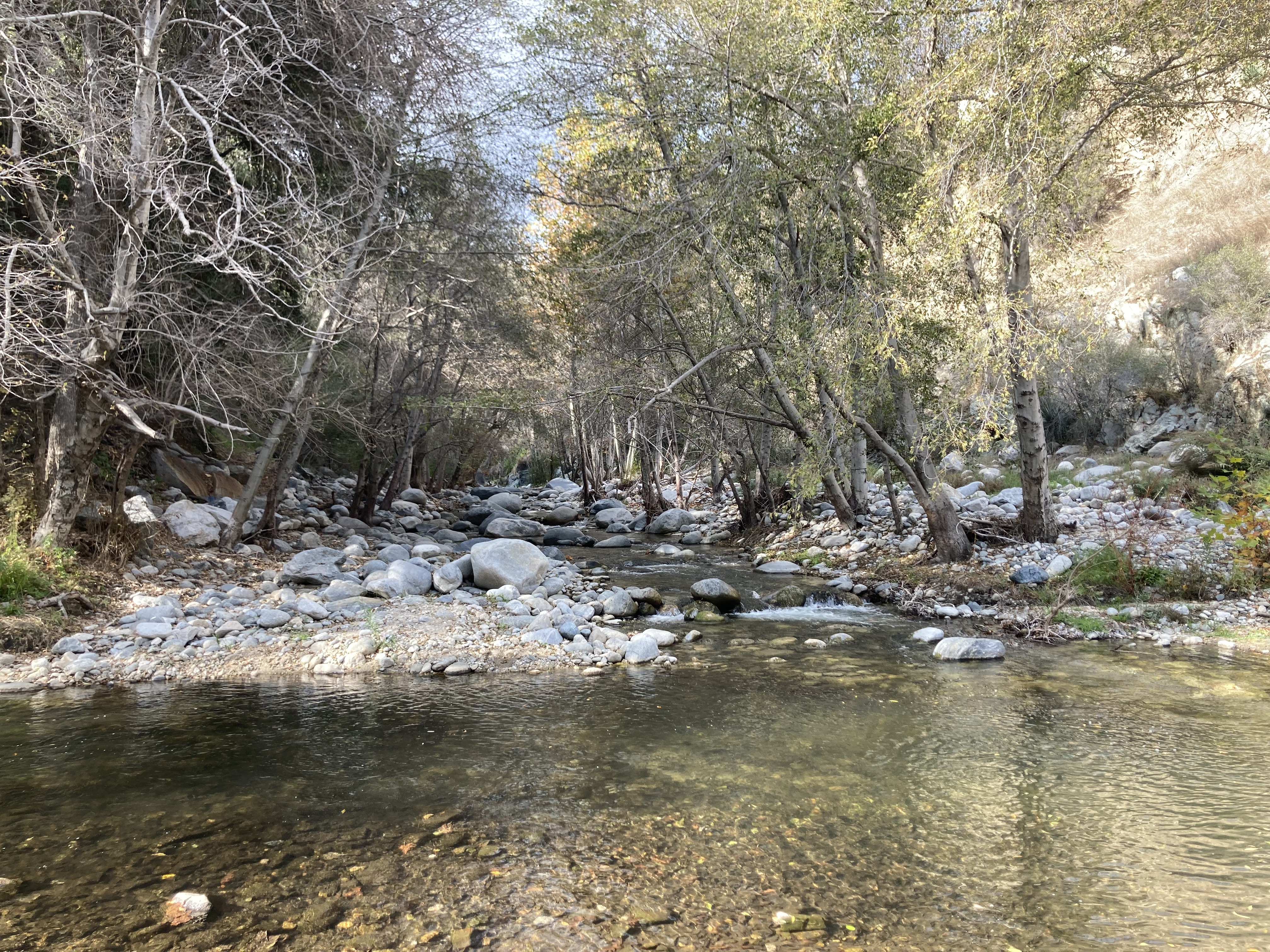
The beckoning entrance to Bear Creek last week, far from the madding and messy crowds of summer. The goal should be to keep the monument in pristine condition. This will take federal money, local money, grant money, a transparent Forest Service, many dedicated volunteer groups, a strong enforcement arm and public education to get off Fodor’s “No List.” (Credit: Jim Burns)
IF THIS GRAFFITI bugs you, why not make a quick phone call to our friends at the Forest Service, (626) 574-1613? (Credit Jim Burns)
We Southern California steam fly fishers are a unique lot. If you’re reading this, you must love overcoming obstacles. After all, for a modest investment in an 8 weight, a decent waterproof reel, working on a longer cast and a sinking line, there’s the Pacific Ocean right in front of you, with its siren call of corbina runs, maybe a halibut and, for sure, a perch. (Just don’t bonk any beach joggers on the head when they absentmindedly walk into your back cast. That can lead to therapy — for both of you!)
Yet, here you are wandering the San Gabriel National Monument, doing the Curtis Creek sneak behind JPL, pondering a long drive to Deep Creek or scouting Piru Creek to the west. I mean, what’s with you?
Your friends up north, think you must be a bit daffy to get excited by a hand-size catch that takes a full-size outing to snag, or stiffle a chuckle when you tell them about the three (count them, three) fish passages in various stages of planning on the LA River.
They want to chase steelhead, dammit, on the Klamath or the Trinity; or bow a spey rod lifting a massive Lahontan Cutty at Pyramid Lake, or shiver through a UFO encounter and a fighting ‘bo on the Nature Conservancy water of the McCloud.
The heavy equipment that removed thousands of tons of debris are gone, but the scarring remains. (Credit Jim Burns)
The very fact we have a lot of water that can or might hold wild trout right here in dry, hot Southern California thrills you. You wonder if your ancient Orvis 2 wt. might work well as a Euro rod? Contemplate getting up at dark thirty, just to explore another skinny water and see if it holds trout. Wonder if that was actually a Trico on your windshield and then dream about how the stubborn finny friends who have survived, dams, drought, fire and trash, trash, trash might react to one on 7x tippet? Good lord, those little fellas could hold the genetic makeup of the endangered Southern California Steelhead!
Well, what can I say, I’m right there with you. We are both giddy optimists! I love exploring what we have here in So Cali. And, finally, at long last, tomorrow is opening day on the West Fork of the San Gabriel River. After so, so long being closed during weekdays for a Public Works rehab of the water and riparian habitat conflagrated by the Bobcat Fire, it’s back.
Oh, just don’t mention that part about the UFOs in Dunsmuir. It’s secret.
See you on the river, Jim Burns
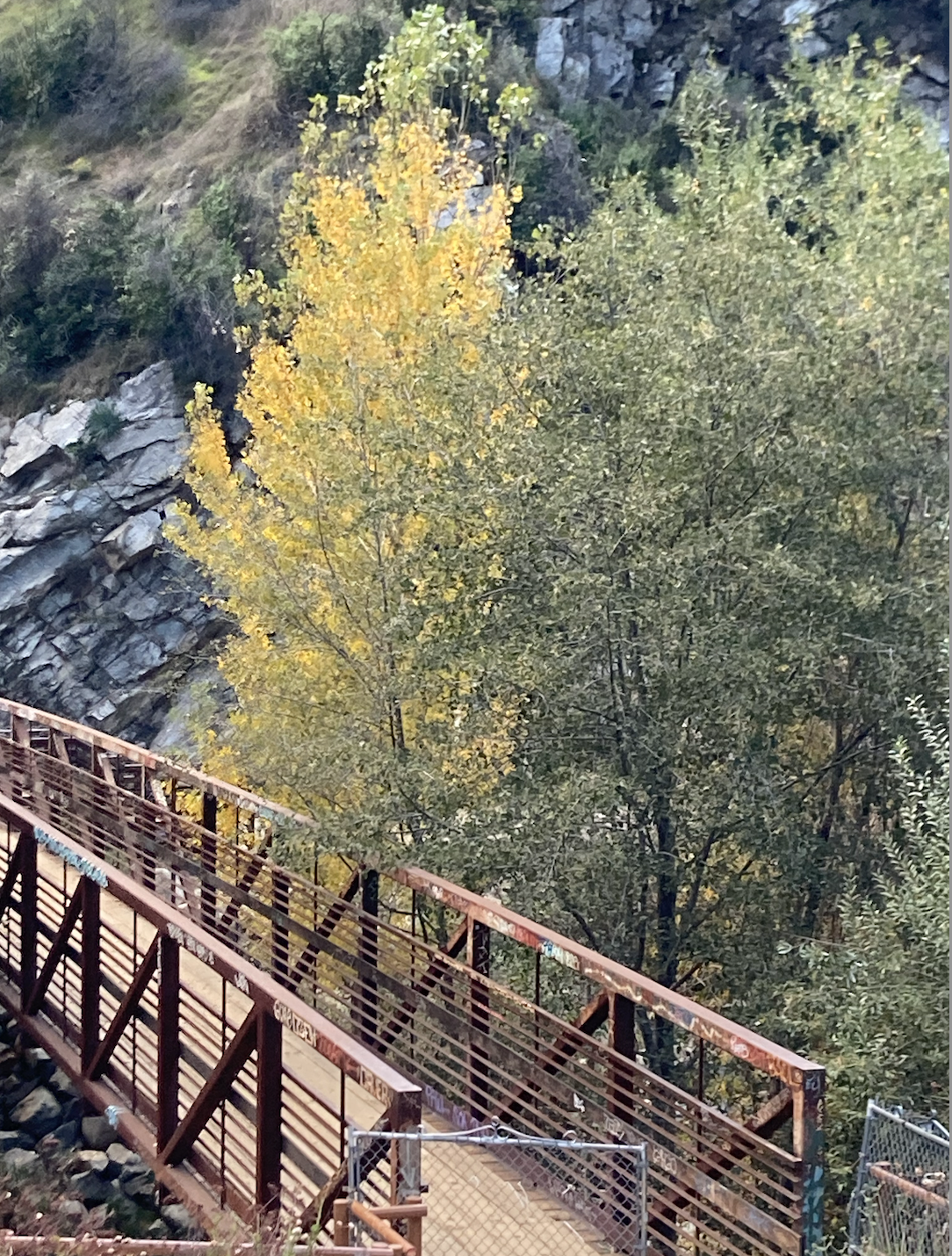
Only the truly optimistic So Cal stream fly fisher dreams of crossing a graffiti scarred footbridge to find paradise. (Credit Jim Burns)
Derek Paul Flor just commented
Tiring of the long and expensive trek up 395, I have decided fishing the local opportunities has it’s own charm. Catching fish then returning them to fight again, has it’s own charm, and in our pressured local waters, it just seems so right.
The closure is over, with some restrictions, but the damage from the Bobcat Fire won’t be for years to come. If you have any fly-fishing stories from the West or East forks of the San Gabriel, please email them to me for posting. I haven’t been able to return to the West Fork quite yet … .
Imagine if, every so often, a cataclysmic storm washed away a mile of beach. One year, the Santa Monica Pier — gone. Five or 10 years later, the cliffs overlooking Lunada Bay fall into the ocean. The scale of our climate emergency would be achingly clear to the legions of Angelenos who treasure our coast.
Something similar is happening in our mountains, where massive firestorms year after year are turning shaded trails into ashen hellscapes, permanently altering forests that have adapted over thousands of years to survive fire, but not this kind of fire. A few weeks ago, I got my first intimate glimpse of this destruction on a trail that opened to hikers April 1, following a 16-month closure by the U.S. Forest Service after the last fire.
I’m talking not about the Sierra Nevada and its giant sequoia groves — though the destruction there is grave — but rather the humble San Gabriel and San Bernardino mountains, right on our doorstep. These mountains, which top out at more than 11,000 feet, make people who live in Los Angeles and love to hike in thin air extremely lucky folks.
We hikers are a cheerful bunch. But the sense lately that our forests have been pushed beyond their ability to recover has turned many into anxiety-stricken doomsayers, ever worried that the next cloud of smoke rising over the mountains on a hot, windy day means the fire has finally come for their spot.
And the last fire did indeed come for my spot — or I should say our spot, since it was a place I enjoyed with my three young children only months before the Bobcat fire stripped it of its foliage. That fire, from September to December 2020, scorched roughly 115,000 acres; it was the second-largest wildfire on record in Los Angeles County, occurring only 11 years after the 2009 Station fire, which burned more than 160,000 acres (about the size of the city of Chicago). In fact, some areas of the forest were still recovering from the Station fire when the Bobcat fire devastated them again.
Now, I know burns are often beneficial to forests, but what came through much of the trail I hiked two weeks ago, high in the San Gabriels off Angeles Crest Highway, was cataclysmic. The dense forest was reduced to burned trunks that from a distance looked like blackened toothpicks. The nearby highway, once hidden from view by healthy trees, was almost always visible, as if to remind hikers of the fossil-fuel consumption driving this destruction.
Still, about halfway into the hike, there were signs of survival and renewal. An area that I feared had been damaged looked almost unscathed. Other hikers were enjoying this section of the trail, perhaps thankful as I was. This contrast — between being utterly unprepared for the destruction I saw and pleasantly surprised by what remained — prompted me to check in with an expert about this forest and these mountains, just to see if I was being alarmist.
“Sadly, no,” said Alan Coles, a 30-year U.S. Forest Service volunteer who spends most of his weekends working on public trails. “Because it’s the plants that adapt to the climate, not the climate that adapts to the plants.”
I knew of Coles from his letters to The Times about forest management and his contributions to an online trail guide. He has scouted some of the areas hit particularly hard by the Bobcat fire, working with trail restoration crews to allow for safe public access to the forest in time for the April 1 reopening (parts of the Bobcat fire burn area remain closed). He told me the area I saw, about 6,700 feet in elevation, was hit hard, so the pines and firs there were almost completely killed off, leaving little chance of recovery.
Over the coming years, he said, the dead trees will fall, probably to be replaced by lower-lying chaparral. He pointed out places where this is already happening, in areas burned by the 2009 Station fire and previous disasters. Throw in global warming and the droughts and wildfires to come that will surpass what we can imagine now, and it’s hard to imagine future wanderers enjoying the generous tree canopies that shade our mountain climbs on sunny days.
My conversation with Coles felt at times like an impromptu grief counseling session. We traded stories of places permanently changed, animals and plants disappearing from the forest, and our experiences with the dreaded poodle dog bush (it’s a “fire follower” growing everywhere now, and under no circumstances should you touch it).
With much of the Bobcat fire burn area reopened and the summer hiking season about the begin, Coles and other trail workers want visitors to understand the forest is still in recovery: So stay on the trail, pack out trash, keep dogs leashed and — for the love of God — avoid starting the next fire.
As we were leaving the San Gabriels recently, I told my three children to look around and try to imprint on their memories what they were experiencing at that moment — the smells, the breeze, the rocky ridgeline trapping the last rays of daylight. Remember it, because every visit to the mountains could be your final goodbye to the forest you know.
Note: I wanted to bring back this post from 2012. With all the rain we’re getting, maybe fly fishing will return to what it was in the San Gabriel Mountains before the drought and the Station Fire. Winter’s always a good time to dream about the next cast.
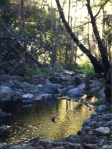
The canyons are full of quiet, beautiful, “fishy” spots. (Jim Burns)
Brrr, it’s cold out there, and even colder in the many fishable canyons of So. Cal’s San Gabriel mountains. Here’s how to have some fun:
1. Play hooky any Monday, Tuesday, Wednesday or Thursday. Skip Friday and forgettabout the weekend. There are always several thousand people who have the same idea at the same time. Crowds = lousy fishing.
2. Dress warmly in layers. Long underwear is a blessing this time of year.
3. Take it easy on the way down. Watch for gravel, sand and rocks that might give way. They will. Count on it.
4. Start with dries and move to nymphs. I know what you’re thinking: no hatch = no surface action. You might be surprised. Of the 10 fish I caught on my recent canyon adventure, two were on dries. Pick the usual suspects. Parachute Adams and his friends.
5. When you do reach into your fly box for a nymph, give that beadhead yellow sallie a try. I know it’s an underused Stone Fly, but the other eight fish I caught were all on this fly. Must be the legs.
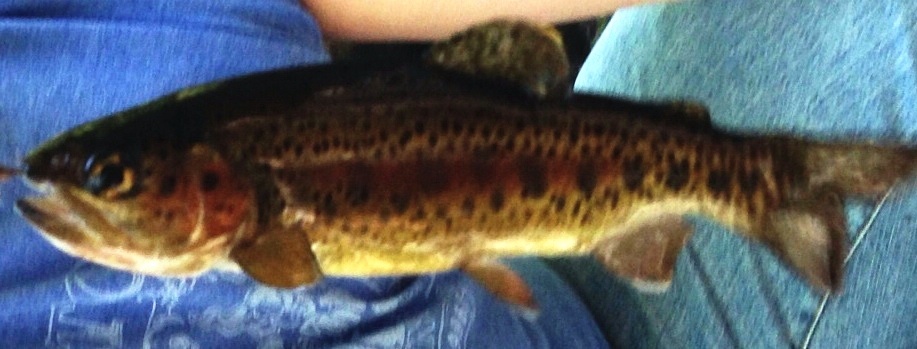
This little rainbow got snapped quickly and then went back in the frigid stream water. (Jim Burns)
6. Smaller is better. Even with all of our rain, flows are down. Size 14-16 or above, please.
7. Pack a lunch and extra water.
8. Bring a friend, someone who will make you laugh at some of those tiny trout you’re bound to hook.
9. Don’t wear hiking boots on slippery rocks. Just because the water’s cold, any rock in the water is still as slippery as it is in summer.
10. Turn your cellphone off. Keep your camera on. I know, you’re saying that there’s no service up there anyway. True, but it’s the principle.
11. Post your pics, so we can all see how good you look grippin’ ‘n’ grinnin’.
12. Keep an extra water and energy snack in the car.
Baker’s dozen: Get down. Get tired. Get silly. Get grateful. Repeat.
CRAFTY CATCH: Under these drought conditions, it takes skill as well as stealth to land one of these jewels. (Jim Burns)One of the great things about fishing an area over a long period of time is that you can really get to know the water. You know that 50 paces up, there’s a great little hole, or you remember the one waterfall that always seems to have a trout underneath it. When my son and I hit a new river or stream, we always expect the worst, then, if it’s a good day, we get super-stoked about the results. That’s one reason a guide can charge you $400 for a day out in his neck of the woods … it is, after all, his neck of the woods, and so the thinking goes, you can slap water for the cost of a few flies, or get into the fish with expert advice.
There are sections of the San Gabriel Mountains where I feel at least close to being an expert, simply because I’ve spent so much time tramping and casting. But, that said, I hadn’t returned to one of my favorite loops in about a year because fishermen had busied themselves strip-mining out all of the fish. Remember, the fish you find on the West Fork, the East Fork, Chantry Flats and behind JPL are natives, not plants, as stocking stopped many years ago. Why we don’t have signs in multiple languages to leave the fish where they are — catch and release — is not only important, but key to their survival.
That much time certainly had passed between my last adventure and Sunday. Swarms of people exiting the parking lot really turn me off, but I was pleasantly surprised by how many of them stayed on the beaten path, while Will and I were able to disappear into some of the lesser-known canyon folds. Our canyons, folks, are a beautiful gift to behold.
Will was testing a new rod, a 3 weight, 4 section, with a sweet fast action.
We didn’t know what to expect from news reports, but also from a phone call to a ranger who said, “Well, you do know there’s a drought on.” Would there be any fish at all? After all, we’d canvassed parts of California’s Golden Trout Wilderness in which healthy streams disappear during summer trout conditions.
Alas, we did see an old favorite pool now choked with algae, water looking barely breathable for the trout who had come back from that strip-mining last year. There were small and wary.
We moved on to another pool, one in which two aggressive males spared with each other. The first time I saw that kind of movement, I mistook it for spawning; it’s more like Irish brawling. Needless to say, when this kind of action is happening, the fish are much more interested in kicking some ass than taking your fly.
Next pool: looked pretty dead, but with a decent amount of water still there, but the color was dark and off-putting, and tree branch sat ready to snag any carelessly thrown fly.
But, as I answered the inevitable question — “Are there fish in there?” — for the sixth time, I heard, “Dad,” with an intonation I’ve learned over these many years. Fish on.
Will had mined a pool in one of those beautiful creases, the kind that makes you forget you are so close to city lights. That trout was a beaut, snagged on a Parachute Adams, very dry.
“Good fish,” we both remarked and did a little laughing and whooping as well, enough so I’m sure the hikers thought there must be a constant stream of gorgeous trout just waiting behind every rock.
“Good luck rod,” we both agreed, and I’m sure it will be, just as soon as Mother Nature blesses us with the water we so badly need.
Brrr, it’s cold out there, and even colder in the many fishable canyons of So. Cal’s San Gabriel mountains. Here’s how to have some fun:
1. Play hooky any Monday, Tuesday, Wednesday or Thursday. Skip Friday and forgettabout the weekend. There are always several thousand people who have the same idea at the same time. Crowds = lousy fishing.
2. Dress warmly in layers. Long underwear is a blessing this time of year.
3. Take it easy on the way down. Watch for gravel, sand and rocks that might give way. They will. Count on it.
4. Start with dries and move to nymphs. I know what you’re thinking: no hatch = no surface action. You might be surprised. Of the 10 fish I caught on my recent canyon adventure, two were on dries. Pick the usual suspects. Parachute Adams and his friends.
5. When you do reach into your fly box for a nymph, give that beadhead yellow sallie a try. I know it’s an underused Stone Fly, but the other eight fish I caught were all on this fly. Must be the legs.
6. Smaller is better. Even with all of our rain, flows are down. Size 14-16 or above, please.
7. Pack a lunch and extra water.
8. Bring a friend, someone who will make you laugh at some of those tiny trout you’re bound to hook.
9. Don’t wear hiking boots on slippery rocks. Just because the water’s cold, any rock in the water is still as slippery as it is in summer.
10. Turn your cellphone off. Keep your camera on. I know, you’re saying that there’s no service up there anyway. True, but it’s the principle.
11. Post your pics, so we can all see how good you look grippin’ ‘n’ grinnin’.
12. Keep an extra water and energy snack in the car.
Baker’s dozen: Get down. Get tired. Get silly. Get grateful. Repeat.
See you on the river, Jim Burns
The canyons are full of quiet, beautiful, “fishy” spots. (Jim Burns)
This brown got fooled by a lot of elk hair caddis on a size 14 hook. (Jim Burns)
This little rainbow got snapped quickly and then went back in the frigid stream water. (Jim Burns)
Springtime has definitely hit the San Gabriel Mountains. Monday (the best time to fly fish to avoid the weekend rush) walking down to and around my favorite canyon, there were critters aplenty. A 4-foot-long Striped Racer slithered just in front of my booted feet, giving me a good scare; what I think was an Eastern Fox squirrel jumped onto a thick tree trunk to inspect me (He found me lacking …); and I spotted a pair of what I believe were Yellow Warblers, mistaking their coloring and size for distant Monarch butterflies appearing and disappearing in the forest canopy.
A fellow hiker cautioned me in the tree shadows: “Look,” she said, “can you believe it?” And there on the ground were a half-dozen or more of this butterfly. But, the question is, what’s it’s name? My handy Pocket Naturalist Guide (which you can get at the Audubon Center at Debs Park) lists the distinctive orange Monarch, the Painted Lady, The Cloudless Sulphur and three others, but none has those amazing horns. If you know what it is, please post the answer.
Meanwhile, for fishing our streams, stick with dries only, and tie on some stealthy 7x tippet to your light leader. Any lighter-weight rod will do, but if you’ve got a 2, 3, or 4 in your arsenal, take it. Also 9 foot is a bit much for our water, with its tight canyons and brush. Eight foot, six inches or shorter is a better choice.
Rainbows and browns were going nuts on just about everything I threw in. Keep the sizes small, 16 or better, but I’ll tell you it’s
This brown got fooled by a lot of elk hair caddis on a size 14 hook. (Jim Burns)
amazing to see a small fish latch on to a fly half its size when you toss a 10 or bigger! Ants are everywhere, so casting a parachute ant should bring good results. Unfortunately, the annoying small black flies have made a comeback, and I spotted a hatch of something tiny and gray-mosquito-colored coming off the water as well, so dark colors are a good bet. Also, pale or light green are perennial favorite colors. And you won’t catch just minnows. There are plenty of bigger fish in our mountains. Please ALWAYS release the fish you catch in areas that won’t be stocked. These are naturals and once they’re gone, so will be our opportunity to enjoy this beautiful resource.
Tramping through the San Gabriels today with my son was a wonder: we caught 16 trout, rainbows and browns, in a half-day’s work. I even foul-hooked a rainbow, which is certainly nothing to brag about, but was fun all the same.
But the point of this post is, please, don’t trash the wilderness. I walked through some brush, only to be snagged by old line that someone had left carelessly near a stream. Attached to it was an old-school wet fly, around a No. 4, so I guess I’m a fly richer, but that could have also tagged me in the eye. Not cool.
I also found a discarded spinning reel (!), more line at another part of the stream, and a Sports Chalet receipt that didn’t looked great against the wildflowers. I mean, come on, if we want to keep our resouces safe and sacred, we can’t treat them like a public toilet.
Remember: pack it in, pack it out.
And, if you are fishing in areas that don’t get stocked, please release your catch. One hole I’ve fished for many seasons with success contained only two small trout. I doubt that my other friends fell prey to cranes or other feathered pros. If you take out the fish, they are gone, Period. Once the fish are gone, what’s the point of our sport?
Sorry for the rant, but as you prepare to get out there for a fantastic season of fly fishing, let’s respect what we have. Please repost.







 lariverflyfishing