Yucking it up in 1938: Herald-Express photographer Coy Watson Jr. (left) and reporter Fred Eldridge (Courtesy KCET).
The Los Angeles Regional Water Quality Control Board is conducting an evaluation of the recreational uses of the channelized rivers and streams in the Los Angeles River Watershed.
As part of this effort they are soliciting information from stakeholders (through a survey) regarding what rivers or streams are visited in the watershed and which recreational activities are enjoyed in and around these bodies of water.
They are conducting this survey in conjunction with KCET and Council District #1 (City of Los Angeles).
First off, congratulations to everyone who attended yesterday’s big river cleanup! Pictures will be posted in this space tomorrow from the event.
Next, now that you’re fired up, take a look at these two links that make it easy to find out who your elected officials are and, equally important, what they’ve been doing.
Fletcher Bridge is definitely in the 31st district (Courtesy Rep. Xavier Becerra Web site).
Govtrack.us features a handy mash-up map of each state that includes districts. True, some of the district numbers can be hard to read, but if you continue to zoom in, visibility increases. For example, Griffith Park is located within congressional district No. 31, the purview of Rep. Xavier Becerra, a democrat.
Armed with that information, you can then plug the name into the aptly titled Legistalker to find news about the politico, including old school, YouTube and Twitter. There are also links to the rep’s Web site, blog and social media. It’s a powerful way to humanize legislators.
It’s a long time until 2040, the date Pasadena, Calif., has set to achieve zero waste. The city sits atop current green kudos of which it can be proud, including Pasadena Water & Power customers using 15 percent less water in 2010 than the previous year, according to the Green City Report.
"Pack it in, pack it out," applies to daily urban living as well as to outdoor sojourns (Barbara Burns).
And it’s about to wade into the plastic shopping bag ban. With bordering unincorporated area Altadena enforcing a ban on them in some markets in July, and all by 2012, the city’s environmental advisory committee meets tomorrow in special session to consider the topic.
After the 2012 deadline, Altadenans visiting the supermarket will have to stash their groceries in reusable bags or pay a dime for a paper one. (Plastic bags used for meat, poultry and fish will be exempt).
According to Jake Armstrong in the Pasadena Weekly, the committee seeks public comment on how best to craft the language of the ban, which would be based on L.A. County’s latest environmental impact report.
Trying to ban the bag without an environmental impact statement can lead a new ordinance to be overturned in the court system. That’s exactly what happened to Manhattan Beach’s ban in the California Court of Appeals in 2010.
“County officials estimate households use 1,600 bags a year and expected that figure to fall by half by 2013 and shave $4 million from cleanup costs,” according to Armstrong.
So far, single-use plastic bag bans have been approved in California in:
– Los Angeles County (unincorporated areas, of which Altadena is one)
— Long Beach
— Malibu
— Calabasas
– Marin County
– San Jose
The plastic bag has become a polarizing cry, with industry and libertarians crying “foul,” and the green movement pushing for an eventual blanket ban. Interesting trivia: they are called “witches britches” in England, apparently because of the way they unattractively flutter in the breeze.
Oh boy, not really the kind of thing you want to read on a Sunday, especially this Sunday, yet there it is: Tony Barboza penned an excellent piece in today’s Los Angeles Timesoutlining species joining the unlucky White croaker on the “do not eat” list.
The familiar "no dumping" warning, featured on sewers around the city (Courtesy ESLPod.com).
From the article: “In the so-called red zone that reaches from Santa Monica to Seal Beach, four fish besides white croaker … are now considered so contaminated with the long-banned pesticide DDT, PCBs and mercury that they too are unsafe to eat.”
Added to the list:
— Barred sand bass
— Black croaker
— Topsmelt
— Barracuda
This revelation, which comes from increased scientific scrutiny, not more dumping, led me to wonder about the Los Angeles River and its carp and other fish populations. The FOLAR fish study from several years ago found surprisingly low levels of toxins in the resident fish population.
Is the L.A. River, butt of many a poo-poo joke, actually cleaner than our slice of the Pacific Ocean?
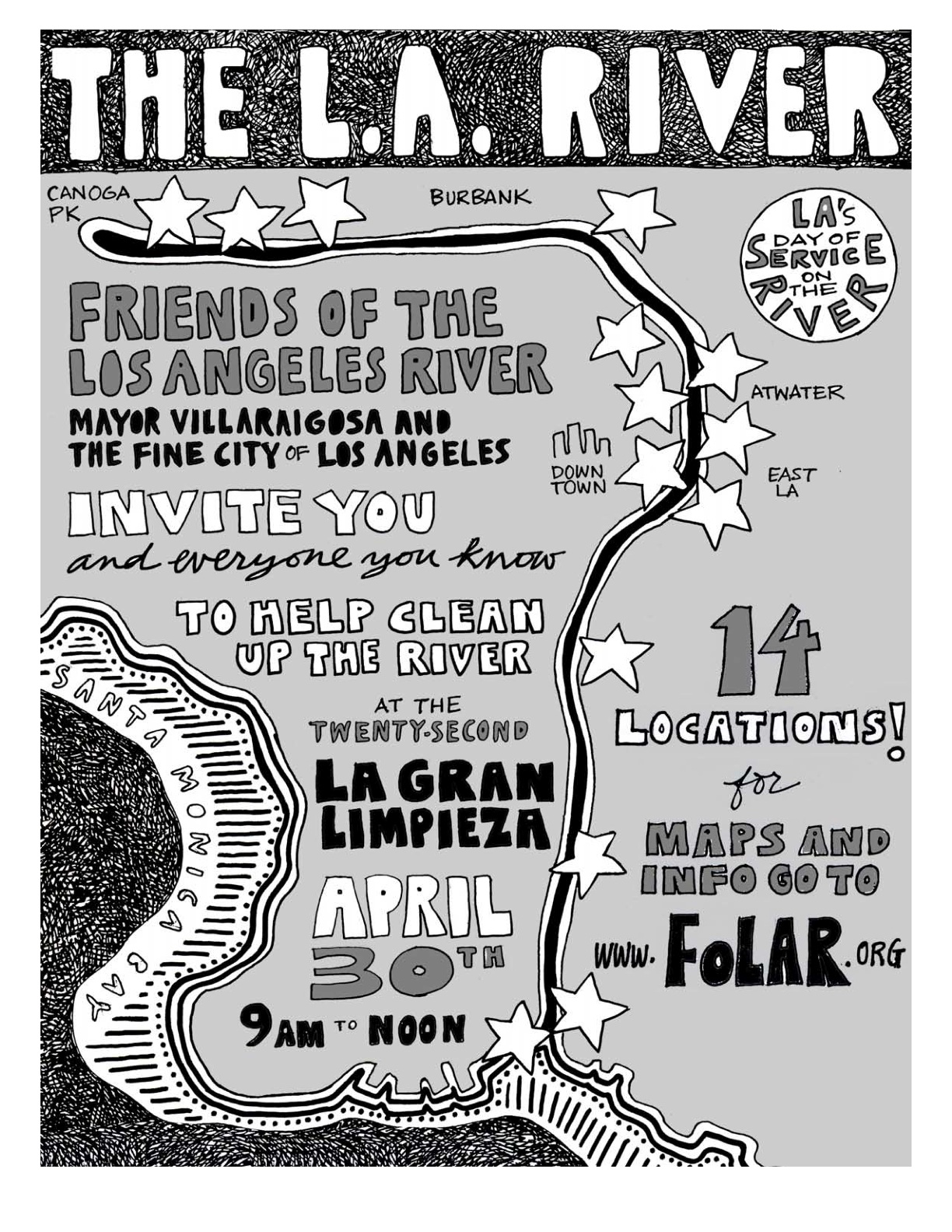
Stake out a site from this nifty cleanup flier (Courtesy Friends of the Los Angeles River).
How can sturdy shoes, a pair of work gloves and sunscreen magically turn into a free T-shirt?
Well, April 30 from 9 a.m. until noon, it’s time to clean up the river, sponsored by Friends of the Los Angeles River and Mayor Antonio Villaraigosa. Check out this link for the deets.
See you on the river wearing my sturdy shoes, Jim Burns
Today, I’m introducing a new aspect to the blog — like the title says, earth quotes. This first one is from the book “Befriending the Earth” by Thomas Berry, CP, with Thomas Clarke, SJ.
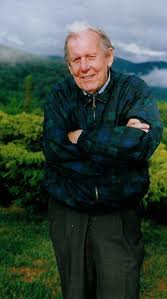
Author Thomas Berry (Courtesy the Thomas Berry Foundation).
“Not long ago, I was talking with several hundred high school students at one of the prestigious high schools in the city of New York. I said that my generation has been an autistic generation. I asked them what autism was. Imagine asking a group of high school students what autism is!
One student got up and explained very clearly: persons being so locked up in themselves that no one and nothing else can get in. It is an isolation process.
That, I think, is what has happened to the human community in our times. We are talking to ourselves. We are not talking to the river, we are not listening to the river. We have broken the great conversation. By breaking the conversation, we have shattered the universe. All these things that are happening now are consequences of this autism.”
If you’d like to share a quote, just e-mail it to me.
Last night at sunset, a host of city and environmental group dignitaries dedicated Confluence Plaza. The crowd of some 75-to-100 people cheered and applauded, as the first jets of water shot from ground level high into the air, to a brass fanfare of “Rigaudon.”
The fountain shoots water into the air for eight minutes at the top of the hour, from 9 a.m.-6 p.m. (Jim Burns)
The scene was nothing, if not surreal — and jubilant.
A more unlikely spot for this landmark probably couldn’t be found. To the north lies the netherworld of the Cypress Park Home Depot parking lot, under the I-5 freeway. Day workers milled around, waiting for that last hourly job, items for purchase sat on a blanket in a spontaneous bazaar, and the roar of rush-hour traffic reached shout-out levels.
Yet, the speakers put this latest addition to the L.A. River Revitalization Master Plan in perspective.
“It means a connection to the environment,” said Romel Pasqual, L.A.’s deputy mayor for environment, from the podium.
His words echoed those of the previous speaker, City Councilmember Ed P. Reyes., who talked about the meager 55 percent high school graduation rate and the fact that “unfortunately, gangs are winning” our youth, instead of education. According to his Web site, in the past Reyes, vice-chair of the Public Safety Committee, has secured funds for neighborhood clean-ups, gang prevention programs and safe route school maps.
Of course, the confluence of the Los Angeles River and the Arroyo Seco is city history at its best. The actual spot is covered in concrete, inaccessible except to the hearty. If you look on a map, it’s basically at the intersection where the I-5 and the 110 meet.
Careful! Park rangers, from left, Kevin Perrine, David Aceves and Fernando Gomez, get their feet wet as the fountain jets were inaugurated. (Jim Burns)
“It’s a beachhead,” Jenny Price, who gives well-regarded tours of the river, said of the plaza.
Indeed, it is the first part of the multiphase Confluence Park project.
The river’s poet laureate wrote a piece for the inauguration and one line probably best summed up the event.
“I prophetize our happiness …” Lewis MacAdams intoned from the podium.
Last night, I woke up to the sound of rain pelting our metal window awnings. Normally good news, checking the weather forecast for the next couple of days, apparently rain will continue. But you know what that means — goodbye spring carp spawn.
Man, was that fun! It was my first spring spawn, and now I know why the more seasoned veteran re-checks his fly box in anticipation. During the last week or so, fish were everywhere — holding, circulating, tailing — waiting for (enjoying) nature’s main event.
Oh, man, there's nothing like losing a big one in the weeds. (Jim Burns)
Of course, the down side to catching carp during this season is getting them to strike. Their minds are on romance, not Glo Bugs.
Any trout fisherman who’s been around will do two things before the first cast: check to see what bugs are on the water, in the trees or the creekside grass; and pull a nice scoopful off the bottom to see what creepies are in it. That way, you can cover dries and nymphs — at least that’s how the theory goes.
See that nasty float in the background? Avoid it! (Jim Burns)
During the six months or so I’ve been carping, I’ve never seen any sort of hatch on our river, nor have I found any crawlies in riverbed samples. There are crayfish for carp to munch, but it makes you wonder what our omnivorous friends chew on to get so gigantic! Our river bottom is an odd mix of concrete, mud and sand.
Case in point, Wednesday, we were trying to get any of the dozen or so fish my son and I spotted to strike. Tailing indicates a fish feeding by butting its head into the bottom to dislodge a meal. The go-to fly on the L.A. River is the lowly Glo Bug, an egg pattern, either weighted or not, in either chartreuse or white. The hot pink, unnatural colors don’t work here.
Anyway, think spawning salmon. Same deal. You basically have to entice a fish who really isn’t hungry to strike. Will and I ran through the fly box — chartreuse and white Glo Bugs, without and with weight; the trusty San Juan worm in red; a larger size Wooly Bugger in green; a larger size Hare’s Ear; even a dry hopper, just for grins. Nada, squat, nary a strike.
The ticket turned out to be a size 18 bead head Prince Nymph. The flash, the “shock and awe,” got tails wagging. And the pull on a Loomis 5 weight, the sound of fly line moving to backing, the run …
What turned our smiles upside down was losing the fish under freshwater seaweed. The warmer-water bloom made us clean the fly before every cast. And in this situation, the carp certainly knew that a nice, heavy roof of weed would help him (her?) to break us off.
Bummer.
But, then again, that’s why we all keep coming back for more!
“Mad as a March hare,” that’s how the old saying goes.
College basketball fanatics anticipate March Madness; Catholics, the beginning of Lent and, for everyone, the last big-gulp gasp of Mardi Gras: “Laissez les bons temps rouler.”
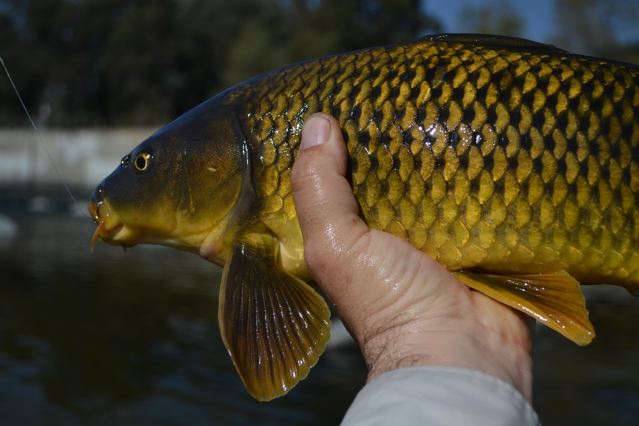
Check out the vivid color on this beauty. (courtesy David Wratchford)
Crafty fly tyers may litter their vises with March Browns to celebrate the beginning of spring.
And for those of us plying urban waters, it’s time for the semi-annual parade of the carp.
“I think they end up in Balboa Lake. I’ve spotted some huge fish in there,” guide David Wratchford told me yesterday at the Fisherman’s Spot. That would be miles, and miles, and miles upstream from where they begin the migration, probably in the Glendale Narrows.
Earlier in the week, he’d left me a voicemail — with some urgency — that the spawn was on.
My question: why now?
Turning to the bible of carp fishing, “Carp on the Fly” by Barry Reynolds and friends, I found the following water chart:
Water Temperature Remarks
39 degrees Carp begin active feeding.
41 degrees Carp begin pre-spawn move to shallows.
61 degrees Sustained temp lethal to carp eggs.
63 degrees Probable lower limit for spawning.
66 degrees Optimal temp for carp.
72 degrees Metabolism increases rapidly.
75 degrees Probable upper limit for spawning.
79 degrees Sustained temps lethal to carp eggs.
90 degrees Metabolism at a high rate.
97-106 degrees Lethal temp limit for carp.
So, once Mother Nature’s spring water thermometer hits the correct temperature, the carp are off and running. And do they ever run, up into the shallows, and the concrete steps that dot the semi-natural surface of Glendale Narrows and beyond.
Wow, a spawning carp, in all its mightiness, moves upstream. (courtesy David Wratchford)
If the March hare’s madness springs from its wacky mating behaviors — including jumping into the air for no apparent reason — the same holds true for carp.
“I saw sea gulls attacking a whole group of them. The fish were almost completely out of the water. I don’t know. It looked like they were trying to pluck out their eyes,” said one old timer I met yesterday.
Another younger guy, dressed in surgeon’s scrubs, told me he thought he’d seen a rock on one of the concrete flats. That rock, of course, turned out to be a monster carp.
“Its back was completely dry,” he said, and added that he couldn’t resist picking it up, then setting it back down in the water. I met him and his two friends with poles in hand, hoping to find more spawning carp.
What does this mean for you? Get fishing before the weather turns. Take advantage of this fine spring weekend. Heck, you might even exchange your normal Glo-Bug for a Mad March Hare’s Ear.





 lariverflyfishing