Tag: fly fishing

L.A. Confidential: Ogden River Restoration Project

This post is “The best of times and the worst of times” for me.

How can you not be happy as a fly fisherman to see the city of Ogden and various players have come together to rebuild this urban river? On the other hand, even with the leverage and political will gaining for our river everyday, we have many, many miles to go before we sleep. To wit:

I want to LEGALLY fly fish our river.

I want to LEGALLY kayak in our river.

I want to LEGALLY walk along its banks.

If you know of other restoration projects that readers of this blog would enjoy, please e-mail me. And thanks to Fly Fishing Frenzy for getting the word out on this wonderful restoration project. Watch the video on the site below.

Below is the article taken from the Connect2utah.com site

The Ogden River runs right through the middle of the city. This river has had over 100 years of abuse and neglect and now the city and a host of others are doing something about it.

Andy Dufford of Chevo Studios has been chosen to create a public art piece in conjunction with the river restoration project. His proposal “Water Cycle” is a public plaza with seating and interactive sculptural elements located along the banks of the river. (Courtesy Ogden City Arts)

It was one year ago that Ogden City announced their plans for the Ogden River Restoration Project. The river from Gibson Avenue to Washington Boulevard was not a place you would find many fisherman, let alone families. Abandoned houses, litter and industrial waste kept most people from enjoying this river. But since last January a lot has changed.

“We found trash dated back to the 1870′s,” said engineer Crystal Young, Ogden River Restoration Project. “This is a good example of how the river has been filled by urban development in past practices. And so you can see all of this concrete and cars and trash has filled this native bank and buried these trees and built these banks up to where I’m standing now. All of this is going to be excavated down to the tree level and pulled back as you can see upstream in sections we’ve completed.”

The river bank and the riparian zone has been restored to its more natural state. Thousands of tons of debris has been removed.

They’ve taken out five to seven whole cars, about 14,000 tons of concrete, several car parts, thousands of tons of scrap metal, lots and lots of tires, about 250 cubic yards of shattered glass.

“Up near the brewery, it was a layer about six feet deep,” said Clint Ormond.

But this project is much more than just removing the garbage. Over four thousand tons of boulders have been placed on the river edge to stabilize the banks and put into the river to create habitat for fish. 40 thousand new plants will be planted and these storm water returns have been built to filter the cities storm drains.

“As the storm water drains in here, the plants and the pond itself will capture the garbage and the sediment from the streets. Keep a lot of the salt and oils captured in these ponds and keep it out of the river,” Clint said.

“We’ve tried to make aspects all along this project for everybody. We’ve got some great backdrops here. We’d like to see people playing in the river, fishing, taking pictures. We want to give a little piece of nature right in downtown,” Justin Anderson, Ogden City Engineer.

Fishermen say the restoration project is making a world of difference.

Lee Salazar has been fishing the Ogden river since he was a boy, “Not too bad. Shoot I’ll take them home and fillet them. My wife has been telling me go get me some fish.”

Lee says he’s seen rapid improvements.

“Two months ago, there was beat up houses that people had burned and it looks beautiful now. Compared to the way it used to look, I love it.”

The Ogden River has a good population of brown trout. But last fall, the DWR stocked this portion of the river with thousands of 10 to 12 inch rainbow trout and just last December.

The DWR released an additional 600 18-22 inch rainbow trout some pushing five pounds.

“We have been stocking for a number of years the upper reach of the Ogden River where there is better habitat than there was down here historically. But ever since Ogden City and the other partners have implemented this large scale restoration project there’s actually habitat here in the lower reaches,” said Ben Nadolski, DWR Aquatics Biologist.

“The difference is transformational Adam, it’s a night and day difference. It’s actually transforming a river back into a river,” Nadolski said.

“And those fish is what we want to promote. Hopefully someday we can even call this a Blue Ribbon Fisher. That would be a goal somewhere in the future where we can sustain that growth. We love this river and we are setting it up, it’s expensive, it’s costing a lot of money,” said Bob Geier, Ogden City River Coordinator.

Funding for the $5 million restoration project has come from, Ogden city, the DWR, the Utah Water Quality Board, Trout Unlimited and others. But they still need $1.5 million to complete the project and you can help. To donate, contact the United Way of Northern Utah and designate your donation to the Ogden River Restoration Project.

“The community deserves a place that they can connect with nature again and have a place where they can come and recreate in the outdoors,” said Crystal. “I just think it’s going to be the greatest community asset to Ogden.

See you on the river, Jim Burns

Quick mends: ‘mousing’ the new The L.A. River

Question: exactly how much time have you wasted this week (it’s not over yet …) “browsing” the Web?

I’d have to answer “lots.” Always on the snoop for info about our river, I came across the new (to me, and copyrighted this year) The LA River. According to a press release, “The Los Angeles River Revitalization Corporation (LARRC), set up by the City of Los Angeles and funded through the Community Redevelopment Agency, has launched a comprehensive, state-of-the-art website at http://www.thelariver.com. It contains hundreds of maps, user guides, photos, development activities, information about the Corporation, a store, and more.”

There apparently is no limit on the number of carp you can take from the L.A. River. But ... who determined this? Certainly not the California Dept. of Fish and Game. (Courtesy http://www.thelariver.com)

Fair enough. Take a look and you’ll see that the site breaks the river into three fishing spots: Lake Balboa, Glendale Narrow and the Long Beach Estuary. Earlier this year, fisher-friend David Wratchford and I wondered about the estuary, and what might lurk to be caught there. Then, we wondered about the legality of fly fishing those waters.

Now we read on this new site:

“Today, although fishing in the river is not an officially-sanctioned activity, since it is currently illegal to walk in the river channel below the bike paths, officials rarely cite the many anglers regularly seen along the soft-bottom sections where fish are to be found.”

True, it’s a far cry from the infamous days when the Duckman had the Griffith Park rangers on speed dial, and would not hesitate to contact them when he saw folks with poles angling the perfumed waters.

Yet, you have to wonder how any elected official can have his cake and eat it, too. How can fishing not be officially sanctioned (in fact, illegal, according to a release given out to the press earlier this year from Councilperson Ed Reyes office), yet turn up on a publicly funded Web site under “Fishing the L.A. River?”

Access to the river means just that. It’s time to officially saction fishing in designated areas of the river. No more double speak!

See you on the river, Jim Burns

Waitin’ for the fishin’ to get better …

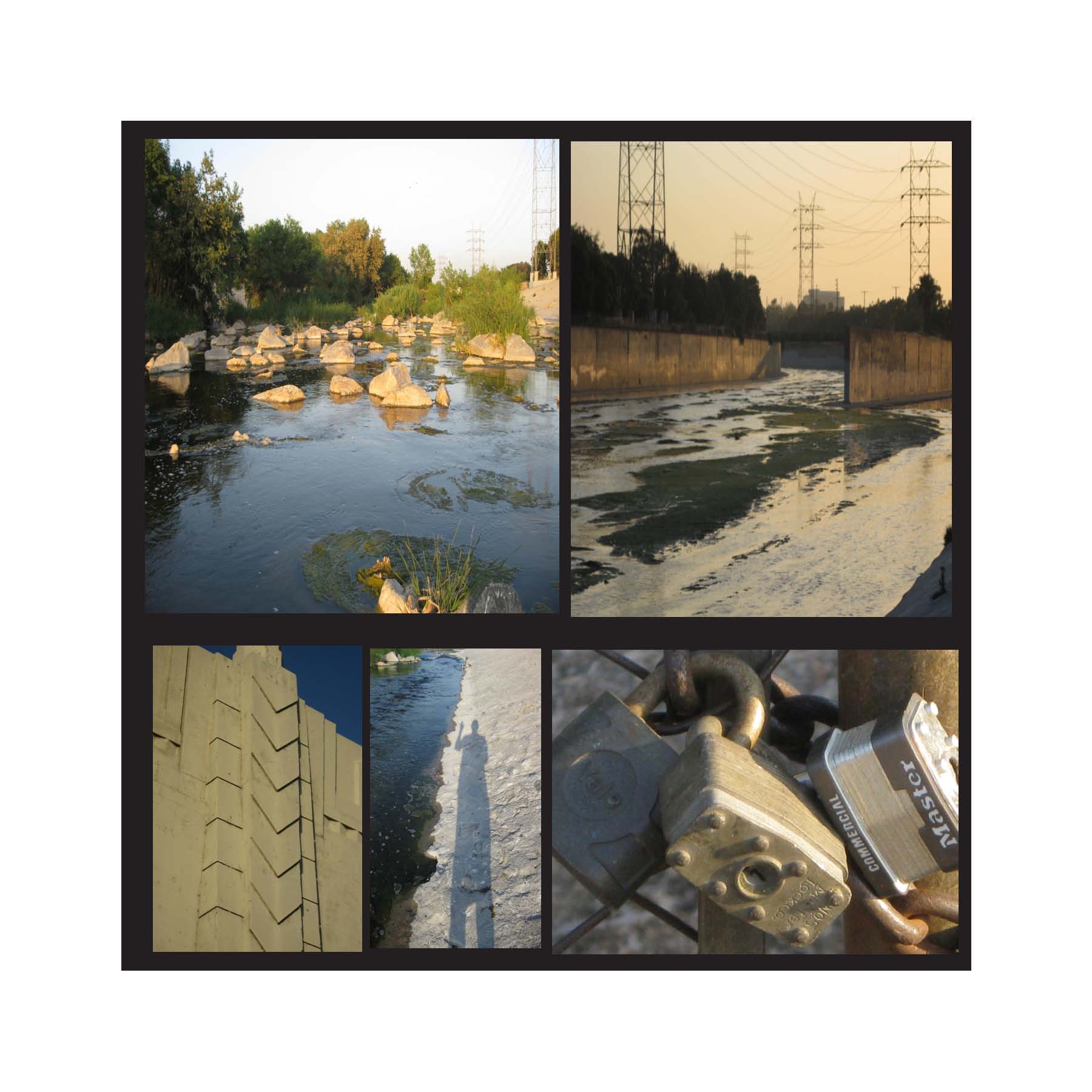
From top left, clockwise, the tranquility of carp-filled pools, at the beginning of Glendale Narrows. Once you get past the city locks, you can see self-shadows and nifty bridge architecture. (Jim Burns)

5,000 L.A. River cleanup volunteers can’t be wrong!

This slideshow requires JavaScript.

Quick mends — How do you use the river?

Yucking it up in 1938: Herald-Express photographer Coy Watson Jr. (left) and reporter Fred Eldridge (Courtesy KCET).

The Los Angeles Regional Water Quality Control Board is conducting an evaluation of the recreational uses of the channelized rivers and streams in the Los Angeles River Watershed.

As part of this effort they are soliciting information from stakeholders (through a survey) regarding what rivers or streams are visited in the watershed and which recreational activities are enjoyed in and around these bodies of water.

They are conducting this survey in conjunction with KCET and Council District #1 (City of Los Angeles).

Can you tell I didn’t write the above?

See you on the river, Jim Burns

Quick mends — Get plugged in to Congress

First off, congratulations to everyone who attended yesterday’s big river cleanup! Pictures will be posted in this space tomorrow from the event.

Next, now that you’re fired up, take a look at these two links that make it easy to find out who your elected officials are and, equally important, what they’ve been doing.

Fletcher Bridge is definitely in the 31st district (Courtesy Rep. Xavier Becerra Web site).

Govtrack.us features a handy mash-up map of each state that includes districts. True, some of the district numbers can be hard to read, but if you continue to zoom in, visibility increases. For example, Griffith Park is located within congressional district No. 31, the purview of  Rep. Xavier Becerra, a democrat.

Armed with that information, you can then plug the name into the aptly titled Legistalker to find news about the politico, including old school, YouTube and Twitter. There are also links to the rep’s Web site, blog and social media. It’s a powerful way to humanize legislators.

See you on the river, Jim Burns
Pasadena explores nix on plastic shopping bags

It’s a long time until 2040, the date Pasadena, Calif., has set to achieve zero waste. The city sits atop current green kudos of which it can be proud, including Pasadena Water & Power customers using 15 percent less water in 2010 than the previous year, according to the Green City Report.

"Pack it in, pack it out," applies to daily urban living as well as to outdoor sojourns (Barbara Burns).

And it’s about to  wade into the plastic shopping bag ban. With bordering unincorporated area Altadena enforcing a ban on them in some markets in July, and all by 2012, the city’s environmental advisory committee meets tomorrow in special session to consider the topic.

After the 2012 deadline, Altadenans visiting the supermarket will have to stash their groceries in reusable bags or pay a dime for a paper one. (Plastic bags used for meat, poultry and fish will be exempt).

According to Jake Armstrong in the Pasadena Weekly, the committee seeks public comment on how best to craft the language of the ban, which would be based on L.A. County’s latest environmental impact report.

Trying to ban the bag without an environmental impact statement can lead a new ordinance to be overturned in the court system. That’s exactly what happened to Manhattan Beach’s ban in the California Court of Appeals in 2010.

“County officials estimate households use 1,600 bags a year and expected that figure to fall by half by 2013 and shave $4 million from cleanup costs,” according to Armstrong.

So far, single-use plastic bag bans have been approved in California in:

– Los Angeles County (unincorporated areas, of which Altadena is one)

— Long Beach

— Malibu

— Calabasas

– Marin County

– San Jose

The plastic bag has become a polarizing cry, with industry and libertarians crying “foul,” and the green movement pushing for an eventual blanket ban. Interesting trivia: they are called “witches britches” in England, apparently because of the way they unattractively flutter in the breeze.

See you on the river, Jim Burns
Quick Mends: List of toxic fish grows

Oh boy, not really the kind of thing you want to read on a Sunday, especially this Sunday, yet there it is: Tony Barboza penned an excellent piece in today’s Los Angeles Timesoutlining species joining the unlucky White croaker on the “do not eat” list.

The familiar "no dumping" warning, featured on sewers around the city (Courtesy ESLPod.com).

From the article: “In the so-called red zone that reaches from Santa Monica to Seal Beach, four fish besides white croaker … are now considered so contaminated with the long-banned pesticide DDT, PCBs and mercury that they too are unsafe to eat.”

Added to the list:

— Barred sand bass

— Black croaker

— Topsmelt

— Barracuda

This revelation, which comes from increased scientific scrutiny, not more dumping, led me to wonder about the Los Angeles River and its carp and other fish populations. The FOLAR fish study from several years ago found surprisingly low levels of toxins in the resident fish population.

Is the L.A. River, butt of many a poo-poo joke, actually cleaner than our slice of the Pacific Ocean?

See you on the river, Jim Burns

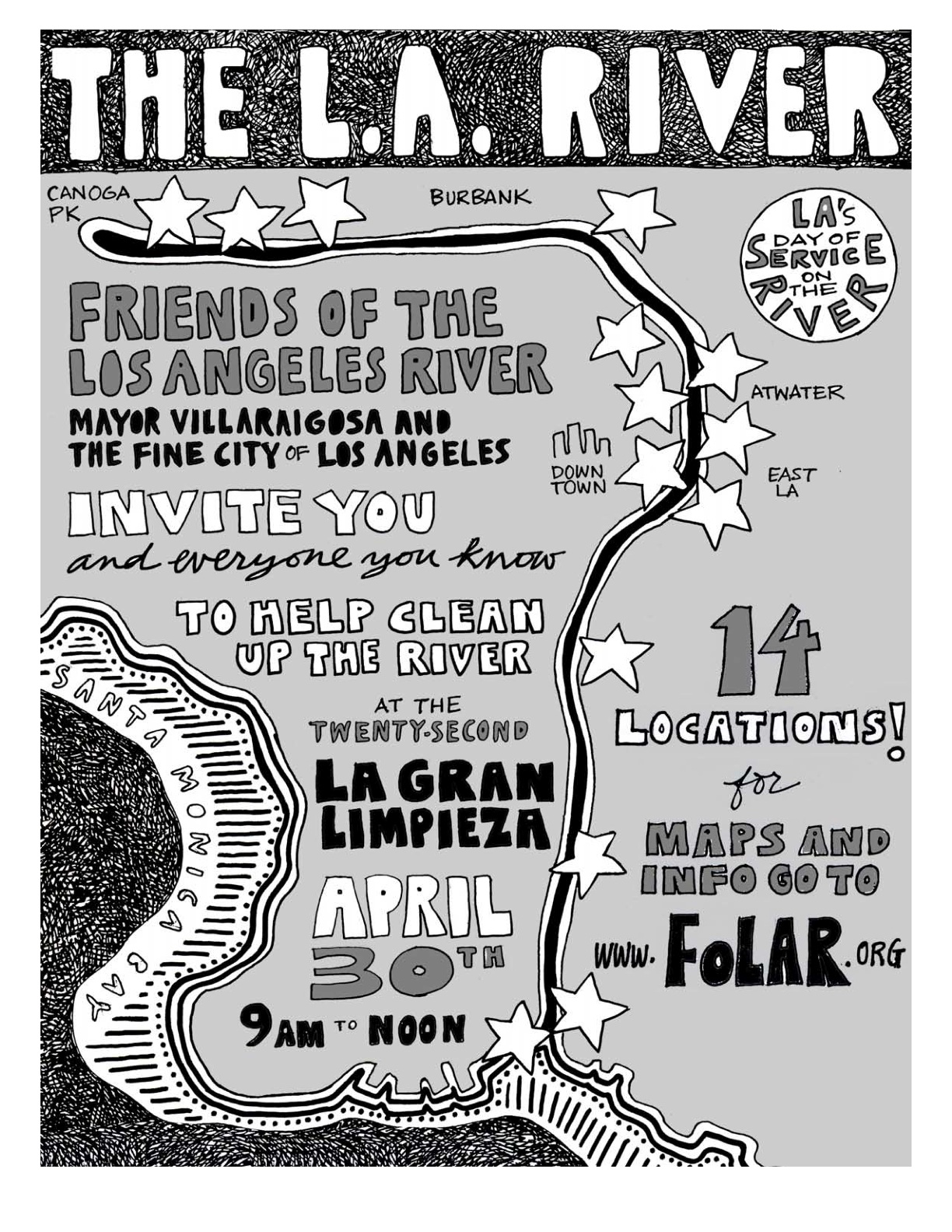
Annual river cleanup slated for April 30

Stake out a site from this nifty cleanup flier (Courtesy Friends of the Los Angeles River).

How can sturdy shoes, a pair of work gloves and sunscreen magically turn into a free T-shirt?

Well, April 30 from 9 a.m. until noon, it’s time to clean up the river, sponsored by Friends of the Los Angeles River and Mayor Antonio Villaraigosa. Check out this link for the deets.

See you on the river wearing my sturdy shoes, Jim Burns

Earth Quotes: Thomas Berry

Today, I’m introducing a new aspect to the blog — like the title says, earth quotes. This first one is from the book “Befriending the Earth” by Thomas Berry, CP, with Thomas Clarke, SJ.

Author Thomas Berry (Courtesy the Thomas Berry Foundation).

“Not long ago, I was talking with several hundred high school students at one of the prestigious high schools in the city of New York. I said that my generation has been an autistic generation. I asked them what autism was. Imagine asking a group of high school students what autism is!

One student got up and explained very clearly: persons being so locked up in themselves that no one and nothing else can get in. It is an isolation process.

That, I think, is what has happened to the human community in our times. We are talking to ourselves. We are not talking to the river, we are not listening to the river. We have broken the great conversation. By breaking the conversation, we have shattered the universe. All these things that are happening now are consequences of this autism.”

If you’d like to share a quote, just e-mail it to me.

See you on the river, Jim Burns