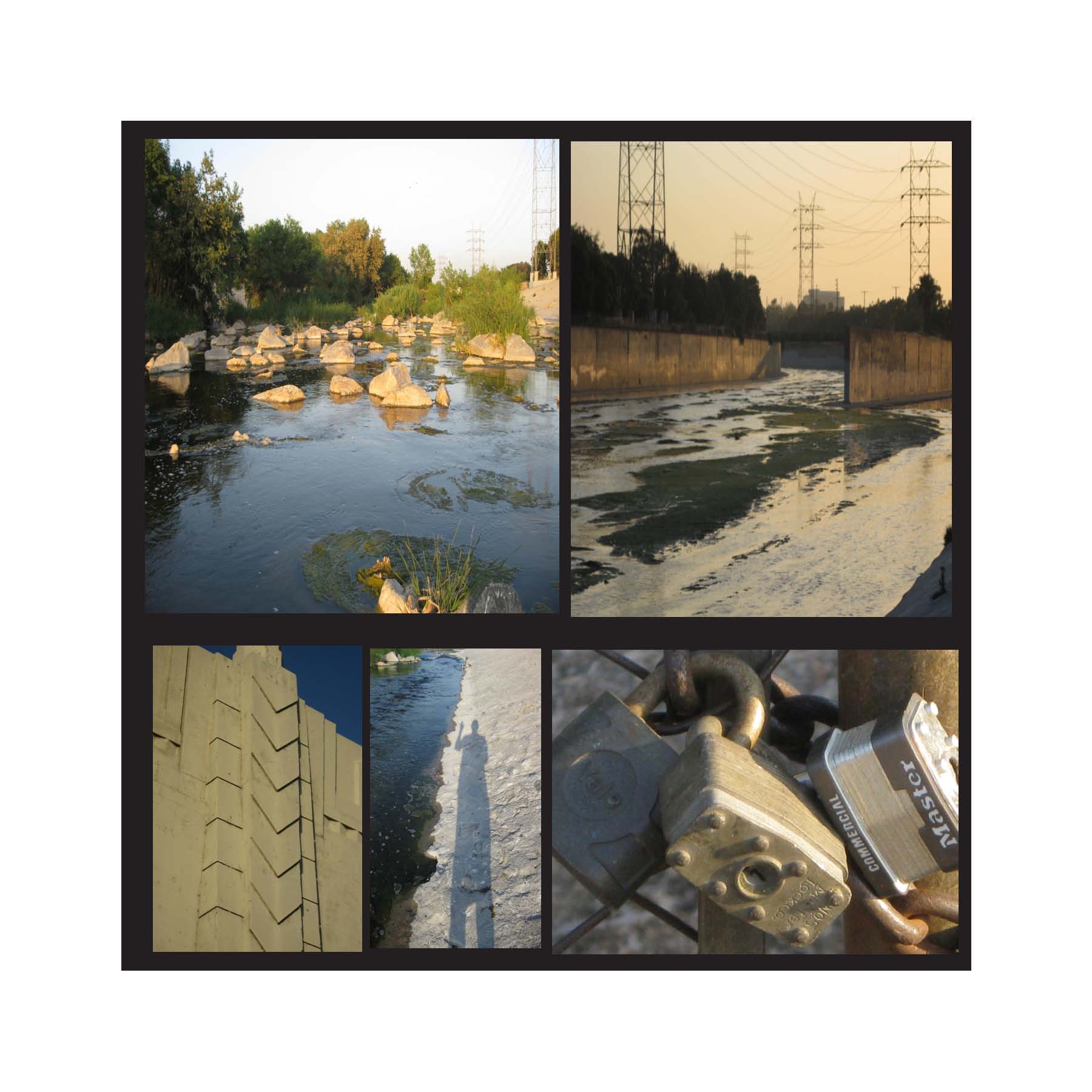
From top left, clockwise, the tranquility of carp-filled pools, at the beginning of Glendale Narrows. Once you get past the city locks, you can see self-shadows and nifty bridge architecture. (Jim Burns)
Dear Senator Kevin de Leon:
I strongly support the bill (SB 1201) that I understand would significantly widen access to the Los Angeles River.
The Los Angeles River is the whole reason I became an environmental and fly fishing blogger. I’d been assigned a story on carp fishing in the river by Richard Anderson, publisher of California Fly Fisher, a bi-monthly publication that is carefully read among the fly fishing community. As I’d never actually been to the river, my first step was to find access to the water. This turned out to be no easy task, and I can still clearly remember driving around the Atwater Village area of Los Angeles with my son. We zigzagged through parking lots, truck depots and all manner of what seemed possible entrances, only to find dead-ends, walls and barbed wire fencing.
Finally, we found an entrance tucked almost invisibly between the I-5 freeway and a golf course. I later learned that this entrance is known as Steelhead Park.
I spent weeks researching that first piece, gleaning lots of information about the river, its fish and its restricted access. For example, I learned that Griffith Park rangers as well as Los Angeles Police Department officers were charged with ticketing anyone who strayed off the bicycle paths. Obviously, those fishing were actually doing so illegally.
In a short two years, recreational access has increased, largely thanks to the work of river advocate George Wolfe, FOLAR, a mostly cooperative city, and a vastly changed U.S. Army Corps of Engineers. But we must go further.
When lives are not in danger from floodwaters, vast stretches of our 51-mile jewel should be open to the public. And, the public should be able to enjoy the access without the trepidation I first experienced.
Today, my blog www.lariverflyfishing.com reached its 10,000th hit, so I feel it is an apt celebration to make this letter to you public, in the hope that others will also write to you to support your efforts.
How many guys carry their own scale? Jim Graves does!
The title says it all: The newspaper America either loves or hates, depending on political affiliation, has sanctioned catching carp with a fly rod. Best quote is that it’s like soccer: No. 1 sport in the world, yet, just catching on in America. Take a look at the piece, written by Chris Santella.
Lots of action on our own river, Friday. We spotted at least 30 fish.
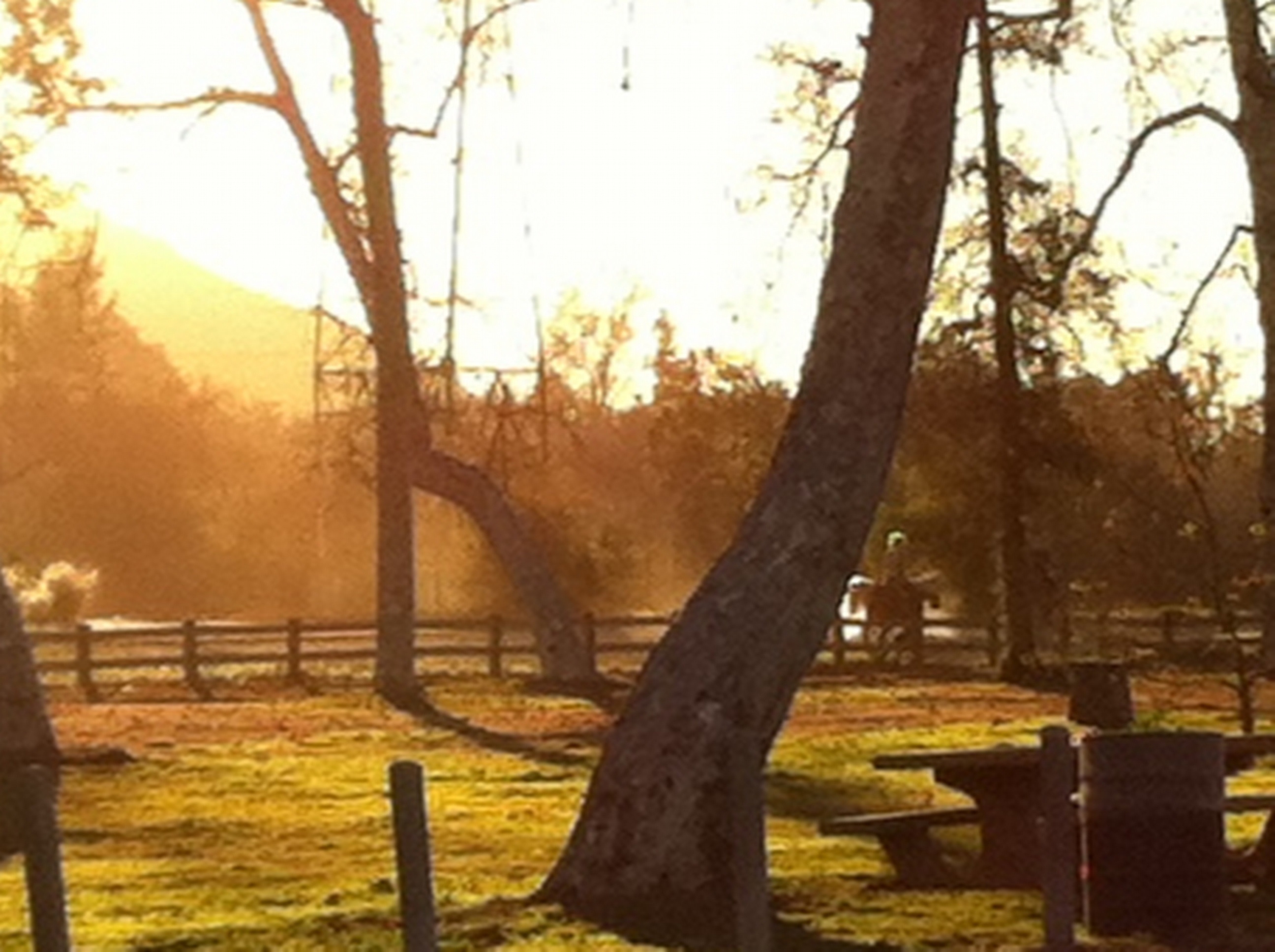
As riders and their horses enjoy this idyllic January scene close to the L.A. River, others are not so fortunate. (Jim Burns)
Every once in a while, you have one of those days, days of insight, days when whatever glasses you usually wear are plucked off and replaced by the new.
And, I have to add, insight — the new — is not always wanted.
Let me explain. Friday, I finally got some time off, so I tied on a new bread fly, hoping not to get skunked. Readers of this blog have followed my fruitless progress, so far.
I was excited. I mean growing up in Chicago, I still can’t believe it when the January weather graces us with Santa Ana wind-warmed temperatures in the 80s. Plus, would you rather fish the glorious L.A. River, or be working? (That’s a rhetorical derrrrr).
Stopped at the freeway entrance on my way, I pulled out my wallet to give a couple of bucks to a homeless woman. If you live near Pasadena, you’ve probably noticed that their numbers seem to be increasing. I debated for so many years whether to give/not give that now whenever I see someone in need, I give what I can.
As I handed her the money, she launched into a rant about how the guy in front of me had given her coupons to Union Station, but she didn’t want to go, because there you had to play the “boy-girl game,” and that she wasn’t out here begging for money because it was such a good time. Anyway, engrossed in what she had to say, I missed the light. In L.A. that’s a major offense, but nobody honked. As I waited for the next green, we talked more and she explained how her friend had contracted scabies at the city-run shelter and she’d taken her to the doctor.
But it was the next part that got me: “You people,” she said accusingly, and I can’t remember what else she said, but I do recall vividly how she looked at me. Maybe you can see it in your mind’s eye.
To the homeless, I now had a moniker. “You people.” From my perspective, they were/are “you people,” so I suppose it cuts both ways. Anyway, I couldn’t shake our conversation, and it rolled around in my mind, still does.
Once parked near the river, I spend the rest of the afternoon searching for carp. Several hours elapsed without a sighting, when, suddenly, I came upon a pool of a half-dozen who spotted me almost as quickly as I saw them. Like trout, carp have excellent eyesight. Picking one up, you’d think that their eyes focus only on the bottom. Not so.
Frustrated after about 10 minutes of casting to likely spots they might have fled, I turned to the concrete bank, calling it quits. About 10 yards in front of me were clothes drying on the chain-link fence, a faded but functioning bicycle, a pair of tennis shoes, a sleeping bag covered by a makeshift tarp. I stopped. The passing water was calm, as was the setting sun, calm, even the repetition of traffic on the I-5, calm. But interiorly I hardly was, as not one, but two residents emerged from the tent, not seeing me in my sheltering thicket.
“You people.”
For a moment, I felt all sorts of emotions, from fear (Would I be attacked?), to stupidity (Why would I be attacked?), to anger (Hey, I’m just trying to fish here, gimme some space.), to empathy (It must be awful to live out here.), to aversion (How am I going to get back to my ride?).
“You people.”
Eventually, I moved quietly to another hole in the fence and climbed through, dipping my nine-foot rod.
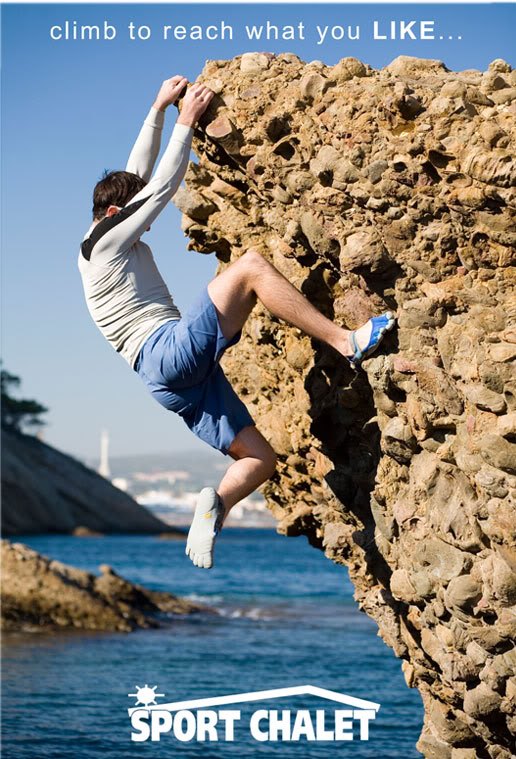
Sports Chalet: This ad from its Facebook page suggests a vibrant retailer. (Courtesy Sports Chalet)
There’s nothing quite like being new at a sport and being in love with it. Everything, from equipment to practice, cries “potential” to the newcomer who dreams of being great: How great could you become? Maybe if you worked really hard, you would be as good as ________. Maybe better?
That’s the beauty of being in love with a sport, not as a spectator, but as a participant. It can pull you out of yourself, out of your comfort zone and show you a whole lot of possibilities.
Moments spent engulfed in your sport mean moments spend completely in the present. No worries, frets, dark clouds, nothing at all like that. Instead, you are purely “time in,” like K0be practicing without a ball for two hours before practice actually begins. Or the freeze-frame moment of the “Bush Push,” when quarterback Matt Leinart made sure USC beat Notre Dame in the last second of the 2005 game.
Besides lots of practice and a role model to chase, being in love with a sport also means finding a place of camaraderie.
Today, for fly fishers, that place is Orvis on South Lake in Pasadena. Fly-fishing manager David Wratchford and his staff , they’re in a groove. You’ll feel it. You’ll want a piece of it.
Or, for the valley folks, Fisherman’s Spot, where the energy isn’t quite as electric, but the expertise can propel you to look deeper into the sport. I mean they still carry flies invented by Gary Fontaine and featured in his 1984 classic “Caddisflies,” because, historically, these are important.
Once my place of sports awe and camaraderie was Sports Chalet, the original, in La Canada, Calif.
That was pre duplication-store mania, which ended badly with stores closing. That was when the mountain man and founder Norbert Olberz made sure that when you walked up the stairs to the fly-fishing area, you were transported into the world of your sports passion.
There was a big wooden box of flies, all sizes, types, full of mystery, mastery and wonder.
Alas, not anymore.
There were friendly experts who talked about water, and spots, and getting away for that weekend on the water, prepared. They dressed the part in fishing shirts and appropriate angling pants, and never seemed to care if you bought anything or not.
Alas, not anymore.
And there were magnificent fly rods with astounding prices — six, seven, eight hundred dollars — that made me want to save and save my money.
Alas, not now.
In fact, going into the “new” original Sports Chalet just makes me sad.
The wooden magic fly box has been replaced by cheesy, tiny cardboard boxes, sealed in plastic, a passable fly, visible within. It’s the difference between buying shrink-wrapped Romaine lettuce at Fresh and Easy, and going to the farmers market, where the sun shines on each healthy head.
The guys who used to hang out to spin fishing yarns? Now, they wear uniforms and want to “up sell” you on one of the dozen fly rods innocuously stashed in a rack above the countertop.
Guess that’s the good news … if you go to the SC in Arcadia, the store doesn’t carry any flies or rods at all. The “inventory” was quietly removed last month, according to an employee. Yet, take a look at its expert advice about fly fishing. You’d think that the magic fly box would have been there forever.
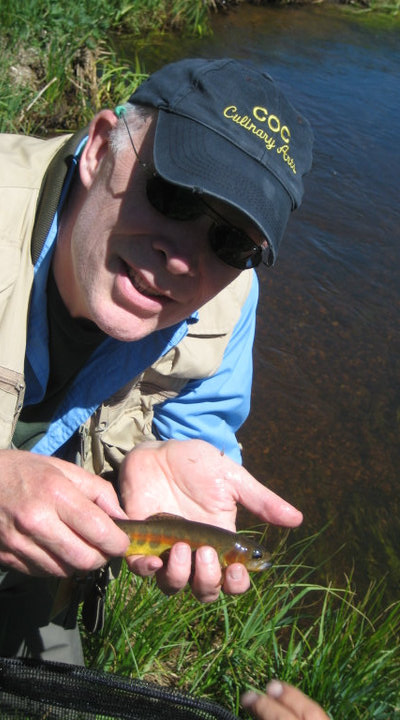
Golden Trout: The state fish is small, but beautiful (Courtesy Guy Jeans).
Last summer, a friend and I caught dozens, and dozens, and dozens of Golden Trout, all in one glorious day. Some days on the water produce memories akin to what used to be called a “Polaroid moment,” living for a long while in one’s memory. That was one of those days, when the weather is perfect, the company, just right, and the fishing, downright fantastic.
So it was with keen interest I read Louis Sahagun’s recent piece in the Los Angeles Times about ranchers rights within the Golden Trout Wilderness and the fate of our state fish. The GTW is a massive 300,000-acre area that sits on the Kern Plateau and is accessible from at least three directions. On its eastern edge from Lone Pine, off Hwy. 395; from the south, accessible from the Sequoia National Park around Mineral King, itself a 30-plus mile adventure on a one-lane, dead-end road; or going north from Kernville.
Remarkably, three of the trout native to the state’s waters are within the area. Besides the California Golden (technically known as the Golden Trout Creek golden trout), there’s also the Little Kern Golden Trout and Kern River Rainbow.
“Common names abound for the golden trout of the Kern River drainage,” writes Robert J. Behnke in his authoritative “Trout and Salmon of North America.” “This can be confusing because they tend to either pinpoint a fish to a particular stream, such as ‘Volcano Creek golden trout,’ or encompass a diversity of forms under one name, such as ‘California golden trout.’ The dozen or so common names for what are really two subspecies (aguabonita and whitei) of rainbow trout reflects the passion that so many have for this pair of jewel-like fish.”
The goldens my friend and I were stalking end up on many a fly-fisher’s bucket list for good reason: their jewel-like beauty. And, although they were once transported to Cottonwood Lakes, then to Arizona and beyond, the only place they naturally occur is right here, where they evolved in isolation from other trout
Size does matter, of course, but a 10-inch fish here is a monster, with the average running around 5-to-7 inches. They are a feast for the eye, with two red stripes, one on the belly, the other along the lateral line, running to the mouth and under the gill. Also, look for large black spots – up to 10 – that run laterally as well. Put these together with a predominately yellow-gold color and there’s little reason for their cousins to enter the beauty contest.
This general description will also come in handy when trying to decided if you’ve landed a pure golden or a hybrid, created through breeding with hatchery rainbows. Remember, these very distinct markings mean you’ve got a golden in your net.
David Lentz, who is California Department of Fish and Game’s native trout conservation coordinator, said that the small size is because of 140 years of habitat degradation. “Continued livestock use results in shallower, wider, warmer water,” he said. Waters in their natural state would be both narrower and deeper, which, in turn, would mean fewer goldens that were bigger. The largest section of interconnected meadows for grazing lies in the South Fork of the Kern area. Sections are now being rested for eight-to-nine years at a time to regain this natural habitat. Some environmentalists have argued that the best way to prevent lifestock from grazing in the upper South Fork watershed is to get goldens listed on the Endangered Species Act, according to Behnke.
Meanwhile, you can volunteer for hands on projects to restore this fragile habitat through the Golden Trout Project.
I was in a mope when I hiked down the canyon trail for some Friday afternoon fishing. No doubt about it, a mope, plain and simple. As I descended, feet feeling enervated, annoyed by the insistent biting flies, I forced a smile at those returning from the water, all bathing suits and youthful laughter, all optimism and camaraderie. Some would say “hi,” others would look up at me shyly, maybe not knowing if they should speak first. But I would have none of it. I felt old and alone. Like I said, a mope, or as Winston Churchill famously called his depressed moods, “the black dog.”
Local high school students Tommy, left, and Charles fly fish for the first time (Jim Burns).
Where was my best fishing buddy? I asked the trees, bitterly (he moved north and we’ve since stopped talking)
Where was my best fishing dog? (died of cancer this summer)
Where was the general fun in life at all, the life I’ve always so enjoyed?
With these dark thoughts swirling like threatening ravens among the trees, I barely heard the footsteps behind me.
“Oh great, some more happy people,” I muttered, not looking around.
And so separated by perhaps two dozen yards, the three of us walked down the rock-strewn trail, me in the lead, the other two out of sight, but thudding along behind.
We were all going to the same place, which irritated me all the more. After all, if you can’t be nice to the ones leaving your refuge, how could you possibly be chatty with those who are invading it?
And — inevitably –when we all stopped together under the shade canopy of a dozen thick trees, the blazing summer light turning to smokey lounge, one of them asked the question.
“Hey, are you fishing down here?”
The teen couldn’t have been more than 16, a big, overgrown kid, like a pup tripping over his own paws.
About to answer, trying to at least be civil, suddenly his friend came along, holding an ocean pole, looming over the trail, about to be hung up on every tree, bush and snagging obstacle. He looked at me, embarrassed, spying all the junk on my vest — the thermometer, the nail nippers, the golden hemostat — and my four-piece fly rod that I’d yet to attach.
“Kinda big for down here,” he mumbled. “We were just looking for something to do.”
My tight lips relaxed. I thought how silly it is to be a middle-aged man, thinking middle-aged thoughts, when life flows each day with such unstoppable exuberance. Still reluctant, I couldn’t help but half-smile.
As we walked on, past an ornery barking dog protecting his master’s property by the side of the creek, I really wondered if I would share the spots I’ve found over these past several months. After all, it’s called “hot spotting” for a reason: your fantastic fishing hole from last month is now dead as a bat because some yahoo has fished it out.
Watching them navigate the path, I suspected these high schoolers would most probably do exactly that. But the sight of that out-of-place pole, and their faces, which it would be a cliché to call “shiny,” spoke otherwise.
And as we walked and chatted, a wonderful thing happened: I came back to myself.
Check out the red cheek on this trout from the San Gabes. (Jim Burns)
Soon, I’d tied a double surgeon’s knot to secure a length of super-skinny tippet to their tuna-tugging line. And I’d gifted them with a tiny bead-head nymph, the kind I knew the trout here loved to chase.
By afternoon’s end, Tommy, the bigger of the two, was learning how to cast a fly line. From the way he finessed my fly rod, I could easily squint my eyes and see an excellent fisherman down the road. And the smiling Charles caught a trout, only to release it back into the water on his own, no coaching from yours truly.
“It’s great down here,” Charles said, ” but people trash it.”
“Yes, they do,” I replied, as Tommy put some of it in my vest.
I left before them, but walking back up the trail, I thought maybe I should have stayed to guide them up. After all it does split confusingly at places, and Tommy had related the story about how their first outing here ended with getting lost and rangers having to come in after the gates closed.
Gut check … go back? I’d left to get some quiet time for myself, but also to give them time to be together without an adult around.
After puffing up the side of the canyon for 30 minutes, I sat in my car, wondering. After a time, I thought maybe I’d take a quick run back down … hadn’t they said they had to be back by twilight?
Then Charles popped into view, carrying that big tuna pole. Anxiety relieved. We both smiled and waved, and I wondered if Tommy would indeed talk his dad into doing some fly pole shopping before they headed out to Waterman the next day.
This life we have. This precious life we share with others.
Norman Maclean penned the classic "A River Runs Through It." (Courtesy Confluence Press)
If it’s been a while since you read “A River Runs Through It,” or if you’ve never read the engrossing tale before, this fall would be a good time to pick up this thin volume. Throughout its pages, Maclean proves his worth, and it’s a mystery to me why he remains one of our most underrated American writers. The movie is good, but not nearly the equal of the book. Here’s the opening paragraph from the book, which won a Pulitzer in 1977:
“In our family there was no clear line between religion and fly fishing. We lived at the junction of great trout rivers in western Montana, and our father was a Presbyterian minister and a fly fisherman who tied his own flies and taught others. He told us about Christ’s disciples being fisherman, and we were left to assume, as my brother and I did, that all first-class fishermen on the Sea of Galilee were fly fisherman, and that John, the favorite, was a dry-fly fisherman.”
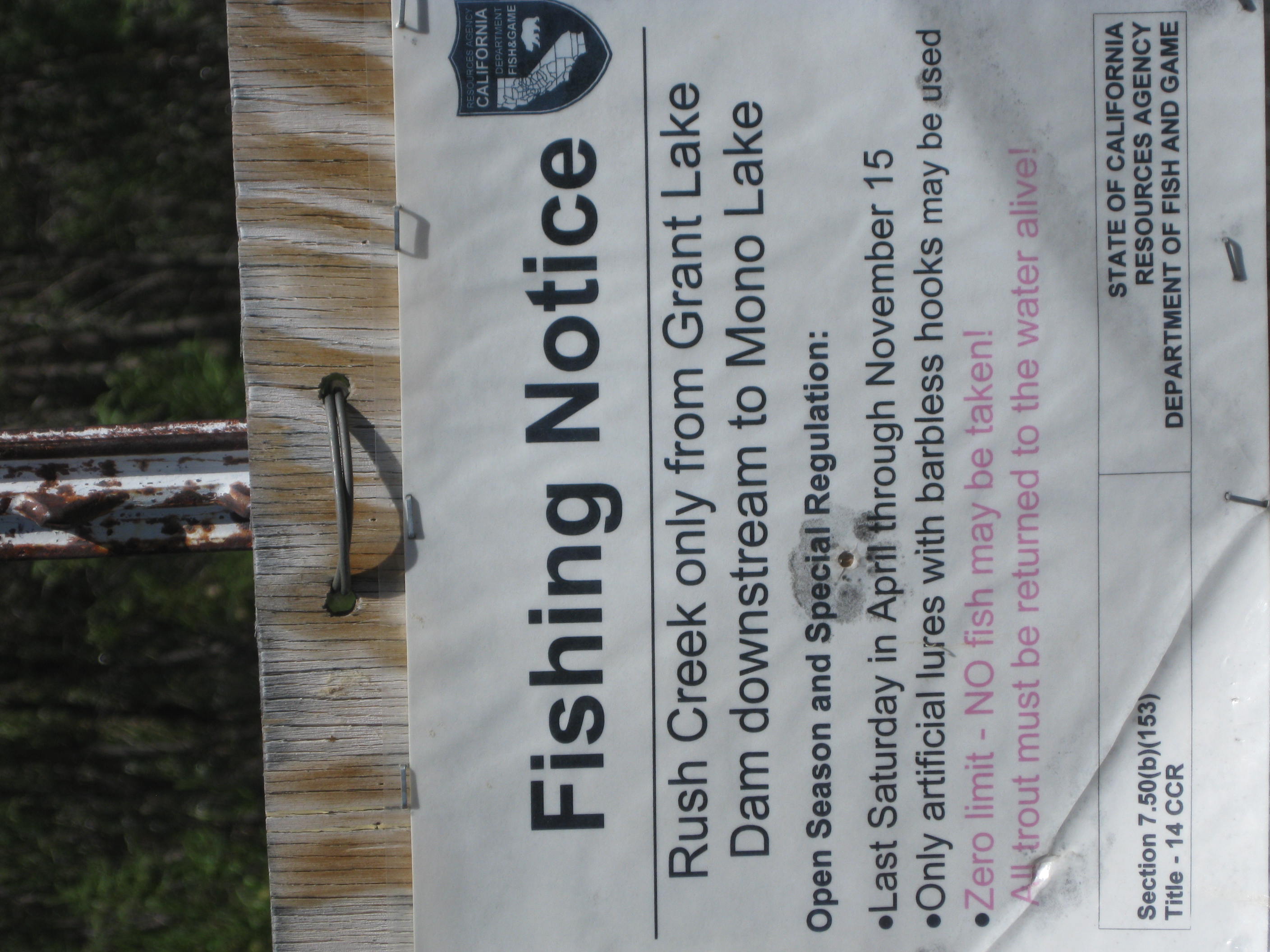
The catch-and-release section of Rush Creek remains a no-go in early summer, unless the water flows change. (Jim Burns).
How’s the old Sam Cooke song go?
“It’s summertime and the livin’ is easy,
Fish are jumpin’ and the cotton is high.”
Jumpin’, that is, everywhere except the eastern Sierra.
Who’s to blame for this atrocity?
Every summer, Bishop, Mammoth Lakes and environs are overrun with bait and fly fishermen, who want to catch as many naturals and plants as possible, from opening day in late April, until season’s end, Nov. 15. You’ll see them wade, float and paddle in the area’s lakes, rivers, streams and private waters. You’ll see them buying up as many worms, dry flies, nymphs and streamers as the sports and fly shops can carry. New expensive rods sell; flashy reels fly off the shelves; tippet and leaders; hemostats and non-felt-bottom boots. Bammo! It’s usually an injection of debit cards and cash for the summer economy.
So this year who’s to blame for fishing that can only be described by this writer as mediocre? That’s after three days on water from the C/R area of Rush Creek, to Hot Creek, to the C/R lower Owens.
Well, here’s the sad truch: It’s not actually who’s to blame, but what.
And that what is Mother Nature.
After a snowpack that was the best in years — 199 percent of normal — and a cool spring, the Tioga Pass, which connects Highway 395 to Yosemite’s eastern gate, finally opened Saturday, June 18. According to the Mammoth Times, Tuolumne Meadows still has a summer blanket of several feet of snow. Rivers are running at ridiculous levels. Maybe some visiting Hollywood producer will make a disaster movie about it in the vein of “2012.”
I mean when’s the last time a guide actually refunded your trip deposit, rather than take you out? It just happened to me.
My son and I watched the white caps on Hot Creek as the water tore through that wind-beaten canyon. You read that correctly — white caps.
So, if you’re headed up for your annual Sierra fix, better check the cfs numbers carefully. The same guide told me he didn’t expect normal flows until August. According to him, last year, which also had unusually heavy snowfall, July was the magical month.
Aside from private waters not affected by the torrent of water coming off the mountains, if you must fish (and if you’re like me, you must), try The Gorge, north of Bishop, off Highway 395. Any fly shop can give you exact directions.
The Browns can be sweet in The Gorge, but you'll work to get down there. (Jim Burns)
Two cautions: it is hot as blazes — expect the high 90s or more — and an unfriendly plant called stinging nettle certainly will make you miserable if you brush against it. Access to the water is down a long, steep, gated road, which means you have to have something left in the tank for the 25-minute or so trudge back up. Long pants, yes; extra water, please, and sunscreen (try the new spray-on from Trader Joe’s. Good stuff.)
Even with the moderate water flows, fishing The Gorge is tough. We managed to catch several browns in several hours; the lengths were more Southern California average than the monsters you’ll find on any local fly fishing Web site. Much as I hate to write this, I probably wouldn’t do it again this season.
As the world’s most honest guide said to me as I signed for my refund, “You fellas are just here at the wrong time, hell, wrong season.”
Which is great news for thirsty Los Angeles after a string of drought years.






 lariverflyfishing
