Tag: Carp

Rain rain, go away …

Last night, I woke up to the sound of rain pelting our metal window awnings. Normally good news, checking the weather forecast for the next couple of days, apparently rain will continue. But you know what that means — goodbye spring carp spawn.

Man, was that fun! It was my first spring spawn, and now I know why the more seasoned veteran re-checks his fly box in anticipation. During the last week or so, fish were everywhere — holding, circulating, tailing — waiting for (enjoying) nature’s main event.

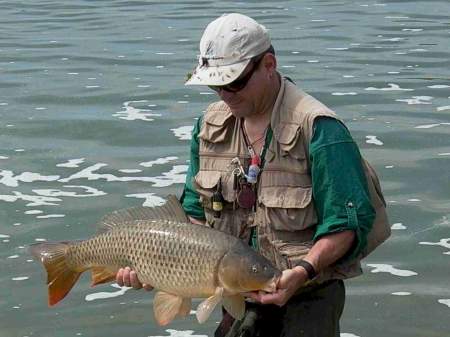
Oh, man, there's nothing like losing a big one in the weeds. (Jim Burns)

Of course, the down side to catching carp during this season is getting them to strike. Their minds are on romance, not Glo Bugs.

Any trout fisherman who’s been around will do two things before the first cast: check to see what bugs are on the water, in the trees or the creekside grass; and pull a nice scoopful off the bottom to see what creepies are in it. That way, you can cover dries and nymphs — at least that’s how the theory goes.

See that nasty float in the background? Avoid it! (Jim Burns)

During the six months or so I’ve been carping, I’ve never seen any sort of hatch on our river, nor have I found any crawlies in riverbed samples. There are crayfish for carp to munch, but it makes you wonder what our omnivorous friends chew on to get so gigantic! Our river bottom is an odd mix of concrete, mud and sand.

Case in point, Wednesday, we were trying to get any of the dozen or so fish my son and I spotted to strike. Tailing indicates a fish feeding by butting its head into the bottom to dislodge a meal. The go-to fly on the L.A. River is the lowly Glo Bug, an egg pattern, either weighted or not, in either chartreuse or white. The hot pink, unnatural colors don’t work here.

Anyway, think spawning salmon. Same deal. You basically have to entice a fish who really isn’t hungry to strike. Will and I ran through the fly box — chartreuse and white Glo Bugs, without and with weight; the trusty San Juan worm in red; a larger size Wooly Bugger in green; a larger size Hare’s Ear; even a dry hopper, just for grins. Nada, squat, nary a strike.

The ticket turned out to be a size 18 bead head Prince Nymph. The flash, the “shock and awe,” got tails wagging. And the pull on a Loomis 5 weight, the sound of fly line moving to backing, the run …

What turned our smiles upside down was losing the fish under freshwater seaweed.  The warmer-water bloom made us clean the fly before every cast. And in this situation, the carp certainly knew that a nice, heavy roof of weed would help him (her?) to break us off.

Bummer.

But, then again, that’s why we all keep coming back for more!

See you on the river, Jim Burns

Spring spawn — it’s on!

“Mad as a March hare,” that’s how the old saying goes.

College basketball fanatics anticipate  March Madness; Catholics, the beginning of Lent and, for everyone,  the last big-gulp gasp of Mardi Gras: “Laissez les bons temps rouler.”
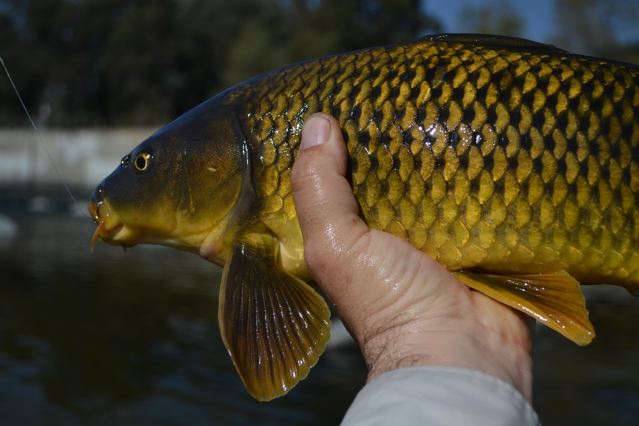
Check out the vivid color on this beauty. (courtesy David Wratchford)

Crafty fly tyers may litter their vises with March Browns to celebrate the beginning of spring.

And for those of us plying urban waters, it’s time for the semi-annual parade of the carp.

“I think they end up in Balboa Lake. I’ve spotted some huge fish in there,” guide David Wratchford told me yesterday at the Fisherman’s Spot. That would be miles, and miles, and miles upstream from where they begin the migration, probably in the Glendale Narrows.

Earlier in the week, he’d left me a voicemail — with some urgency — that the spawn was on.

My question: why now?

Turning to the bible of carp fishing, “Carp on the Fly” by Barry Reynolds and friends, I found the following water chart:

Water Temperature                                               Remarks

39 degrees                                          Carp begin active feeding.

41 degrees                                           Carp begin pre-spawn move  to shallows.

61 degrees                                           Sustained temp lethal to carp eggs.

63 degrees                                           Probable lower limit for spawning.

66 degrees                                           Optimal temp for carp.

72 degrees                                           Metabolism increases rapidly.

75 degrees                                           Probable upper limit for spawning.

79 degrees                                           Sustained temps lethal to carp eggs.

90 degrees                                           Metabolism at a high rate.

97-106 degrees                                  Lethal temp limit for carp.

So, once Mother Nature’s spring water thermometer hits the correct temperature, the carp are off and running. And do they ever run, up into the shallows, and the concrete steps that dot the semi-natural surface of Glendale Narrows and beyond.

Wow, a spawning carp, in all its mightiness, moves upstream. (courtesy David Wratchford)

If the March hare’s madness springs from its wacky mating behaviors — including jumping into the air for no apparent reason — the same holds true for carp.

“I saw sea gulls attacking a whole group of them. The fish were almost completely out of the water. I don’t know. It looked like they were trying to pluck out their eyes,” said one old timer I met yesterday.

Another younger guy, dressed in surgeon’s scrubs, told me he thought he’d seen a rock on one of the concrete flats. That rock, of course, turned out to be a monster carp.

“Its back was completely dry,” he said, and added that he couldn’t resist picking it up, then setting it back down in the water. I met him and his two friends with poles in hand, hoping to find more spawning carp.

What does this mean for you? Get fishing before the weather turns. Take advantage of this fine spring weekend. Heck, you might even exchange your normal Glo-Bug for a Mad March Hare’s Ear.

See you on the river, Jim Burns
Upcoming River Tour with FoLAR and Jenny Price

If you haven’t taken a river tour with Jenny Price, consider it. My wife and I toured with her several months ago, and it was an eye opener. Example: Think we live in a desert? Nine out of 10 would answer, “Of course,” but not if they’d taken this marvelous tour. Details below:

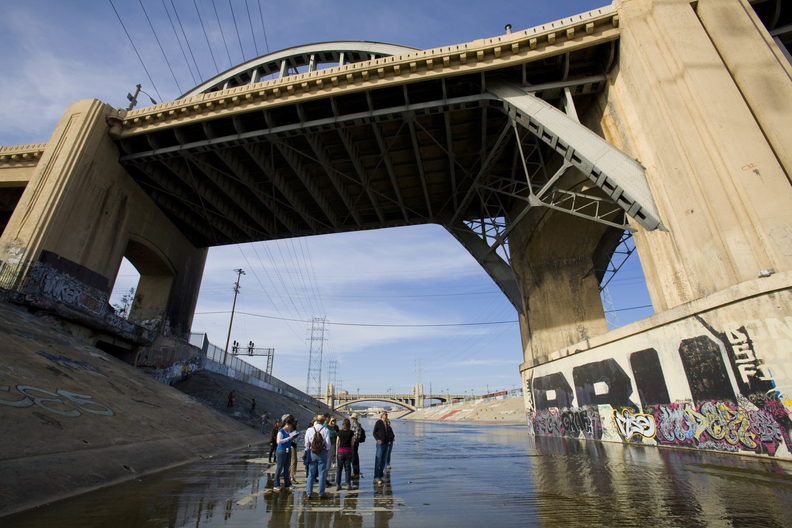
Get to know the river, up close and personal, like this shot under the Sixth Street Bridge. (Courtesy FoLAR)
Carpool Los Angeles River Tour
Elysian Valley to Long Beach
Special Water Edition
Follow docent, Jenny Price, to the Glendale Narrows, Arroyo Seco Confluence,
Downtown, Maywood Riverfront Park, Dominguez Gap Wetlands, and
Long Beach Harbor.
Saturday, March 12, 2011
9:00AM – 5:00PM (option to leave midday)

Featuring speakers from Santa Monica Baykeeper, Food & Water Watch, and
Environment Now.
To register, visit
See you on the river, Jim Burns


A message from our buddy, George Wolfe

Dear prospective L.A. River boater,

KCET’s gorgeous new ‘Departure’ series provides a lot of great information & the latest news about navigating the L.A. River, the ongoing challenges of obtaining official access to the river, & other tales about life along the river.  I hope that you’ll support their efforts while getting questions answered about our green business in development and your role in a future river expedition this year.  Feel free to post comments in order to open up discussions. Or perhaps send this notice around your email circles… or post a link on your favorite social media site.  Thx! 

Kayaking activist George Wolfe was instrumental last year in establishing the Los Angeles River as a "navigable waterway," which invoked the Clean Water Act. (courtesy George Wolfe)
1/4: LA River Expedition (2:54) — a brief history of how the ‘2008 LA River Expedition’ played a key role in protecting the river and its watershed
2/4: It’s Surreal (4:03) — on the quirky, “surreal” nature of the L.A.River
3/4: The River – Beyond a Glance (5:41) — what it’s like to physically navigate the L.A. River in a boat
4/4: Accessing the Water (3:46) — regarding recreational activities on the river + the challenges of creating a proper access policy
A couple other items:
* If you feel inspired to help push the process along (and it can help), I recommend that you contact your city councilmember, county supervisor or state political rep(s) and urge our local governmental agencies to create a clear, comprehensive LA River recreational use policy so that you can start using your river via LA River Expeditions in spring 2011.
* L.A. River Expeditions has been honored in the past few months with two environmental awards for its conservation work on behalf of the L.A. River: the ‘Green Paddle’ (presented by the American Canoe Association) and a ‘River Warrior’ award (presented by the Resources Renewal Institute).  To see more info on those, see our News page at http://www.lariverexpeditions.org/page_news.php
__________________________
George Wolfe
President & Founder
L.A. River Expeditions
george@LARiverExpeditions.org

Quick Mends

Why is it every Friday I could be fishing — at least for a few hours — it’s raining in L.A.? Tomorrow, snow is in the forecast!

Anyway, while housebound, surfing for carp stories, I found this interesting piece from Cape Town, South Africa, on the blog paracaddis.

It’s worth a read for several reasons:

Fat evidence that carp are alive and well in South Africa. (courtesy paracaddis)

First, it’s a heroic tale about a skunk.

Second, the weather is frickin’ hot.

Third, the fishers talk about Czech nymphing, or short-distance nymphing, akin to “high sticking,” but with more flies (OK, that’s really an oversimplification. For more, read the link.)

In my short experience, I’ve found that on our river, if you don’t see them, you won’t catch them. And, well, even when you do see them, you need a stealthy approach. They are some spooky fish.

Enough of this. Sunday morning, I’m going to try out my theories — unless, of course, it’s still snowing.

See you on the river, Jim Burns
Missing a ‘really big shew’

Browsing through the latest copy of Richard Anderson’s marvelous mag, “California Fly Fisher,” I recently spied an advertisement for the 2011 Fly Fishing Show in Pasadena, Calif. (Full disclosure. I’ve written a couple of pieces for him.)

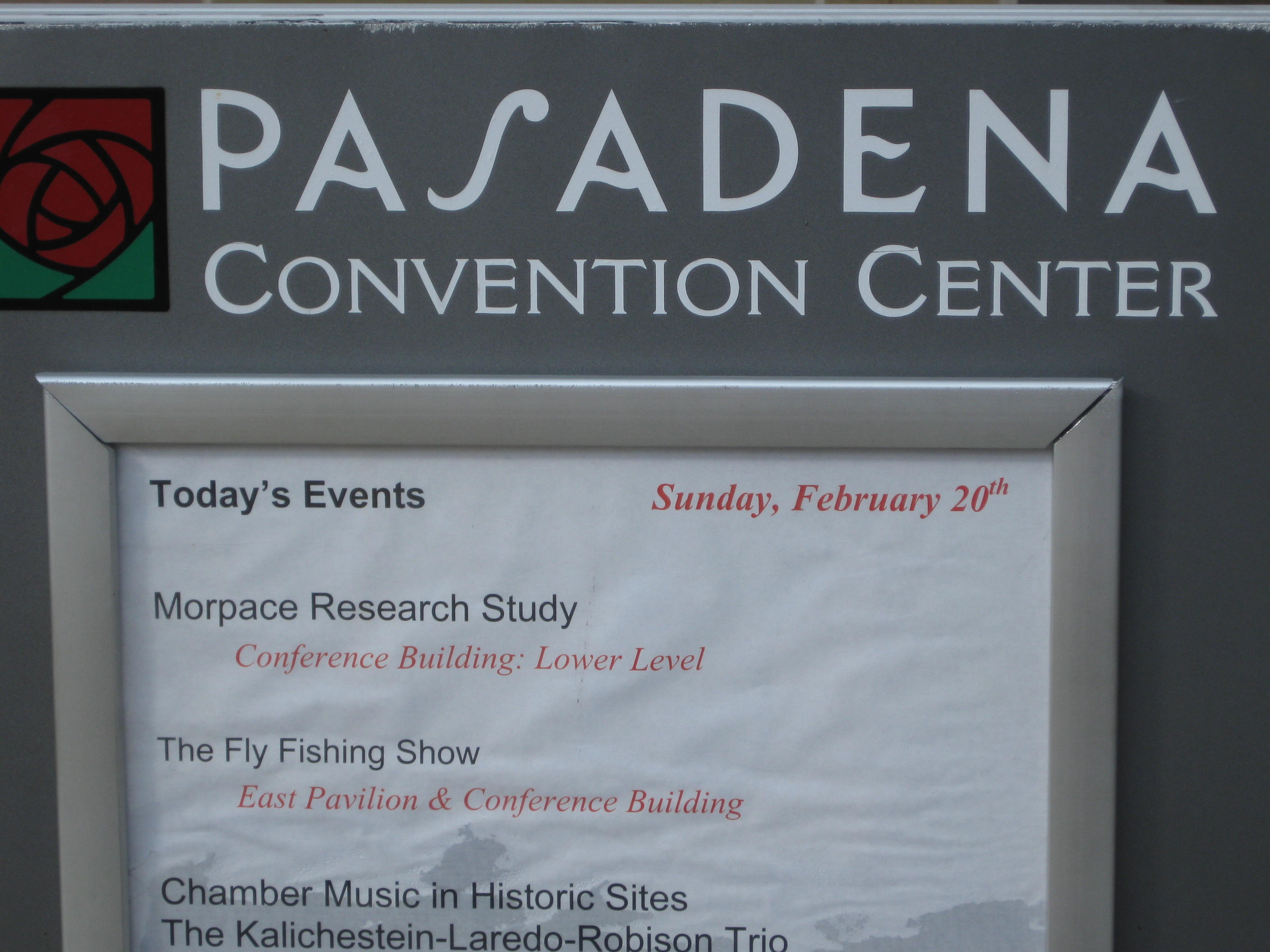
This is as far as the writer got to visiting the 2011 Fly Fishing Show in Pasadena.

Wow, I thought, what a great place to corral a bunch of stories for this ol’ hungry blog! Especially of interest, two seminars, “Sight Casting to Carp, the Golden Ghost of Southern California,” and “Fly Fishing Warm Water — Bass, Like, Carp.”

Because, as my industrialist daddy used to say, “time is money,” I went to the show’s site, only to find out that it’s a road show, with the next stop in Stockton later this month. But, unfortunately, there was no schedule of what was going on, and when.

So, I procrastinated and found myself asking the ticket lady inside her little portable booth outside the Pasadena Convention Center if, at 3:15 p.m. on a chilly Sunday afternoon, I could get a discount. Fifteen bucks is pretty dear these recessionary days.

Oh, and did I mention that the show closed at 4:30?

“No,” she said bluntly, and even in the dim light reminding of a confessional, I could see she wasn’t going to budge on the budget.

I ask you, isn’t $5 better than nothing?

So … my report on the show is zippo, nada, not a note taken, nor a voice recorded.

I guess that’s the beautiful thing about blogging and not getting paid for it. If you blow it, well, there’s always tomorrow.

One thing I did notice during my time peering in the picture windows and watching a newbie casting demo, the demographic for the show is basically mine — and older. Lots older. When our lot gets to pounding on tables at the bar and other likely spots, we like to opine on the lack of youthfulness in the sport. And by youthfulness, I don’t mean the bad-ass contingent that looks to be refugees from snowboarding. (Don’t get indignant … Anyone for a snowboarding/ice fishing combo?)

Anyway, getting “the youth” involved means getting off our older behinds, going to schools, casting ponds, derbies, whatever, to turn on the truly young to the wonders of nature. Neal Taylor was genius in doing it, and his obit ran today in the Los Angeles Times, paleolithic edition. Four thousand children a year come to Lake Cachuma, near Santa Barbara, and possibly many heard a tale spun by Taylor. Among his more notable students, presidents Carter, Reagan and Eisenhower.

After all, how can you miss with a spiel that begins, “”At Lake Cachuma, we have seeds that walk, spiders that fly, plants that catch fish and trees that predict rain.”

See you on the river, Jim Burns

Quick Mends

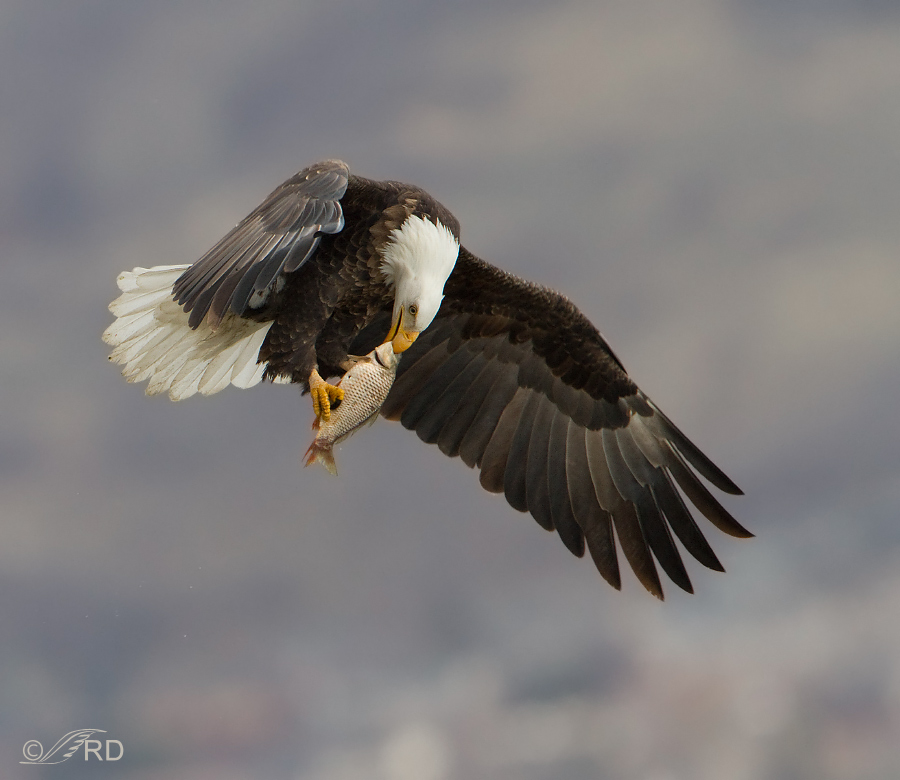
The power and majesty of nature (Courtesy Ron Dudley).

Thanks to Ron Dudley and Feathered Photography for this amazing sequence of our national bird getting a tasty meal of common carp. Wow, worth a look.


See you on the river, Jim Burns
Quick Mends

Calabasas city fathers (and mothers ...) agree: plastic bags = yuck.

UPDATE: Under “the snowball is rolling” category (with apologies to my home town, Chicago, worst storm since 1967 …), the Calabasas city council heard an ordinance at its last session about “regulating the use of plastic carryout bags and recyclable paper bags and promote the use of reusable bags in the City,” according to a memo from the city attorney. Next step, slated for Feb. 9, is to formally adopt the ordinance by adding it to the city’s municipal code.

See you on the river, Jim Burns

Quick Mends

The name says it all ... (courtesy Rock the Boat).

Take a look at the new trailer for the upcoming doc, “Rock the Boat.”  It’s so inspiring to see what George Wolfe of L.A. River Expeditions and other activists have done in a short period of time.

See you on the river, Jim Burns

Getting hooked on plastic bag bans

I’ve railed against plastic bags before in this space, so it was with glee that I read the Los Angeles Times today (legacy edition with black coffee and oatmeal) to find the Santa Monica City Council voted to ban them, beginning in September. Oh, and that vote was unanimous.

How many plastic bags do the good citizens of this beach city use in a year, you rightly ask? The advocacy group Heal the Bay estimates the number in excess of 25 million.

LA Public Works removing debris caught by booms from the L.A. River after a storm event. (Courtesy Algalita Marine Research Foundation)

According to the piece, Heal the Bay began pushing the issue two years ago, which stalled amid industry threats of a lawsuit. After the city’s environmental review of the proposed ordinance, the language was softened to include reusable polyethylene bags. These bags, according to an L.A. County environmental study, are stronger than single-use bags, and can be wiped clean, a good start for using them over again, instead of tossing in the garbage.

That pleased the Save the Plastic Bag Coalition, which praised the changes.

And, stores will now be able to charge a dime per paper bag within city limits. To avoid fees, just bring your own.

So far, single-use bag bans have been approved in :

— Los Angeles County

— Marin County

— San Jose

Next week, Calabasas considers whether it wants to join the growing movement.

Anyway, if you’re reading this at work, take a peek at a preview for “Plastic Planet,” a new doc from Europe.  I’m wary of “shock-jock docs,” which seem so evenly reported, but many times stack the deck a la the later works of Michael Moore. Admittedly, I’ve only watched the trailer, but will rent it.

See you on the (cleaner) river, Jim Burns