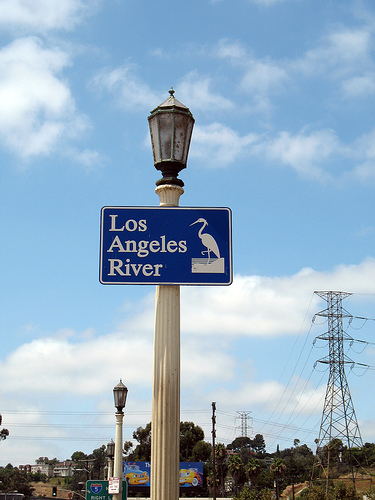
This quotation from Kenneth Grahame’s “The Wind in the Willows” was published in 1908. Of course, it’s a children’s classic, but the quote about England’s River Thames inhabits the end page for the city’s Los Angeles River Revitalization Master Plan.
“By it and with it and on it and in it…It’s brother and sister to me, and aunts, and company, and food and drink, and (naturally) washing. It’s my world, and I don’t want any other. What it hasn’t got is not worth having, and what it doesn’t know is not worth knowing.
Whether in winter or summer, spring, or autumn, it’s always got its fun and its excitements.
When the floods are on in February…and the brown water runs by my best bedroom window; or again when it all drops away and shows patches of mud…and the rushes and weed clog the channels…I can potter about dry shod over most of the bed of it and find fresh food to eat, and things careless people have dropped out of boats!”
UPDATE: “Damnation” is a documentary well worth watching.
I’ve been working on a complicated piece this summer that, frankly, I’ll be happy to send in to the editor next week. It’s about Southern California steelhead. That alone may come as a shock to some readers of this space — not that I’m working on it, but that there actually is such a fish in our Mediterranean clime.
Dating from 1943, it’s fair to ask what purpose this federal dam serves today (Jim Burns).
When I think of the mighty steelhead, I envision surging rivers somewhere in the Northwest, and rain-soaked attempts by dogged casters to get a strike, as these powerful giants return from the ocean to spawn in fresh water. Unlike salmon that spawn and die, a steelhead may make more than one trip to the ocean and back to its native waters. Because it covers so many miles, the fish is known as an “umbrella” species, whose health can either augur well or poorly for the rest of us. Steelhead made the Endangered Species List in 1997, and the status was reaffirmed in 2006, according to the National Marine Fisheries Service.
In pursuit of the truth about the viability of this species here in So. Cal., I’ve spent time with city officials, the Army Corps of Engineers, environmentalists of varied stripes, biologists and just plain everyday folks who love to fish.
All of them agree that one of the literal obstacles to getting steelhead off the list is dams that stop them from returning to their native habitats to spawn. I wanted to see for myself what one of these dams looked like. My wife agreed, and so we walked upstream yesterday in the July heat from Jet Propulsion Laboratory about four miles to Brown Mountain Dam.
Googling any topic can be deceiving, and so it was with our sojourn. No one in Pasadena needs to be reminded of the horrific Station Fire that took firemen’s lives, burned homes and ruined habitat two years ago. From reading, we expected our hike to be grim: lots of lunar landscapes, dead trees and squashed hopes. Not so.
Yes, there were dead trees. And, yes, there were large debris flows along the modest flow of the upper Arroyo Seco, all the way to the dam. But, there were also marvelous live oak canopies, wildflowers, cacti, blooming yuccas, calling birds, annoying insects. The Station Fire was devastating, but it hasn’t robbed us completely of this splendid natural respite.
Fish, however, were another matter. I spent unscientific time tossing rocks into likely holes, and even nymphed riffles and edges for a bit. If there are still fish, they were taking a long nap. This is particularly bad news as native rainbow trout (actually any rainbow trout) under the right conditions can become a steelhead. And there is a lot of work going into various plans to recover this species — in the Los Angeles River watershed.
Back to the dam. You’ve got to ask yourself, why, with the county ready to pour some $32 million into dredging and dumping the area above Devils’ Gate Dam, this little gem goes unnoticed. If I were a good reporter, I would have already asked an engineer how many tons of sediment lie behind Brown Mountain, just waiting to foul the county’s efforts if, God forbid, we have an earthquake of sufficient magnitude to bring the thing down.
Walking around its structure made me wonder aloud if the idea behind this dam was to slow the notoriously fast flow of winter storm water down the canyon. From my layman’s perspective, it’s a long way down those four miles to the flood plain alongside JPL. Couldn’t we allow it to return to its original state?
If nothing else, a walk up the Arroyo Seco should cure anyone of doubts about removing our channelized monstrosity of flood control to return our streams and rivers to the way they were.
According to emergency officials, a break in an Exxon oil pipeline caused the spill into the Yellowstone River Friday that has so far spewed thousands of gallons into the water, endangering residents, wild life and, of course, the rainbow trout for which Montana is famous. In fact, trout fishing is a $400 million business in that state.
The spill occurred near Billings, 100 miles below Yellowstone National Park and its prized fishing waters, which draw 11 million visitors a year to a state with a population of just 980,000, according to the Los Angeles Times.
The Billings Gazette features updates on the event, while CNN has video coverage.
“BAG,” and from here on out, supermarkets and pharmacies in unincorporated areas of L.A County will charge you a dime for each paper bag you need to carry out items from the store. Single-use plastic bags will be offered, however, for carryout, fruits, vegetables and raw meats.
What’s it mean?
On the heels of a 1 percent drop in sales tax here in the county, it is now wise to save your pennies by bringing your own bags for shopping. Yesterday, according to various news sources, shoppers who forgot their bags got creative by enlisting cardboard boxes, multitasking hand and arm grips a la Brazilian jujitsu, reusable totes and even Gucci purses.
Reaction has been mostly positive, according to store personnel.
After having covered this for the past several months, I have mixed feelings about the piecemeal bans we’re seeing. A statewide ban would have been more effective and easier on consumers. Now, your bag burden depends on where you’re shopping: Altadena, yes; adjacent Pasadena, no …
Let’s wait and see if the ban decreases the amount of plastic harvested in next year’s river cleanup.
Last summer, the Environmental Protection Agency declared all 51 miles of the river navigable. This summer … well, it looks as if beginning July 8 for 50 bucks a person you’ll be able to kayak three miles of the rio through the idyllic Sepulveda Basin. For the full scoop, read Louis Sahagun’s piece in today’s Los Angeles Times.
Sign of the times: Kayaking could be coming to a river near you. (Jim Burns)
A shout out to George Wolfe, who was willing to break the law to get this rolling. Another shout-out to Councilperson Ed Reyes, a champion of the river. And to the many, many others (blogger Joe Linton comes to mind) who have pushed, cajoled, persuaded, informed, and insisted that the Los Angeles River must be transformed from a concrete channel to a natural river, for the people’s use and enjoyment.
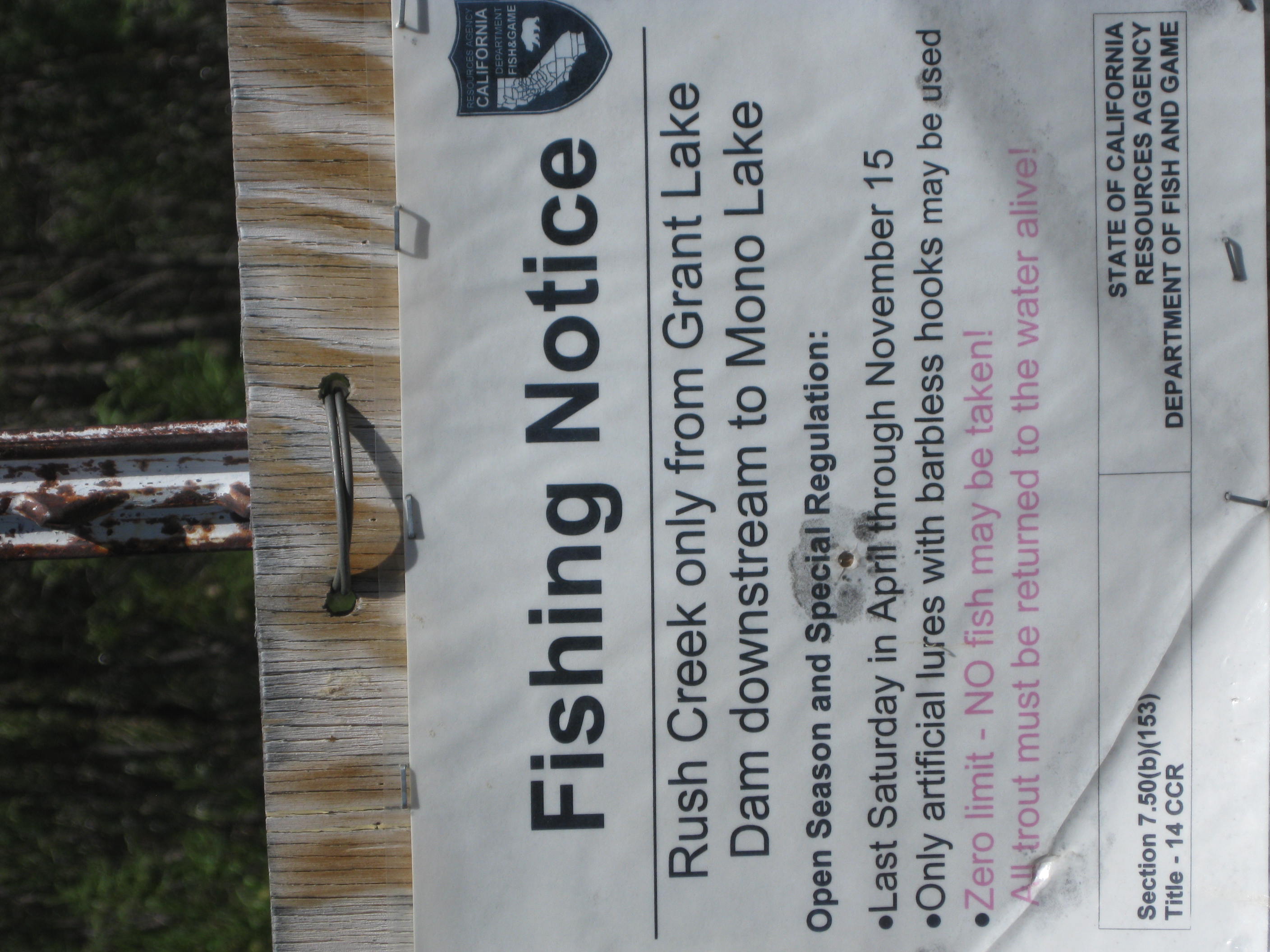
The catch-and-release section of Rush Creek remains a no-go in early summer, unless the water flows change. (Jim Burns).
How’s the old Sam Cooke song go?
“It’s summertime and the livin’ is easy,
Fish are jumpin’ and the cotton is high.”
Jumpin’, that is, everywhere except the eastern Sierra.
Who’s to blame for this atrocity?
Every summer, Bishop, Mammoth Lakes and environs are overrun with bait and fly fishermen, who want to catch as many naturals and plants as possible, from opening day in late April, until season’s end, Nov. 15. You’ll see them wade, float and paddle in the area’s lakes, rivers, streams and private waters. You’ll see them buying up as many worms, dry flies, nymphs and streamers as the sports and fly shops can carry. New expensive rods sell; flashy reels fly off the shelves; tippet and leaders; hemostats and non-felt-bottom boots. Bammo! It’s usually an injection of debit cards and cash for the summer economy.
So this year who’s to blame for fishing that can only be described by this writer as mediocre? That’s after three days on water from the C/R area of Rush Creek, to Hot Creek, to the C/R lower Owens.
Well, here’s the sad truch: It’s not actually who’s to blame, but what.
And that what is Mother Nature.
After a snowpack that was the best in years — 199 percent of normal — and a cool spring, the Tioga Pass, which connects Highway 395 to Yosemite’s eastern gate, finally opened Saturday, June 18. According to the Mammoth Times, Tuolumne Meadows still has a summer blanket of several feet of snow. Rivers are running at ridiculous levels. Maybe some visiting Hollywood producer will make a disaster movie about it in the vein of “2012.”
I mean when’s the last time a guide actually refunded your trip deposit, rather than take you out? It just happened to me.
My son and I watched the white caps on Hot Creek as the water tore through that wind-beaten canyon. You read that correctly — white caps.
So, if you’re headed up for your annual Sierra fix, better check the cfs numbers carefully. The same guide told me he didn’t expect normal flows until August. According to him, last year, which also had unusually heavy snowfall, July was the magical month.
Aside from private waters not affected by the torrent of water coming off the mountains, if you must fish (and if you’re like me, you must), try The Gorge, north of Bishop, off Highway 395. Any fly shop can give you exact directions.
The Browns can be sweet in The Gorge, but you'll work to get down there. (Jim Burns)
Two cautions: it is hot as blazes — expect the high 90s or more — and an unfriendly plant called stinging nettle certainly will make you miserable if you brush against it. Access to the water is down a long, steep, gated road, which means you have to have something left in the tank for the 25-minute or so trudge back up. Long pants, yes; extra water, please, and sunscreen (try the new spray-on from Trader Joe’s. Good stuff.)
Even with the moderate water flows, fishing The Gorge is tough. We managed to catch several browns in several hours; the lengths were more Southern California average than the monsters you’ll find on any local fly fishing Web site. Much as I hate to write this, I probably wouldn’t do it again this season.
As the world’s most honest guide said to me as I signed for my refund, “You fellas are just here at the wrong time, hell, wrong season.”
Which is great news for thirsty Los Angeles after a string of drought years.
This poem by Gary Snyder is from his book “Mountains and Rivers without end.” To me, it epitomizes the feeling I get everytime I’m on the river, fishing or not. See you on the river, Jim Burns
Water words: The poet Gary Snyder. (courtesy University of Illinois)
A few days ago, with a half-hour to kill, I put a line in my favorite spot at the river. With trout, that’s usually enough time to hook up, but not with carp. At least, that’s the way it rolls on our river, and for moi.
California Dreamin’: Could we ever be legally kayaking in the river and watching jumping carp? (Courtesy Weekly Times Now)
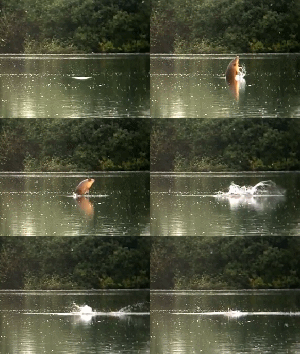
But I did get to see one jump way out of the pool, then come down in an inelegant belly flop.
Last year, when I started carping, I’d see this and think “Oh, man, am I ever gonna hook that sucker,” but not anymore. Jumping carp are interested in something, but not eating a fly.
So … why do they jump? Fun? Recreation? Boredom?
I checked the bible — “Carp on the Fly” by Barry Reynolds and friends — to find this passage. Italics are mine:
“Shallow-water hell raisers are exactly that: carp that are making a spectacle of themselves by leaping, splashing, and thrashing in the shallows. These fish seem utterly oblivious to the dangers they may face by drawing attention to themselves.
Often, there is a reason for this, particularly in the spring when carp are spawning. As you might expect, spawning fish are usually not very interested in your fly — they have other things in mind.
True, but this happened in June — no spawn on.
But at other times, these hell raisers are carp that are smashing through schools of baitfish and they’re a very good target for a small streamer.
False for the L.A. River. I’ve never seen a school of baitfish on it.
So … what causes this behavior? Here’s an answer from a carp fishing forum based in Georgia:
“Carp actively break the surface of the water for two reasons. Both reasons are due to water quality/lack of oxygen. If the ph factor is too acidic or the dissolved oxygen count is too low carp come up to seek more comfortable conditions. Carp normally stay and feed and roam on the bottom. When they are on the surface they are almost impossible to catch.”
Sounds good, but who knows (except for that last part, which is true, true!)
I put together this poll from various answers found on the Web. Any fish biologists out there care to clear up this mystery?
Many have compared Annie Dillard’s 1974 Pulitzer Prize winning Pilgrim at Tinker Creek to Walden, Henry David Thoreau’s seminal work on living independently.
Annie Dillard, who won a Pulitzer Prize for "Pilgrim at Tinker Creek," has penned 11 books. (Courtesy Phyllis Rose/Harper Collins Publishers)
“The pressure of growth among animals is a kind of terrible hunger. These billions must eat in order to fuel their surge to sexual maturity so that they may pump out more billions of eggs. And what are the fish on the bed going to eat, or hatched mantises in a Mason jar going to eat, but each other? There is a terrible innocence in the benumbed world of the lower animals, reducing life there to a universal chomp. Edwin Way Teale, in The Strange Lives of Familiar Insects—a book I couldn’t live without—describes several occasions of meals mouthed under the pressure of a hunger that knew no bounds.
“There is the dragonfly nymph, for instance, which stalks the bottom of the creek and the pond in search of live prey to snare with its hooked, unfolding lip. Dragonfly nymphs are insatiable and mighty. They clasp and devour whole minnows and fat tadpoles. “A dragonfly nymph,” says Teale, “has even been seen climbing up out of the water on a plant to attack a helpless dragonfly emerging, soft and rumpled, from its nymphal skin.” Is this where I draw the line?
“It is between mothers and their offspring that these feedings have truly macabre overtones. Look at lacewings. Lacewings are those fragile green creatures with large, transparent wings. The larvae eat enormous numbers of aphids, the adults mate in a fluttering rush of instinct, lay eggs, and die by the millions in the first cold snap of fall. Sometimes, when a female lays her fertile eggs on a green leaf atop a slender stalked thread, she is hungry. She pauses in her laying, turns around, and eats her eggs one by one, then lays some more, and eats them, too.”
This post is “The best of times and the worst of times” for me.
How can you not be happy as a fly fisherman to see the city of Ogden and various players have come together to rebuild this urban river? On the other hand, even with the leverage and political will gaining for our river everyday, we have many, many miles to go before we sleep. To wit:
I want to LEGALLY fly fish our river.
I want to LEGALLY kayak in our river.
I want to LEGALLY walk along its banks.
If you know of other restoration projects that readers of this blog would enjoy, please e-mail me. And thanks to Fly Fishing Frenzy for getting the word out on this wonderful restoration project. Watch the video on the site below.
The Ogden River runs right through the middle of the city. This river has had over 100 years of abuse and neglect and now the city and a host of others are doing something about it.
Andy Dufford of Chevo Studios has been chosen to create a public art piece in conjunction with the river restoration project. His proposal “Water Cycle” is a public plaza with seating and interactive sculptural elements located along the banks of the river. (Courtesy Ogden City Arts)
It was one year ago that Ogden City announced their plans for the Ogden River Restoration Project. The river from Gibson Avenue to Washington Boulevard was not a place you would find many fisherman, let alone families. Abandoned houses, litter and industrial waste kept most people from enjoying this river. But since last January a lot has changed.
“We found trash dated back to the 1870′s,” said engineer Crystal Young, Ogden River Restoration Project. “This is a good example of how the river has been filled by urban development in past practices. And so you can see all of this concrete and cars and trash has filled this native bank and buried these trees and built these banks up to where I’m standing now. All of this is going to be excavated down to the tree level and pulled back as you can see upstream in sections we’ve completed.”
The river bank and the riparian zone has been restored to its more natural state. Thousands of tons of debris has been removed.
They’ve taken out five to seven whole cars, about 14,000 tons of concrete, several car parts, thousands of tons of scrap metal, lots and lots of tires, about 250 cubic yards of shattered glass.
“Up near the brewery, it was a layer about six feet deep,” said Clint Ormond.
But this project is much more than just removing the garbage. Over four thousand tons of boulders have been placed on the river edge to stabilize the banks and put into the river to create habitat for fish. 40 thousand new plants will be planted and these storm water returns have been built to filter the cities storm drains.
“As the storm water drains in here, the plants and the pond itself will capture the garbage and the sediment from the streets. Keep a lot of the salt and oils captured in these ponds and keep it out of the river,” Clint said.
“We’ve tried to make aspects all along this project for everybody. We’ve got some great backdrops here. We’d like to see people playing in the river, fishing, taking pictures. We want to give a little piece of nature right in downtown,” Justin Anderson, Ogden City Engineer.
Fishermen say the restoration project is making a world of difference.
Lee Salazar has been fishing the Ogden river since he was a boy, “Not too bad. Shoot I’ll take them home and fillet them. My wife has been telling me go get me some fish.”
Lee says he’s seen rapid improvements.
“Two months ago, there was beat up houses that people had burned and it looks beautiful now. Compared to the way it used to look, I love it.”
The Ogden River has a good population of brown trout. But last fall, the DWR stocked this portion of the river with thousands of 10 to 12 inch rainbow trout and just last December.
The DWR released an additional 600 18-22 inch rainbow trout some pushing five pounds.
“We have been stocking for a number of years the upper reach of the Ogden River where there is better habitat than there was down here historically. But ever since Ogden City and the other partners have implemented this large scale restoration project there’s actually habitat here in the lower reaches,” said Ben Nadolski, DWR Aquatics Biologist.
“The difference is transformational Adam, it’s a night and day difference. It’s actually transforming a river back into a river,” Nadolski said.
“And those fish is what we want to promote. Hopefully someday we can even call this a Blue Ribbon Fisher. That would be a goal somewhere in the future where we can sustain that growth. We love this river and we are setting it up, it’s expensive, it’s costing a lot of money,” said Bob Geier, Ogden City River Coordinator.
Funding for the $5 million restoration project has come from, Ogden city, the DWR, the Utah Water Quality Board, Trout Unlimited and others. But they still need $1.5 million to complete the project and you can help. To donate, contact the United Way of Northern Utah and designate your donation to the Ogden River Restoration Project.
“The community deserves a place that they can connect with nature again and have a place where they can come and recreate in the outdoors,” said Crystal. “I just think it’s going to be the greatest community asset to Ogden.



 This quotation from Kenneth Grahame’s “The Wind in the Willows” was published in 1908. Of course, it’s a children’s classic, but the quote about England’s River Thames inhabits the end page for the city’s Los Angeles River Revitalization Master Plan.



 lariverflyfishing