Europe is one of the best continents to be in when it comes to vacations. Backpacking and taking in the sights on a bus or train is one of the best life experiences you’ll never forget. Among the best places in Europe is Germany. Apart from its scenic views, castles rich with history and the amazing food, it’s also the best places in the world to catch carp. While your wife may frown at the thought of you fishing while you’re in your second honeymoon, the best places to fish in Germany are also some of the most unique and picturesque locations you will ever see.
If this is your first time fishing in Germany, it would be best to hire a guide. Not that we don’t trust your fishing instincts or expertise, it’s just that locations here have peak and off peak seasons for fishing. On top of this, Germany has a strict and stringent fishing policy. You will need a temporary license to start fishing and if you’re going to fish in private property, you will need to pay the owner some royalties as well. Before this discourages you, let me assure you that if you hire a guide, all of these problems will go away. For a modest fee, your papers, the fishing location and all the gear you will need to fish that elusive German carp will be taken care of. You can check the internet for fishing guides like ProNature to help you with your fishing experience. The good thing about these guides is that they can also arrange your accommodations in some of the best B&B inns in the country.
Once you hire a guide, don’t forget to learn the tricks of the trade so you can go at it alone the next time you’re in Germany. Since fishing is regulated here, there is an abundance of catch and the sizes are relatively bigger than their U.S. counterparts. If there was ever a time for you to start your loved ones on fishing, this would be the place to do it.
This brown got fooled by a lot of elk hair caddis on a size 14 hook. (Jim Burns)
Opening Day in the Sierra is almost upon us (April 27), and according to writer Darcy Ellis, it heralds at least a decent season. Ellis penned “Epic season taking shape,” but after reading her piece in the Inyo Register Eastern Sierra Fishing Guide, I’m not sure “epic” is exactly the word the average fisherman would use.
“All of the elements have come together in 2013 for a banner fishing season: plenty of water, even more fish and lots of angling-related action for fishermen and their families,” read the article’s lead sentence.
Ample water is based on an interview with a Dept. of Fish and Wildlife environmental scientist, quoted as saying that “… we’re not anticipating low water this year.” Adequate water is one of the key criteria before the DFW will plant fish.
With the Monrovia fire still smoldering as I write this, it may surprise parched Southern Californians to hear this sort of prognostication. It also surprised the California Dept. of Water Resources.
“The snowpack is at 54 percent of normal, so it’s not looking good,” said Jennifer Lida, an information officer for the department.
The last manual survey of the year, in which DWR surveyors actually go into the mountains instead of relying on electronic sensors, is scheduled in about two weeks on Echo Summit, near Lake Tahoe. This measurement traditionally documents the wetness of any given season. Snowpack normally provides about a third of California’s water as it melts into streams, reservoirs and aquifers. The short-term good news is that “most key storage reservoirs are above or near historic levels,” according to the department.
Given this scenario, I’d get my fishing in early. Last year in the Golden Trout Wilderness, one favorite creek had turned into runs of unconnected water by August.
Still it looks like there will be lots of trout in the middle Sierra, the L.A. mecca for fly fishing. According to Ellis’s article, DFW plans to plant just shy of 1 million pounds of trout this season. You can check the planting schedule here.
Finally, there certainly will be family events during the summer. One that’s new is Trout Fest on June 29 at the Hot Creek Hatchery outside Mammoth. The flier promises kids going to the event that they will be able to “catch a fish, feed a fish, taste a fish, touch a fish.”
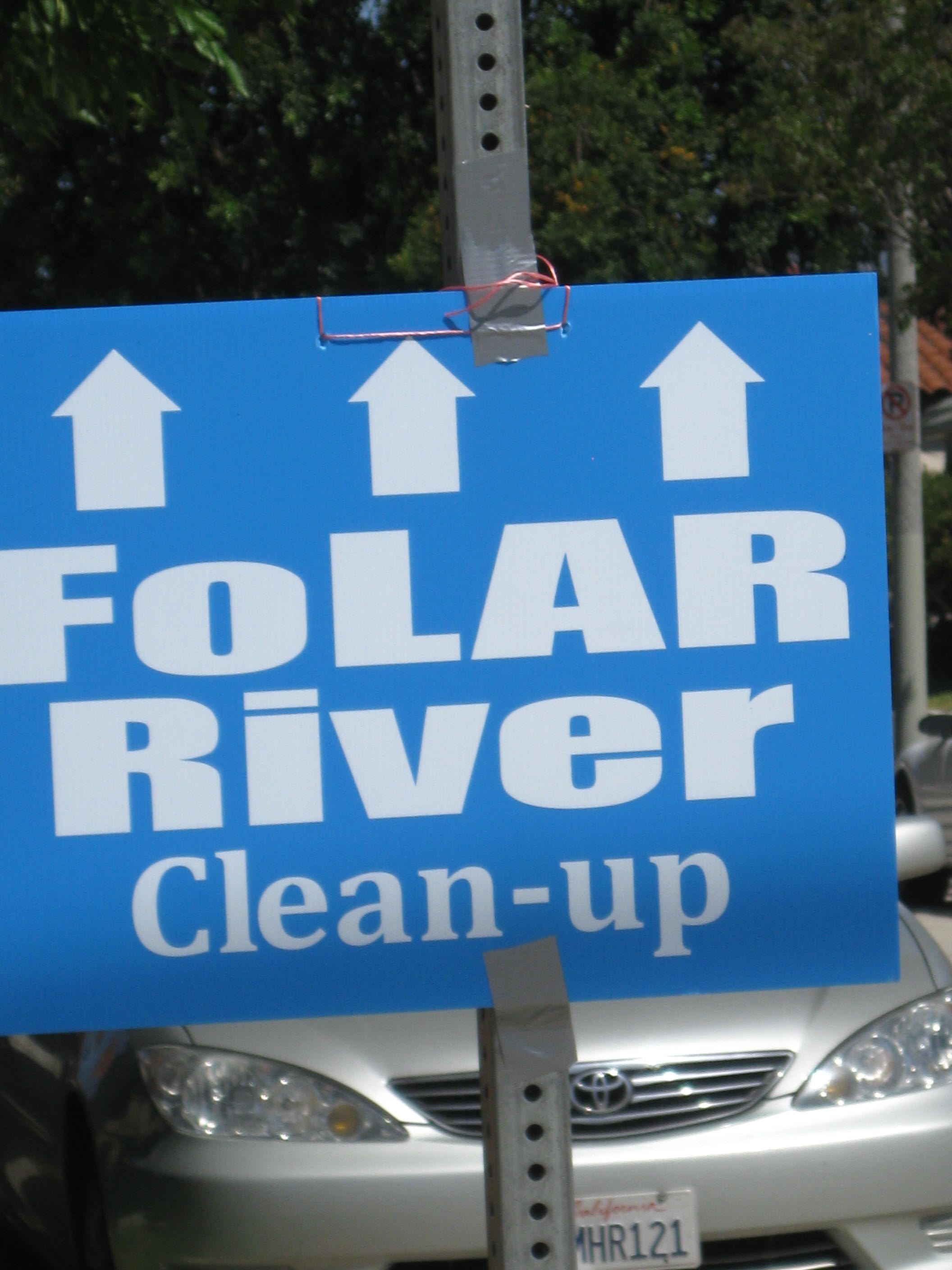
The next FOLAR river cleanup is slated for Saturday, May 18.(Barbara Burns)
UPDATE The new law goes into effect for large grocery chains and pharmacies beginning July 1, 2015. It will extend to convenience stores and liquor stores July 1, 2016.
Heartening news out of Sacramento, as the California Grocers Assn. announced support of a bill to nix single-use plastic bags in most grocery stores and pharmacies by 2015.
An initial hearing on SB 405, penned by state senator Alex Padilla (D-Pacoima), in the Senate Environmental Quality Committee is set for tomorrow, the Los Angeles Times reports.
See you on the river, Jim Burns
MAY 30, 2013, UPDATE: “Senate Bill 405 failed to top the 21-vote threshold needed for passage, with senators voting in favor of the measure 18-17. Four senators did not cast votes. The bill will be allowed to be reconsidered, meaning it could be back before a Senate committee or the Senate floor.” — Waste & Recycling News
WEST FORK: Even as new signage and a bridge go up, the fly fishing has gone way down.. (Jim Burns)
UPDATE: This post is more than four years old, but continues to get traffic, so I wanted to give readers the lowdown, as of mid-July, 2017. California Dept. of Fish and Wildlife recruited members of the Pasadena Casting Club and other groups to fish, snorkel and help access the health of the stream. The result: encouraging. Ten anglers caught 60 fish in five hours, all rainbows, ranging from under six to more than 13 inches. Two years ago, a similar study found only 20 fish. Our beloved West Fork is going in the right direction once again.
There’s no doubt that fly fishing is very much akin to love — true love, of course — and that possibly as writer Thomas Wolfe once lamented, “you can’t go home again.” Maybe all of that’s overstating the case, but a recent return trip to the West Fork left me wringing my hands.
Here’s how my day went, after some two years of staying away.
— Had Wednesday off … a near perfect weekday to go fishing
— Weather was perfect, in the 80s
— Found a spot in the lower parking area. That never happens
— Stoked
— Enjoy new signage for Cogswell Dam on locked gate
— Decide to hitch when a Prius driver opened the locked gate. She initially stopped, got spooked and waved as she accelerated past me
— Spot new, unfinished bridge to upper parking lot. Frown. Good roads make bad fishing
— Resumed enjoying day, trying to spot fish in the put-and-take area. Can’t see any trout
— Met a friendly dog named Crazy, or some such. He followed me up the canyon, much to owner’s chagrin
— Patient owner walked all the way back to get Crazy. Crazy followed me again. Owner carried Crazy off toward car
— Truck passed me on the road. Wonder how many people have a key to that damned gate?
And so some dark clouds began trying to intrude on my happy day off. At the first bridge, I saw two small trout, doing their round-and-round dance in the water, which I mistakenly called a mating ritual in these pages. Ready to thread up my ancient Orvis No. 2, 6-foot rod, I realized I’d torn the loop off the fly line on my last adventure. Darn. Time for a barrel knot between the 7x, 12 foot tippet (length not smart for this water …), and how do you tie a barrel knot again? Oh yeah, that’s how you do it.
— Fish gone
— Spied the trail up Bear Creek. Took it
— Caught one fingerling trout
— Wonder at the beauty of this (for me) discovery. Splendid to be alive
— Where were the fish? Waterbugs fooled me, as they looked like rises from a distance
— Made acquaintance of nice duck couple. They also wondered where the fish were
After what seemed like forever, even in this California canyon paradise, finally I spotted tiny fish rising. I rested on a boulder by the water and thought “tiny fish beat no fish,” so I threaded a tiny dry something, but to no avail. Then, a miniscule wired midge under a small yellow sallie nymph. Nada. Yes, there were plenty of tug, tug, tugs, but that was it.
— Exasperated, took closer look at fish. Whoa. These weren’t trout, but arroyo chub (I think)
Arroyo Chub are little guys that love to patrol their lanes. (Courtesy Sierra Club)
— Had a grand time, out of myself, like being a kid, forgot the world, gloomy thoughts. Note to self: Must take wife picnicking here
— Headed back to road. Got decent pull at the Bear Creek pool that is fished by everyone and his mom, aunt, uncle, frenemy and others
Then, I saw three trucks parked right there, right by the side of the road, on the two sides of the road, actually
— Fly fisher having no luck at all by bridge
— Walking, hope to meet Crazy again
— Older gentleman in Long Beach Fly Fishing Club shirt, driving truck, asked me, “If I took ’em all out?” I say “no”
— Fight off gloomy thoughts like why do any of us think we can fish in the first place
— Start car with half-smile on my face. Was expecting full smile
And there you have it. This area needs help, folks. It is so achingly beautiful, yet at the same time so neglected by the thoughtless weekend crowds, the swimming, the fishing pressure, the easy access, the environmental lawsuits, the lack of any official presence … what else? I know for certain, I’ll not follow Wolfe’s advice. I’ll brave the traffic and maybe even Crazy to fish the catch-and-release section upriver one more time.
PADDLE UP: The L.A. Conservation Corps guides a group through still waters and overhanging willows. (Jim Burns)
The Los Angeles City Council voted yesterday to approve the first recreational zone on the Los Angeles River.
The motion passed in an amended form over the objections raised in public meetings about adequate neighborhood parking and the rights of dog owners to walk their pets along the river’s bank in the defined area. Beginning Memorial Day through Labor Day, riverside residents, as well as visiting kayakers and others, will judge how successful, or lacking, the program is.
It was a clear victory for Councilmember Ed Reyes’s office, which looked to expand the recreational use of the river after the success of last summer’s Paddle the L.A. River program farther north in the San Fernando Valley. Expect signage, provided in collaboration with KCET, a shuttle to get kayakers from parking near Confluence Park to the put in, and, finally, a single entity, the Mountains Recreation Conservation Authority, to enforce the rules, instead of L.A.P.D. Also, expect the MRCA to be looking for a valid freshwater fishing license if you’ve got a rod in the water.
Although generally supportive of the zone, the Department of Fish and Game remains cautious going forward.
“In general, yes, we would support the recreational zone, but the devil is in the details, senior biologist Dwayne Maxwell said via email. “The development of a recreational zone has the potential to improve some of the habitat characteristics of this reach of the Los Angeles River. We are having some difficulty, however, seeing this water as a plantable trout water. The number of exotic fish species and the potential high bank and water-oriented uses of the river probably would not make it a high priority sport fishing water.”
The amendments included:
— Clarify that the pilot recreational zone program consists of the ElysianValley area south of Fletcher Drive, from Rattlesnake Park to Egret Park;
— Recognize that the Mountains Recreation and Conservation Authority (MRCA),the U.S.Army Corps of Engineers, the Los Angeles County and the City have mutually agreed to conditions that satisfy all concerns for the operation of the pilot recreational zone program;
— Grant the MRCA authority to manage the designated recreational zone area and utilize the MRCA Park Ordinance to regulate park and public trust doctrine activities.
U.S. Army Corps biologist Erin Jones points to one of the soft-bottom areas of the Los Angeles River near North Atwater Park. (Jim Burns)
The Los Angeles City Council votes on the Pilot Recreational Zone Program tomorrow. If the zone is approved, the city will build upon the successful Paddle the River program, allowing kayaks to launch south of Fletcher Drive and run about two and a half miles downsteam from Memorial Day through Labor Day. Sorry, that doesn’t include float tubes for fisherman.
One public comment meeting last month quickly turned contentious as dog owners argued against the prohibition of walking their pets along the river, which is one stipulation of the plan. Owners could still walk their dogs on the bike path.
Meanwhile, remember that the next important item for the river will be a public comment period on four proposed plans for ARBOR (Alternative with Restoration Benefits and Opportunities for Revitalization). Here are comments from Erin Jones, a biologist with the U.S. Army Corps of Engineers. She studied ecology and environmental science, receiving an MS from UC-Santa Barbara. After graduate school, she continued with plant and wildlife studies in the field, and has now moved into national environmental policy.
FF: So what is the Corps looking at?
EJ: Basically, the four different options for construction, the Corps refers to them as alternatives, all involve restoration along the river and they are basically of varying scales, and varying costs as well.
We choose a range of options to evaluate in order to see what the impacts are, what the costs are, what the benefits are, at the varying scales. Our smallest alternative may involve a couple of different areas and our biggest alternative involves our whole actions and study area.
FF: Where is that?
EJ: Our largest-scale alternative would have those things, but also add on the confluence of Arroyo Seco, the confluence of Verdugo Wash, the Piggyback Yard, which is in downtown, bigger areas like that, which are more involved in terms of construction.
FF: What does your field work entail?
EJ: What I do in terms of these types of feasibility studies, where we are trying to develop different plans, is to choose one of those plans to try to implement. My involvement is helping to develop these different options and determine what’s going to be the best restoration action, and in what places. I also look at what kind of plants and wildlife were on the river historically and what can we do to restore that same type of habitat.
At this point and time, we’ve come up with just very general plant palettes, we call it, a list of plants that we’d want to see established in those areas. Historically on the river and on the floodplain, there was a lot of fresh water marsh, and there was a lot of cottonwood-willow riparian forest.
FF: How do you gauge historic conditions?
EJ: For this project, the Corps mission for ecosystem restoration is to restore as much as we can to historic conditions, before human involvement, which is difficult and we can’t always do that, but we want to do the very best we can. And so part of that means looking at the history, looking at what was there, part of our research involved acquiring some historic maps from the Huntington Library. They had historic linen maps from 1896 and those maps were very detailed, and they showed the course of the river, at least that snapshot in time, where it meandered, and what some of the habitats were along the river, so we were able to use that, along with other resources, you know different publications, to get a feel for what was here before.
Even at that time the evidence of human settlement was there with crops adjacent the river, and even a little bit of settlement in the downtown area. So that’s where it’s difficult to know what was around, pre-settlement, because finding those records is difficult. But I think we generally have a pretty good idea from the research that we’ve done, so we’ve been trying to use species, for instance, that we know were here historically.
FF: Carp were not here, so would you get rid of them as an invasive species?
EJ: You know at this point in time, I don’t think we’ve talked about active removal of non-native fish. You know when we implement the project that’s something we can look at. I know that construction projects on the Santa Ana River, which I’m familiar with because I work out of Prado Dam, whenever they have diversions for their projects, they pull all the non-native fish out and just leave them on the banks for the raccoons to come and get. At some point, they had to have a bucket loader come, there were so many invasive fish in there, and take them away. You know that’s something that we could definitely look at for this project, the removal of non-native fish during our active construction. For restoring native fish, you need to remove the non-natives.
EJ: It’s definitely challenging, especially because the native fish need the cooler temperatures and they need the shade, they need downed wood to create refuge, you know those things aren’t necessarily present in this system. As I said, we can do our best to restore those features in our project. And even stock with native fish to try and restore the populations, but there’s only so much we can do. But I know that some of the features of our project involve trying to mimic native fish habitat with the goal of trying to restore for the natives. Things like riffle pool complexes, and refugia, things like that. Considering the numbers of non-native fish that are in the river now, it’s a challenge, for sure.
FF: So, would the concrete come out?
EJ: Part of the challenge with the project is maintaining flood capacity. This project was built in the early 20th century as a flood control project. And, unfortunately, all of the natural resources were eliminated with that project, so now putting it back we still have to consider safety of people and damage to infrastructure, so removing the concrete fully, we did look at that, and it just wasn’t possible for the cost and for maintaining that capacity, so places like Taylor Yard, we have a big space next to the river, those are the kinds of places where some of our plans look at taking out that concrete bank and just widening the river at that point and really restoring a lot of habitat in those areas. Piggyback Yard is another area in some of our plans where that might be possible.
The Glendale Narrows, wherever these is a soft bottom, that will be left intact. Enhanced, of course, removing arundo, non-natives, that’s a part of the entire program, to remove non-natives, but the Glendale Narrows area is going to be maintained, the soft bottom areas will be maintained.
“Mad as a March hare,” that’s how the old saying goes.
College basketball fanatics anticipate March Madness; Catholics, the beginning of Lent and, for everyone, the last big-gulp gasp of Mardi Gras: “Laissez les bons temps rouler.”
Crafty fly tyers may litter their vises with March Browns to celebrate the beginning of spring.
Smaller males surround a larger female carp on their way up the Los Angeles River. (Derek Bourassa).
And for those of us plying urban waters, it’s time for the semi-annual parade of the carp.
“I think they end up in Balboa Lake. I’ve spotted some huge fish in there,” guide David Wratchford told me yesterday at the Fisherman’s Spot. That would be miles, and miles, and miles upstream from where they begin the migration, probably in the Glendale Narrows.
Earlier in the week, he’d left me a voicemail — with some urgency — that the spawn was on.
My question: why now?
Turning to the bible of carp fishing, “Carp on the Fly” by Barry Reynolds and friends, I found the following water chart:
Water Temperature Remarks
39 degrees Carp begin active feeding.
41 degrees Carp begin pre-spawn move to shallows.
61 degrees Sustained temp lethal to carp eggs.
63 degrees Probable lower limit for spawning.
66 degrees Optimal temp for carp.
72 degrees Metabolism increases rapidly.
75 degrees Probable upper limit for spawning.
79 degrees Sustained temps lethal to carp eggs.
90 degrees Metabolism at a high rate.
97-106 degrees Lethal temp limit for carp.
So, once Mother Nature’s spring water thermometer hits the correct temperature, the carp are off and running. And do they ever run, up into the shallows, and the concrete steps that dot the semi-natural surface of Glendale Narrows and beyond.
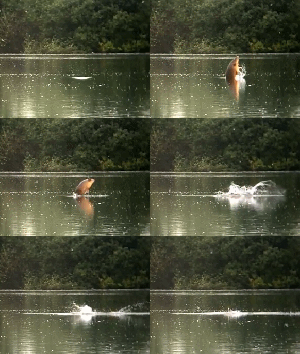
If the March hare’s madness springs from its wacky mating behaviors — including jumping into the air for no apparent reason — the same holds true for carp.
“I saw sea gulls attacking a whole group of them. The fish were almost completely out of the water. I don’t know. It looked like they were trying to pluck out their eyes,” said one old timer I met yesterday.
Another younger guy, dressed in surgeon’s scrubs, told me he thought he’d seen a rock on one of the concrete flats. That rock, of course, turned out to be a monster carp.
“Its back was completely dry,” he said, and added that he couldn’t resist picking it up, then setting it back down in the water. I met him and his two friends with poles in hand, hoping to find more spawning carp.
What does this mean for you? Get fishing before the weather turns. Take advantage of this fine spring weekend. Heck, you might even exchange your normal Glo-Bug for a Mad March Hare’s Ear.









 lariverflyfishing