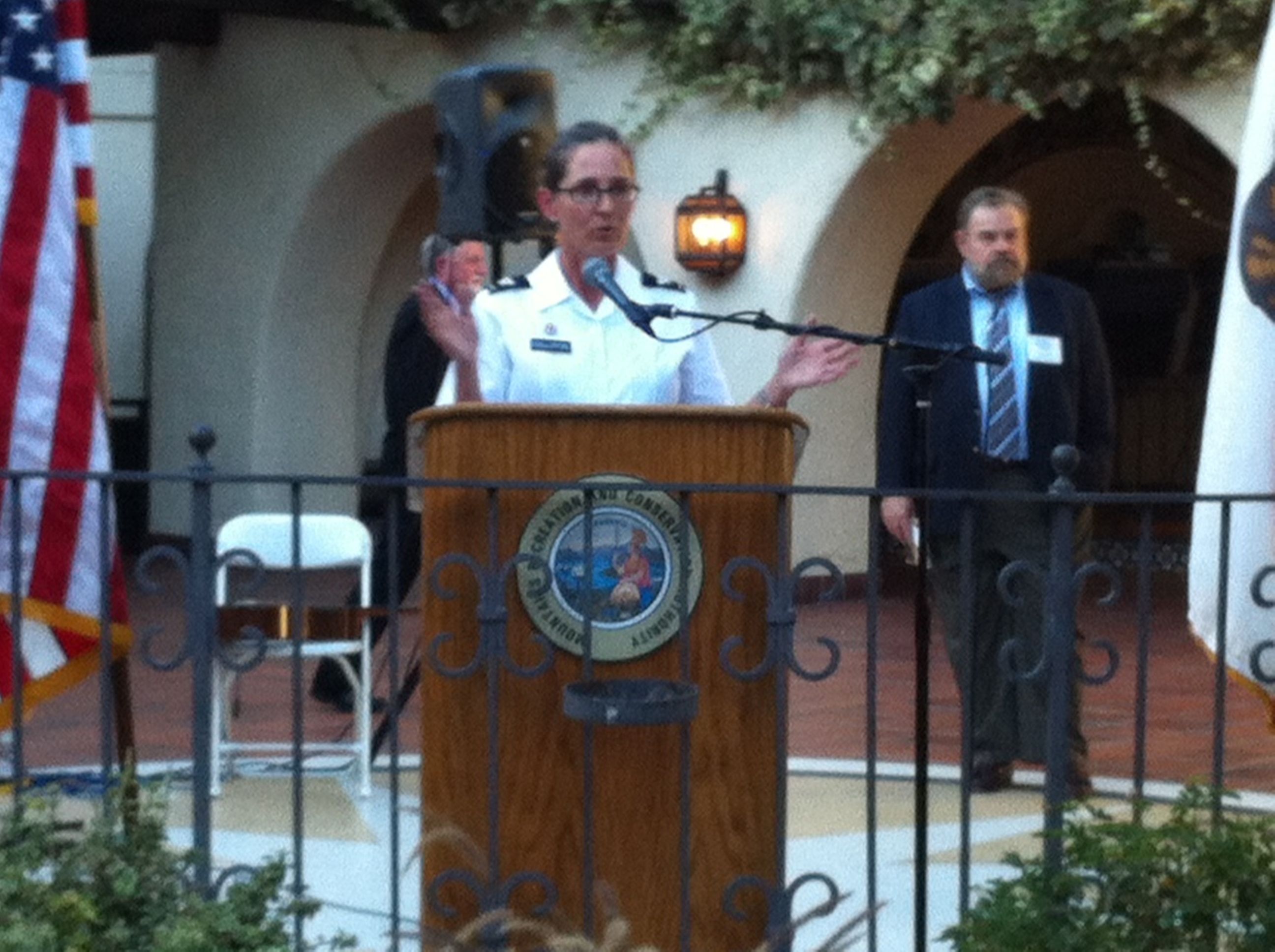
Col. Kim Colloton emphasizes a point yesterday at the Los Angeles River Center. She is the first female commander to occupy the U.S. Army Corps top job in L.A. (Jim Burns)
In an unprecedented first, river advocates threw a party to welcome the first U.S. Army Corps female district commander to Los Angeles. Spanish guitars played as guests from a multi-pronged coalition of community groups, private enterprise and government officials sipped sangria to welcome Col. Kim Colloton at the Los Angeles River Center plaza.
The river center is a stronghold of advocacy groups, which include Friends of the Los Angeles River and the Arroyo Seco Foundation. The audience and speakers included two Los Angeles city councilmembers, the mayor of Burbank, and representatives of local cities, the state and the federal government.
“This has never been done before,” said Lewis MacAdams, founder of FOLAR, and, until recently, a longtime self-proclaimed “enemy” of the Corps. But MacAdams, along with others, increasingly see the Corps as part of the solution, not the problem.
“It’s going to get more challenging as the interest gets wider, as more and more people view the river as an asset toward open space, and renewal, and improvement of the city,” Alejandro Ortiz, FOLAR chairman said. “You would wonder if the Corps of Engineers is the ideal partner. At first thought, you might think it’s not, but as it turns out the Army Corps of Engineers is the guiding light toward salvation. And salvation has a name. It’s Option 20.”
At stake is how much money the federal government is willing to put into implementing an ecosystem restoration that could possibly remake the Los Angeles River into a vital part of the city. Last week, the Los Angeles City Council made it officially known that it wanted to see the biggest package possible, that’s $1 billion (Alternative 20), which would be spent on the river from Glendale Narrows to downtown, an 11-mile area. There are three other “best buy” alternatives that will be spelled soon-to-be-released report, each with a lesser price tag.
“Just from my short month here in my new job, and by this synergy that I have felt and seen tonight, I can feel that we are united in a vision to protect, restore and maximize this river’s benefits for future generations,” Col. Colloton said to the crowd of around 200.
The crowd found out that the long-awaited ARBOR study, which names four possible paths to ecosystem restoration, will be available for public comment on Sept. 13. There will be an email box to make it easy for people to voice their opinions on the Corps’ website. How much money is spent must be voted on and approved by Congress.
Pushing for the billion-dollar restoration option, from left, are councilmembers Cedillo, LaBonge and O’Farrell. in the center, back, is California State Assemblymember Jimmy Gomez (D., 51st District) (Jim Burns)
In preparation for what could be remembered as an historic city council vote, three councilmembers made their case poolside for the most expensive restoration of the Los Angeles River at over $1 billion. It was a continuation of a public relations campaign over the summer to convince Washington to open its strained pocketbook in favor of a local project with considerable political capital.
The press conference, strategically held at Downey Pool, close to both the river and Los Angeles State Historic Park, presaged the first time since 2006 that the city would declare its priority publicly. Ironically, its partner, the U.S. Army Corps of Engineers, didn’t attend.
“I think you’re going to see an unprecedented push and an unprecedented effort of collaboration. We are dead serious about this, and we are aspiring to work together, to collaborate, to pool all the resources, working with the state, but also preparing to go to Washington, working with the Army Crops of Engineers to get the biggest package that we can for the city,” said newly elected Councilmember Gil Cedillo.
He, together with council colleagues Mitch O’Farrell and Tom LeBonge, made it clear that the city wants the federal government to spend $1 billion over the next several years to restore the Los Angeles River to at least a semblance of what it once was, as will be outlined in the Corps’ Los Angeles River Ecosystem Restoration Feasibility Study (ARBOR), which cost $10 million and seven years to complete.
Even though the actual study, along with its four restoration alternatives, won’t be released by the U.S. Army Corps of Engineers until Sept. 20, politicians and river advocates are lining up in support of the most expensive plan. After ARBOR’s release, there will be a 45-day public comment period and a public meeting on Oct. 17. Although a month away from the report’s official release by the Army Corps., the broad outline has been available for weeks.
A few hours later, the Los Angeles City Council voted unanimously “to endorse a Los Angeles River Ecosystem Restoration Feasibility Study alternative that results in the most expansive ecosystem restoration.”
Last week, Los Angeles Mayor Eric Garcetti sent a letter to Washington advocating for the same thing.
“The ARBOR study Alternative 20 will begin to reweave the city and the watershed together,” said Lewis MacAdams, who established Friends of the Los Angeles River, and is now considered the “grandfather” of the current restoration effort. “It will bring the river together with the mountains, and it will bring the people together with the habitat, miles of concrete will be destroyed. It would begin to payback with this billion dollars all the work that’s been done to destroy the L.A. River.”
MacAdams recounted how, as an old-time Army Corps of Engineers fighter, he was surprised to be invited to a teleconference between the L.A. District and the national headquarters in Washington a couple of months ago. He went on to say he was shocked when I saw what was going to become the proposal of the L.A. district, Alternative 20.
By contrast, Alternative 13., said to be favored in Washington and the least expensive of the plans, has a projected cost of just under $450 million to pull concrete and make other habitat changes along the 11 miles of the river from downtown to Griffith Park.
“We’re Los Angeles. We deserve a $1 billion investment in the Los Angeles River. We’re going to fight for this,” O’Farrell said.
With so much going on for our river, it’s easy to forget about other restoration efforts around the country.CarpSlam7-2013-Brochure is coming up Saturday, Sept. 7, to benefit the South Platte. Denver Trout Unlimited has used past proceeds to restore:
$11,000 to South Platte Suburban Parks and Recreation District Project
$14,000 to Overland Park Pond Restoration
$25,000 to River South Project
To raise additional money for the effort, McTage over at Fly Carpin’ has designed a T-shirt and is selling it on EBay. It’s $18 and the proceeds will go to Trout Unlimited’s restoration efforts.
Take a look at that raging L.A. River, bottom left, in the previous century. (Courtesy Library of Congress)
As the Army Corps readies its public unveiling of four revisions of the L.A. River, take a look at this insanely nostalgic set of 25 photos of the pre-concrete river at Curbed L.A. Just how much concrete will come out will be a matter of public debate, even in this time of diminishing federal dollars, so get ready to comment. I’ll list a link once it’s available.
Also, we’re closing in on Labor Day and the end of the recreation zone pilot project. Walt Young of the MRCA says that all went well from the quasi-public agency’s view, which is good news for the zone’s renewal next year.
So, if you haven’t wetted that fly line yet, get out there!
This high-country brook trout wears its hybridized spots well. (Will Burns)
Few experiences in the fly-fishing world satisfy quite like pulling a trout from a mountain stream on a dry. Maybe that sounds corny, a little like the Hallmark card version of our sport, but it’s true.
— I don’t care if the fish is big.
— I don’t care if I match the hatch.
— I don’t even care if I have to do the Curtis Creek Sneak.
Because I am just plain lucky, my son also shares this fascination, which we enjoyed last week on some Yosemite creeks on the eastern-most edge of this fabulous park.But to get to the good stuff — even in very low water years such as this one — you’ve got to do some research.
Probably the best place to start is with California Fly Fisher magazine, which you can buy at your local fly shop. But remember that no matter how good the information when written, you won’t know what a piece of water is really like until you’ve fished it for yourself. And vacation time being so much more precious than work time, always be prepared with Plan B if your first choice doesn’t work out.
One of the biggest items to consider before spending those precious days is water flow. The Sierra is notorious for both ends of this equation, both super high and really low. Any So. Californian can tell you that we got a few drops of rain this season, and any environmentalist can throw around the fact that the Sierra snow pack is expected to shrink by half in this century.
Sometimes “getting down” isn’t just about the music. (Will Burns)
In low-water years, streams can dry up entirely, and you have to be on your technical game to land the residents of very low-running water. We had brookies spot us from 30 feet out in their scant foot of water. And who knows why, but even from that distance, if you point your finger at them, they scatter, breaking the stillness of the pool.
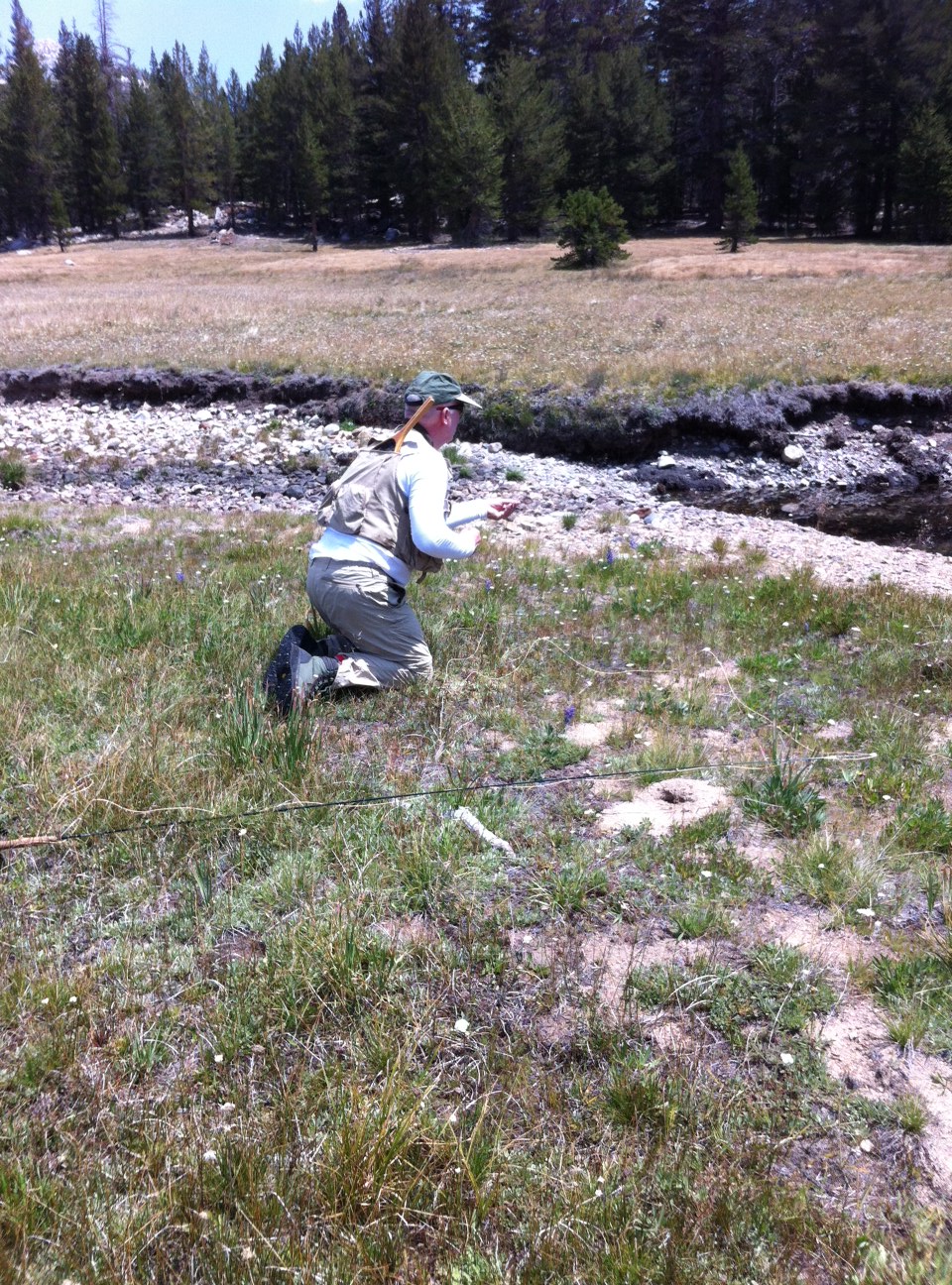
When’s the last time you practiced casting while you’re down on both knees? Stealth and an accurate cast are what it takes to land this very spooky fish.
The first two days, we plied two creeks full of brook trout and what looked to be an achingly beautiful hybrid between brookies and goldens. We saw, maybe, 10 other people, tops, and no one else fishing. That’s called dry-fly heaven.
The next day, with several dozen successfully released fish already under our belts, we decided to sample the Tuolumne River as it runs through its namesake meadows. The fishing was terrible, partially because of rock throwers, inner tubers and the like, but gazing through pure, sweet mountain water as it undulated over the taffy-colored granite bottom washed away our no-fish cares. Still, we agitated to get into more fish and fewer folks.
As we walked back to Will’s car, we joked that in the same way we could tell when we approached a waterfall– by sound — now we could tell we were close to the parking lot by the annoying “be-bee-beee” of a car alarm. Little did we realize that it was his car’s alarm going off, squeezed as it was between a pair lumbering F-150s.
I’m sure there are ironic depths to that story, but my point is the chaos of hundreds — thousands — of innocently lost park-goers, as well as oriented, determined ones, and their cars, bikes and visiting tour buses, shouldn’t dissuade you from fishing the Tioga side of the park. With research, it is easy to completely beat the crowds. The $20 admission fee gets you in for a week, and after holding your breath going up the Tioga Pass, you might have to hold it again because of the area’s otherworldly beauty. It’s within 40 minutes’ drive of Mammoth Lakes and June Lake is also right there.
And as you release that hard-earned trout, remember wild, native fish are a gift we must preserve and share with future generations.
Newly elected Council-member Mitch O’Farrell. (Courtesy City Council District 13)
Even though termed-out river champion Ed Reyes’s district went to Gilbert Cedillo, the new self-proclaimed keeper of the flame is newly elected Council-member Mitch O’Farrell. And front-and-center is the most important decision to impact the Los Angeles River since it was channelized last century.
“We have some alternatives that are being entertained right now by the Army Corps [of Engineers] and the Feds,” O’Farrell recently told The Los Angeles Downtown News, referencing Alternative 20, which is the most extensive and expensive of the revitalization plans. “We all support that, but it has a $1 billion price tag. There are some [alternatives] that are a lot less than that.”
Meanwhile, the Corps can’t officially comment on the details until the report containing the four alternatives (not three, as was widely reported in the Los Angeles Times last week) is released in early September, according to a spokesman. But sources close to the process say that Washington balked at the Alternative 20, billion-dollar price tag and will push for the cheapest of the alternatives. When released, the report will also identify the Corps tentatively selected plan (TSP).
“The TSP is ‘tentative’ and not a final agency decision,” said the new Los Angeles District Commander Col. Kim Colloton. “We will ask for public and agency comments on all alternatives, and consider all comments before we make a final decision. Transparency and community involvement are vitally important.”
In a press release, Colloton said the Corps, City of Los Angeles and stakeholders have jointly developed the alternatives, and the purpose of the collaborative effort has been to find ways to improve the L.A. River ecosystem in a constrained funding environment.
“Hundreds of ideas were explored, and the best of these were combined to come up with the final array of alternatives in the draft report,” she said. “The ultimate goal is to maximize ecosystem benefits relative to costs.”
Once released, the action will trigger a 45-day public comment period that will help inform a final report, which will include a recommendation to Congress.
Then Councilmember Eric Garcetti opens a part of the bike path along the Los Angeles River in 2011. (Jim Burns)
While river advocates await the public unveiling of the Los Angeles River Ecosystem Restoration Feasibility Study (nicknamed ARBOR), the p.r. battle for Angelino hearts and minds has already begun. In September, after several years of drafting and almost $10 million in cost, the U.S. Army Corps of Engineers will release four alternatives, each with a different cost, and each with a different impact on the river. The public will then have 45 days to comment before a single alternative moves forward.
“It’s a doozy,” said one person close to the study, which is currently undergoing legal review.
As Carol Armstrong, director of the Los Angeles River Project office, told me last year,“Remember that the fundamental purpose of the study is to improve the ecosystem values in the LA River– and that means riparian habitat that is good for wildlife, including fish species. The study will go public with its alternatives early next year. Once finished, it will recommend one of those as its recommended project, which will then go to Washington, DC, for approval by the federal powers-that-be.”
Think of it in terms of a Beverly Hills plastic surgeon’s menu of procedures. You could go for some Botox injections to temporarily solve that wrinkly face, or throw in for a full-blown, long-lasting, facelift.
The facelift alternative is what the nonprofit Friends of the River advocates with the “Piggyback Alternative,” known to the Corps as Alternative 20. It is the most comprehensive approach to river restoration, according to FoLAR president and founder Lewis MacAdams. The estimated price tag is $1 billion-plus to restore and remake 11 miles of the river between Union Station and Griffith Park.
Today, the Los Angeles River Revitalization Corp, another nonprofit, threw down with its 51-mile greenway project, which aims to have that much yardage in bike paths and foot trails along the river by 2020. That would essentially cover the entire length of the river from the San Fernando Valley to Long Beach. Currently, 26 miles along the river are open to bicyclists before they have to hit the mean streets, just north of downtown. Although not one of the alternatives, the 2020 Greenway plan aligns itself more naturally with Alternative 20 than with Alternative 13, said to be the Corps favorite in these times of tightening budgets.
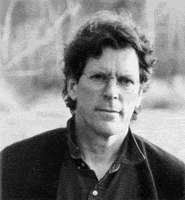
Author David James Duncan (Courtesy High Country News)
Written as an afterword 20 years later to his successful “The River Why,” David James Duncan ponders our environmental future. The reference to Thomas Mann’s classic “Buddenbrooks” is appropriately obscure, but when you realize that book is about the decline in health of four generations — each less healthy than the last — it gives this warning, written in 2003, even more poignancy today.
“Our legacy as Americans, like that of Hanno Buddenbrooks, is too powerful to escape. That the world is small, that its so-called ‘resources’ are not a boundless economic bonanza but finite parts of a fragile and holy web of life, that humanity is part of the same web, that the web’s health and ours are as closely connected as a child’s life and its heartbeat — these God-given links and limits will, I feel certain, be the scalding revelations of coming decades. Because they will scald, I pray for other revelations that soothe like love and water — and I believe we’ll get them. As wrongheaded and deadly as humans can be, we haven’t eradicated love or water yet.”
Dating from 1943, it’s fair to ask what purpose this federal dam atop the Hahamonga watershed serves today (Jim Burns).
All right, even on the West Coast, we realize Vermont is famous for maple syrup, but what about the American Museum of Fly Fishing in Manchester, Vt.? Not so much.
Still, according to American River’s River Blog, the two organizations have partnered up to highlight eco-education. At a recent AMFF meeting, Steve White, who runs American Rivers’ Anglers Fund, talked about protection and restoration of vital fish habitat through dam removals, and Wild and Scenic designations, among other topics.
Meanwhile, the PBS NewsHour continues to cover restoration efforts for California’s San Joaquin River, which may be the largest river restoration project in the country. These troubled financial times may set the project back several decades, a project in which $100 million has been spent thus far, with a projected cost of $2 billion.
Closer to home, the Arroyo Seco Foundation and a bevy of environmental activists wonder why Edison continues to receive an E-ticket ride to trash the Hahamonga habitat in the verdant canyon area next to the Jet Propulsion Lab in Pasadena. At issue, the city of Pasadena granted Edison a utility easement through Hahamongna Watershed Park for its power poles heading north/south to Jet Propulsion Laboratory more than 60 years ago. The giant electric utility claims that the easement gives it the right to maintain access to the poles that lead along the west side of the park from near Devil’s Gate Dam all the way up to JPL, according to ASF’s website.
Concerned residents have lobbied the city and are ready to fight the utility, particularly after losing the battle to protect the Arcadia Oak Grove in 2011. What the Los Angeles Times described as a “a prized grove of more than 200 oaks and sycamores,” owned by the county Department of Public Works, was reduced to stumps and sawdust as the agency prepared the site to take on 500,000 cubic yards of silt, rocks and vegetation to be scooped out of Santa Anita Reservoir.
Meanwhile, we’re all waiting for the verdict of the U.S. Army Corps on the restoration of the Los Angeles River. Watch this space to find out which of the various proposals will get the green light.
It’s been 16 years since the classic “Carp on the Fly” hit book stores. Now, author Kirk Deeter takes readers into the 21st Century with “The Orvis Guide to Fly Fishing for Carp.” (Jim Burns)
The discerning reader divides non-fiction books about fly fishing into two categories: “how to” and “dream on,” and it’s a rare merger that can satisfy a reader’s desire for both. Yet, author Kirk Deeter manages just that in his new “The Orvis Guide to Fly Fishing for Carp.”
The dichotomy may lie in the type of writer each category draws. How-to writers predominately dwell on the acquisition of a skill set: fly tying, for example, can include anecdotes about where a fly is best used, or the genius of the hand behind an original fly, but usually the writing forms tight bands of knowledge around a skill with prose that may be interesting, but pedantic.
On the other hand, dream-on books are more a subset of adventure travel writing, a pastime honed by the Brits on their wide-ranging, sun-never-sets, escapades. I’m thinking here specifically of Chris Santella’s “Fifty Places to Fly Fish Before You Die,” the modern-day, bucket list approach to adventure travel writing.
Many “dream-on” books stand the test of time precisely because that snapshot of an adventure has been so vividly captured and eloquently composed. I’m thinking of Charles McDermand’s “Waters of the Golden Trout Wilderness,” and of Ray Bergman’s “Trout,” both of which leave readers dreaming not of the future possibilities, but of worlds that have been lost.
The last book I remember to combine the qualities of making us better fly fishers, as well as stoking our desire to get out and do it is Sheridan Anderson’s “Curtis Creek Manifesto,” a marvel with the subtitle, “A Fully Illustrated Guide to the Strategy, Finesse, Tactics and Paraphernalia of Fly Fishing.” I would wager that Anderson captured many a novice’s imagination as he envisioned exactly where to perform that initial “Curtis Creek sneak.” I still vividly remember getting down on my hands and knees on the catch-and-release section of the Owens outside Bishop, Calif., savoring that, possibly, using my newly acquired stealth, no trout would spot my otherwise hulking frame.
In essence, books that combine both qualities are rare and possess the kind of magic publishers seek while devouring manuscripts in the hopes of finding what will keep a book in print to become a “perennial.” Case in point, the manifesto was originally published in May, 1978.
It’s been 16 years since the classic “Carp on the Fly” broke very new ground by advocating catching what was then widely considered a garbage fish. While trying to figure out exactly what was going on with carp on the Los Angeles River, I turned to it over and over again. You can find with a little searching on this blog, its table on water temperatures and carp.
That seminal book by Barry Reynolds, Brad Befus and John Berryman begins with the sentence, “Yes, this really is a book about fly fishing for carp,” and goes on to cover everything about the fish from habitat, to stalking, to proper fly presentation. I’m careful with words like “classic,” but this definitely is one, with a homespun feel aided by black-and-white photographs. The cover always struck me as odd, a whimsical line drawing that shows a carp contemplating a tasty crayfish. Instead of predator and prey, the two seem about to begin a conversation.
The cover shot for Deeter’s book shows a freshly released bruiser-of-a-carp in shallow, clear water. There’s no ambiguity in this shot. Any fisherman would want a piece of this fish. And the art throughout the book will draw readers to dreaming, whether of the flats of Lake Michigan or even of the Los Angeles River. I did yearn for more information in the captions.
Illustrator Mary Kelley penned useful, even inventive graphics to help readers understand this elusive prey. In one, “Grading the Presentation Zone,” she uses grades from A to F around a carp’s head and upper body to represent the strike zone.
And Deeter knows his way around prose, deftly fielding even the least-exciting of topics. He begins, “When I told my mother I was writing a book on fly fishing for carp, her first response was, ‘Why would you do that?’ ”
It’s his breezy style that pulls all the elements together and lifts this book from the ho-hum to something much more. By the end of the book, readers know a reasonable amount about this wary adversary, its traits, behavior, and the best ways to catch him.
My question to myself right now: how can I possibly be writing this glowing review about a book that has a corporate logo plastered on its cover? While Deeter deftly makes his generic recommendations based on rod length and weight, the photographs tell the tale of an Orvis purchase. Ditto nets, waders, wading shoes and fishing pliers.
Still, because of the thorough research, enviable and obvious time on the water, gripping prose and spot-on photography, readers probably won’t wince when it comes to product placement.
Oh, and the Curtis Creek sneak? Peruse the pages and you’ll find it, along with a thorough education from this decade’s most useful book on a growing obsession.











 lariverflyfishing