



Bugs


In almost all things, three’s a charm, and so it was yesterday for the twice-denied Long
Beach leg of the important Friends of the Los Angeles River fish study. Last year’s two attempts came up mostly empty, but yesterday afternoon’s fishing by about 25 conventional and fly fishermen netted three common carp and two smelt. If the number leaves you shaking your head, that 25 skilled anglers would have such a lean haul on a near-perfect winter fishing afternoon, you’re not alone.
Fishers threw every manner of enticement to their prey, including carp carrot flies, woolly buggers, artificial worms, real worms, and a ” fish-licous”concoction of garlic and masa, the cornmeal used to make tortillas. But for the most part, this estuary where fresh and salt water mix has yet to fully reveal what lives below.
“Well, at least it’s better than last time,” said Sabrina Drill, a UC Cooperative Extension biologist, who along with fellow scientist Rosie Dagit has been periodically mapping the river’s fish population since 2008. But her face showed the disappointment that the yield of this event — monikered “Fish for Science” — wasn’t full of the expected gold doubloons.

An optimistic Trout Unlimited’s Bob Blankenship had emailed several participants before the event that “Maybe this storm will bring with it a few migrating steelhead to Long Beach?” And we all heartily agreed.
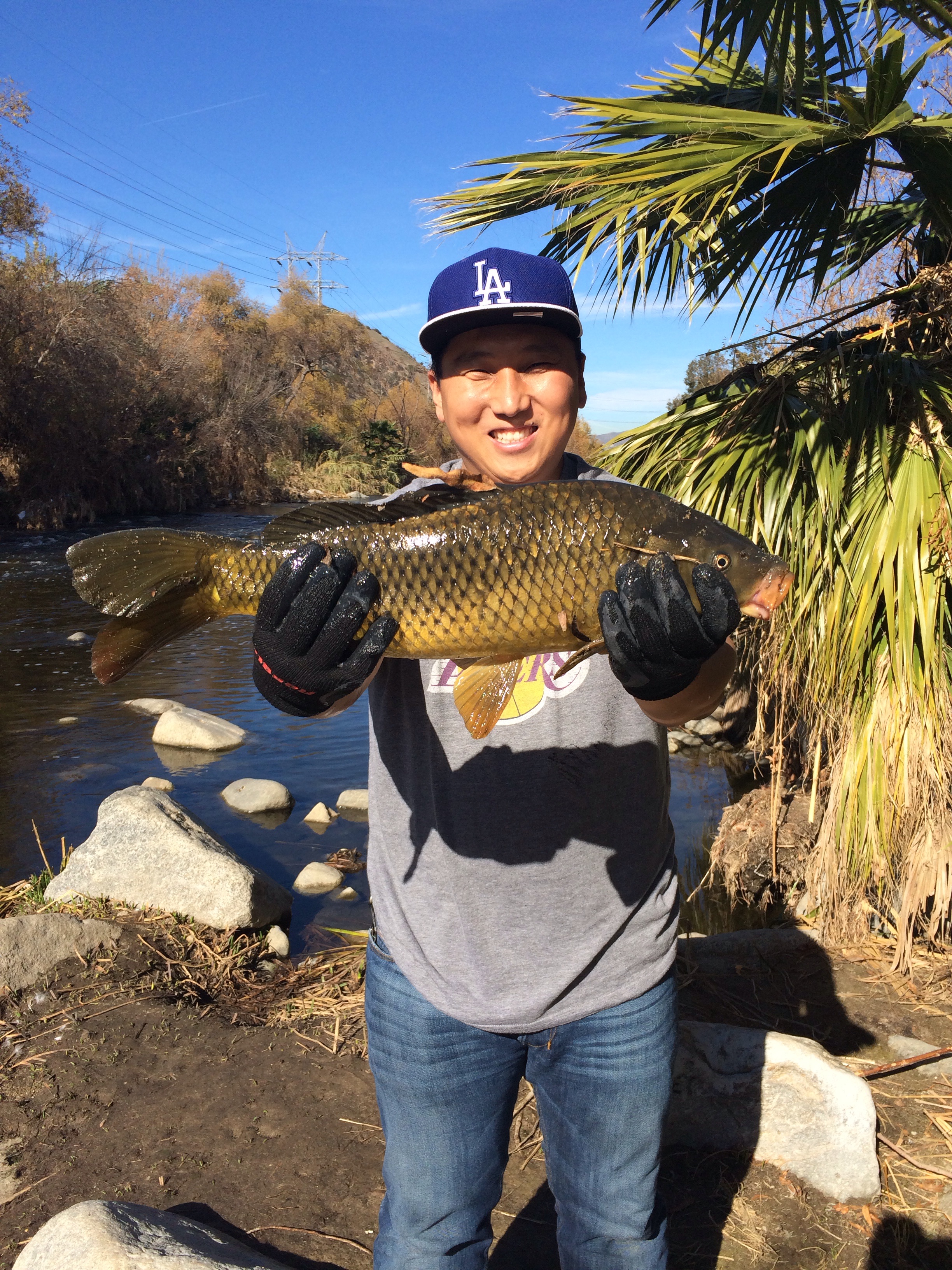
True, Nick Faught of Corona left a happy man. He’d purchased a new 5 wt. specifically for catching carp, and the beast that later weighed in at over 8 pounds gave him all he could handle.
“I’m used to catching trout in the Sierra,” he said, dripping wet, while managing to get his fish into an orange Home Depot bucket in the middle of a lagoon. Faught had hooked and lost what was most likely this fish, then hooked it again. Between the slippery submerged rocks, the powerful and slippery carp, and his desire to get the fish to the biologists some 100 yards away, he went for a swim — saved his fish again, frying his cellphone in the process. Even soaked to the skin through his waders, Faught smiled as he held his carp later safely on shore for a trophy shot.
His grit and enthusiasm really characterize many of the participants who came to help the professionals map the river before restoration begins. Each event brings more anglers.
These are very serious, big-money times for an urban river that is famous for all of the wrong reasons, like Kim Kardashian. It’s as iconic as the Hollywood sign, yet after years of appearances in movies such as “The Terminator” and “Grease,” in which 51 miles of concrete form more undulating racetrack scar than ambling waters, the Army Corps of Engineers — yes, the same agency that excavated and paved it — now has recommended to Congress a $1 billion makeover, or “make right,” depending on your point of view.
In other words, once Congress approves the money, it will be billion-dollar boots on the ground in L.A. And that’s what has Dagit, a senior biologist for the Resource Conservation District of the Santa Monica Mountains, anticipating better days. Dagit, Drill and other biologists have tracked river species, first with the FoLAR fish study in 2008 and now with an extension of that study focused on the river’s estuary.
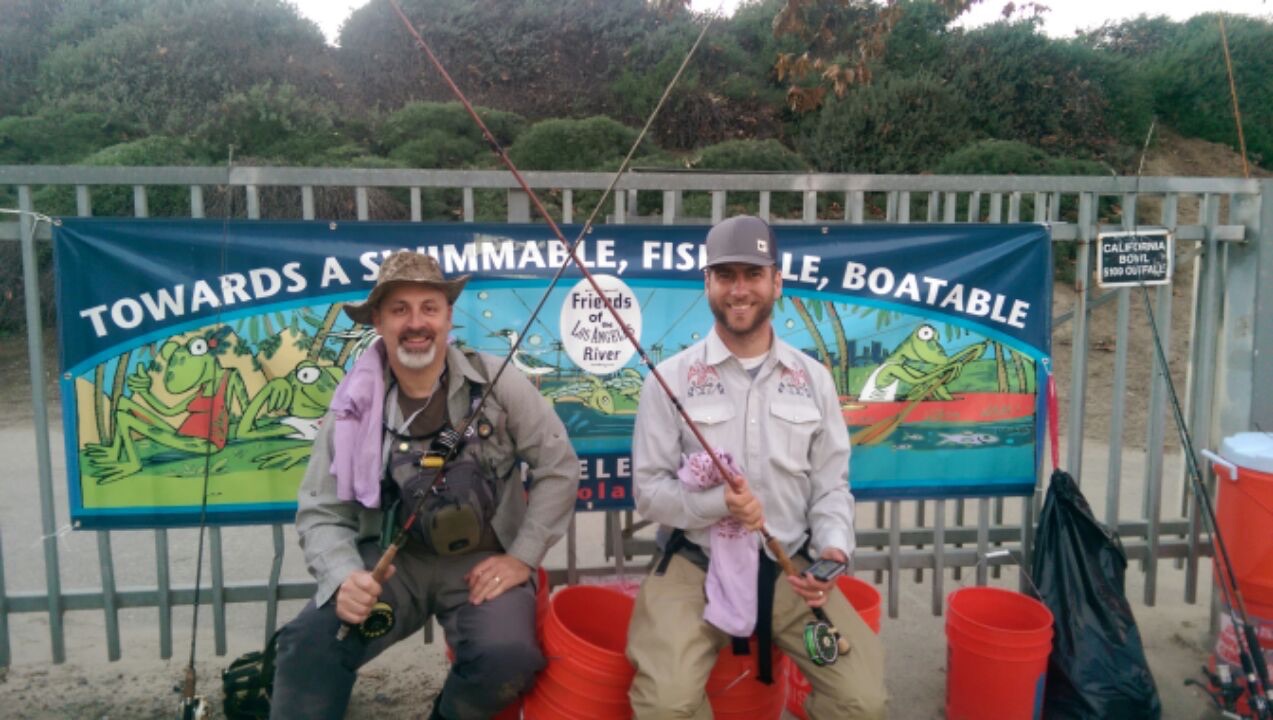
Bets are on that Dagit, Drill and company will be back for another round. After all, the 2008 study, conducted in Atwater Village north of downtown found some 1,200 fish, including carp, tilapia and bass.
“This is a gateway,” Dagit said during the October attempt, while looking toward Long Beach Harbor. “and you can’t underestimate the importance of this section. Having a baseline of understanding which species are present and where will be is a really important tool to help us gauge the success of the proposed restoration efforts once they are initiated.”
Citizen Science Hall O’ Famers
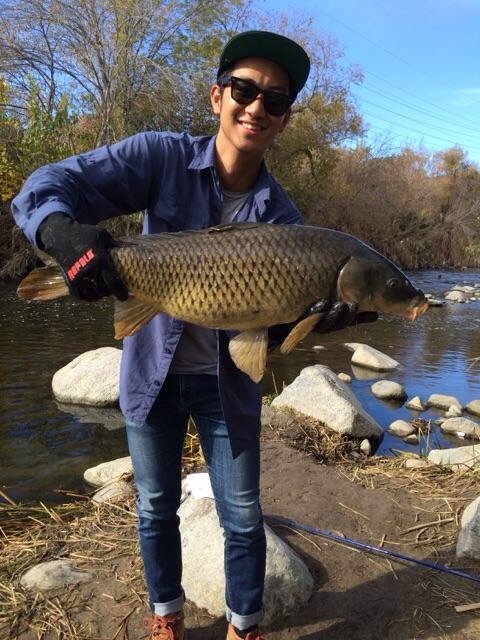
Three large carp (22-24 inches), thanks to Steve Simon, Nick Faught and Greg Madrigal.
See you on the river, Jim Burns
The WordPress.com stats helper monkeys prepared a 2014 annual report for this blog.

Here’s an excerpt:
The concert hall at the Sydney Opera House holds 2,700 people. This blog was viewed about 31,000 times in 2014. If it were a concert at Sydney Opera House, it would take about 11 sold-out performances for that many people to see it.
Hello Anglers,
We need You, to help Us, Catch Fish in the Long Beach Portion of the Los Angeles River.
Got your attention?
OK, now, here are the details.
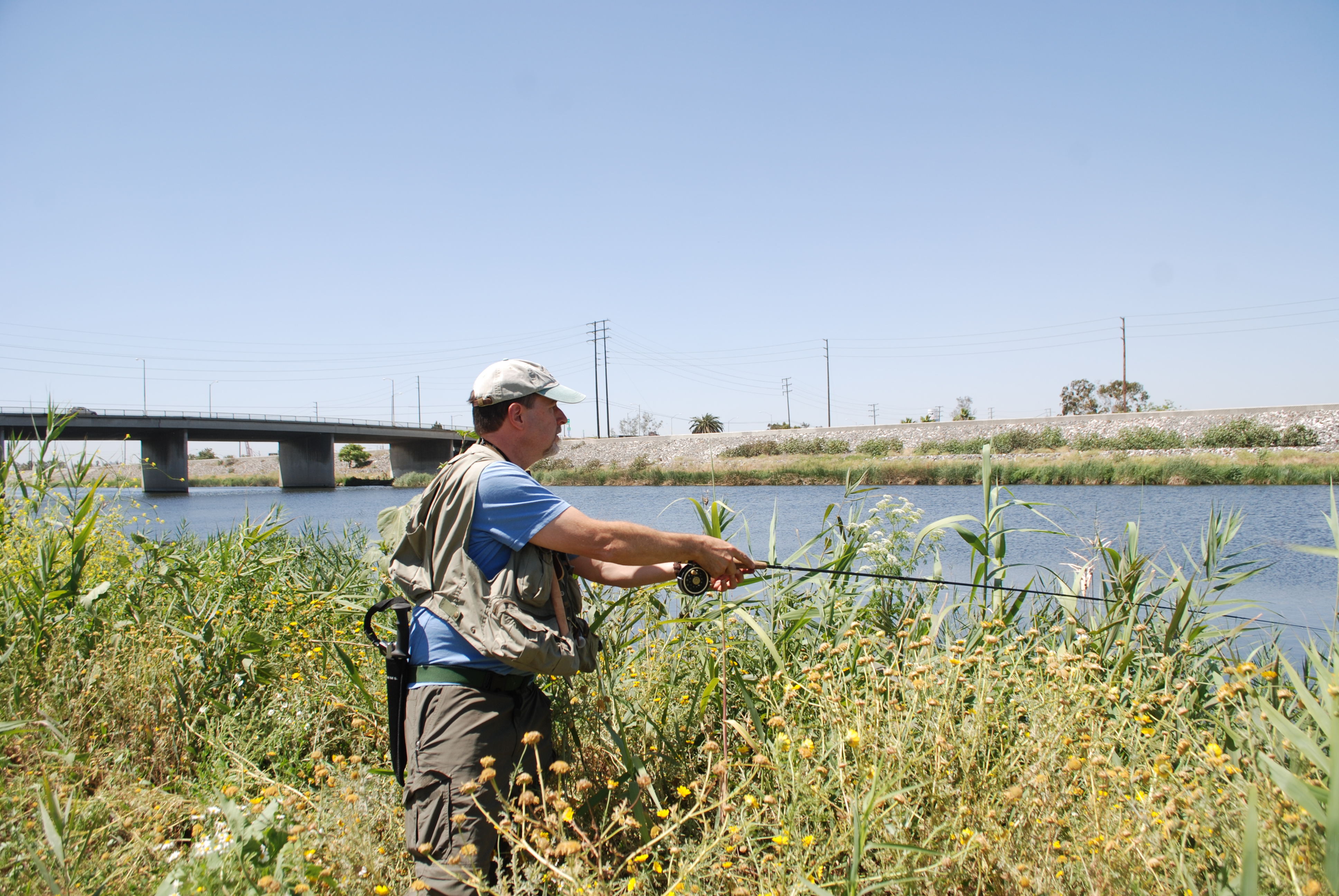
Friends of the Los Angeles River (FoLAR) in partnership with the Aquarium of the Pacific will host Phase 3 of a scientific fish study with help from the Resource Conservation District of the Santa Monica Mountains. We need Citizen Scientists, in this case, volunteer anglers to help us catch what is in the soft bottom section of the Los Angeles River at Long Beach.
This is a rare chance for you to fish in an area that one does not normally access, contact WPB@FoLAR.org to hold a spot. Fishing will start at 2pm until dusk on Saturday, January 3rd, 2015.
The fishing is limited to adults as this area of the L.A. River is difficult to access, yet, on the shore The Los Angeles River Rover – FoLAR’s Mobile Museum & Education Center – will be open from noon until dusk on Saturday, January 3rd, 2015 for everyone to enjoy. Click on the link below to see what the River Rover has to offer…
http://folar.org/education/river-rover/
The FoLAR study of fish began in 2006 and after collection and identification of hundreds of fish in the Elysian Valley portion of the L.A. River, the 2008 fish study was born. To our surprise, we discovered eight different species of fish, that were pretty healthy, low in mercury as well as low in Polychlorinated Biphenyls (PCBs) compared to ocean fish studies. The fish that were discovered/identified in the study were Carp, Tilapia, Fathead Minnow, Black Bullhead, Amazon Sailfin Catfish, Green Sunfish and one Largemouth Bass. You can view or download this study from the below link…
http://folar.org/wp-content/uploads/studies/fish-study-2008.pdf
The 2008 FoLAR Fish Study was just one section of the L.A. River, what lives in the waters of the Sepulveda Basin, the tributaries or Long Beach are unknown, until now. In May and October of 2014, FoLAR went back on a fish hunt, deciding that Long Beach would be a great start of a new scientific fish study. As with the Elysian Valley study, it could take up to 2 years to collect accurate and representative data.
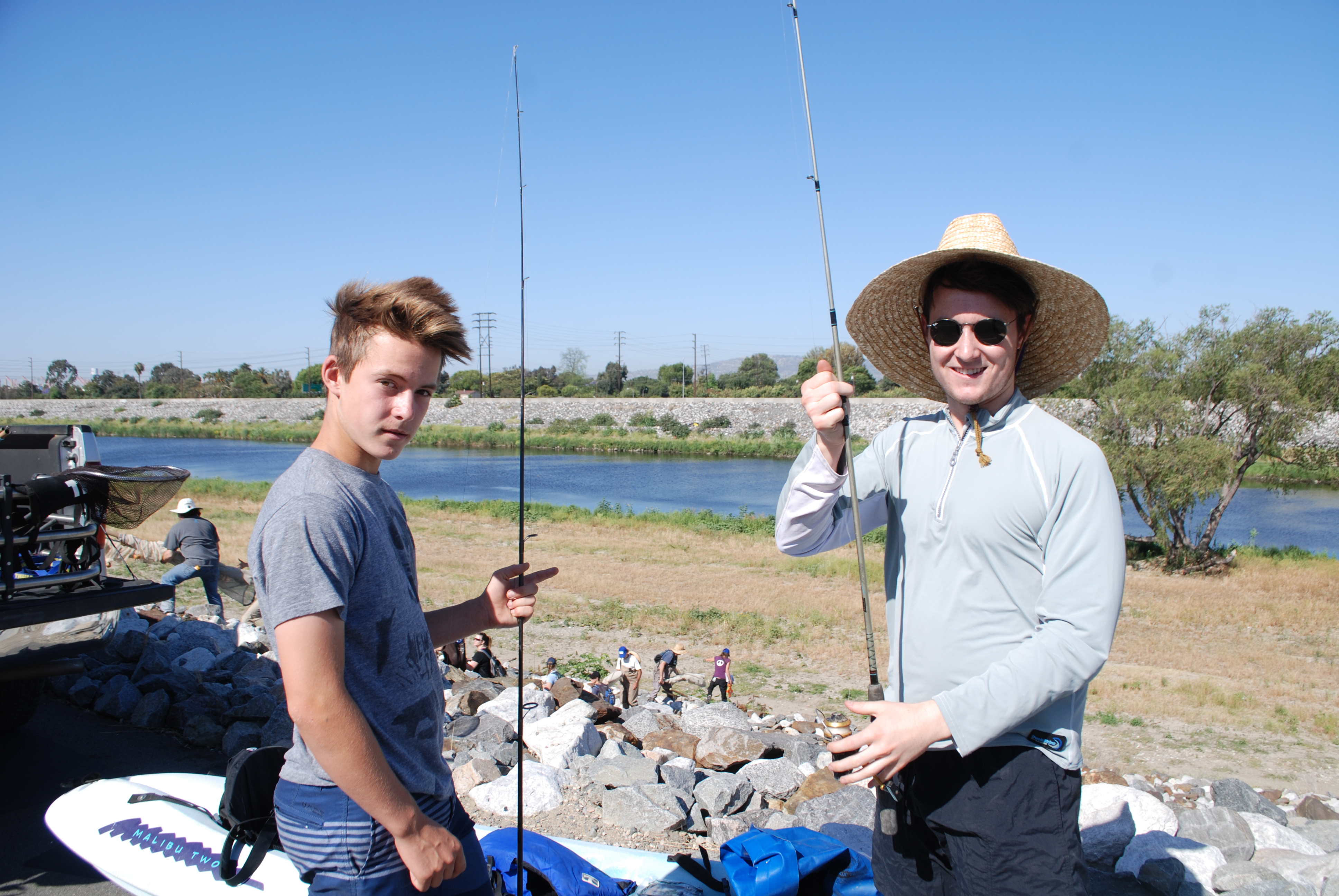
As a volunteer angler, you agree to be a Citizen Scientist while experiencing the thrill of fishing in an area that is not normally fished. After you hold your spot with WPB@FoLAR.org you will be directed to the location via a follow up e-mail. FoLAR will not provide equipment, you will have to bring your own. The choice of equipment will be up to each angler, either come with rod and reel and bait, or even go the lengths of bringing waders or other equipment you are familiar with. Once you catch a fish, you will then put it in a provided bucket of water and bring it to one of the three biologists from the Resource Conservation District of the Santa Monica Mountains, Rosi Dagit, Sabrina Drill or Lizzy Montgomery. They will weigh, measure and photograph the species. Dr. Richard Gossett from Cal State Long Beach will be on hand to test the toxicity of the fish as he did in the 2008 study of the Elysian Valley fish.
If you cannot make it, we will have plenty of other fishing opportunities on the Los Angeles River throughout 2015, including the second annual FoLAR Catch & Release Fish Derby, “Off tha’ Hook”…
http://www.laweekly.com/informer/2014/09/10/you-can-fly-fish-the-la-river-and-its-pretty-damn-cool
If you fish on the Los Angeles River you can help us establish what species reside within these waters by downloading an app or using the web through iNaturalist.
iNaturalist is a place where you can record what you see in nature, meet other nature lovers and learn about the natural world. Lizzy Montgomery from the Resource Conservation District of the Santa Monica Mountains developed a Fish of the L.A. River page where you can upload a photo of the fish you catch and where you caught them. This will help us understand better the biodiversity with the Los Angeles River watershed. iNaturalist can also be fun for any parts of Los Angeles by uploading Birds, Lizards and Insects as well. Join iNaturalist today by clicking on the link below…
http://www.inaturalist.org/projects/fish-of-the-la-river-peces-del-rio-de-los-angeles
We hope to see you at Saturday afternoon January 3rd.
Hey Jim,
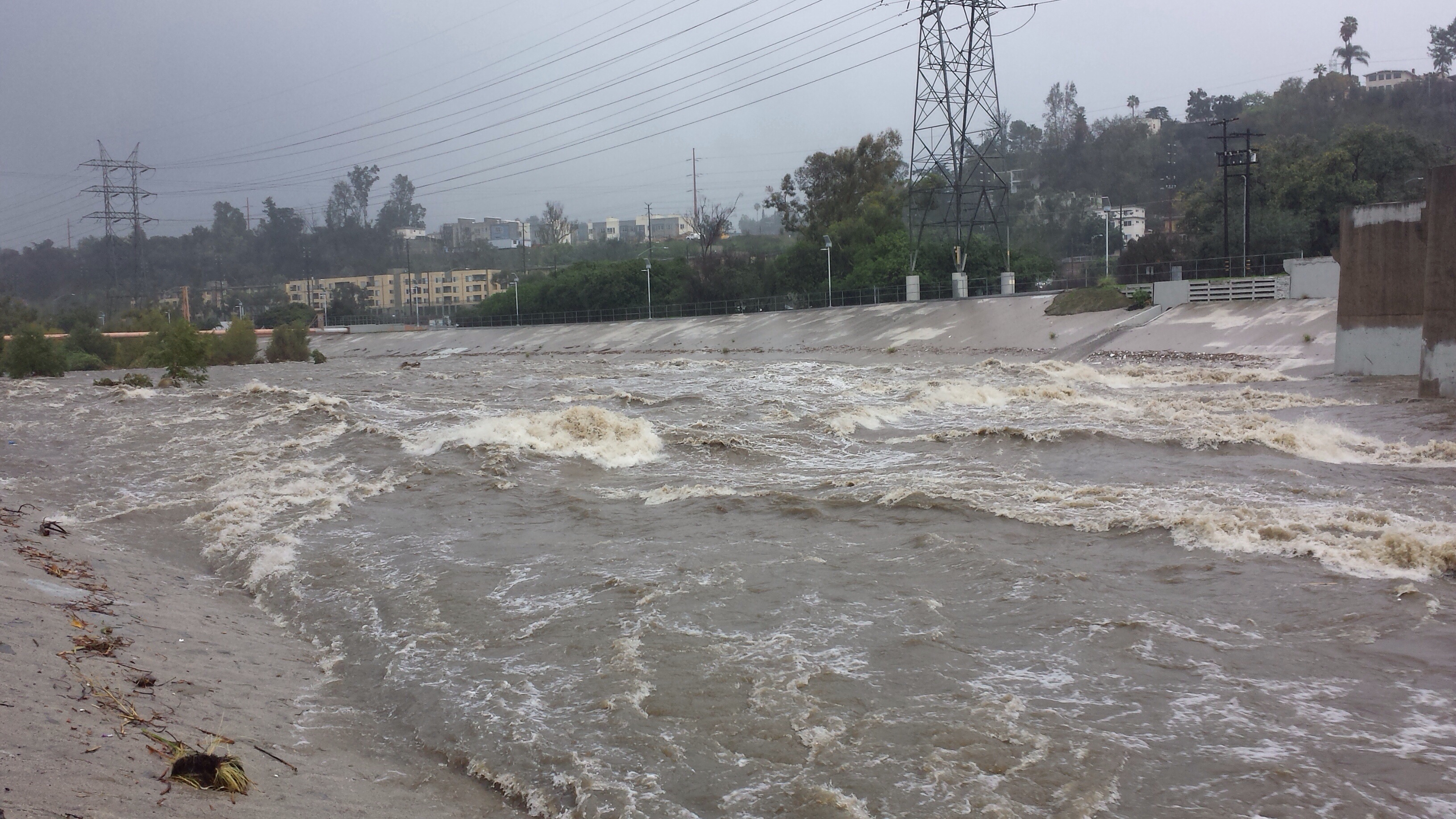
Thought you’d like to see this shot, although you may have many by now. This is at the Glendale Blvd. bridge, notice the amount of vegetation and small islands that are completely submerged. Those are some serious rapids. L.A. River, in all her glory!
Take care,
Ryan Anglin
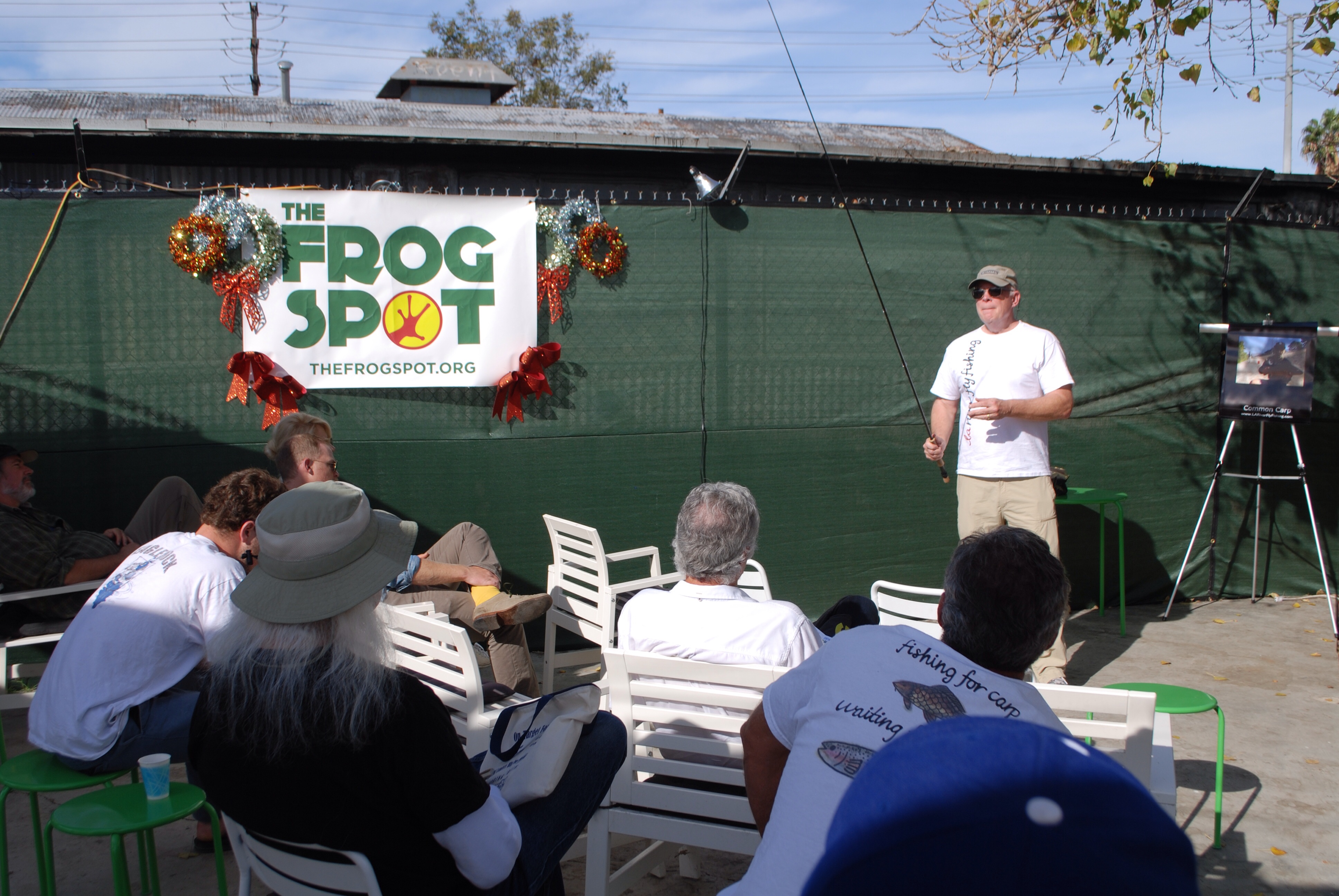
Oh, the tall tales fisherfolk tell. As a matter of fact, they say that if you weren’t born with the ability to stretch the truth just a wee bit, spending time on the water will surely school you in that all-too-human trait.
But, at the Frog Spot, sharing and learning more about fishing the L.A. River Sunday, not a tall tale emerged from the gathered fishing fanatics, just a bounty of hard-won knowledge about our river. The weather was perfect; the setting, urban-divine, as bicyclists zoomed along the bike lane, possibly fired up by CicLAvia, while AMTRAK whistled its station arrival not far away.
— William Preston Bowling, who organized the first Off Tha’ Hook fishing derby in September, served as MC, but he also filled in the crowd of a dozen or so participants on Friends of the Los Angeles River (FoLAR) line recovery efforts. Your line has a life of around 5,000 years, so please think twice before tossing that next bird’s nest into the water. Grove Pashley, of LA River Kayak Safari, reminded us of two blue herons separately caught up in bird’s nests of line in the last couple of years. I know one died, but I’m not sure of the other’s fate.
Bowling said that soon there will be line disposal tubes at high-traffic areas along the river. FoLAR will recycle the line by sending it to Berkley, a company that actually re-purposes used line, turning it into new.
— Robert Blankenship from Trout Unlimited turned his darkroom PowerPoint into a daytime handout, and regaled us with tales of Southern California Steelhead recovery efforts. His presentation was made all the more sweet by a guest appearance from Tom Tomlinson, who wrote “Against the Currents: The Unlikely Story of the Southern California Steelhead” this year, published by the Aquarium of the Pacific in Long Beach. If you haven’t read this important book yet, pick it up.
Blankenship showed us how Santa Barbara has re-designed its flood control channels to include holding water for steelhead returning from the ocean. The story of the steelhead here in our truly unwelcoming climes is one of courage, fortitude and grit. There’s actually a self-guided tour that links steelhead art and brew pubs, which sounded like the best of both worlds to many of us. Look for more from TU under the local leadership of Blankenship, a strong advocate for our river.
— Next, Lizzy Montgomery from the Resource Conservation District of the Santa Monica Mountains told us about the INaturalist app, and how to use it. Take a look here for more info. I’m not sure that as a fishing community we’re using this as much as we could/should. The research that comes from fishers out there on the water can greatly aid biologists who can’t use their standard procedures for species and fish counts. As she said, ” I can’t imagine we would use SCUBA gear on this river.” Agreed.
— Ban Luu, who has plied the river since 2007 using traditional tackle, told us he had no idea there were fish in it when he first cast out: He was testing a new rod and reel to get ready for an ocean trip! With each cast, he heard splashing, thudding, all the auditory telltale signs of big fish. “I was hooked,” he said, no pun intended. And Luu is the right guy to get hooked, taking time to keep a detailed fishing journal, perfecting his light tackle gear after much research and trial and error. Also, he has perfected his own masa blend with garlic, after rejecting both bread and tortilla baits, both well regarded by locals.
And … ready for this, Luu said he’s caught over 2,000 fish since 2007! After listening to his presentation, I am sure this isn’t a fish tale.
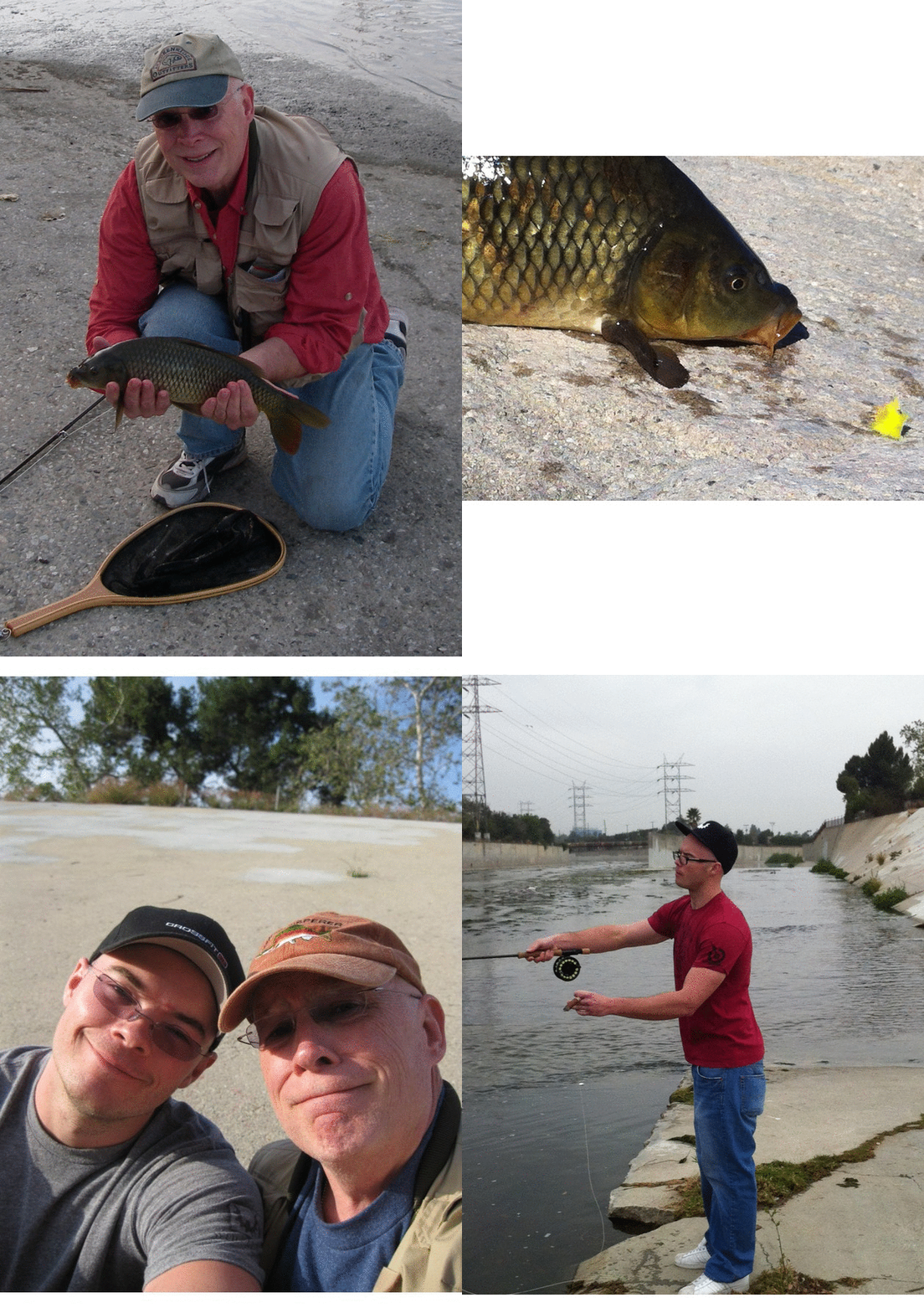
As for yours truly, I discussed the usual suspects we catch on our river, as well as fly rods and flies that give you the best chance of hooking up. I, too, used old-school photographs from this blog that included fish and the commentators who sent them in to illustrate my talk.Simply put, without the LARFF community, I would have had much less to discuss. Thank you for your support and friendship over the last four years!
Finally, Bowling reminded us that we are all invited to participate in the return to the lower section of the river, Saturday, Jan. 3, from 2 p.m. until dusk. Get in touch with him (wpb@folar.org) to reserve your spot (free), and help to document what fish are in that lower section on WIllow Street.
Who knows, steelhead may yet be waiting for discovery, akin to those spotted on the San Gabriel River. Blankenship shared a wonderful picture from a few years back of a large steelhead hanging out by a discarded TV in a West L.A. flood control channel. It was a renewed call to “bring ’em home,” as FoLAR co-founder Lewis MacAdams would say.
See you on the river. — Jim Burns
 Free lecture: Fishing on the Los Angeles River
Sunday, Dec. 7, noon-2 p.m.
Yes, there are fish in the Los Angeles River!
Enjoy a free talk at The Frog Spot with three fishing experts. Jim Burns of LA River Fly Fishing will describe the fish swimming in the river today, where they are and how to catch them. Robert Blankenship of Trout Unlimited will discuss efforts to bring back the native Southern California Steelhead. Elysian Valley fisherman and FOLAR docent Ban Luu will offer tips and techniques for fishing in the Glendale Narrows. FOLAR’s own William Preston Bowling will also share information about its scientific fish studies as well as a new citizen science opportunity.
The Frog Spot
2825 Benedict Street LA 90039
Sent from my iPad
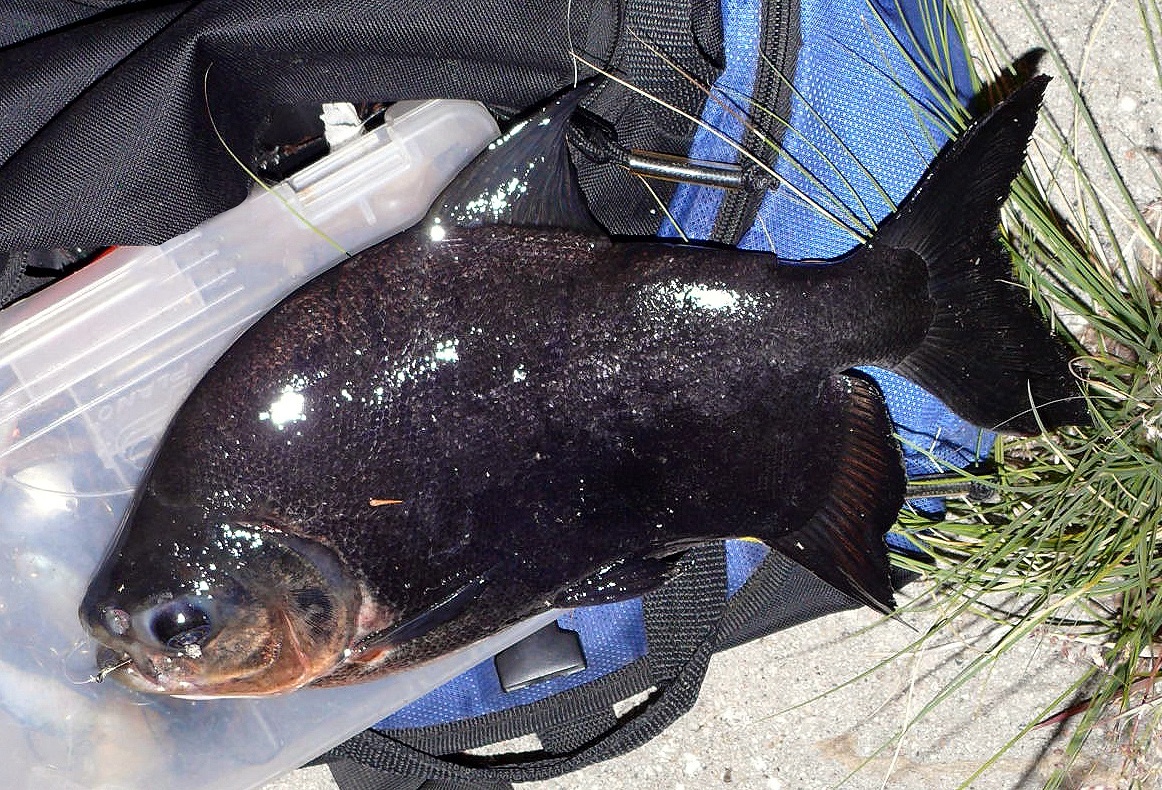
LARFF gets a fair number of fish and beauty shots coming across the electronic transom, but this one definitely takes the cake. Know what it is?
A pacu.
What’s a pacu?
As the fly fisher who hooked it said via email, “I caught that exotic fish and posted it on my Facebook, and a lot of friends told me it was a pacu, not native to here, and it matched photos from the Internet.”
James Czasonis went on to write that it looked like a big pirahna, but the teeth were more flat. Although the teeth aren’t visible in these shots, the host of “River Monsters,” Jeremy Wade, explains here that the flat teeth are used for crushing seeds, unlike a pirahna’s that are sharper and used for tearing apart flesh. Both are native to the Amazon River in South America.
Pacus have been found in Papua New Guinea, and much closer to home in Michigan, Illinois, Ohio, and now in Los Angeles.
How’d that happen?

Apparently, some unaware aquarium owners believe these fish will only grow “so big” because of the glass confines of their watery cages. But, that logic turns out to be a myth and when the pacu overstays its welcome, it gets dumped into local waterways.
And, yes, it is illegal to dump nonnative exotic fish.
Authorities in Ohio aren’t overly concerned about a pacu takeover because the fish dies out once the weather gets cold.
As for the potential threat here in warmer climes, Czasonis said this was the only one he’d seen or caught, and “I still didn’t want to hold it up and let it back into the river.”
See you on the river, Jim Burns

 lariverflyfishing