In a political time, it’s once again time to get political.
If you thought that suction dredging mining was banned for good from the East Fork of the San Gabriel River outside Los Angeles, and other once-pristine California waters, think again.
You can read my coverage from 2012. I thought it was a done deal that the California Department of Fish and Wildlife would be allowed to stop illegal activities even on federal lands, even within a national monument. But Pasadena Casting Club Conservation Chair John Tobin recently alerted me that, sadly, it might not be the case in the future.
As Tobin wrote in an email, “California Senate Bill 637, effective January 1, 2016, created a path for the statutory prohibition against suction dredge mining on our California streams to be lifted.”
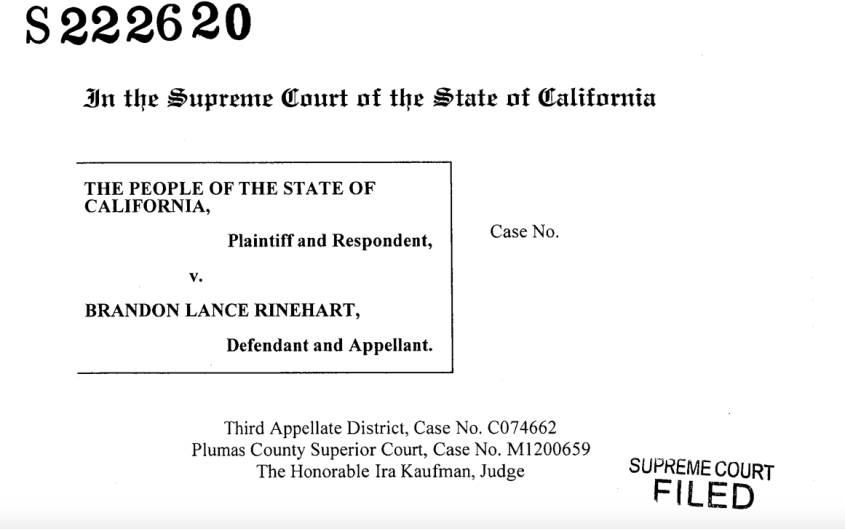
Currently, there’s a case before the California Supreme Court challenging whether state environmental law that makes a particular mining claim on federal land commercially impractical preempted by the federal mining laws, according to the brief.
In other words, can California through its police power protect the environment, even on federal land?
For anglers, this means a choice between antiquated, destructive machinery disrupting the stream bed and scattering whatever trout may have thrived there for a largely recreational activity. Imagine trying to wet a line next to one of these contraptions. Imagine the downstream effect to the water.
Can you imagine trying to fish downstream from this suction dredging mining operation? (Photo courtesy of Trout Unlimited.)
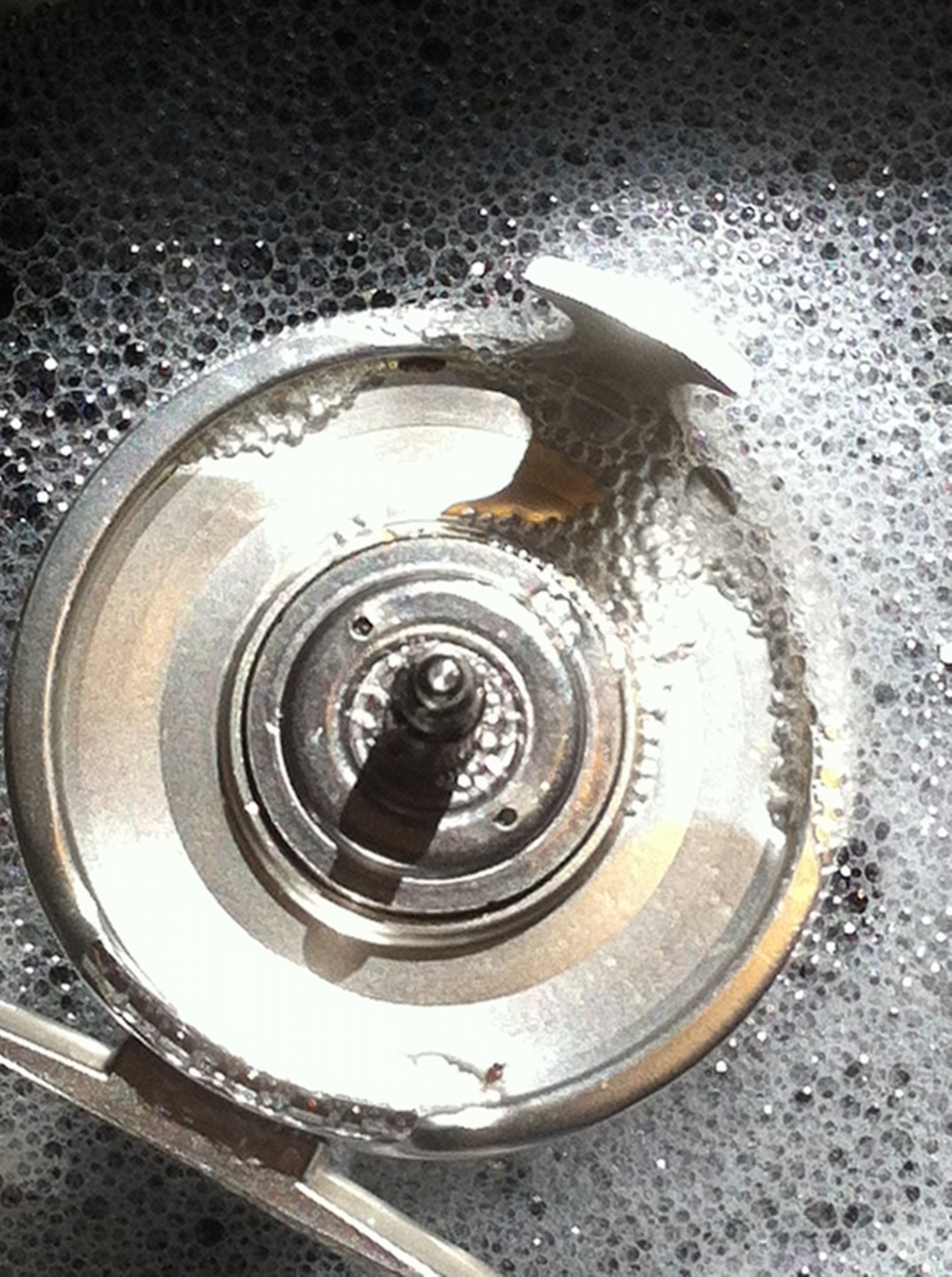
If you’ve fishing the L.A. River, at least once a season, think about cleaning your reel. (Jim Burns)Sand and gunk make their way into your reel. (Jim Burns)Take the plunge, and soak your reel in mild dish detergent. (Jim Burns)Buy some light reel oil, or, better yet, raid the wife’s Singer for sewing machine oil. (Jim Burns)Yuck! It’s a dirty world out there, so as you oil, also use your cotton tip to clean those hard-to-get-at places. (Jim Burns)Man, that’s shiny clean! Time to put it back together. (Jim Burns)
BACK TO THE BAD OLD DAYS when you couldn’t access the river. Notice no one is close to the shore. (Jim Burns)
Today was about as perfect an L.A. fishing day as you could get: temperature in the low 70s; carp for the sighting; long stretches of river to yourself. So, what’s not to like?
Barriers.
The Atwater Village “temporary” barriers are still there after close to a year. Remember the Army Corps installed them last January to protect Atwater Village from the predicted El Nino flooding. Well, the possibility of getting a super soaker came and went, but the sand-filled blockades are still there. I was reminded of President Ronald Reagan’s famous line, delivered at the Berlin Wall in 1987: “Mr. Gorbachev, tear down this wall.”
I haven’t walked the whole length, but according to a piece that ran in the Eastsider in January, it’s three miles long!
And because scaling the barriers — filled with sand and 4 feet high — is difficult, access along this very long stretch is once again contained to the walking path above the river. So, if you want to:
— fly fish
— walk your dog near river’s edge
— enjoy the occasional turtle
— bird watch
— take wildlife photographs while smelling the river’s Tide-scented waters
you won’t be doing it unless you are fit and able enough to hoist yourself up and over the barrier. Where does that leave the disabled who would like to enjoy our river?
The barriers have been there so long that weeds are actually growing in many of the containers, as if that were their intended use.
I read the Corps has decided the area is at risk if we experience a “100 year flood.” Is that the reason for not dismantling the barriers? For me, it’s a blatant attempt to keep the river away from people, just like you. Thank you, Army Corps., for attempting to protect the area, but the risk is gone and what’s left is classic overreach.
It’s supposed to rain tomorrow, so if anyone is in that area, please take a shot of how high the water gets, and, of course, don’t try to access the lower river reaches. If the water rises anywhere near these dreadful barriers, I’ll retract this post. Otherwise, it’s time for all of us to echo Reagan’s words — the fight to get access to the river has been too long and hard to let it be snatched away once again by a government agency.
See you on the river, Jim Burns
Please get rid of the barriers!!!
My wife is handicapped and can’t jump over the barriers! There’s no need for them anymore!!!
“Patagonia, the Ventura-based outdoor clothing and gear company, is working with Hewlett and other groups to raise the funds needed to take out the dam by 2020. It would be the largest dam removal in California history (eclipsing the recent San Clemente project).”
I only wish Brown Mountain Dam behind the Jet Propulsion Laboratory were on the list.
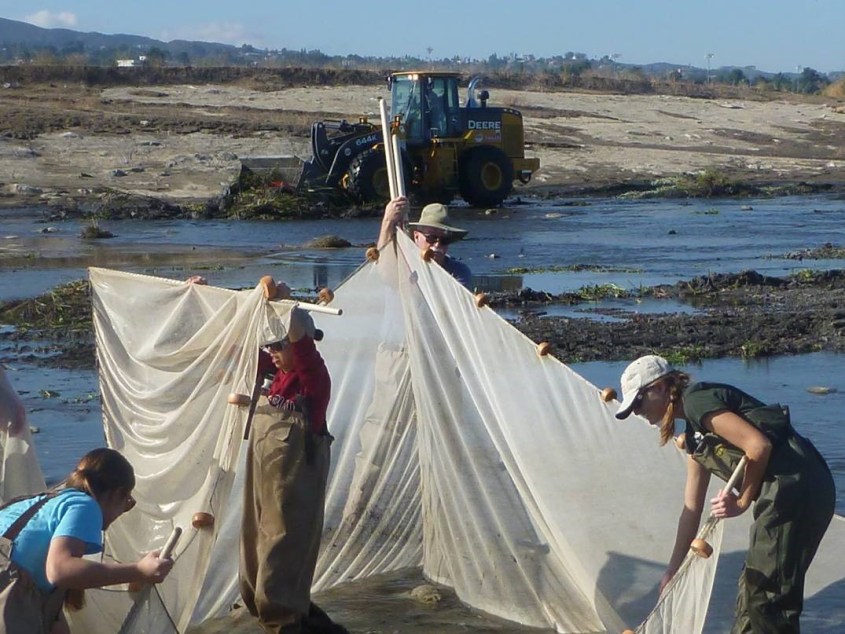
STAYING FOCUSED on the fish study at hand, volunteers get some company in the background. (Credit RCDSMM Stream Team)
By Rosi Dagit
Guest Contributor
On our return to Sepulveda Basin, to continue the upper river fish survey, we captured 203 fish, a far cry from the more than 3,600 tilapia fry caught this time last year.
There had been the first major rain of the season the day before, on Monday, Nov. 21, with between 0.75-1.25 inches over the LA River basin. Sediment and the remains of several homeless encampments were in our car park site. Muck was unconsolidated and varied from 1-6 inches deep. We couldn’t walk far upstream, starting 30 yards to the underpass at Burbank Blvd. because the water was too deep but flow in the main stem concrete area where the sample sites are located was shallow. Most of the vegetation along the banks was gone with just a few patches of water primrose (Ludwigia hexapetala), a few cattails and some willows closer to the bridge were all that remained.
The majority of fish were non-native juvenile Tilapia sp. and Gambusia affinis. Both of these species are common and abundant throughout the LA River, where they were initially released to control mosquito larvae. Samples of both species, as well as fathead minnow, juvenile red swamp crayfish and Asiatic clams were also collected and frozen for toxicology testing.
A single adult Plecostomus (Hypostomus plecostomus), which is a common aquarium fish, was also found washed up on the concrete bank at site 2. It recovered when placed into cool water, but was collected for toxicology testing.
An Army Corps ‘dozer and dump truck moved sediment and debris out of the concrete channel, according to their management permit. The site supervisor kindly allowed us to complete our site 1 and 2 sampling before they moved heavy equipment into that area. The rest of our six sites were upstream of their work area.
YOU NEVER KNOW when an aquarium dweller will show up in the LA River, in this case the gnarly Plecostomus. (Credit RCDSMM Stream Team)
Following collection of what looked like an arroyo chub (but was later confirmed to be a fathead minnow) at site 1, just downstream of the disturbance in the channel, we contacted the California Department of Fish and Game about this potential threat to any other arroyo chub that might have washed down.
Dagit is the Senior Conservation Biologist, Resource Conservation District of the Santa Monica Mountains.
8 a.m., arrive at meeting site – The park gate on Burbank Boulevard, just west of Woodley Avenue. This is the kayak loading site and it’s roughly a quarter-mile upstream from Sepulveda Dam.
8:30 a.m., William Preston Bowling will greet everyone with liability waivers. Volunteers signed in, put on waders/sunscreen, and took the fishing gear and buckets down to the river at site 1 and Anglers bring their own gear and valid fishing license.
We are collecting fish to observe and throw back, showing all your catch to biologists once caught, they will decide what species to keep for toxicity study.
This will be the second outing of the third “Los Angeles River Fish Studies” created by FoLAR. This study is in Partnership with Stillwater Sciences and the Resource Conservation District of the Santa Monica Mountains.
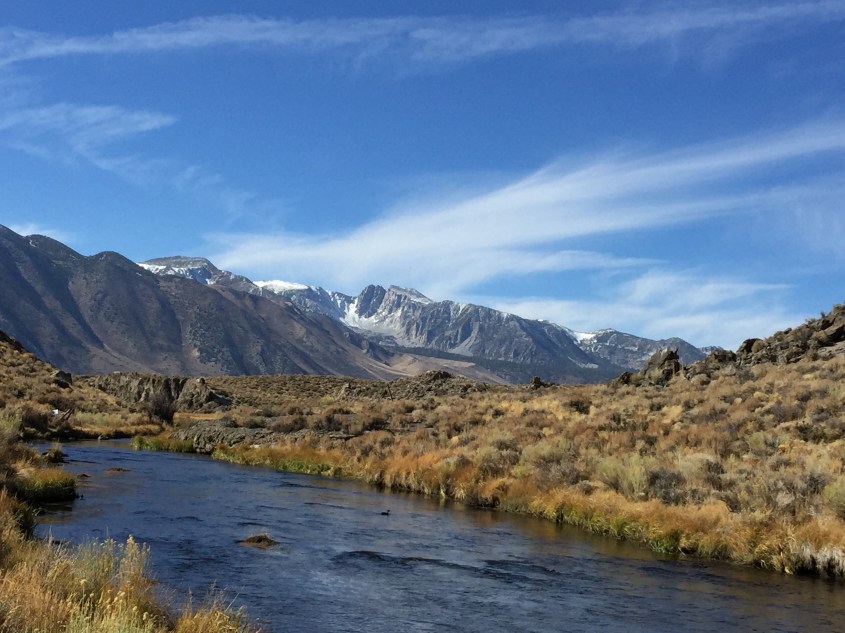
HOT CREEK always sets me back on my haunches. What a beautiful spot. (Jim Burns)
Fall fishing, for me, is the best fishing. Maybe I love it simply because I love the fall — the blistering So.Cal. sun takes an occasional break; football is back; and, I don’t know, turning leaves, colder nights, a moon that seems clearer, nearer.
So last weekend my wife and I escaped to Mammoth Lakes for the first time in a couple of years. I’d been alerted to the stocking of Hot Creek — the So. Cal. holy of holies — by John Tobin, Pasadena Casting Club’s conservation editor. When he told me the California Department of Fish and Game planned to release more than 6,000 fish. I wasn’t sure what to think. My impression over all these years was that Hot Creek contained only natives.(We can talk about natives, browns, rainbows in another post.)
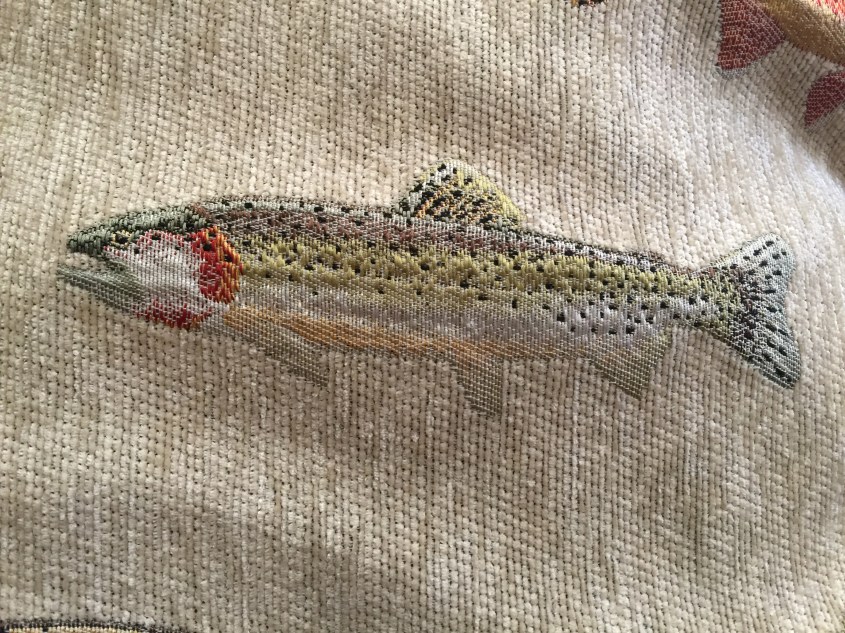
PILLOW TROUT: Or, maybe, somewhere over the rainbow? (Jim Burns)
When I asked my buddy, who would also be in Mammoth, if he wanted to fish Hot Creek, he declined because they were stockers. I mulled, I brooded, I went to the local fly shop for guidance, where a guide told me that Hot Creek Ranch had laid down the law — either stock, or the property would go up for sale. I haven’t confirmed that statement with the owners, but it made sense. A business owner has to have a profit base. Without the base, what’s the point?
A recent CDFG press release confirms this woeful condition: “For unknown reasons, the Hot Creek fishery appears to have declined substantially in recent years, with markedly lower catch rates and few trophy (>18”) fish coming to the creel. Drought-related impacts are the suspected cause, including low flows, lack of flushing flows in late spring/early summer to mobilize fine sediments and expose spawning gravels, potential changes in water quality/chemistry and increased aquatic vegetation.”
Then there is the fact that Hot Creek is a designated “wild trout water.” Why would you stock it and allow it to retain that designation?
The press release goes on to say, “While it may appear counter-intuitive to stock a designated Wild Trout Water, California Fish and Game Commission Policy allows for such stocking under specified terms and conditions. The Commission Designated Wild Trout Waters Policy, under subsection I.B. states that designated waters should be: “Able to support, with appropriate angling regulations, wild trout populations of sufficient magnitude to provide satisfactory trout catches in terms of number or size of fish.” Subsection II.A. states: “Domestic strains of catchable-sized trout shall not be planted in designated wild trout waters.” And Subsection II.B. states: “Hatchery-produced trout of suitable wild and semi-wild strains may be planted in designated waters, but only if necessary to supplement natural trout reproduction.”
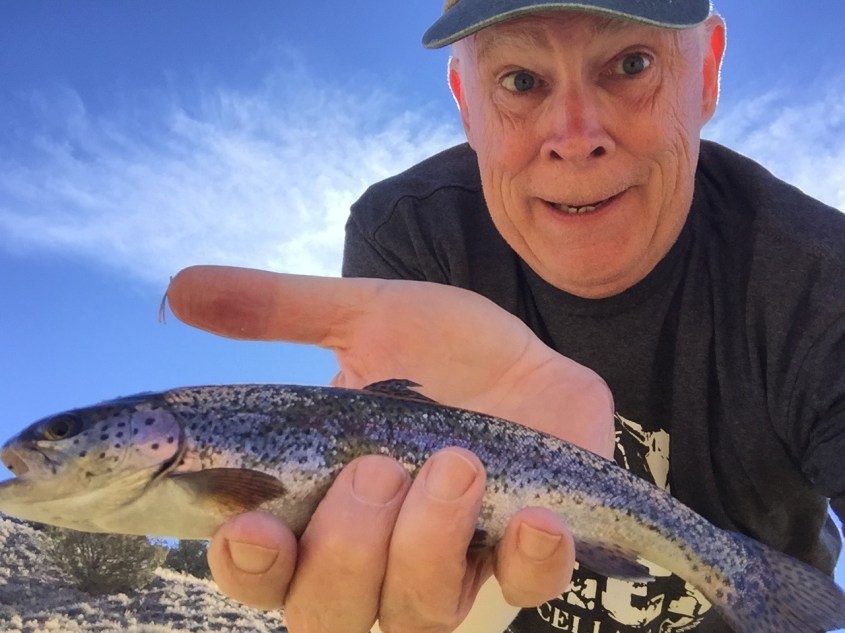
TROUT SANS ADIPOSE: And it’s time for a quick selfie before he’s back in the water. (Jim Burns)
Anyway, after cuddling the condo’s trout pillow that night, I decided to try my luck. All I can say is within 15 minutes of trudging down the dirt pathway and moving past a guide untangling a client’s bird’s nest, I was into a fish. He was sure he owned the run, and I was sure I would soon own him. A longer cast with my old Sage SP 3 wt., rigged with 5x, and a sparsely tied elkhair caddis and the fish was on, fighting, running — then hiding in the red flowing weeds.
One in the weeds can ruin your whole day. If you can’t see him and can barely feel him on your line, then disaster may be tapping you on the shoulder. It was only through hard-won weed experience on our own LA River that I brought him to net, snapped a selfie, and let out a good, old-fashioned “whoop, whoop.”
It was a very good day, but I wonder, do you support stocking a Wild Trout Water?
Please take this very quick survey.
David Kestenbaum – 6 days ago
I have been fishing Hot Creek for 30 years. The stream has been devastated by the drought. Very few anglers even bothered to fish Hot Creek over the last year or two because of the lack of fish. The trout that were stocked are diploid fish and will reproduce in the stream and hopefully restore the stream to its past glory.
A little known fact is that the stream had previously been stocked, both on the ranch and in the public water until about seven years ago. At the end of the season the hatchery would dump its excess fish into the creek and a former ranch manager many years ago, before Kevin and Bill, stocked on the ranch. So, the creek has never been a pure wild trout fishery. After a year in the stream a native strain stocked fish will behave wild and except for the clipped fin is almost impossible to tell apart from the native ones. The stocked fish off-spring will truly be wild. I for one am very grateful the the DFW for stroking my beloved stream.



 Fellow anglers,





 And because scaling the barriers — filled with sand and 4 feet high — is difficult, access along this very long stretch is once again contained to the walking path above the river. So, if you want to:

 lariverflyfishing
Please get rid of the barriers!!!
My wife is handicapped and can’t jump over the barriers! There’s no need for them anymore!!!