



Bugs
 Hi everyone,

By Rosi Dagit
Guest Contributor
She was lying on her back on the bottom of a pool, pushed by the flow against a rock. Bruised, scales falling off, scrapes all over her body, she was barely breathing. Gently holding her face into the flow, she gasped for air and hung limply in my hands. I could feel her muscles twitch and contract, but she could not swim at all. When I let her go, she sank to the bottom on her back and rolled with the flow on her side, up against my feet, unable to orient herself.
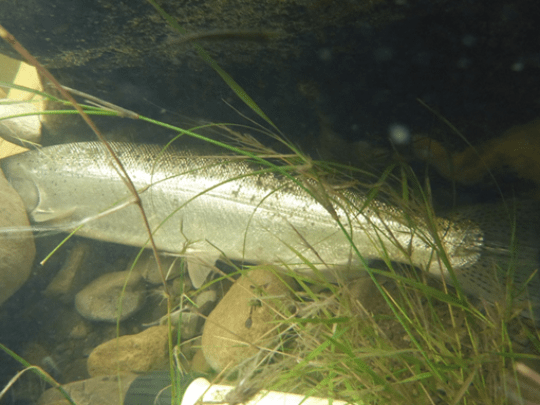
At 23 inches, she was a full-grown anadromous steelhead that had fought her way upstream against the current in search of a place to spawn. The creek was wondrous after all the winter storms, with steady flows cascading over rocks, providing a background music calling her upstream to find a good place to lay her eggs.
For several minutes we stood and discussed what to do. She was clearly not going to recover and survive, but she was not quite dead yet. It was just heartbreaking to think of losing this fish, one of only four anadromous adults known to have returned to the creeks so far this year in all of Southern California.
What went wrong? How did she get so banged up? Was the flow too strong? Was she too old and tired, having waited too many years for the rains to come?
She died in my hands. I brought her battered body back to teach us and help us learn to tell her story. Her scales will tell us her age. Her DNA will give us insight into her ancestry. She was not one of our tagged fish, but from somewhere else. Only 18 eggs, an empty stomach. The promise of the future for southern steelhead took a big loss today.
Rosi Dagit is a Senior Conservation Biologist for the Resource Conservation District of the Santa Monica Mountains.
Editor’s Note: Dagit and the RCDSMM have permits to monitor and handle these endangered fish. Only permitted biologists are allowed to handle them. There is a substantial fine per fish (around $25,000) for harassment or taking one from the water, if not permitted.
This story from the Ventura County Star has gone viral in the last several days, according to Pasadena Casting Club’s John Tobin. As the club’s conservation editor and an enthusiastic environmentalist, he was excited by the sighting of this endangered species, adding, “this could be the L.A. River!”
I share his sentiment and hope that the push to develop the river doesn’t leave out the most important part — a return of Southern California Coast Steelhead.
Of course, after years of drought, spotting a southern steelhead in a creek at Leo Carrillo State Park is a reason for everyone to cheer. Gone are the days of steelhead runs, when an entire industry sprang up to cater to fishermen who traveled to witness and catch these magnificent fish as they made their way from the ocean to their spawning grounds in our local mountains.
“It was so exciting to find an actual steelhead, as they are rare as hens teeth this year,” said Rosi Dagit, team leader and senior conservation biologist for Resource Conservation District of the Santa Monica Mountains, by email. “Only four anadromous adults have been documented thus far, and one died in my hands in Malibu on Wednesday. A lot of future hopes are with this lovely fish and we wish her many babies to help recover the population!”

See you on the river, Jim Burns
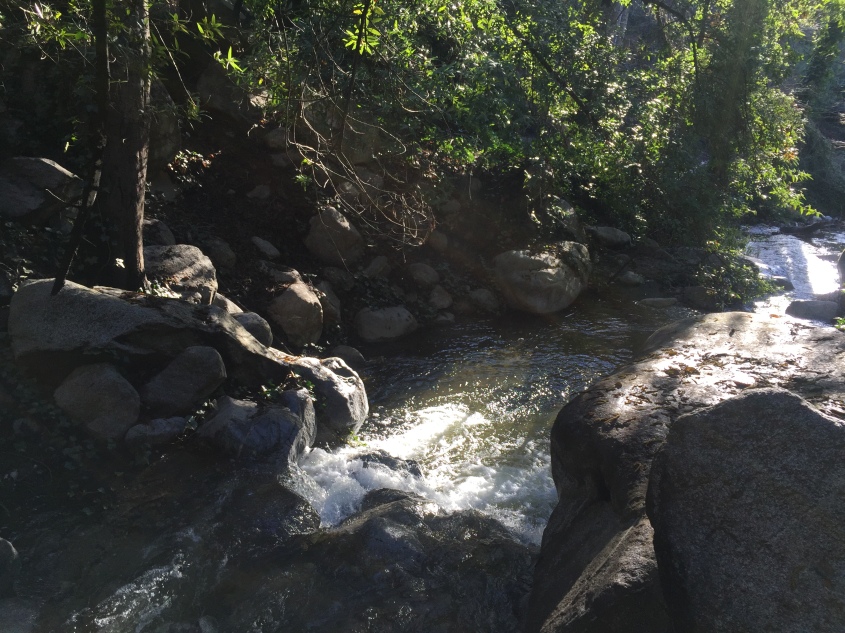
A fairly short, but deep pool almost under the first bridge. About 3 feet deep under the mini-waterfall, 8 feet wide, and maybe 12 feet long. (Courtesy Patrick Jackson)
By Patrick Jackson
Guest Contributor
On the weekend of Feb. 11, my dad and I went hiking and fishing up through Santa Anita Canyon up to Sturtevant falls. We arrived at Chantry Flat around 8:30 a.m. and reached our first fishing spot around 8:45. After fishing under the bridge for 15 minutes and seeing and catching no fish, we headed to the first dam. Fished here for about 15 minutes, no fish seen or caught. It was a re-occurring pattern for the rest of the hike.
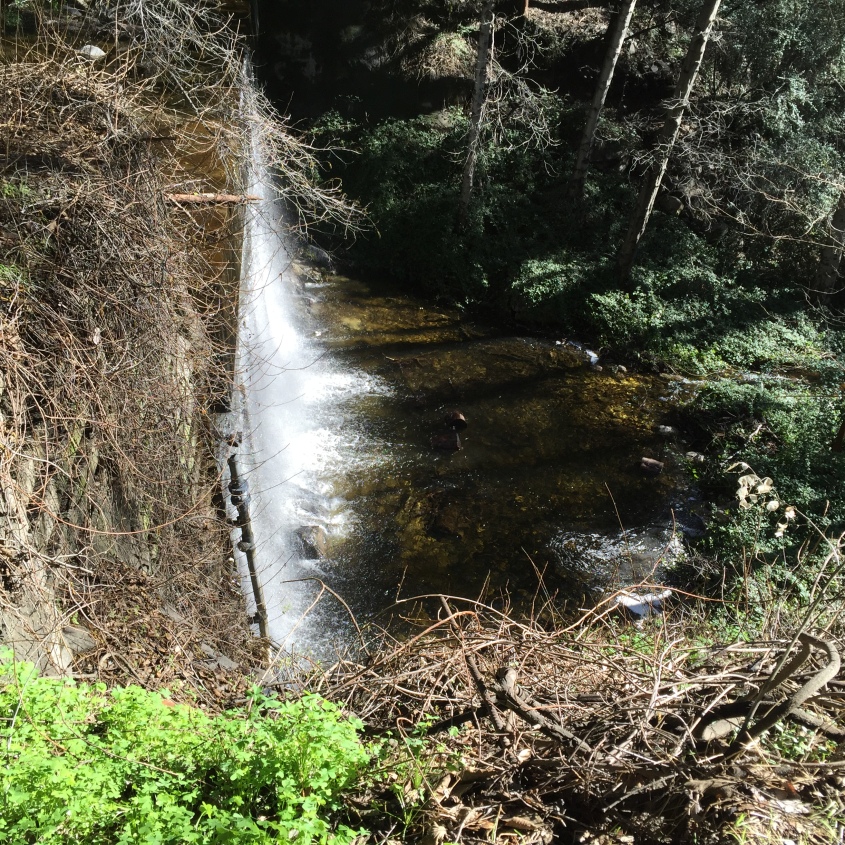
I started off the day with a Prince Nymph, but being it was my second time throwing a nymph, I decided to switch to more familiar dry fly fishing at the first dam. With a 7.5 ft. 5/6wt rod, 7.5 ft. leader and a tippet, I tried out a Prince Nymph (not sure if it was exactly that but similar to it), Parachute Adams, Adams, and a California Mosquito fly (all flies were on the small end, Im not exactly sure what size). My dad was primarily fishing with a spinning reel and small artificial lures.
By John Goraj
Guest Contributor
Hello all:
I wanted to give you a quick update on the initial “trout scout” that Arroyo Seco Foundation and volunteers did last week at Switzer’s Falls on Feb. 11. Please keep in mind that this first trip was not meant to be a technical, scientific survey, but rather to get a general idea of the habitat conditions for native trout and stream ecology/hydrology at the moment. But, the next few trips will become more technical as time goes on, employing GIS, DNA extraction and using snorkeling and wetsuit gear to look for trout.

We walked about two miles down the trail, stopping several times along the way to survey conditions and look for evidence of life. One thing is for certain — the Arroyo Seco has not flowed this turbulently in several years! I would guess that the streamflow was close to 50-75 cubic feet per second. It was so wonderful to see. We had to jump over the stream on rocks and downed logs several times along the way. There were several three-to-four-foot-deep pools as we made our way through the canyon. Many of these pools possessed some critical habitat features needed for rainbow trout: clean gravel beds; in-stream woody debris and boulders that create additional pools, turbulent, cool water and overhanging vegetation creating cover. Additionally, the strong root systems of white alder and cottonwood trees that line the stream have established solid banks, which is another key component of healthy mountain streams needed to sustain trout species.
Although we did not see any fish this time, the most salient observation I can make right now is that I do believe some trout are living up there. All or most of the necessary habitat conditions are present and I think it’s only a matter of time before we see some fish.
The next survey will focus on going deeper into the Bear Canyon area. I have heard from several anglers that they have seen trout up here prior to the 2009 Station Fire. The combined effects of the fire and the recent five-year drought had made seeing trout in this area improbable. But I don’t think this is case anymore. The Switzer Falls/Bear Canyon area is recovering quickly and now with all the rain and snowmelt, conditions have changed for the better.
Thank you for your interest as always and feel free to email me with any questions or comments at: john@arroyoseco.org.
Hello Stewards,


Who is using a tenkara rod on the river to catch carp? If you haven’t see this “experiment” from a couple of guides in Salt Lake City, it’s pretty cool. Have a look here.
My thought, though, is that if you can’t take some of the fight out of a carp, you’ll never land it, especially if your rod is geared for trout, at 4x or 5x. As our friends over at TenkaraBum said, ” Fishing for carp with a tenkara rod is like taking a knife to a gun fight.
Let me know if you’ve had any luck with tenkara and carp. My son gave me a one for Christmas (for trout), but I’ve yet to check it out.
See you on the river, Jim Burns
Note: I wanted to bring back this post from 2012. With all the rain we’re getting, maybe fly fishing will return to what it was in the San Gabriel Mountains before the drought and the Station Fire. Winter’s always a good time to dream about the next cast.
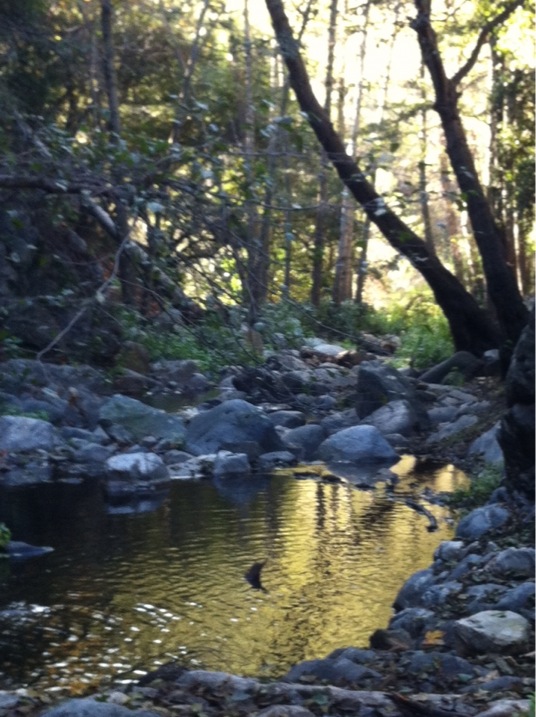
Brrr, it’s cold out there, and even colder in the many fishable canyons of So. Cal’s San Gabriel mountains. Here’s how to have some fun:
1. Play hooky any Monday, Tuesday, Wednesday or Thursday. Skip Friday and forgettabout the weekend. There are always several thousand people who have the same idea at the same time. Crowds = lousy fishing.
2. Dress warmly in layers. Long underwear is a blessing this time of year.
3. Take it easy on the way down. Watch for gravel, sand and rocks that might give way. They will. Count on it.
4. Start with dries and move to nymphs. I know what you’re thinking: no hatch = no surface action. You might be surprised. Of the 10 fish I caught on my recent canyon adventure, two were on dries. Pick the usual suspects. Parachute Adams and his friends.
5. When you do reach into your fly box for a nymph, give that beadhead yellow sallie a try. I know it’s an underused Stone Fly, but the other eight fish I caught were all on this fly. Must be the legs.

6. Smaller is better. Even with all of our rain, flows are down. Size 14-16 or above, please.
7. Pack a lunch and extra water.
8. Bring a friend, someone who will make you laugh at some of those tiny trout you’re bound to hook.
9. Don’t wear hiking boots on slippery rocks. Just because the water’s cold, any rock in the water is still as slippery as it is in summer.
10. Turn your cellphone off. Keep your camera on. I know, you’re saying that there’s no service up there anyway. True, but it’s the principle.
11. Post your pics, so we can all see how good you look grippin’ ‘n’ grinnin’.
12. Keep an extra water and energy snack in the car.
Baker’s dozen: Get down. Get tired. Get silly. Get grateful. Repeat.
See you on the river, Jim Burns
\
 lariverflyfishing
I am so excited to see this post on your blog Jim! This past season I caught my first carp on a Tenkara rod, the Tenkara USA Ito rod actually. I was using 5x tippet and kebari style fly I tied myself. This rod was certainly not made to fish for Carp and I was glad to have the 5x tippet, which theoretically should break before the rod does. The fight lasted a good 10 minutes but I successfully landed the fish without a net. The fish was pretty tired afterwards though and it took a long time for me to revive her before releasing.
A rod with more power (like the one you pictured above the Nissin Red Dragon carp rod) would allow you to bring the fish to hand much quicker, therefore reducing their stress. Chris at Tenkara Bum recommends 2x tippet for the Nissin Red Dragon carp rod so you can really put a nice bend in the rod with large fish and not worry about anything breaking. Here is a picture of my first Carp (right around 55cm long not sure on the weight though)