



As requested by county officials, California Department of Fish and Wildlife (CDFW) Director Charlton H. Bonham delayed the start of the trout opener in Alpine, Inyo and Mono counties. The director made this decision in consultation with California Fish and Game Commission President Eric Sklar.
The trout season was scheduled to open in these three counties this Saturday, April 25. The delay to the opener in these counties expires May 31.
Meanwhile, more fishing for shut-ins, this time at Brooks Falls – Katmai National Park, Alaska.



Washington State has closed fishing until May 4 on more than 7 million acres of public land; Oregon put the kibosh on recreational hunting, fishing, crabbing and clamming to non-residents, due to concerns about travel to Oregon to participate in these outdoor activities; for now, there’s no fishing, diving or boating in Florida’s Keys; meanwhile, free-wheelin’ Texas has declared fishing an essential activity; but what about California, home to more than 1 million resident fishing licenses?
Because of pandemonium during the call this week, the California Fish and Game Commission abruptly canceled a teleconference Thursday morning of more than 500 participants amid cries of “make fishing great again!” and “fascists!” before it could consider authorizing a limited ban on sportfishing in some areas, according to the Sacramento Bee.
The statewide heat got so hot that fishing was one of Gov. Gavin Newsom’s points during his Thursday briefing,
“I’m passionate about fishing myself and I’m getting inundated by people that are concerned that we’ve canceled the fishing season,” the governor said at his daily COVID-19 briefing. “That is not the case, we are not canceling the fishing season in California.”
He added the state wants “to delay, not deny, the season,” according to KTLA.
Trout fishing season begins the last Saturday in April and runs through Nov. 15 every year. Opening Day, aka “Fishmas,” is Saturday, April 25, in Mono County.
As California more likely proposes a county by county system, it could be a model of what to expect as the state goes back to work. This is pure conjecture on my part, of course, but eventually we will have to find a way to safely ease our “shelter in place” restrictions.
When the meeting is rescheduled it will be posted on the commission’s website.
See you on the river (eventually), Jim Burns

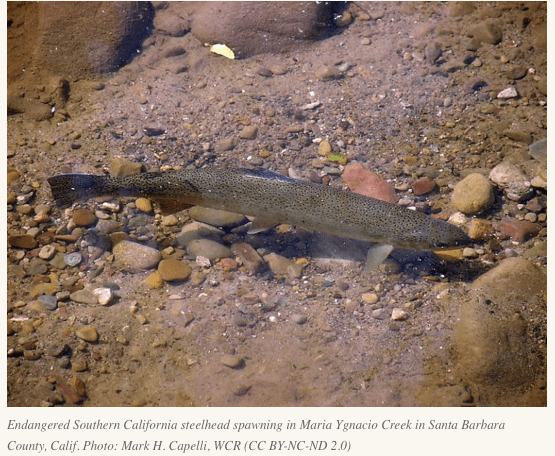
Thanks to Steve Kuchenski for passing along this hopeful news from The Revelator. Read the entire post here.
Removing one gigantic dam can have a massive effect on restoring a river ecosystem.
But bringing down more than 80 smaller dams? That can also cause a transformation.
This spring the Forest Service, aided by U.S. Marine Corps members, will blast apart 13 more dams in the Trabuco ranger district inSouthern California’s Cleveland National Forest.
It’s the last phase of a groundbreaking project that began more than five years ago to remove a total of 81 dams from four streams in the mountains of Orange County.


Hello fellow fishers, sheltering in place.
It seems a natural to decamp to the great out of doors right now, to escape the virus anxieties and homebound blues. After all, municipal golf courses are still open, so what’s not to like in an even bigger venue?
That idea for me came crashing down when my friend and fishing guide Chris Leonard sent me an excellent blog post about how Bishop, California, is dealing with an onslaught of climbers. As one of the West’s best bouldering spots, I can see how the draw to go would be strong. But, questions arise as out-of-towners look for supplies and indoor camaraderie.
Here’s a sample from Thundercling:
Bishop, California, hosts some of the finest bouldering in the world, along with a friendly community dependent on visiting climbers. With COVID-19 sweeping into every nook of our nation, however, the town is struggling to limit visiting climbers; so far, unsuccessfully, putting the local population at risk for infection, a bleak prospect for a tiny community hours from the nearest metropolis.
“The current scene feels like people are on winter or spring break,” said Tammy Wilson, a local climber, skier, restaurant worker, and Volunteer Coordinator for the Flash Foxy Women’s Climbing Festival. “Lots of cars in the parking lots, more people at the boulders than Thanksgiving week. Massive crowds of people camping and in coffee shops and grocery stores.”
Despite mass outreach and the desperate warnings from physicians and health care workers worldwide, climbers from around the country have descended upon Bishop as though a global pandemic were some sort of hall pass from responsibility and magnanimity. These climbers, many of whom laud social services and universal health care and employ progressive social media messaging, have willed themselves to rise above distress and summarily jettisoned the very meaning of community in favor of sending some random V8 on volcanic tuft.
And that stalwart of independent journalism in the West, High Country News, turns our attention to the crowds descending on Arches National Park. Many years ago, environmental pioneer Edward Abbey warned that good roads would cause greater crowds to visit the park, but I’m sure he never imagined this scenario.
Ski resorts have shuttered. Disneyland is closed. Professional sports have been canceled. For most of the United States, social events and attractions ranging from museum visits to music festivals have vanished. But despite nationwide warnings that people should stay at home and limit unnecessary outings, national parks and monuments have, for the most part, remained open.
As a result, visitors desperate for activity and distraction have flooded into Moab, Utah, the gateway to Arches National Park. “We had crowds of people that felt like peak summertime,” said Ashley Kumburis, who manages a rafting and jeep tour outfitter that’s still open. “If you didn’t know this contagious virus was spreading, you would think it was a regular summer day in Moab.”
On March 16, doctors from Moab Regional Hospital sent a letter to Gov. Gary Herbert, R, asking for help. “We are writing this letter to implore you to shut down all non-essential business service in Moab,” it reads. Citing a lack of hospital beds and no local intensive care unit — at a time when lodging for the following weekend was estimated to be at between 75-95% capacity — officials were concerned that “tourism would drive the spread” of COVID-19. Within a few hours, the Southeast Utah Health Department issued an order closing restaurants and lodging, and camping on both public and private land to outside visitors.
Even though it hurts, stay home. I just pulled out of a trip I’ve been absolutely crazy to take for months, spring fly fishing the Western Sierra. We need to stop this thing any way we can. It’s not a hoax, fake news, overblown, over-estimated. It’s real.
See you on the river, Jim Burns
 lariverflyfishing