Crisis on Montana’s Madison River highlights how far humans will go to rescue fish

Courtesy The Slide Inn

Editor’s Note: I wanted to run this because it shows what extraordinary lengths people will go to in trying to protect fish. This story is from the famous Galloup’s Slide Inn on Montana’s Madison River.

By now many of you are aware of the events that transpired over the last several days, but we will give you a short summary just in case you missed it. In the early morning hours of Nov.30, flows out of Hebgen Dam dropped from 640 cfs to under 200 cfs in a matter of a few minutes. This gave the fish populations inhabiting the stretch between the Dam and Earthquake Lake very little time to search out deeper water, and many became stranded in channels and small puddles among the larger rocks.

We did not become aware of the situation until it was brought up by one of our customers around 9 a.m. and Montana Fish, Wildlife, and Parks was contacted immediately in order to get in touch with NorthWestern Energy. Other Fly Shops and friends were contacted shortly thereafter in order to get the word out, and we headed upstream to investigate. What we found was heart breaking, as there were trout, whitefish and sculpin trapped in small areas throughout that entire system. There were a handful of fish that had died as well, but the biggest area of concern were the large spawning areas that were now completely out of the water.

We continued to pick up as many fish as we could, and got them back into the main river. By now word was getting around and we would soon have people from West Yellowstone and Ennis coming to help relocate these stranded fish. By 1 p.m. Montana FWP, Northwestern Energy and more volunteers were on the scene. NorthWestern Energy would later announce that the drop in water was due to a damaged gate component, and that repair crews would be working through the night until they were able to raise the gates up. Later that afternoon they were able to increase the flows to 248 cfs by releasing water over the emergency spillway, but all we could do was watch the USGS gauge above the West Fork continue to drop. At around 4 p.m. MT FWP stopped by the shop to bring us up to speed, and to tell us we were now in recovery mode — Meaning that they needed volunteers to walk the banks starting the morning of Dec. 1 to help relocate any stranded fish.
It was a long night for many of us, as we hoped that the water would stay high enough to cover the primary spawning areas between the Slide Area and Ennis Lake. There was a very real possibility that many of these areas would be exposed to cold air and suffer a similar fate to the areas between the lakes. We woke in the morning and got out to the river. The areas between Lyon’s Bridge and Ennis were far better than expected, and while it was obviously extremely shallow, there was still plenty of water running from bank to bank.

It became apparent to most of the volunteers that day that the areas that needed the most attention were upstream from Lyon’s Bridge. Many people split into teams and walked the banks up and downstream from the major access sites such as Raynold’s Bridge, Three Dollar, Pine Butte and the West Fork.
Courtesy The Slide Inn

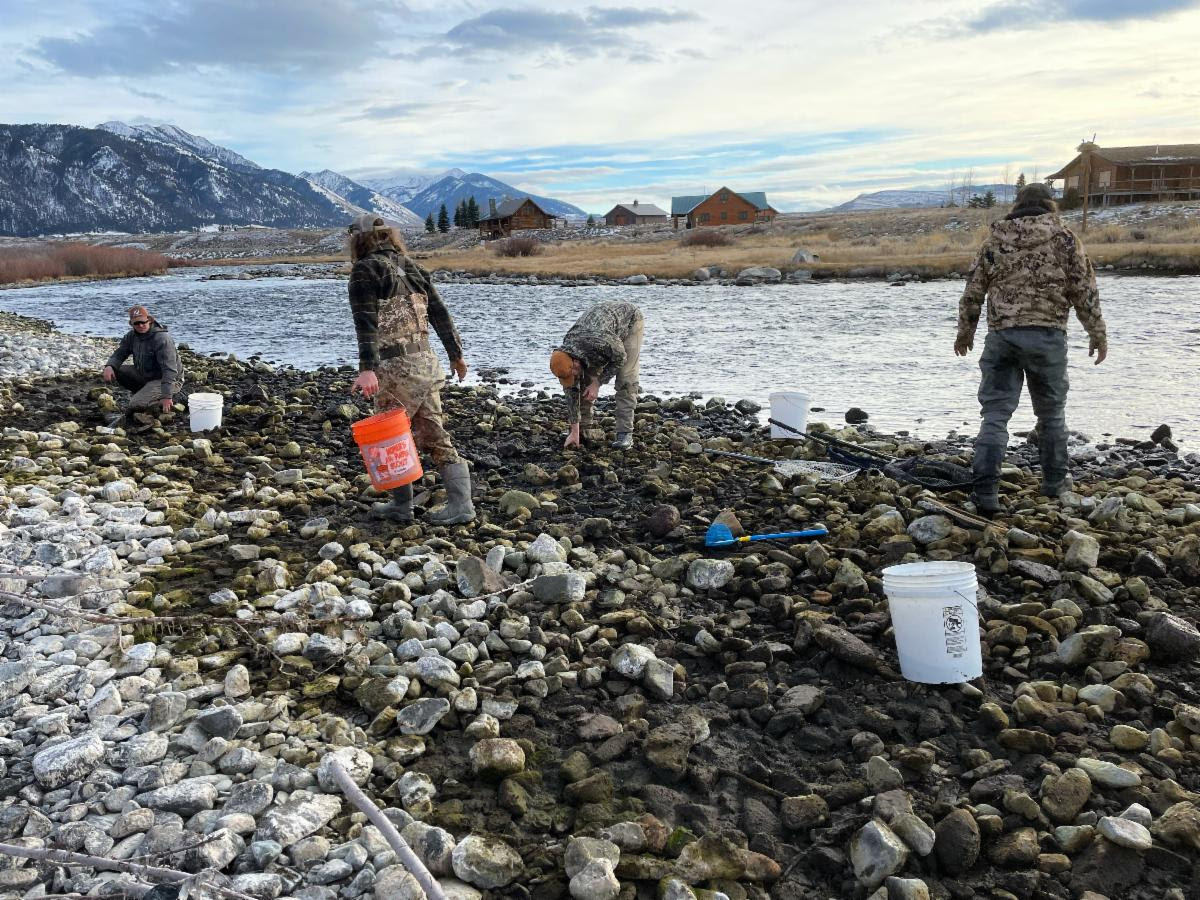
Our crew went downstream from Three Dollar to Pine Butte on both sides of the river, and we were actually pleasantly surprised at the conditions. About 95% of the prime spawning areas were still underwater, and there were very few stranded fish in the channels. There were a lot of sculpin that needed a hand to get back into the main river, but we did not encounter any dead fish. The two areas that were hit the hardest in this stretch were two channels located approximately one mile above Pine Butte as you can see in the pictures below.

The Channels from the West Fork up to Eagles Nest on the other side of the river also faced similar conditions but we did not encounter many stranded trout there. The channels from the Slide Inn down to Raynold’s Bridge did have stranded fish and thanks to all of the people out there yesterday, many of them were returned to the main channel. Unfortunately we did lose a lot eggs in this stretch, as most of the channels were dry and there were a lot of sculpin that needed to be rescued from underneath dry rocks.

Courtesy The Slide Inn
As the sun started to dip behind the horizon, we all headed back to our trucks after a long day on the river. The amount of people who showed up to help was absolutely incredible. Not only did the locals show up in force but we had folks from every corner of the state willing to lend a hand … it was just incredible to see.

Once we got to the shop, we heard that NorthWestern Energy had a new gate component en route from Anaconda and that the flow could be restored shortly if the installation was successful. I know a lot of us were still nervous, as the water levels continued to drop ever so slightly at the Kirby gauge above the West Fork. If the river dropped below 300 cfs a lot of the spawning gravel in the Three Dollar Bridge area would be exposed, so we really needed the dam to return to normal flows as soon as possible.

As fate would have it, we all woke up early to check on the progress and when the numbers 640 appeared on the Hebgen gauge, there was a giant sigh of relief. Water levels had also stayed above 300 cfs at the Kirby gauge throughout the night and we did not have a hard frost. Upon further investigation, NorthWestern Energy had repaired the dam just before midnight and water levels were already starting to come up around Raynold’s Bridge by 8 a.m.
In summary, a very large percentage of our spawning beds are safe and sound from Quake Lake all the way down to Ennis Lake. The areas that suffered the highest mortality of fish, eggs, and bug life were Between the Lakes, The Slide Area down to Raynold’s Bridge, and a few channels between the West Fork and Eagle’s Nest. It will take a few years to see what kind of impact the last 48 hours has had on this fishery, but at least we can all breath a little easier today.

Lastly, thank you to EVERYONE for their help. You have no idea how much it meant to see all of you lining the banks and helping out the Upper Madison when it needed it the most.

— The Slide Inn

Malibu’s Rindge Dam moves closer to removal

Musician, fly fisher and conservation advocate Bernard Yin shot the drone footage for this video from CalTrout. Follow Bernard on Instagram @bernardyingram

Groups to protest KORE exploratory mining in Mammoth Lakes on Saturday

What’s happening?

The U.S. Forest Service announced in a media release this week that KORE Mining, Ltd. will begin exploratory drilling as early as Tuesday, November 30, in Long Valley. 

“The public should expect that heavy equipment including a drill rig will be on the roads near Whitmore Hot Springs and Antelope Springs Roads,” the media release says.

Friends of the Inyo (FOI), together with the Center for Biological Diversity, Western Watersheds Project and Sierra Club, is suing the U.S. Forest Service for allowing KORE Mining’s destructive activities to proceed.

“This is a bad project for the community of Mammoth Lakes, Southern Mono County, and negatively impacts wildlife, including the imperiled bi-state sage grouse, and our recreational tourism economy,” FOI Executive Director Wendy Schneider said. “It provides no benefit to the people of Mono County.”

What can I do?

Mammoth Lakes area activists are organizing a peaceful protest this Saturday, Nov. 20, from Noon to 3 p.m. A Facebook page that provides details has been set up. You can access it by clicking here or on the button below.

“The goal of this protest is to bring awareness to community members in Mammoth Lakes and the Eastern Sierra about KORE Mining’s intentions to implement an open pit gold mine,” the protest Facebook page says. “We are encouraging folks to make signs and banners in preparation for the event.”

Friends of the Inyo supports this peaceful protest.

End to a tough year

Those of a certain age will remember Porky Pig’s sign off, “ba-dee, ba-dee, ba-dee, that’s all folks,” as the 2021 fishing season ends on many of our rivers today. And if you remember the joys of Porky Pig and his friends Donald Duck, Bugs Bunny and hapless Elmer Fudd, you probably hope for another year, instead of taking it for granted.  I certainly know I do.

If 2020 was our COVID year, 2021 has been all about reentry, and it’s hard to figure. Everybody seems to be mad and raging about something.  I have opinions, but my posts, all 635 of them, are not political here on LA River. I just began my 11th year, which is hard to believe.

The moon shines brightly before dawn on the banks of Oregon’s Owyhee River, named for the old spelling of Hawaii. (Jim Burns)

Also, as readers have noticed, I don’t write nearly as much as I used to. I’ve trimmed back on traditional print as well, so you won’t see my byline in California Fly Fisher, but I’ll continue for Fallon’s Angler. At this point in my life, I get to be choosy.

Back to the year. From Western press reports, I expected overrun river conditions along the likely suspects, where new anglers would resemble a herd of raging bulls in Pamplona. Heat, passion and too much flask time can lead to inconsideration for your fellow anglers. So can just plain etiquette ignorance. One of the beautiful things about fly fishing is how much respect we have for each other on the water, as well as for fish and their habitats. Let’s not lose that beautiful part of our sport as our numbers increase. “Share the water.”

Sign from the West Fork in better days. (Jim Burns)

I still mourn the loss of the West Fork of the San Gabriel because of the Bobcat Fire, which, as it turns out, is irreplaceable as a beauty spot within a short drive from L.A. that had lots of small rainbows, a bike lane, shade and happy times. When it will actually return to those conditions, is anyone’s guess, but the stream is slated to reopen April 1, 2022. I hope that date isn’t another sign of things to come.

I was lucky enough to fish the nearest good water from L.A., the Kern, in winter and spring with no other anglers in sight on the 20-Mile Stretch. I went out with Rob Buehler of Buehler Brothers fame, on each occasion. Great guide and great guy.  

Spring became summer with the drought tightening a dry, dusty grip across the West. Did you know Elko, Nevada, still has a fly shop and a weekly fishing column? The columnist and shop owner, Joe Doucette, even calls you back when you’re trying to find a spot to catch a Bonneville Cutthroat Trout in Nevada’s Great Basin National Park. For lots of reasons, that didn’t happen (yet), but my chats with Joe led me to a beaver pond in Nevada’s Ruby Range, full of small, radiant cutties. My wife and I missed a mountain lake, but even with a sky dirty gray from persistent Western wildfires, those small fish were a wonder to behold.

Next, I skipped Idaho’s Henry’s Fork out of agoraphobia, and instead went desert fishing on the awesome Owyhee River in Oregon at the Idaho border. Andrew Catt and I left Boise at 4:30 in the morning to beat the unrelenting summer heat. After an hour’s drive, we found very cold water and very active browns, even as the temperature soared into the high 90s.

Hanging with Seattle Pat on a cold night in the Western Sierra (Credit Jack Train)
TUSC’s Luis Rincon gets snowbound after the group woke up to an unexpected snowfall. (Credit Michelle)

The end of the season found me on the Western side of the Sierra last month with Trout Unlimited South Coast friends and new friends. The water levels at Edison and Henderson were heart-bracingly low, as was the drive into the back country through acres and acres of Camp Fire burn. We’d cancelled our trip with Jimmie Morales last year because of COVID, so it was pretty amazing to have Pat from Seattle, Jack, the nomad, and Rocky from Texas come join in. Several of our group without all-wheel drive vehicles got snowed in and had to spend an extra day. (Some have all the luck … .)

As for the LA River, it continues to be the source of crazy stories, like the one my friend, Bob, told me recently about the opera singer who enjoys the same carp honey hole. Only in LA, right? Earlier in the year, Bob and I couldn’t figure out what the mysterious raindrops in a forlorn pond were all about, until with a net he and his fiancée, Karen, discovered lots of large bullfrog tadpoles coming up for air. At first, I was madly casting to them, thinking they were blue sunfish rises!

So, readers, my fishy advice? Enjoy getting outdoors; enjoy the camaraderie of those of like mind; put yourself on a social media diet; show the ones you love how much you actually do love them and keep a little in reserve for those who come off cranky, but probably just need a hug. Keep it light and easy streamside, our refuge. This year I fished with guys who have wildly different political views from mine, and guess what – we all enjoyed each other’s much-needed company.

What will next year bring us all? As Porky Pig might stutter, “Stay tuned, folks … .”

See you on the river, Jim Burns

Influential Osprey Magazine publishes 100th issue, adds online presence

After three decades of advocating for wild steelhead in print, now you can read these in-depth scientific article online at http://www.ospreysteelhead.org. Please also consider donating to this important organization. (Courtesy Osprey Magazine)

Yvon Chouinard, founder of the outdoor clothing company Patagonia, legendary mountaineer, conservationist, and steelheader once said “science without activism is dead science.” That could have made a pretty darned good motto for The Osprey. With this edition, we celebrate our 100th issue of bringing vital information about dwindling populations of wild Pacific salmon and steelhead in service of their recovery and conservation.

While we cover a broad range of subjects, including wild fish policy and management plan analysis, opinion, news and even legal matters, our core focus has always been to bring the latest, cutting-edge wild fish science forward, to inform our audience of fish researchers and managers, professional conservationists, angler activists, and everyone else who cares about the future of wild salmon and steelhead.

Rainy day reading list from World Rivers Day

Here’s an excellent list of books about rivers from World Rivers Day. Some titles I recognize, some I don’t. With fishing season closed for the winter, these books could keep you company on your fly-tying bench. They’ve got “the movie” at No. 5. I’m definitely going to check out No. 13, “How to Think Like a Fish.” Wonder if it will help me with my backcast?

Tight lines, Jim

  • 1. For those with little ones in their lives, Mark Angelo’s new illustrated children’s book, “The Little Creek that Could; the story of a stream that came back to life” has just been released. Based on a true stream restoration story that unfolded over the past 50 years, the book is an inspirational and hopeful tale about how nature can heal itself, if only we give it a chance – a wonderful and timely message for kids. The book is also a tribute to all those that strive to clean-up and restore rivers.
  •  2. Another much anticipated book is Rivers Run Through Us; A Natural and Human History of Great Rivers of North America by Eric Taylor. This book is an engaging, informative, and personal exploration of some of the great rivers of North America and highlights the fact that every river has a great story to tell. 
  • 3. The Emerald Mile by Kevin Fedarko.
  • 4. The River Why by David James Duncan. 
  • 5. A River Runs Through It by Norman Mclean. 
  • 6. In addition, Highland River by Neil M Gunn is a wonderful story of a young man who returns to the fishing village of Caithness, Scotland, to follow his home river to its source. 
  • 7. Running the Amazon by Joe Kane from back in 1989 remains a great adventure. 
  • 8. Rod Haig Brown’s classic, A River Never Sleeps. 
  • 9. Where Rivers Run: A 6,000-Mile Exploration of Canada by Canoe by Joanie and Gary McGuffin. 
  • 10. Robert Collins’ The Nile is an excellent and informative book.
  •  11. And Blue River, Black Sea; a journey along the Danube into the heart of New Europe by Andrew Eames chronicles an incredible journey while providing a sparkling history of south-eastern Europe. 
  • 12. For a white knuckle ride, Hell or High Water: surviving Tibet’s Tsangpo River is as good as it gets.
  • 13. How to Think Like a Fish by Jeremy Wade is perfect for any fishing aficionado.
  • 14. Jerome K Jerome’s Three Men in a Boat remains an excellent guide for any serious Thames River pilgrim. 
  • 15. And for those with an interest “down-under,” the book, Rivers: The Lifeblood of Australia, by Ian Hoskins is filled with amazing images and a wealth of information.

‘Pick the dang stuff up’

THIS HARD-SELL APPROACH was spotted over the summer on the Arroyo Seco above Jet Propulsion Laboratory in Pasadena. (Jim Burns)

5 Rivers #cleanmywater 2021 from Winged Reel on Vimeo.

What’s a ‘wildie’? Well, it involves carp … in England … in remote places … fascinating