Category: Spots

Places to fish along the river.

The Golden Trout Wilderness is golden, after all

NO PHOTOSHOP HERE: That’s the actual color of Golden Trout … spectacular! (Jim Burns)

Author Thomas McGuane describes fly fishing better than most, and he certainly got it right with his musings about “20-fish days” in “The Longest Silence.” Of course, he wrote about stripper bass in Atlantic Ocean boils, yet the sentiment for all fisherman — from stream, to river, to broad-horizon ocean — remains the same: longing to catch lots and lots.

It’s a wonderfully greedy obsession and one my son and I tested last week over a couple of days in California’s Golden Trout Wilderness. First, topo map in hand,  we plied the eastern approach. From Lone Pine off the 395, you take a left at the only stoplight in town, then watch for signs (virtually non-existent) to Horsehoe Meadow Road, drive up the dreaded “Z” (don’t slip off the edge …), park and walk. From town to your destination is probably two-to-three hours.

By the way, speaking of signs, you won’t see one anywhere in town to announce the GTW, which doesn’t open until July. Very strange. And most of the locals seemed bent on driving tourists (many French and Austrians there to hike nearby Mt. Whitney) away. Seriously, Lone Piners, what’s up?

Sounds much worse than it actually was, however, because once we arrived at 10,000 feet,  our reward was 50 goldens over the day.

“Take one on your first cast,” I said to Will, and sure enough his grin as he pulled the first one out of the water said the rest. I was lucky enough to nab No. 50 in late afternoon, exhausted from the day’s hiking and catching.

The next day, we approached from the south, bunking in Kernville. This was essentially car fishing, with no topo map required. We quit after a couple of hours with only 27 caught and released.  Low water in each spot didn’t deter us. After a scant rain year, you can’t expect the flows you crave.

Nope, they’re not big fish, so if any of you want to laugh, go ahead. The biggest fish was  around 12 inches, which is a whopper by golden standards. But, I ask you, isn’t this one of the most beautiful species on the planet?

With the right rod in hand, small fish become bigger fish. On a dry, they run, fight, dive and try to get your flouro tied multiple times around that poorly placed log or shock of river vegetation. With the wrong rod, you’ll think you’re pulling up sardines from the party boat. I used my 2-weight Orvis full flex, matched to a small Battenkill reel, overlined with a 3-weight line.

Any attractor pattern does the trick with these seemingly starving fish, but don’t forget your terrestrials. Grasshoppers float for days and were a blast to fish. They also proved a great way to keep the tiniest fish off the hook.

The  massive 300,000-acre GTW sits on the Kern Plateau and is accessible from at least three directions. On its eastern edge from Lone Pine, off Hwy. 395; from the south, accessible from the Sequoia National Park around Mineral King, itself a 30-plus mile adventure on a one-lane, dead-end road; or going north from Kernville.

In other words, if you are in reasonably good shape, you can day-trip to some great waters and be home in time for a steak dinner at McNally’s Lodge, north of Kernville on M-99.

The Golden Trout is considered a heritage fish, and by catching six different forms of California native trout from their historic drainages and photographing them in situ, you can receive a colorful, personalized certificate featuring the art of fish illustrator Joseph Tomelleri, according to the DFG Web site. The certificate will show six full-color images representing the trout you caught, along with their dates and locations. So far, the DFG has sent out about 150 certificates.

Remarkably, three of the trout native to the state’s waters are within the area. Besides the California Golden (technically known as the Golden Trout Creek golden trout), there’s also the Little Kern Golden Trout and Kern River Rainbow.

“Common names abound for the golden trout of the Kern River drainable,” writes Robert J. Behnke in is authoritative “Trout and Salmon of North America.” “This can be confusing because they tend to either pinpoint a fish to a particular stream, such as ‘Volcano Creek golden trout,’ or encompass a diversity of forms under one name, such as ‘California golden trout.’ The dozen or so common names for what are really two subspecies (aguabonita and whitei) of rainbow trout reflects the passion that so many have for this pair of jewel-like fish.”

Certificate aside, the Goldens we were after end up on many a fly-fisher’s bucket list for good reason: their jewel-like beauty. And, although they were once transported to Cottonwood Lakes, then to Arizona and beyond, the only place they naturally occur is right here, where they evolved in isolation from other trout.

My son’s a big guy, but it’s still true, most are small fish. (Jim Burns)

As I said, they are a feast for the eye, with two red stripes, one on the belly, the other along the lateral line, running to the mouth and under the gill. Also, look for large black spots – up to 10 – that run laterally as well. Put these together with a predominately yellow-gold color and there’s little reason for their cousins to enter the beauty contest.

This general description will also come in handy when trying to decided if you’ve landed a pure golden or a hybrid, created through breeding with hatchery rainbows. Remember, these very distinct markings mean you’ve got a golden in your net.

David Lentz, who is California Department of Fish and Game’s native trout conservation coordinator, said that the small size is because of 140 years of habitat degradation from livestock.

“Continued livestock use results in shallower, wider, warmer water,” he said. Waters in their natural state would be both narrower and deeper, which, in turn, would mean fewer goldens that were bigger. The largest section of interconnected meadows for grazing lies in the South Fork of the Kern area. Sections are now being rested for eight-to-nine years at a time to regain this natural habitat. Some environmentalists have argued that the best way to prevent lifestock from grazing in the upper South Fork watershed is to get goldens listed on the Endangered Species Act, according to Behnke.

See you on the river, Jim Burns
The DWP needs to do more on the lower Owens

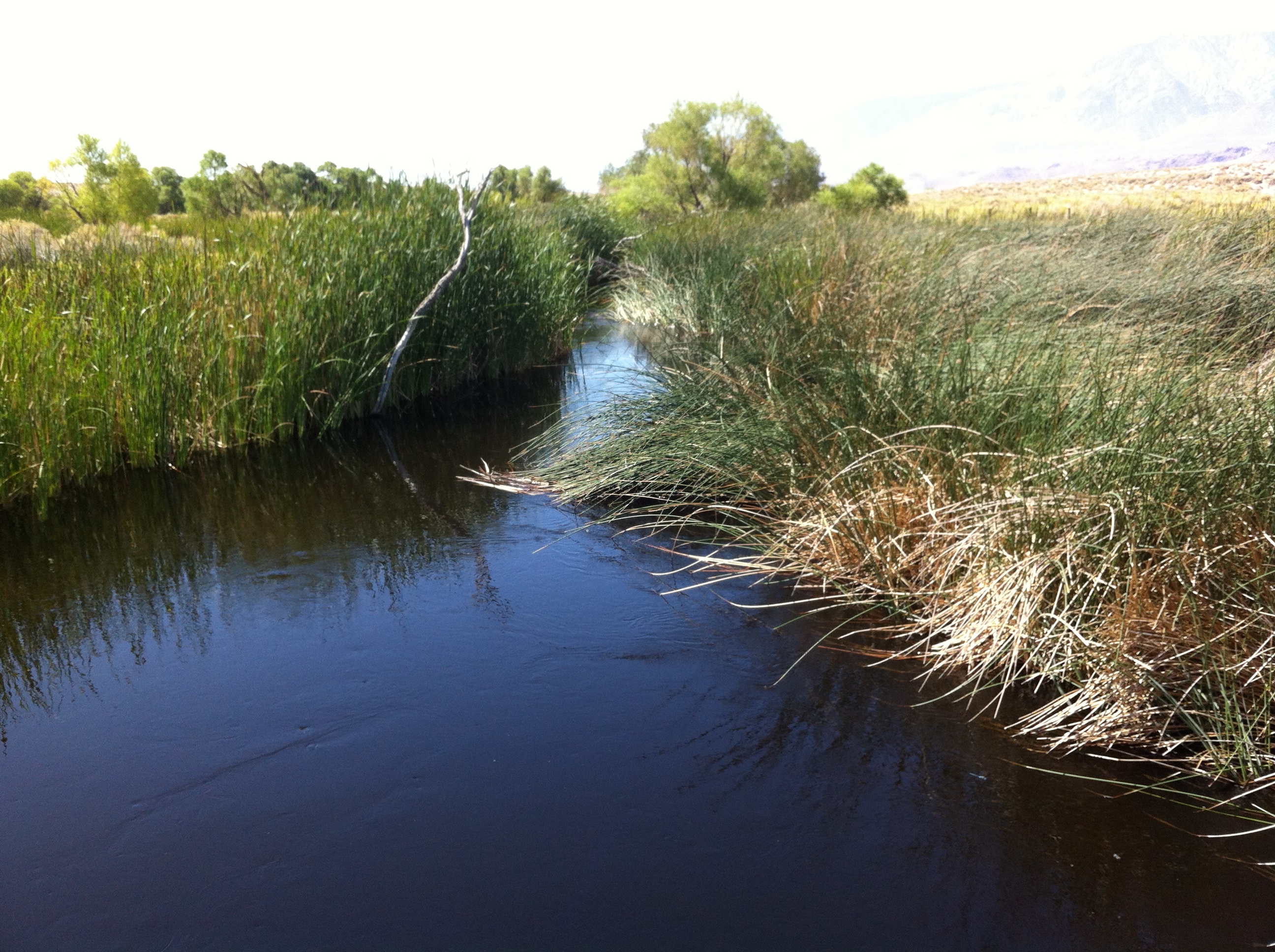
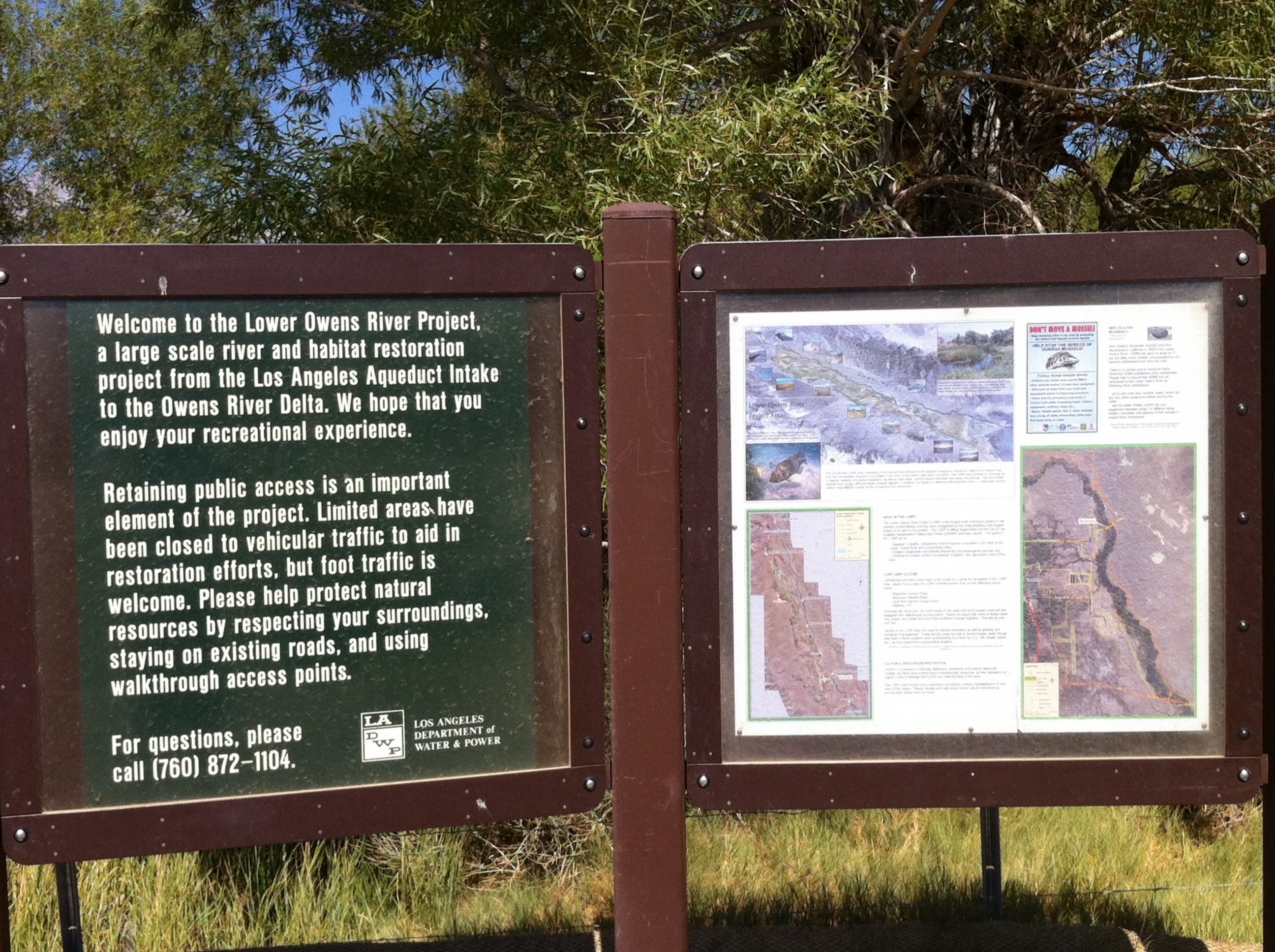
The Lower Owens River Project is all explained on these nifty signs, but that doesn’t help your cast through the tules. (Jim Burns)

Stoked by a warm-water fishing article that recently appeared in Cal Fly Fisher mag, my son and I stopped in Lone Pine over the weekend to check out the lower Owens. After all, I’d fished the ponds behind Bishop for bass and panfish, and this piece sang the praises of throwing a bass bug into the river’s hot summer waters.

After a two-minute ride from town we found, yes, more water flowed; the weather was unseasonably hot as blazes; and we did spot a good-sized bass near a bank.

But now for that all-important cast … bonk. Only the croak of an insistent bull frog kept us smiling.

The looming LORP problem for the fly fisherman remains terrible access. If you’re a tule, you’re really a happy camper surrounded by lots of your tule friends, but if you’re struggling through them, fly rod in hand, feet in the muck leading to where you might find the river’s edge, it’s just not so good. Casting? No way. The only casts we got in were right next to the road.

Last summer, reporter Louis Sagahun from the Los Angeles Times penned:

“The largest river restoration ever attempted in the West — intended to support a cornucopia of wildlife and outdoor activities — has left a 62-mile stretch of the Lower Owens so overrun with cattails, cane and bulrushes that it may take decades to bring them under control.”

Kind of gives a new meaning to “out in the tules,” doesn’t it? (Jim Burns)

He was writing about the Lower Owens River Project, LORP for short, that began about six years ago when L.A. Department of Water and Power began putting more water into the river that it had diverted to Los Angeles Aqueduct since 1913.

It’s a shame to have the restoration project in full swing, as evidenced by the nifty explanatory signage about the project and a new, shiny access gate, and not be able to fish. Anybody got a lawn mover?

I’d skip this one until there’s a solution, possibly like the disabled fishing platform on the ponds outside Bishop.

See you on the river, Jim Burns

Deep Creek can’t conquer the summer winds

HANDY MAP: The National Forest Service helps you to get oriented once you finally find Deep Creek. (Jim Burns)

UPDATE: Take Deep Creek off your fishing radar until the drought ends. You’ll find little water and few fish. Also, because this is a protected area, if the native fish die out, that will also be the end of this once beautiful water because it won’t be stocked. Don’t add to their stress by catching them.

Weather and fate are tied together.

Two winters ago, So. Cal. was literally awash in water, and so was Deep Creek, high in the mountains above San Bernardino. Those 18-plus inches helped to carry this once-cherry spot back to the near-top of many an anglers’ list. My last visit was May, 2011, which I chronicled here.

So wondering what our sub par rainfall for the year just ended (6.97 inches, June 30) did to the place, yesterday I jammed the hour and a half from my house to Lake Arrowhead, thinking that “lucky Monday” would apply, even in summer. Any fly fisher can tell you that Mondays are the best time to avoid all those other folks, some with waders on, lots without, who want to hike, swim, bike, laze, and generally cavort on our public lands. But sometimes that Monday luck runs out.

Sure enough,  on a hot, windy gust the “whhhhiiiiinnnneeee” sound of a dirt bike engine greeted me, as I managed to find a parking spot among the dozen cars and one RV at the end of the road. It was just shy of noon as I rolled down the windows, ate a home-packed lunch, then — because I’m an optimist — inaugurated my new waders, even though the mercury was fast approaching 90 degrees F.

Thusly cocooned, I trudged past a nice grandfather and family, boots feeling way too big and clumsy for the heat. From his lawn chair in the shade, he looked me up and down, saying, “You think there’s enough water to catch a trout?”  He quickly realized I was on my way in and didn’t have a clue.  I grimaced, hoping he hadn’t just inadvertently given me one.

After spending about four hours systematically working my way around the semi-circle of water that surround the Splinters Cabin, down to the beginning of the canyon, all I can say is, unfortunately,  Deep Creek’s done for the season. The water is fishable, true, but the fish are few, small and not ready to believe your newly tied midge is anything but a bunch of wire and fixings. Also, true, that on the last hole I lost a nice fish because I forgot that a log has two sides, and I was on the wrong one. Equally true, I fished a 7-weight leader for the little guys, which he easily broke with the log’s help.

For the rest of this long, hot summer, if you are more of an optimist than I, a party of three young guys who I think had just escaped from a scene in “Sucker Punch” told me that they’d spotted large fish much deeper in the canyon. I was done after losing the only good fish of the day, and didn’t follow their advice. Instead,  I stripped off the waders and had a great time splashing my bathing-suit way back to the car, almost as free as a child until “whhhhiiiiinnnneeee” again reached my ears on hot, gusts,  while I panted my way over the last hill.

From dirt, to pock-marked asphalt, to the mountain-lip-hugging Highway 18, I couldn’t shake that eerie sound memory of straining machine, amplified by the wind. Then, suddenly, my fear realized, I saw plumes of smoke rising hundreds of feet from the distant San Bernardino valley. Scattered orange cones closed the 18. I stopped in front of a CHPS officer who told me how to thread my way onto the 138, to connect with the 15, then home. Tiny Arrowhead-adjacent Crestline was under a voluntary evacuation. Officials would later dub the brush fire, “the Panorama Fire,” which has burned 75 acres as I write and is still burning.

As Henry Wadsworth Longfellow reminded us long ago, “through woods and mountain passes, the winds, like anthems, roll.”

See you on the river, Jim Burns

Bummed out at the Thienes Avenue Gateway

What’s wrong with this view? No fish on the line. (Jim Burns)

Hoping to find a new fly-fishing spot for readers of this space, as well as for moi, I ventured into unknown territory today — the San Gabriel River. Not the East Fork, nor the West Fork, but the actual river in El Monte, off Peck Road.

Locals told me about Thienes (pronounced “THE-na” by the peeps), that guys were hooking up there. So, anxious to do the same, I ventured over today, and got my hopes way up, because it’s such a beautiful spot right off the Emerald Necklace bike path that connects the Rio Hondo and San Gabriel cycling lanes within the San Gabriel Valley. I mean, this could be urban fishing at its finest: safe place to park your cark; painted totems to greet you; an ornate gate; a spot that looks a bit like a bus shelter for respite from the sun; a smoothly paved bike lane; and then the pristine river.

You can cast into the water as far as you can muster it, from one long walkway that separates two sections of the river. Believe me, if you’re practicing your cast, I’d much rather do it here than any casting pond I’ve been to. Also, people were really friendly.

Only one problem: I got skunked, using a 5 weight overstrung with a 6-weight line, Globugs and a red San Juan worm. Did I wish I’d brought a Woolly Bugger? Oh, yeah. I could see hundreds and hundreds of fry swimming around, and there appeared to be excellent habitat for game fish — reeds, water shaded by trees, even a waterfall. But — zippo, at least for today.

Thienes Park features a beautifully crafted entrance gate. (Jim Burns

So, for those of you who already know this spot, please share the wealth. Next time, I’d like to have a fish on.

See you on the water, Jim Burns

Visit North Atwater Creek Pocket Park (if you can find it …)

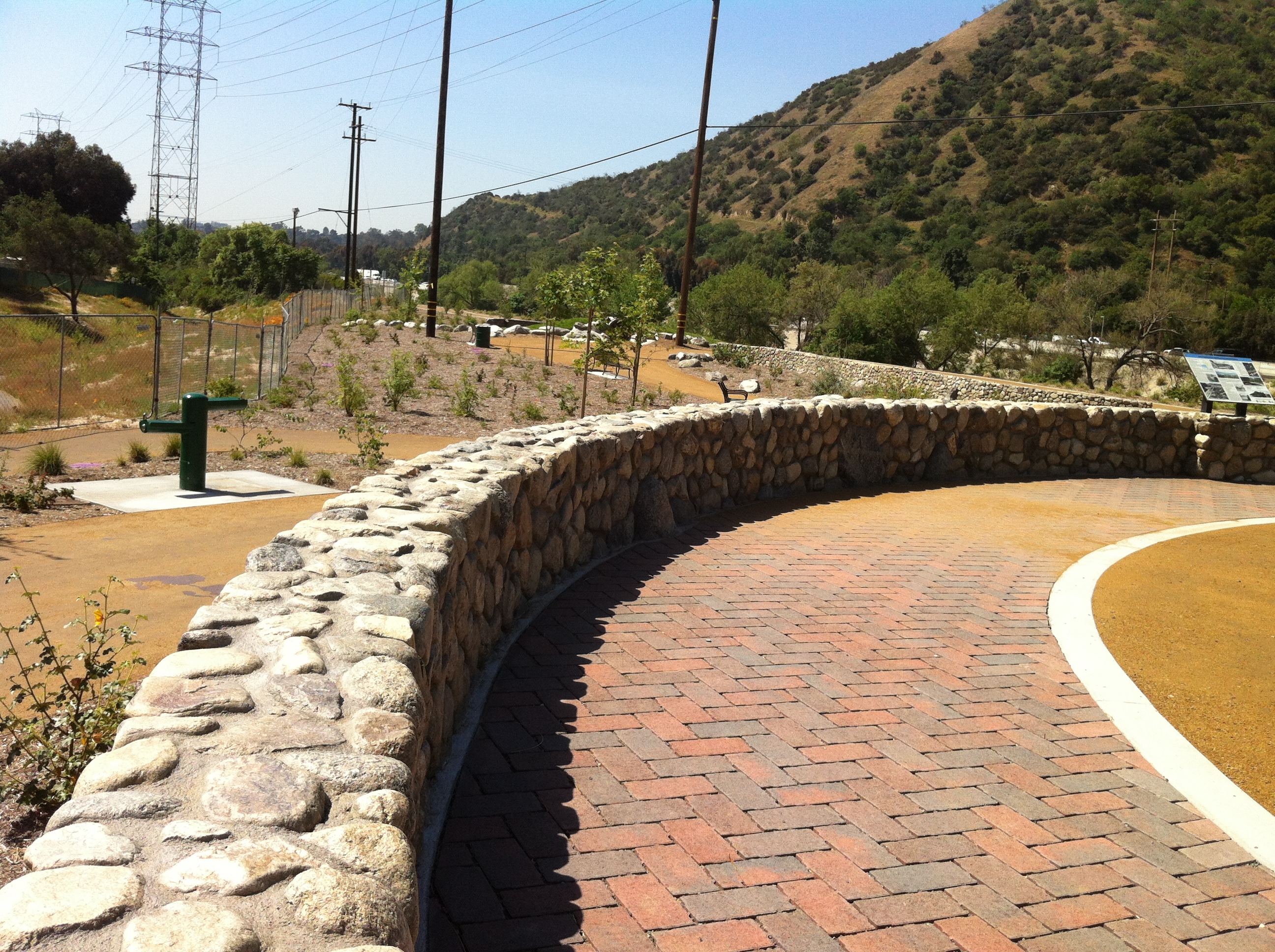
Bird’s eye view: Inside a storm drain, safe for kids, one of the many improvements made at the North Atwater Creek Pocket Park. (Jim Burns)

When I first began exploring the L.A. River, problem No. 1 was finding it. My son and I encountered lots of barbed wire fences, dead-end big box parking lots, and industrial parks, all situated basically on the river, and all with no access granted. That was two years ago, and even though I now have my favs that get us to the carp, the river is basically an insider’s secret.

So, too, are the pocket parks scattered around its concrete banks. The first time I heard about the Yoga Pocket Park in Atwater Village, I thought someone was pulling my downward dog-facing legs … not so. The originators of this tiny green space — I believe the lead was Northwest Trees, but can’t swear to it — were afraid that a more traditional exercise park, based on stations for strenuous physical exercise, would bring gangs.

Today, walking north from the golf course in Atwater Village, through Steelhead Park (another hard-to-find spot, but from the golf course parking lot, head toward the freeway and you’ll see it), you’ll see North Atwater Creek Pocket Park after about 10 minutes of hoofing. Check out the waters here as well …

Open for about eight weeks, the park shows what the river will eventually become: neighborhoods connected instead of rejected; green grass instead of broken asphalt; good vibes instead of creepy. Take a look at the pics below to get a feeling for the place. And, fishermen, there’s a working water fountain, in case you’re thirsty.

This beautiful natural wall and brick work pull your eye toward Griffith Park. (Jim Burns)

Was it worth the $4 million that came primarily, according to city info, from the settlement of two Clean Water Act enforcement actions? Yes, yes, it was. Bring your rod and check it out. And if you have kids, bring them as well.

See you on the river, Jim Burns

Which is your fav, the West or East Fork of the San Gabriel River?

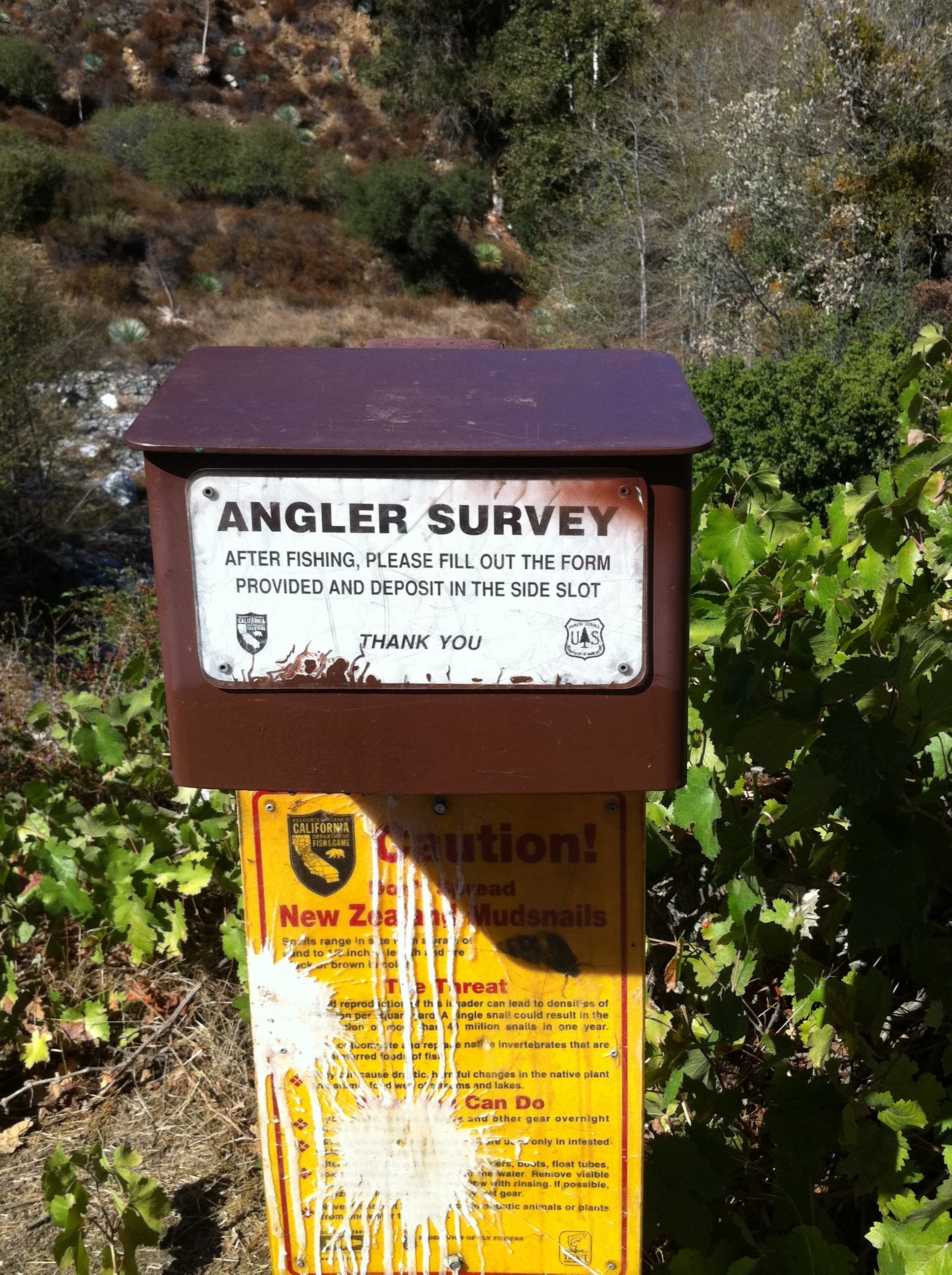
Got Fish? You want to have caught plenty before filling out the survey. (Jim Burns)

Spurred on by an article in the current California Fly Fisher magazine, I spent most of Friday hiking and fishing on the East Fork of the San Gabriel River. Richard Alden Bean’s enticing article made me do it.

“The East Fork is a truly wild river in its upper sections and has recently been added to both the Wild Trout Program and the Heritage Trout Program of the California Department of Fish and Game,” he wrote.

This was good news, if for no other reason than I’ve got a golden trout and squat else toward my plaque. As the DFG website says, “By catching six different forms of California native trout from their historic drainages and photographing these fish you can receive a colorful, personalized certificate featuring the art of renowned fish illustrator Joseph Tomelleri.”  Your specific prey, according to Bean, is the coastal rainbow trout.

But …

First off, I loathe Friday, Saturday and Sunday fishing in the San Gabes, because what you end up with is people, people and more people. You’ve got your hikers, your waders, your drinkers; you’ve got your families with young children and water-wading dogs trying to help a fisherman by pointing at the one fish in the pool before pawing at the splash. I mean I’m very happy all sorts of different folks use the water on the weekends … just not so happy to be confined to using it with them, due to that little thing called making money (Remember the adage, “You’ve either got time, or money.”).

Long story short, I got Friday-skunked on the East Fork, and it’s never a fun feeling. As I tramped out near dusk, I vowed to come back soonest, but I wonder if readers of this blog wouldn’t share some inspiration in the meantime.

Which is your favorite fork?

Don't you just hate getting skunked? (Jim Burns)

Do you prefer the West with its accessible bike path and easy downhill ride back to the parking lot? Its fishable access ramps?

Or, do you like the East Fork, known for its pack-station appeal, and winding path to the fabled “Bridge to Nowhere”?

See you on the river, Jim Burns


Fly fishing for the first time in the San Gabriel Mountains

I was in a mope when I hiked down the canyon trail for some Friday afternoon fishing. No doubt about it, a mope, plain and simple. As I descended, feet feeling enervated, annoyed by the insistent biting flies, I forced a smile at those returning from the water, all bathing suits and youthful laughter, all optimism and camaraderie. Some would say “hi,” others would look up at me shyly, maybe not knowing if they should speak first. But I would have none of it. I felt old and alone. Like I said, a mope, or as Winston Churchill famously called his depressed moods, “the black dog.”

Local high school students Tommy, left, and Charles fly fish for the first time (Jim Burns).

Where was my best fishing buddy? I asked the trees, bitterly (he moved north and we’ve since stopped talking)

Where was my best fishing dog? (died of cancer this summer)

Where was the general fun in life at all, the life I’ve always so enjoyed?

With these dark thoughts swirling like threatening ravens among the trees,  I barely heard the footsteps behind me.

“Oh great, some more happy people,” I muttered, not looking around.

And so separated by perhaps two dozen yards, the three of us walked down the rock-strewn trail, me in the lead, the other two out of sight, but thudding along behind.

We were all going to the same place, which irritated me all the more. After all, if you can’t be nice to the ones leaving your refuge, how could you possibly be chatty with those who are invading it?

And — inevitably –when we all stopped together under the shade canopy of a dozen thick trees, the blazing summer light turning to smokey lounge, one of them asked the question.

“Hey, are you fishing down here?”

The teen couldn’t have been more than 16, a big, overgrown kid, like a pup tripping over his own paws.

About to answer, trying to at least be civil, suddenly his friend came along, holding an ocean pole, looming over the trail, about to be hung up on every tree, bush and snagging obstacle. He looked at me, embarrassed, spying all the junk on my vest — the thermometer, the nail nippers, the golden hemostat — and my four-piece fly rod that I’d yet to attach.

“Kinda big for down here,” he mumbled. “We were just looking for something to do.”

My tight lips relaxed. I thought how silly it is to be a middle-aged man, thinking middle-aged thoughts, when life flows each day with such unstoppable exuberance. Still reluctant, I couldn’t help but half-smile.

As we walked on, past an ornery barking dog protecting his master’s property by the side of the creek, I really wondered if I would share the spots I’ve found over these past several months. After all, it’s called “hot spotting” for a reason: your fantastic fishing hole from last month is now dead as a bat because some yahoo has fished it out.

Watching them navigate the path, I suspected these high schoolers would most probably do exactly that. But the sight of that out-of-place pole, and their faces, which it would be a cliché to call “shiny,” spoke otherwise.

And as we walked and chatted, a wonderful thing happened: I came back to myself.

Check out the red cheek on this trout from the San Gabes. (Jim Burns)

Soon, I’d tied a double surgeon’s knot to secure a length of super-skinny tippet to their tuna-tugging line. And I’d gifted them with a tiny bead-head nymph, the kind I knew the trout here loved to chase.

By afternoon’s end, Tommy, the bigger of the two, was learning how to cast a fly line. From the way he finessed my fly rod, I could easily squint my eyes and see an excellent fisherman down the road. And the smiling Charles caught a trout, only to release it back into the water on his own, no coaching from yours truly.

“It’s great down here,” Charles said, ” but people trash it.”

“Yes, they do,” I replied, as Tommy put some of it in my vest.

I left before them, but walking back up the trail, I thought maybe I should have stayed to guide them up. After all it does split confusingly at places, and Tommy had related the story about how their first outing here ended with getting lost and rangers having to come in after the gates closed.

Gut check … go back? I’d left to get some quiet time for myself, but also to give them time to be together without an adult around.

After puffing up the side of the canyon for 30 minutes, I sat in my car, wondering. After a time, I thought maybe I’d take a quick run back down … hadn’t they said they had to be back by twilight?

Then Charles popped into view, carrying that big tuna pole. Anxiety relieved. We both smiled and waved, and I wondered if Tommy would indeed talk his dad into doing some fly pole shopping before they headed out to Waterman the next day.

This life we have. This precious life we share with others.

See you on the river, Jim Burns


The Sweet Spot: Flickin’ dries on the West Fork

Maybe it was reading a hopeful headline in the Pasadena Star News, “San Gabriel River gets good grade despite signs of stress,” penned by our buddy Steve Scauzillo, that got me back to the West Fork. Even though the water lies a mere 25 miles from my house, I rarely find myself there. I think I got scared off by a lawsuit that stopped the Dept. of Fish and Game from stocking it some years back.

Licensed to fish: In 1929, wasn't there a Depression going on, just like this one? (Courtesy Drexel Grapevine Antiques)

Anyway, kicking around online, I found this document from DFG in 2008:

“The West Fork of the San Gabriel River supports the most important coldwater fishery

in Los Angeles County. It sustains a catch and release and special-regulations-only

fishery in the upper section and a put-and-take fishery in the lower portion. It also is

home to the federally threatened Santa Ana sucker, two fish species of special concern

(speckled dace and the arroyo chub) and a population of western pond turtles (also a

special concern species).

The fisheries habitat provided by the West Fork of the San Gabriel River has been

degraded by flood control activities, overuse by the recreating public and major

wildfires.”

Not sure about the stocking lawsuit, but this pretty much sums it up. Traveling up Highway 39 from Azusa, you’ll spot the parking lot. There are actually two, the lower favored by fly fishers and mountain bikers. For those unfamiliar with the water, it’s catch and release only, past the second bridge, about two miles from the parking lot up the paved service road toward Cogswell Dam, which rules the top of the water, about six miles up.

The first mile or so spells summer fun for lots of kids and their parents, who splash away the heat in the river’s pools and eddies. It’s noisy and very urban, with occasional graffiti and homies. There’s also a very low consciousness about garbage, even with a huge dumpster right there. If you go, be a nice person, pitch in and pull out what others toss.

First spot to try is Bear Creek, one mile up. It can be fun, as can the rest of the sections, past the fishing ramps for our disabled brethren that lie farther up.

The flow was fast and springlike, except directly after the second bridge, which sputtered like typical hot, lackluster water. Small black flies were annoying as hell, a trademark of West Fork in summer. The trout were taking small dries such as Parachute Adams, as well as small nymphs, like a prince, or yummy midges, like the zebra. Don’t expect bigger trout, but also don’t expect to catch only minnows. Little browns are in there. Bring your lightest, shortest rod, some 7x tippet, bug spray, a decent hat, sunglasses, sunscreen, and a bike, if you’ve got one. The best part of the West Fork may just be the glide down after a day’s fishing. You’ll hardly touch the pedals.

Anyway, the point of this rambling entry really has little to do with fishing, but rather with antique fishing licenses. As I wrapped up the day near Bear Creek, a fully outfitted fly fisher appeared who I thought might be a ranger. He gave me the Emporer’s sign, and I signed back, “thumbs up,” and suggested he come down to the water to work a pool.

His name was Steve, I think, and he hailed from Simi Valley. He comes every week to the West Fork. As we talked about the heartbreak of Mammoth Lakes— a fishery that many will agree seems to decline a bit more every year — I noticed his many fishing licenses, mostly from back East. Looking more closely, I noticed most of the dates were from the middle of the last century.

Antique fishing licenses! Because I’ve lived a sheltered life, I’d never seen one of these before, and now I absolutely must start collecting. More snooping on the Web revealed Drexel Grapevine Antiques, in Valdese, N.C. Like everyone who’s ever read the Curtis Creek Manifesto knows, one of the best parts of fly fishing is in the characters you meet along the water.

See you on the river, Jim Burns

It’s a hike to Arroyo Seco’s Brown Mountain Dam

UPDATE: “Damnation” is a documentary well worth watching.

I’ve been working on a complicated piece this summer that, frankly, I’ll be happy to send in to the editor next week. It’s about Southern California steelhead. That alone may come as a shock to some readers of this space — not that I’m working on it, but that there actually is such a fish in our Mediterranean clime.

Dating from 1943, it’s fair to ask what purpose this federal dam serves today (Jim Burns).

When I think of the mighty steelhead, I envision surging rivers somewhere in the Northwest, and rain-soaked attempts by dogged casters to get a strike, as these powerful giants return from the ocean to spawn in fresh water. Unlike salmon that spawn and die, a steelhead may make more than one trip to the ocean and back to its native waters. Because it covers so many miles, the fish is known as an “umbrella” species, whose health can either augur well or poorly for the rest of us. Steelhead made the Endangered Species List in 1997, and the status was reaffirmed in 2006, according to the National Marine Fisheries Service.

In pursuit of the truth about the viability of this species here in So. Cal., I’ve spent time with city officials, the Army Corps of Engineers, environmentalists of varied stripes, biologists and just plain everyday folks who love to fish.

All of them agree that one of the literal obstacles to getting steelhead off the list is dams that stop them from returning to their native habitats to spawn.  I wanted to see for myself what one of these dams looked like. My wife agreed, and so we walked upstream yesterday in the July heat from Jet Propulsion Laboratory about four miles to Brown Mountain Dam.

Googling any topic can be deceiving, and so it was with our sojourn. No one in Pasadena needs to be reminded of the horrific Station Fire that took firemen’s lives, burned homes and ruined habitat two years ago. From reading, we expected our hike to be grim: lots of lunar landscapes, dead trees and squashed hopes. Not so.

Yes, there were dead trees. And, yes, there were large debris flows along the modest flow of the upper Arroyo Seco, all the way to the dam. But, there were also marvelous live oak canopies, wildflowers, cacti, blooming yuccas, calling birds, annoying insects. The Station Fire was devastating, but it hasn’t robbed us completely of this splendid natural respite.

Fish, however, were another matter. I spent unscientific time tossing rocks into likely holes, and even nymphed riffles and edges for a bit. If there are still fish, they were taking a long nap. This is particularly bad news as native rainbow trout (actually any rainbow trout) under the right conditions can become a steelhead. And there is a lot of work going into various plans to recover this species — in the Los Angeles River watershed.

Back to the dam. You’ve got to ask yourself, why, with the county ready to pour some $32 million into dredging and dumping the area above Devils’ Gate Dam, this little gem goes unnoticed. If I were a good reporter, I would have already asked an engineer how many tons of sediment lie behind Brown Mountain, just waiting to foul the county’s efforts if, God forbid, we have an earthquake of sufficient magnitude to bring the thing down.

Walking around its structure made me wonder aloud if the idea behind this dam was to slow the notoriously fast flow of winter storm water down the canyon. From my layman’s perspective, it’s a long way down those four miles to the flood plain alongside JPL. Couldn’t we allow it to return to its original state?

If nothing else, a walk up the Arroyo Seco should cure anyone of doubts about removing our channelized monstrosity of flood control to return our streams and rivers to the way they were.

See you on the river, Jim Burns

The Sweet Spot: The Gorge

The catch-and-release section of Rush Creek remains a no-go in early summer, unless the water flows change. (Jim Burns).

How’s the old Sam Cooke song go?

“It’s summertime and the livin’ is easy,

Fish are jumpin’ and the cotton is high.”

Jumpin’, that is, everywhere except the eastern Sierra.

Who’s to blame for this atrocity?

Every summer, Bishop, Mammoth Lakes and environs are overrun with bait and fly fishermen, who want to catch as many naturals and plants as possible, from opening day in late April, until season’s end, Nov. 15. You’ll see them wade, float and paddle in the area’s lakes, rivers, streams and private waters. You’ll see them buying up as many worms, dry flies, nymphs and streamers as the sports and fly shops can carry. New expensive rods sell; flashy reels fly off the shelves; tippet and leaders; hemostats and non-felt-bottom boots. Bammo! It’s usually an injection of debit cards and cash for the summer economy.

So this year who’s to blame for fishing that can only be described by this writer as mediocre? That’s after three days on water from the C/R area of Rush Creek, to Hot Creek, to the C/R lower Owens.

Well, here’s the sad truch: It’s not actually who’s to blame, but what.

And that what is Mother Nature.

After a snowpack that was the best in years — 199 percent of normal — and a cool spring, the Tioga Pass, which connects Highway 395 to Yosemite’s eastern gate, finally opened Saturday, June 18. According to the Mammoth Times, Tuolumne Meadows still has a summer blanket of several feet of snow. Rivers are running at ridiculous levels. Maybe some visiting Hollywood producer will make a disaster movie about it in the vein of “2012.”

I mean when’s the last time a guide actually refunded your trip deposit, rather than take you out? It just happened to me.

My son and I watched the white caps on Hot Creek as the water tore through that wind-beaten canyon. You read that correctly — white caps.

So, if you’re headed up for your annual Sierra fix, better check the cfs numbers carefully. The same guide told me he didn’t expect normal flows until August. According to him, last year, which also had unusually heavy snowfall, July was the magical month.

Aside from private waters not affected by the torrent of water coming off the mountains, if you must fish (and if you’re like me, you must), try The Gorge, north of Bishop, off Highway 395. Any fly shop can give you exact directions.

The Browns can be sweet in The Gorge, but you'll work to get down there. (Jim Burns)

Two cautions: it is hot as blazes — expect the high 90s or more — and an unfriendly plant called stinging nettle certainly will make you miserable if you brush against it. Access to the water is down a long, steep, gated road, which means you have to have something left in the tank for the 25-minute or so trudge back up. Long pants, yes; extra water, please, and sunscreen (try the new spray-on from Trader Joe’s. Good stuff.)

Even with the moderate water flows, fishing The Gorge is tough. We managed to catch several browns in several hours; the lengths were more Southern California average than the monsters you’ll find on any local fly fishing Web site. Much as I hate to write this, I probably wouldn’t do it again this season.

As the world’s most honest guide said to me as I signed for my refund, “You fellas are just here at the wrong time, hell, wrong season.”

Which is great news for thirsty Los Angeles after a string of drought years.

See you on the river, Jim Burns