The bad: The prospect of extinction may seem unduly pessimistic to some, but the Aquarium of the Pacific in Long Beach announced recently that it had acquired 1,200 delta smelt from a UC Davis research hatchery. (Los Angeles Times)
The ugly: Hawaii’s Waikiki Beach could soon be underwater, as rising sea levels caused by climate change overtake its white sand beaches and bustling streets, AP reports:
Honolulu will start experiencing frequent flooding within the next 15 to 20 years, officials predict.
State lawmakers are considering spending millions for a coastline protection program aimed at defending the city from regular tidal inundations. (Axios)
The use of market forces to fight Asian carp may be taking a hard turn. By turning the fish into concrete.
For several years, companies in the mid-Mississippi River valley have been buying and processing the fish, largely for the Chinese market. To expand the market and get more anglers interested in fishing for them, civil engineer James Nobles developed a way to use by-products from processing as an ingredient in concrete.
“The main thing is to make (carp-crete) profitable for the fishermen so we can bring more people in to catch these fish and get them out of this lake,” said Western Kentucky marina operator Wayne Breedlove, who hosted a pour of “carp-crete” this week, covered by Laurel Black of The Paducah Sun. “It’s getting to the point where it’s dangerous for these boaters.”
“Asian carp pose a threat to the $1.2 billion fishing and recreational boating industries in Western Kentucky, and are wreaking similar havoc in Tennessee,” Black notes. “The carp consume forage that popular species, like bass, rely on to survive, and one species is known to jump out of the water when startled, potentially causing injury to boaters. If carp-crete proves successful, it would help make catching Asian carp more lucrative for commercial fishermen. Commercial harvesting is the best way to manage the Asian carp population, according to the Tennessee Wildlife Resources Agency.”
Breedlove told Black that cost has proven to be carp-crete’s only drawback so far. “The carp ash for the carp-crete was produced in Southern Illinois, which is also testing the product,” she reports.
Scientists estimate about 1 billion painted lady butterflies are currently flying north from the Mexican desert to reach breeding grounds in Oregon. (Courtesy Yale University)
The beginning of the week, I was stuck trying to make a morning left turn when I saw lots of smudges floating in the distance. Fire? I thought, while the light turned red once again. As I waited for my next chance to turn, the smudges turned into — butterflies, dozens and dozens flew past my windshield, being pushed skyward by the oncoming traffic. It was an amazing sight and I’m sure you’ve shared a similar one if you live here.
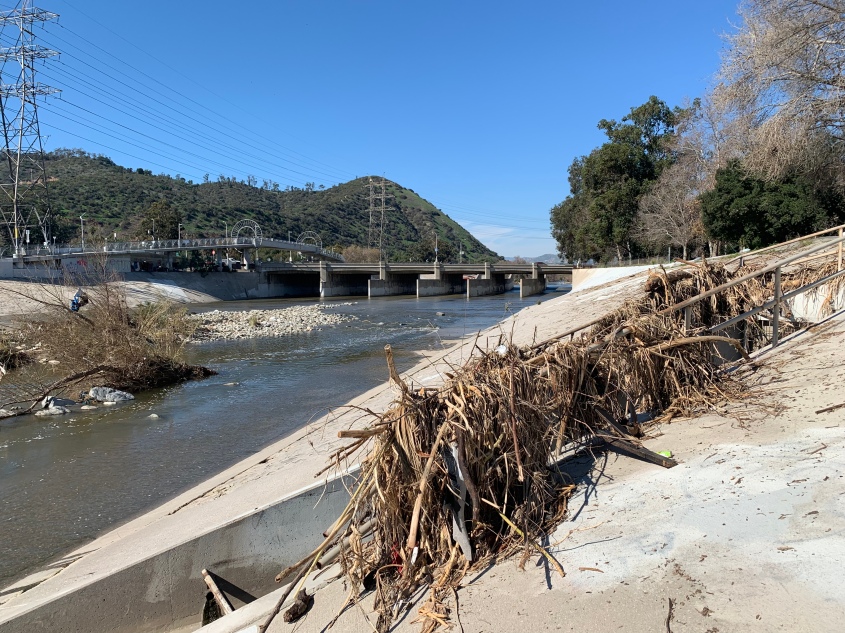
Thanks for these dramatic video images of the Los Feliz and Sunnynook areas from Trout Unlimited’s Bob Blankenship and stills from Pasadena Cast Club’s Steve Kuchenski. If you ever needed a reminder to stay away from the LA River during storms, this is it!
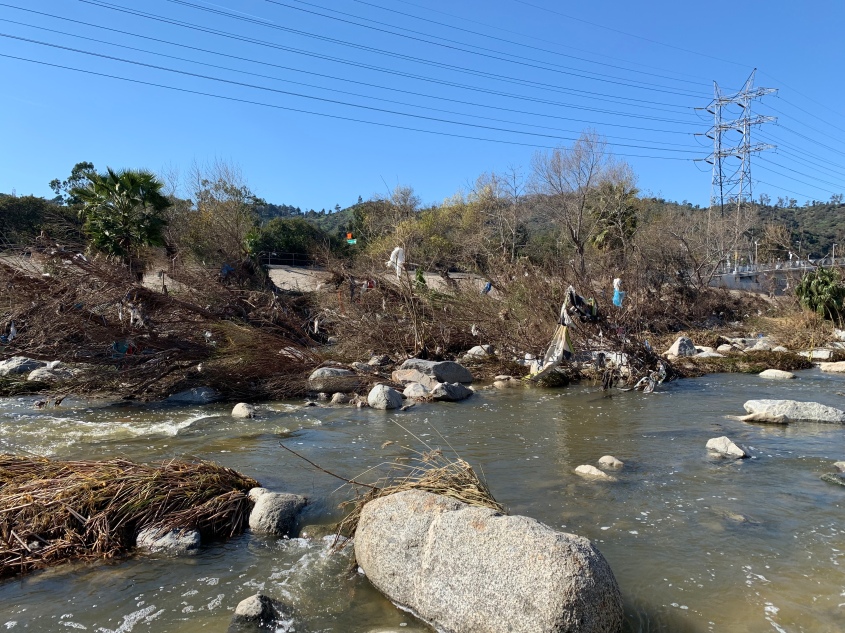
THE STORM’S aftermath shows debris halfway up the wall where the water crested. Note, this is the same area as in the video above! (Courtesy Steve Kuchenski)TIME FOR another river clean up, with more storms on their way. (Courtesy Steve Kuchenski)
Even after the rain stopped falling Wednesday, the pedestrian bridge pilings in Atwater Village cause a mean curl. Because the LA River has little-to-no permanent structure, expect your favorite fishing spot to be radically changed for your next visit. (Courtesy Robert Blankenship)
More than 1,000 fish died in Malibu Lagoon last week from what scientists suspect was higher-than-average water temperature. (Courtesy #follownews)
More than 1,000 fish, mostly mullets, were discovered last week floating dead in Malibu Lagoon, according to the Los Angeles Times.
Fish die-offs have been widely reported this summer in Florida and the Gulf Coast due to a persistent red algae bloom. Our own die-off in Malibu Lagoon occurred because of high-than-average water temperatures, at least that’s the suspicion of state park scientists.
Scientists also blame hotter-than-average ocean temperatures for the Southland’s muggy conditions this summer. Temperatures have been recorded around 80 degrees F.
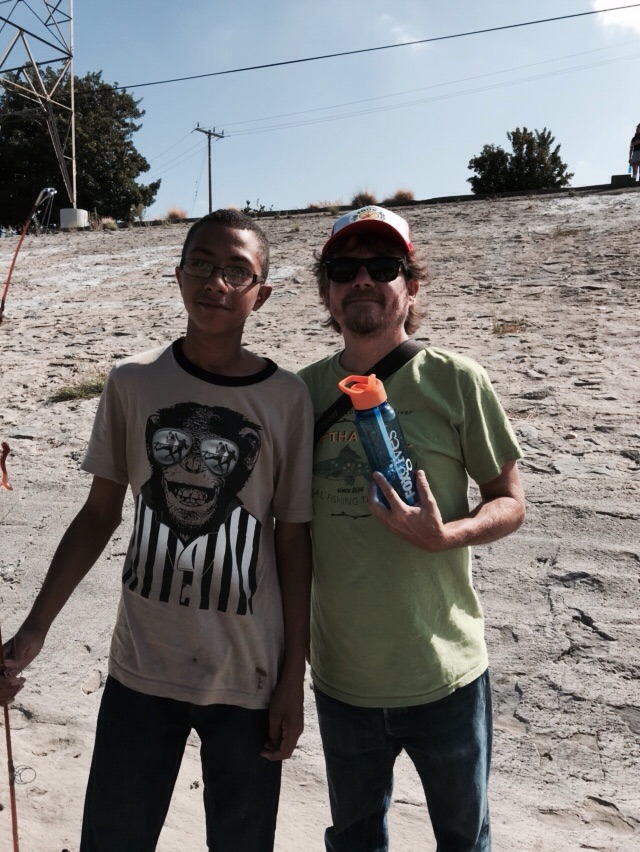
ONE OF 2015’S WINNERS Issaih Salgado, then-15, of Palmdale (left) hangs with event organizer Bill Bowling. (Jim Burns)
And now for some gloom-free news: For all of you who have sorely missed FoLAR’s “Off Tha Hook” fishing throwback on the LA River, rejoice:
Trout Unlimited’s South Coast Chapter, based in OC, has been awarded a $20,000 grant from the California Department of Fish and Wildlife to provide instruction, equipment, and support for local families to participate in a series of fishing outings on the Los Angeles River this year, according to the TU website.
The funding for this grant comes from the George H. W. Bush Vamos a Pescar Education Fund administered by the Recreational Boating and Fishing Foundation. The Vamos a Pescar initiative is focused on engaging Hispanic families in fishing, boating, and conservation activities.
As a consultant on “Off Tha Hook,” I’m super excited kids will once again have a structured way to engage our river and catch the passion we all love. My favorite memories of the three fishing throwback years were of kids — kids rushing down the rip-rap to get to the water; kids learning how to knot a hook on a line; kids wondering where in the heck all the fish went; and — blam — kids hooking up on possibly the first fish of their young lives.
TROUT UNLIMITED’S Bob Blankenship meets the official greeter during the last “Off Tha Hook” in 2016. (Jim Burns).
As TU chapter president Robert Blankenship, who was instrumental in “Off Tha Hook” along with FoLAR co-founder Lewis MacAdams and former all-star-staffer William Preston Bowling, said in that same post:
“In an increasingly wired world, fishing encourages Americans young and old to discover and connect with the nature around us, even in highly urbanized settings such as the greater Los Angeles area. This grant funding will allow us to introduce dozens of kids and adults to the wonders of fishing who may never have had such opportunity.”
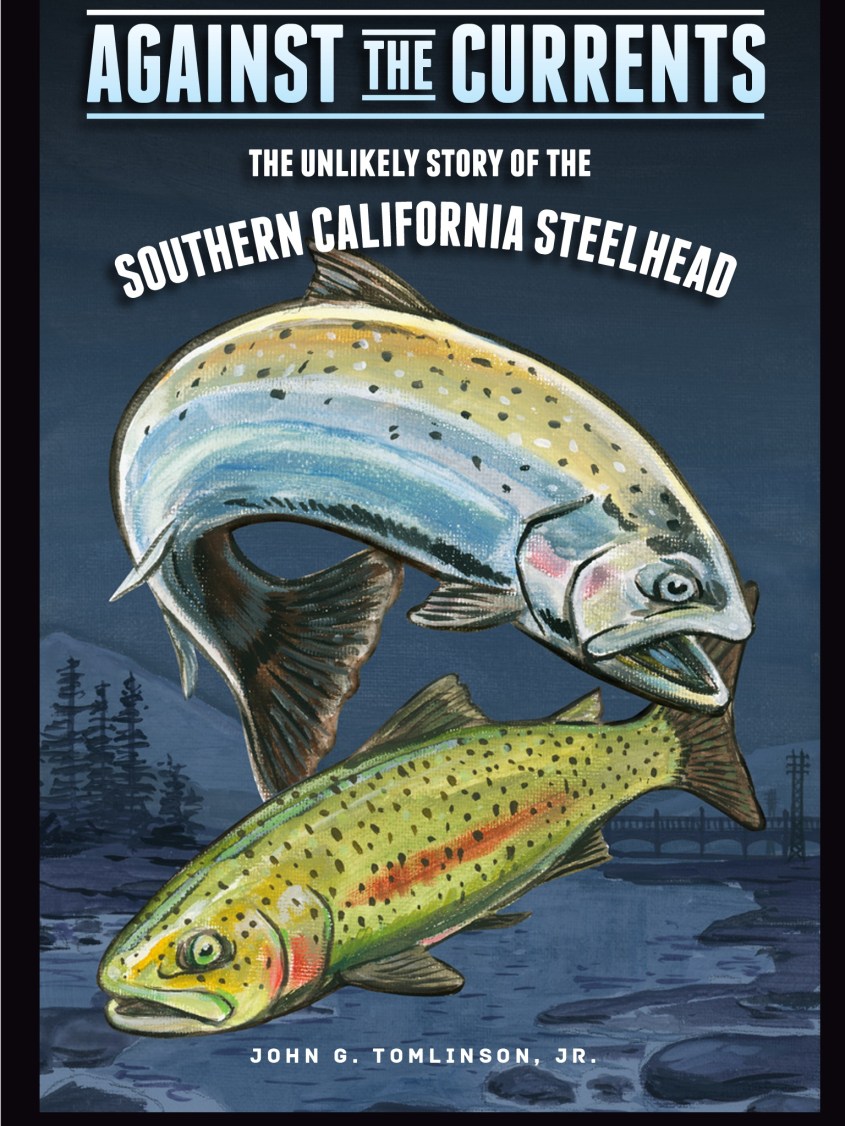
The first book published by Aquarium of the Pacific in Long Beach details the struggles of the endangered Southern California Steelhead. (Courtesy Aquarium of the Pacific)
Tim Brick, the foundation’s managing director, adds:
“We’re still look for trout, but the stream is below 1 cubic feet per second again. We need to identify the pools and resting spots where the trout are hiding. Probably Bear Canyon is the most likely spot. Anyone care to go on a trout scout adventure?”
Finally, to get a taste of what fishing used to be like here, I’m rerunning my 2014 review of historian Tom Tomlinson’s excellent book, ““Against the Currents: The Unlikely Story of the Southern California Steelhead” below.
***
If you think you’ve finished your summer reading list, stop! Consider one more book, please.
“Against the Current, The Unlikely Story of the Southern California Steelhead” could not, in truth, be a more unlikely tale. Author Tom Tomlinson takes the reader on an environmental roller coaster ride that matches our region’s boom-or-bust water supply, and throws in plenty of human Greek drama.
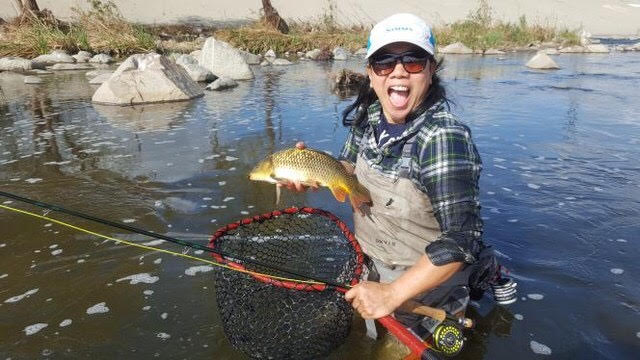
Beautiful color on this trout, which was released, unharmed, back to the water. (Jim Burns)
What just over a 100 years ago was a region so pristine that Easterners came here to mend their health, through hunting, fishing and soaking up the sunshine, quickly turned into what we have today. As someone who has lived here for over 30 years with no plans of leaving, I’m not complaining, but when you read this book and realize what it once was — especially if you enjoy fly fishing the San Gabes — well, get our your handkerchief.
Sob.
One fact to prime the tears: In the early 1900s, the then-equivalent of the California Dept. of Fish and Wildlife set the limit of fish taken at … 100. If you’ve ever put boots to dirt and fly to water in our mountains, this should give you a chill. Guests at the local fishing camps regularly hauled in lots of rainbows, and, yes, steelhead. And they hauled, and they hauled and they hauled. Think buffalo in the plains states.
How we got from those abundant fishy beginnings to where we are today is a story of good intentions gone to greed, it’s about that simple.
As for the steelhead once again taking center stage as we enter the Great Los Angeles River Rebuilding, well, this magnificent creature needs our help to get off the endangered species list.
When Congress approves the billion bucks for a river makeover early next year (Update: As of this writing three years later, the federal money hasn’t arrived), I hope every politician, every engineer and every investor gets a copy of this book. They should look up the section on one Henry O’Melveny, lawyer, fishing advocate, Creel Club founder, ice plant owner and, sadly, leader of the pack that done the natural inhabitants of our erratic rivers and streams in. Indeed, he is a figure as defining of Greek tragedy as Oedipus or Agamemnon.
Fast forward to today, and a mayor who is bringing in major bucks from Washington for the river as well as public transportation. I hope that Mayor Eric Garcetti reads this slim volume. It is the most compelling work to date on why the natural habitat can’t take a backseat to our own urban comfort zone. That story already happened.






 lariverflyfishing