

When you think about it, most of the conservation buzz for us anglers who deeply care about such things is farther away.
What I mean by that is for Angelenos, catching steelhead means climbing into the car to drive to the airport (because your good buddy wouldn’t think of taking you to LAX), then an airplane, flying to Sacramento or Redding, renting an automobile, hitting the Trinity, or the Klamath or the Rogue. It’s a simple fact of the fishing world. Big river fish are in wilder places.
For many years now, I’ve advocated that while hoisting a chrome is certainly a sign that God loves us, fishing locally isn’t to be forgotten. Stalking the San Gabes in search of wild trout is such a thrill. And if you want to fish locally, you need to have a place in which to do it. All you trash pickers in the San Gabriel Mountains National Monument, all you stubborn advocates of the LA, I love you for all the volunteer hours you’ve put in!
Which brings us to the “taking care of what ya got” part of this story. The clever title of this book, “Rewilding the Urban Frontier: River Conservation in the Anthropocene,” uses two current catchphrases in turn. “Rewilding” is defined as “a conservation approach that involves restoring large areas of nature to their natural state.”
How would that truly apply to the Los Angeles River? I doubt the city, nor its homeowners, renters and visitors, would like to wake up one morning to find the LA was once again slipping its course. Flooding, after all, is how our river became encased in concrete and what gave the Flood Control folks an iron grip over conservation efforts.
Back in the day the river’s course could meander over several miles within its alluvial flood plane. So actually “rewilding” the LA? Not gonna happen.
Still, we’ve all waited patiently (and not so much so) for the Army Corps to make good on its promise to at least naturalizing a section of the river near downtown sculpting it to a more natural state, to bring back cooler water temps, shade and more fish-friendly environs. And watch this space for an upcoming article in American Fly Fishing about Trout Unlimited South Coast Chapter’s efforts in the lower river.
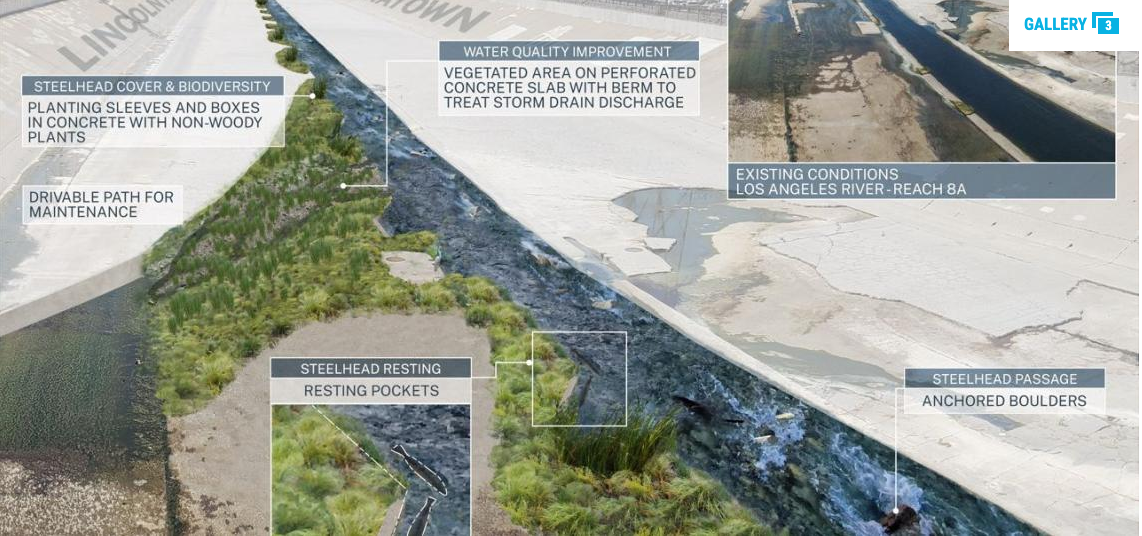
For all the money spent, actual “rewilding” is a misnomer. Many scientists, activists, politicians, and good hearts have tried to make things better for years, and maybe that’s enough. To my mind, a wildlife corridor, though essential, is not rewilding.
Of the word “anthropocene,” there can be no doubt that we live in an age in which the human hand has touched just about everything on Earth. The thing I find tricky about this definition, “the proposed name for a geological epoch following the Holocene, dating from the commencement of significant human impact on Earth up to the present day,” is precisely that it advocates for a geological epoch. Isn’t it a bit fanciful to include human activity as creating a geological epoch? Climate change, yes, leading to increased heat and wildfires, certainly, but to me geologic means something more.
Pegging efforts to the 1972 Clean Water Act, which acted as a catalyst for water clean ups during an era of both budding environmental awareness and explosive urban growth, the book tackles two separate tracks: ideas about preventing further loss of biodiversity; and conversations about environmental and social inequities.
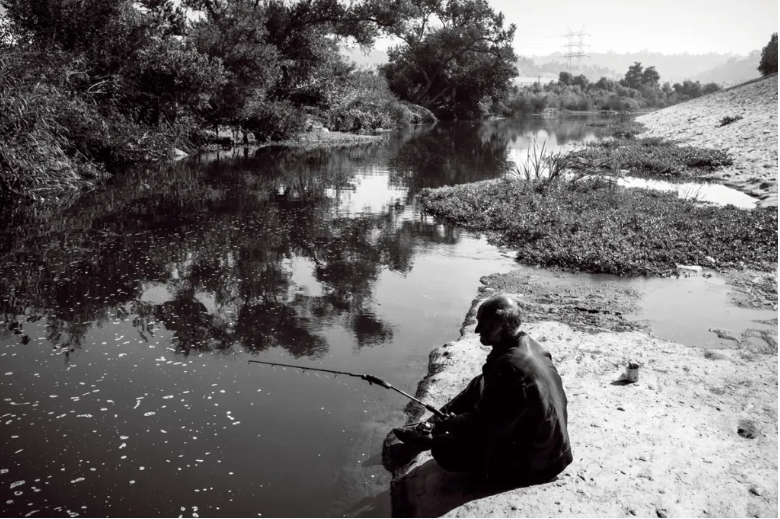
Brian B. Rasmussen, a professor at Cal Lutheran, wrote the Los Angeles chapter. He contacted me a few years ago and we had a nice chat about all things “riverly” as we used to say. My thoughts are included in his chapter, which dwells mainly on the inequities of the “white river” and the “minoritized river,” in other words “fishing for fun, not food.” The lens through which he views the LA is certainly worth a read, especially for its history of carp and how they got here. The name of his chapter, after all, is “Angling in the Anthropocene: Carp and the Making of Race on the Los Angeles River.” A feature on the homeless fishing for food came out a couple of years ago in High Country News.
Finally, if you’re interested in this topic, Gonzaga Climate Institute will host a YouTube conversation with the book’s editor and some of the contributors on Tuesday, Oct. 22.
See you on the river, Jim Burns
 lariverflyfishing
9-7-24
Jim,
As always, I appreciate your involvement. I have no great hopes that the LA River will be what we desire it to be, the wildlife corridor for the Southern Steelhead, but there are reasons for my concern.
Last week I was on the West Walker in the Sonora Pass Region, and found it to be highly pressured in the common areas. I caught dinks in that river, but surprisingly, The Little Walker was yielding 14″ trout with apparent ease. I say apparent because the fish were plentiful, but a 14″ ‘Bow plays with a glass 2 weight like it’s a cardboard matchstick. I decided to fish the same section when I was leaving, a day later with a 5 weight, and parked at the access point where I had been fishing. There, was a guy with his YouTube camera and a handheld line with multiple hooks on it. He had just spent his morning catching and keeping everything I had released the day before. He was immensely proud of himself… no shame for clearing out the 300 yards I had fished just about 36 hour earlier. I figured there was no way he could have picked every fish out of there. I was wrong. It was the Friday before the holiday weekend. He took everyone’s fun from them for his YouTube Channel. I was so upset, that I did not fish the rest of the day on the way back down to Bishop for our evening stay before driving home on Saturday. Frankly, I was incensed. I mean, he was entitled to a five fish limit, but I am fairly confident there were more than 5 fresh fish in his cooler that morning. I regret not taking down his license plate. In any case, the fishery will rebound, but I feel like it will be a half-mile walk next time and not a quarter-mile walk to have a chance at some decent ‘bows. Let’s just say he was an ESL person and leave it at that. If he will do it there, where won’t he do it, and that is what concerns me about the LA River “project”. The only fish I caught was in the first 50 feet of fishing, then after that… nothing. It disturbs me to see the disruption. In five years of being on the water, I have yet to see a game warden, and I suspect that is what emboldens people to take what they want. Maybe I’m also angry because I saw a sizeable Rainbow struggling to right itself in the current as I was walking in. I tried to get to him but the brush kept me from being able to run him down and net him. Naturally I blame the YouTube guy. I realize it’s unprovable, but it is disheartening to see the evidence and know he didn’t give a rip about the watershed, except for what he could get out of it. So, am I saying we shouldn’t try? Absolutely not, but it will be hard to keep poachers out of the river when the Steelhead run, if we get that far.
Disappointment aside, I had 4 nice days (and cold nights) in a tent with my long-suffering wife sandwiched between two days in Bishop at a lousy motel that won’t get my business again. That’s another story, but unimportant. I had a long chat with “Jeff” at Ken’s in Bridgeport and we talked about the fish-kill on the East Walker. He allowed that the big fish seemed to be gone, but the lower section was producing fish in up to a 16″ range. It was my intention to spend time there on the way down to Bishop, but frankly, my late morning encounter soured me. But, at least the fishery is still alive, and not utter Armageddon as has been portrayed. I did stop at Ken’s on the way out and gave them the “fishing report” so they had something to tell their guests. They were surprised that the West Walker beyond the Marine base was not producing on stimulators. I spent 4 hours in the plunge pools, trout aggressively slashing at but not taking, an Adams Irresistible or any attractor pattern. My final pool of the day (I was exhausted) had me change to a more natural pattern without white indicators of any sort and my second cast with a Rocky Mountain Rod Company Tenkara rod with a Crane-fly pattern yielded my first fish of the day. I have a nice picture of the fish with the fly pattern in his mouth. It was inadvertent, but a good reminder that perhaps a highly visible fly to me, may not be what the fish want. Oddly enough, that evening, with the same attractor patterns, I had wild action on The Little Walker. I had spent most of the afternoon on The West Walker with a 3 weight fly-rod (not glass) without much success, changed to a Tenkara and had success, then, well, the rest is in the books. I’m not married to any single fly-rod or style, but I have found that you can be outmatched by a trout! I know I can be outsmarted, that much is evident.
I will allow that I am not really big on handling trout. I usually unhook them in the net, make sure they are okay, then release them from the net, but the last fish I caught on Friday was so beautiful that I unhooked it, picked it up out of the net and held it into the side-current until it realized it was free, and off it went back into the main-current. It was thrilling! I know why people do it now, but I’ll go back to my normal procedure to minimize contact. I just thought it was a little bit more docile that I expected when I placed it in the water which is why I wanted to be sure I didn’t return a fish into the water before it was ready. I’d already seen one fish struggling to right itself that morning.
Well, I guess I’ll see you on the water! Maybe San Antonio Creek… but not until it cools off! Whew! Too hot for my comfort right now, not to mention the fish!
All the Best,
Derek Flor
Derek Flor – President
Loissa Harvey â For everything else…
augerfab@outlook.comaugerfab@outlook.com
Construction Fabricators
10004 Greenleaf Ave.
Santa Fe Springs, CA 90670
(562) 946-1873
[cid:156f2e2d-38af-4915-9271-039504d49b65]
Derek, Thanks for this report. Why some folks refuse to play by the rules makes those of us who do crazy. Watershed ignorance is something we can’t afford; and we have so few wardens to bring the hammer to these folks. Stay well!
Add to that the wildfires on the East Fork and heading toward Baldy. I can’t speak to how the fire started, but as we observe the overcrowding of the few accessible miles of river available to Angelino’s and no evidence of lightning strikes, one can only wonder at the carelessness of we humans. I was fortunate to have a “wild” childhood, in that my brother and I spent massive amounts of time in the woods and on the waters in my home State of Minnesota, as often as not, in a canoe. So, seeing the carelessness of the casual day-tripper is troubling for me. However, we must try to be better than that and “it starts with me”. That was a lesson my mom and my dad drilled into all 6 of us as kids. I feel fortunate to have been a “Wild Child”. I’m more civilized now, but that’s age… and a modicum of wisdom.
Thank you sir!