A HERO’S RETURN for this fall-run Chinook Salmon spotted on Oct. 16, in a tributary of the Klamath River after removal of four dams marking the first fish to return since 1916. (Photo by Mark Hereford, Oregon Department of Fish Wildlife, Courtesy: ODFW)MEANWHILE, ARE THESE fish endangered Southern California Steelhead in Orange County? (Courtesy William Preston Bowling)
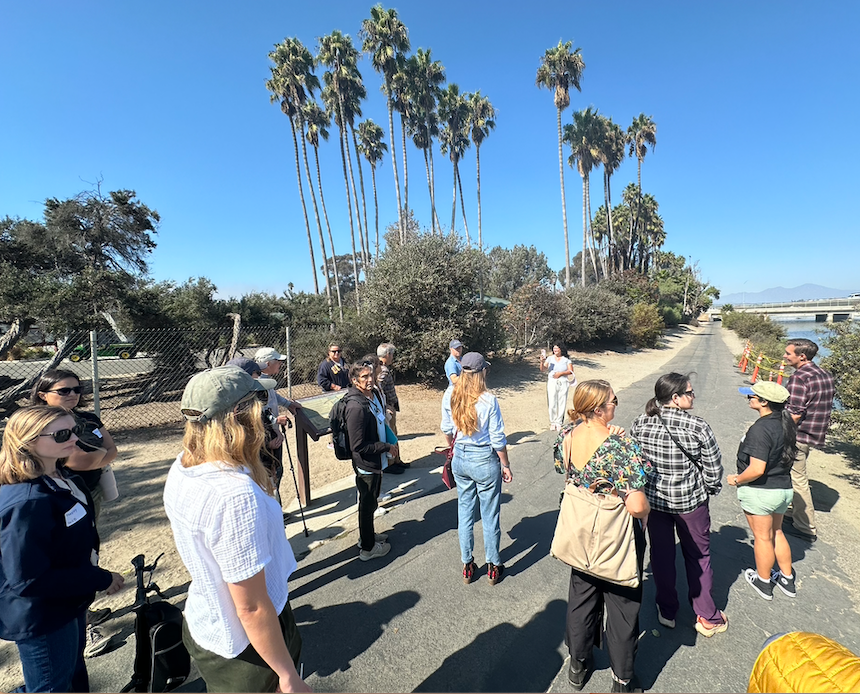
Were they steelhead? That was the question a group of environmentalists and scientists asked themselves as they watched a group of large fish navigate the urban waters close to Orange County’s San Juan Creek Estuary.
Ironically, the group was there on a site visit for Trout Unlimited’s San Juan Creek Estuary Restoration Project, led by longtime advocate George Sutherland, who with help from the California Department of Fish and Wildlife wrangled a 30-plus inch steelhead from estuary waters back into the Pacific Ocean. He’d been tipped of the fish’s inability to reach the ocean by a local shopkeeper. That was in the early 2000s.
Fast forward to 2024 and TU is pursuing grants to improve the area’s habitat for native fish, wildlife and plants, restoring the health of this important water.
Even though Sutherland spearheaded signage about steelhead in this area, the group was amazed to sight what could be the almost mythical Southern California Steelhead, an endangered species, once caught in the thousands in local rivers.
“It was a sign, as we walked past our sign–The Trout Unlimited Steelhead lifecycle–that a hard look is needed in the San Juan Creek Estuary as a place that needs to be restored for the animals that use this area,” ” said William Preston Bowling, President of Trout Unlimited South Coast Chapter. “Evidence of Steelhead Trout and other fish species with an osprey in a palm tree to balance out the circle of life.”
But, the biologists weren’t completely convinced that these fish were steelies, focusing on the shape of the dorsal fins, as well as what they characterized as larger mouths.
Ironically, at least according to one participant, these biologists admitted they’d never actually seen a steelhead in the wild.
The mystery continues until a positive ID is confirmed.
The Los Angeles River is again raking in grant money for its makeover, a boon to us Angelenos, as well as to the species who depend on the river for survival.
First off, Trout Unlimited South Coast chapter received $4.6 million late last year from the California Wildlife Conservation Board for the planning, design, education and outreach for the Lower L.A. River project over the next three years. It includes creating riparian habitat, slower currents and shady rest areas for steelhead migrating back home to the San Gabriel Mountains. That is the largest grant ever received by any TU chapter in the country. Emphasis on the Lower River and Dills Park, as well as the city of Paramount, is a hopeful sign that communities long neglected by LA’s power players will begin to get their due.
Meanwhile, the Bowtie, the former headquarters of Southern Pacific Railroad, was recently awarded $5,896,000 in funding for remediation and construction. In 2003, California State Parks bought the property called G-1, which is now referred to as “the Bowtie” (due to its shape), with the intent of transforming the currently undeveloped industrial land into a safe and clean, vibrant public green space, according to California State Parks. The makeover will focus on nature conservation and restoration, education and providing opportunities for passive recreation.
In all these two projects join:
— LA River & Caballero Creek Confluence Park (MRCA) – Construction
— LARiverWay Bike Path Segment 1&2 project (City of LA) – Design, partially-funded
— LARiverWay Bike Path Segment 8 (City of LA) – just became funded
— LA River East Bank RiverWay (City of LA, along Atwater Village) – Design, funded
— LA River Bike Path Improvements (City of LA, along Elysian Valley) – Design, funded
— Paseo del Rio project at Taylor Yard (City of LA, MRCA, State Parks) – Early design, partially-funded
— LA River Ecosystem Restoration and Recreation project Reach 1 (US Army Corps of Engineers, north side of Griffith Park) – Design, funded
— LA River Path Project (Metro, through Downtown LA and Vernon) – Design, funded (mega-project)
— Fish passage in the Downtown LA area, which is also in design but needs to find implementation funding.
The list totals nearly $500 million in project investments.
So, here’s a question for you: How much money does South Dakota have for conservation project in a year?
According to Ballotpedia, $23,650,008, which was the most recent available figure was for 2015. Now that sounds like a truckload of cash until you look at the figure for California, $9,108,000,000, you read that right.
On the high end, three states spent more than $1 billion on environmental and natural resources departments in fiscal year 2015 — Cali, Florida and New York. And just for the record, California spent more — way more — than both Florida and New York combined.
While on the low end, four states spent less than $30 million on environmental and natural resources departments in fiscal year 2015— Oklahoma, Nebraska, South Dakota and Connecticut.
Since passage of the Endangered Species Act 50 years ago, more than 1,700 plants, mammals, fish, insects and other species in the U.S. have been listed as threatened or endangered with extinction, according to the Los Angeles Times. And just like the big the states, there are winners and losers. Guess which species are the biggest winners of federal environmental bucks.
Of the roughly $1.2 billion a year spent on endangered and threatened species, about half goes toward recovery of just two types of fish: salmon and steelhead trout along the West Coast. Meanwhile, the tiny Virginia fringed mountain snail had $100 spent on its behalf in 2020 after only being seen once in more than three decades. There are also species — more than 200 imperiled plants, animals, fish and other creatures, according to the article — that had nothing spent on their behalf.
During the past 10 years, the Los Angeles River has moved from object of dumpster humor to a symbol of urban rewilding. According to the city’s LARiverWorks, there are nine projects worth $500 million in the pipeline, from funded design stage to construction. Although two fish passages are envisioned, one in downtown Los Angeles, the Lower LA River Channel Restoration and Access stands out for conservationists.
“The LA River restoration effort is not about fishing, and it’s not really about trout,” said Bob Blankenship, of TU’s South Coast Chapter, who along with another TU board member, Karen Barnett, spearheaded the effort. “It’s about helping local people reimagine their local river, with global exposure that will jump start other restoration efforts.”
According to the LA Master Plan, many histories of the LA River focus on two central narratives: the devastating floods of the 1930s, and the rapid development in the first half of the 20th century that led the United States Army Corps of Engineers and the LA County Flood Control District to channelize and line LA’s main inland waterway. Now, designers, engineers and conservationists are reimagining how 51 miles of mostly concrete that cuts through neighborhoods, many of them underserved, can be knitted back together.
The idea of “urban rewilding” is one that has gained traction in other major cities, both in America as well as Europe. The Associated Press reported
Chicago’s Shedd Aquarium and the nonprofit Urban Rivers are installing “floating wetlands” on part of the Chicago River to provide fish breeding areas, bird and pollinator habitat and root systems that cleanse polluted water. Or the Rewild London Fund that plans to spend more than $850,000 dedicated to increasing, for example, water voles in freshly restored waterways, as well as helping swifts and sparrows to again flourish in the city.
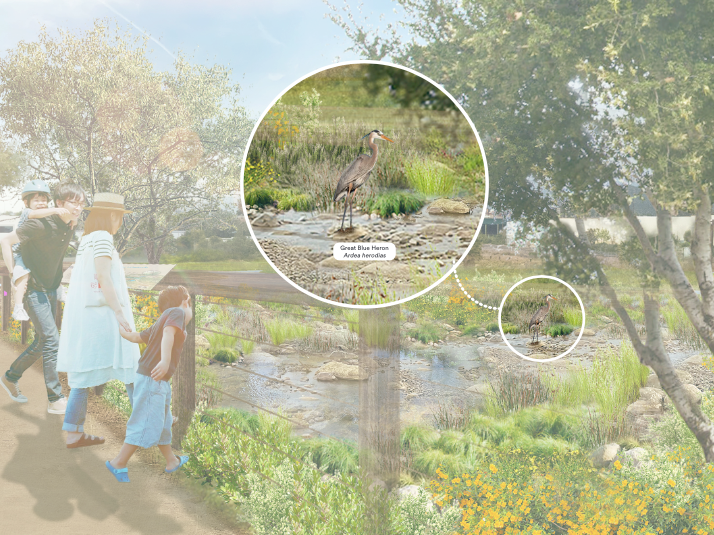
Back in Los Angeles, working with grant money of $300,000, the South Coast Chapter’s project team, as well as the City of Paramount, and the Odyssey STEM Academy, completed a conceptual design for the Lower LA River that incorporates seasonal public access and open space in a naturalized river channel.
David Johnson, Community Services Manager for the City of Paramount, put it well.
“Paramount residents live in a highly urbanized, built-out environment. A reconstructed natural river segment here would provide an amazing opportunity to connect with the natural environment in our own backyard,” he said. “It is important for residents to look upon the Los Angeles River as something that is functioning and crucial to protect, particularly for any impacts downstream where it flows to our local beaches and ocean.
Trout Unlimited basically turned the design element on its head, by involving local residents — most notably students from the Odyssey Stem Academy — then from that input, nudging the design professionals to technically stretch to meet the neighborhood’s criteria. A prime concern is in any river reimagining is the possibility of a 100-year flood event. In the case of the lower river project, that means a fish passage that allows returning steelhead to rest and regenerate in its pools and shade, also must be able to move enough water through the channel to avoid flooding.
Nicole Bottomley teaches in the STEM (science, technology, engineers and mathematics) curriculum at Odyssey Stem Academy, a public school in the Paramount Unified School District. Senior capstone projects were interdisciplinary, which included advisers in math, English, science and Spanish.
“I am so grateful for this organization to have given this to our community and these scholars,” Bottomley said.
Gerardo Silva, was graduated last year and is currently studying biology at Cerritos Community College with the hope of transferring to UCLA. He and his partner choose biodiversity and its effects on aerosols as their seamster-long project. To compare how rewinding a place contributes to healthier air, they chose to compare Glendale Narrows, an area of the river north of Paramount, that still has a soft bottom section, with the area around Dills Park and a housing development unique to Paramount called the “Sans” neighborhood, because each street is named for a saint and begins with the word “San.”
The riparian area of the Narrows is home to dozens of bird species, including snowy egrets, great blue herons and migrating Canadian geese. They are drawn to the flowing water, as well as to the native plants here that include native Arroyo willows and water cress. It’s also one of the best places to imagine what the migration of the endangered Southern California steelhead was like, when thousands of these fish returned to the San Gabriel Mountains several dozen miles away to spawn.
“The majority of our project was tons and tons of research to back up our hypothesis and claims,” Silva said.
Although Silva intimately was unable to prove his hypothesis because of lack of time, when you speak with him you get the feeling this project will help propel him into a science career. And one day he may see the Lower River Channel Restoration realized, along with an urban community’s dream of a greener future.
See you on the river, Jim Burns
This piece originally ran in TROUT magazine, summer 2023
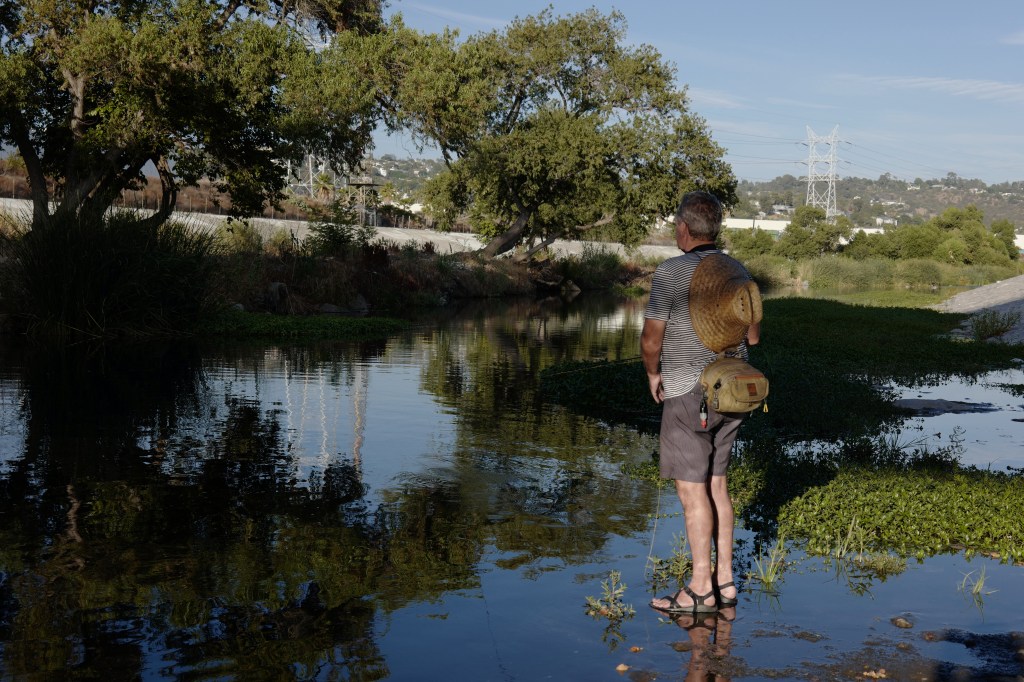
One of four dozen freshly minted fishers who attended Trout Unlimited ‘s LA River Fishing Workshops over the holiday weekend. (Credit: Jim Burns)
Sometimes miracles happen, especially when you give them a nudge.
Way back in November, 2010, I met a couple of boys on bikes, who at first unnerved me, under a bridge in a part of Los Angeles, forgotten and unloved. A part of Los Angeles that could be dangerous, definitely was dirty and made me wonder why. I wrote this:
I met Mario and his friend as they rode their bikes under the Hyperion Bridge. When he called to me, at first I felt unnerved. Then, looking around, I felt foolish to think that this bright-faced boy might be up to no good.
“Fly fishing?” he asked with a knowing smile.
“Got a good spot?” I answered in return.
And off we went, two kids who might have been Tom and Huck from earlier days, and an older gentleman, two on bikes, one on sneakers, plying the waters of the Glendale Narrows.
WINNER Issaih Salgago, 15, of Palmdale (left) hangs with event organizer Bill Bowling at the second “Off Da’ Hook” in 2015. (Credit: Jim Burns)
That very day, I vowed to myself, angry and standing under dozens of plastic bags hanging from a tree, that I would find a way to add something positive to the lives of the young people of Los Angeles, and, at least in part, that’s why I’ve continue to pen this blog for so many years.
Highlights of helping to get youngsters off their screens and into green urban environs include, three years with Friends of The LA River’s “Off Da Hook” fishing derby; helping out with FoLAR’s river fish studies, and years now of Trout Unlimited’s annual fishing workshops.
There simply is nothing like giving back to our city’s youth. Nothing like being a volunteer. Nothing quite like watching as a young person catches their first fish out of the LA, then helping them to throw it back.
So, hats off and hearts out to all those who volunteer their precious time to a worthy cause. We live in a time of tremendous cynicism and mistrust, a time of soul-gripping fear, a time when our young people are more susceptible to fear and depression that in years past.
I don’t claim to have any solutions other than to lean into whatever faith you practice and to practice the easy compassion that comes naturally from the human spirit. Especially on this day when we honor those who have selflessly served us, think about giving some time to our youngsters. If you kayak, teach a kid to kayak as well; if you birdwatch, take them along to see some new species and marvel at the beauty right here in our ruined river; if you bike, you know where I’m going with the argument. As we age, we realize it’s an imperative to help others and to give whatever we can. Start today. With your help, it only gets better — not worse — from here.
See you on the river, Jim Burns
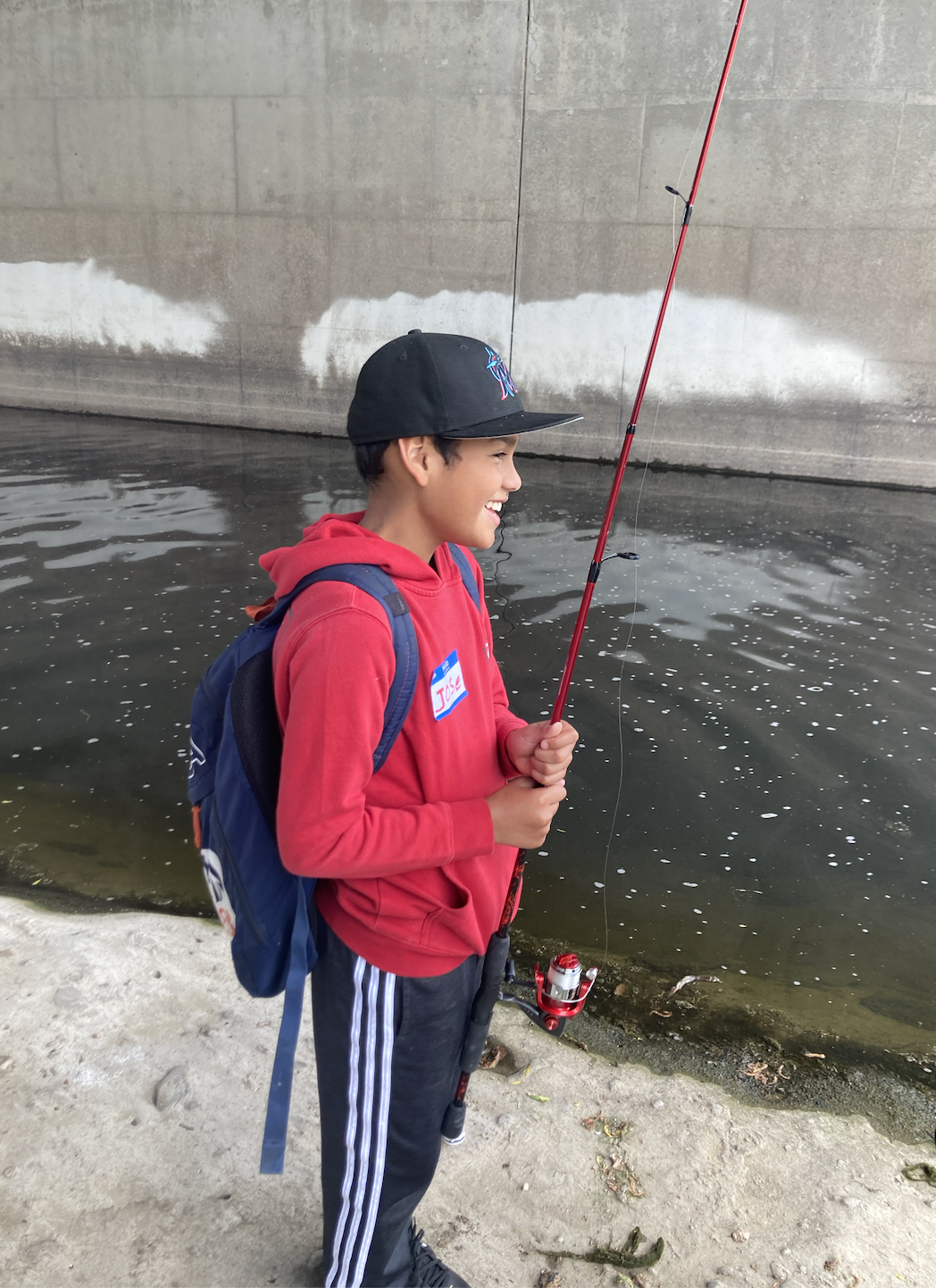
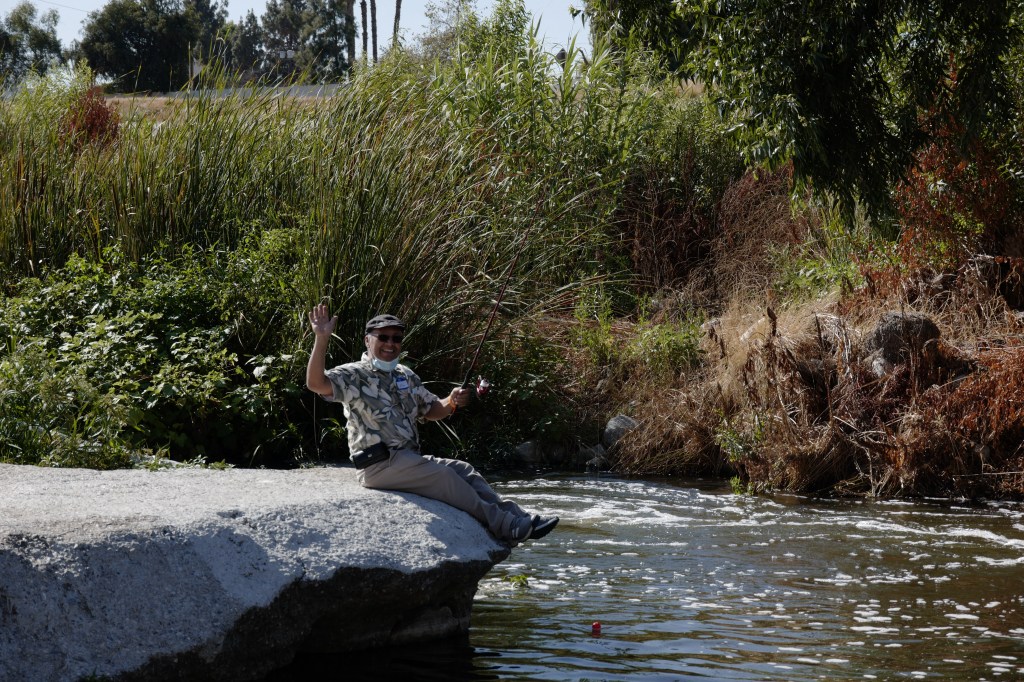
SMILES and a big wave defined this year’s LA River Fishing Workshops, as many wetted a line for the first time, with hopefully many outings to come. (Credit: Jim Burns)
“Doom scrolling” wasn’t even a thing until 2018, and now Merriam-Webster has selected “gaslighting” as the 2022 word of the year. But good news, many times, is hiding just beneath the surface, in the same way that final swing on an exhausting steelie trip can bring you the best fish of the day. So, what better time to read some environmental success stories from folks who love to fish and know a healthy environment is key. Good news is the best antidote to the bottomless bummer.
See you on the river, Jim Burns
William Preston Bowling, President, South Coast Chapter of Trout Unlimited
Chapter board members Karen Barnett and Bob Blankenship partnered with the City of Paramount to design a fish passage in the Lower Los Angeles River. The river goes through several different municipalities, like Compton, Long Beach, Linwood and the City of Paramount has created an exemplary storm drain system from the neighborhood storm water run off through a bioswale in Dills Park. Barnett and Blankenship thought this would be a great place to focus and create an in-channel native plant area with rocks and sandy areas for the fish to relax. The focus area is right below another “River City”… South Gate. This is where Frank Gehry plans to make some sort of riverside park with a ferris wheel. We imagine this to be steel and concrete as a nod to his past creations and just south of it at Dills Park is just the opposite. Taking the concrete sections back to nature with public access to enjoy these areas in hope that one day all the River Cities can do the same, so the elusive Steelhead Trout will return to this urban river as it once did, prior to the 1940s. Check out Bob and Karen’s great work.
Kesley Gallagher
16-time IGFA record holder, 2018 Ladies Tarpon Fly Champion
CalTrout made significant headway this year on the Rindge Dam Project (Malibu Creek); it will be moving into the Engineering and Design phase in 2023. Public Outreach by CalTrout in the LA area has been a focus to increase awareness of the Rindge Dam project and other initiatives this year; also, in 2023, CalTrout will be heading up a West Fork clean-up day in partnership with the Volunteer Fisheries Restoration Crew, Pasadena Casting Club and Patagonia Pasadena; details will be forthcoming.
Mention the LA River and I think “Them,” “Point Blank,” “Terminator 2” and “Grease.” With the UK’s privatized water companies discharging 2.7 million hours of untreated sewage into our waterways last year, mention any river in England and I think “Richard III.”
More in hope than expectation, two of my fishing mates, Pete and Jon, set-out to explore the Bristol Avon’s urban tributaries in search of wild brown trout and recording a podcast about their adventures. The result was the Fishtolian and it was incredibly inspiring listening to their enthusiasm for all things wild and showing that, like in LA, life still thrives among the Asdal trolleys, White Lightning cans and floaters.
Unquestionably, Southern California’s own Yvon Chouinard’s decision to shift Patagonia’s ownership to Mother Earth, to combat our climate crisis, is undoubtedly the most significant. I value my affiliation with global leader Orvis, as their significant 5% pre-tax donations continue to fund outdoor-improving projects throughout the globe.
From our local watersheds to the most remote South Pacific atolls, we are one world, and need to endeavor to do our part to make a difference. What will you do today to make our world a better place for our grandchildren?
Bernard Yin
Par Avion, and several decades of chasing SoCal trout
– The recent progress on the Klamath River to bring down several dams is truly exciting, refreshing and encouraging. For years we have heard this conversation through the ether and I am sure like many, it’s been hard to think that there was any hope. It looks like the only hurdles remaining are logistics. In other words, the paperwork and the bureaucracy has achieved certain hurdles that were never thought possible. If this can be done on a river as large as the Klamath, when would like to think steps can be taken on smaller drainages; especially when derelict dams are concerned.
– On a more “local” level, I wish to call attention CalTrout and their efforts, in general terms, to improve the passage between the ocean and the upper reaches of a given watershed. In Southern California, steps continue to be taken on the Ventura drainage, the Malibu Creek drainage, and the Trabuco creek drainage. When I say steps, this can be defined in a variety of ways so it might be best to visit their website to get into the nitty-gritty details but they are serious. Serious in a good way. and making progress.
– I would like to share a more personal anecdote but something that I think would serve as a word of encouragement to anyone who sees anything that is not going well for fish or a water system. A few years ago I noticed that a freshly implemented fish ladder was falling a little short of its intended purpose, because as trout tried to navigate a certain elbow in the ladder (180 degree bend) they would actually miss the ladder and strand themselves on dry ground. Vultures and other birds would hang about during the migratory seasons to take advantage of this. Upon observing this, my wife, Rebecca, and I did our best to document it and reported it to the necessary agencies. Fast forward about a year and some change, baffles were implemented to prevent the fish from jumping out. According to the Department of Fish and Wildlife representative with whom we’ve had good communication, our feedback was considered very helpful bordering on instrumental in creating this fix. We’re not trying to take all the credit for it and we kind of don’t care … . As long as we save a few fish from turning into vulture food! The takeaway is that we all need to speak up. We all need to provide feedback. We need to inform each other and various agencies; alert the world around us to issues that, who knows, might be fixable!
Derek Berlin
Public Engagement Specialist, CalTrout
Two conservation wins that stand out for me, among many others, in 2022 include the progress on Klamath Dam removals, and the international agreement to protect 30% of earths lands and waters in order to preserve the planets biodiversity.
The Klamath dams removal project overcame its last major hurdle in November of this year, with work anticipated to begin in early 2023. The project stands as an incredible example of stakeholders and communities coming together to achieve a difficult common goal. Removing four dams on the Klamath is a critical step toward repairing historic degradations and reestablishing an essential salmon run that once numbered in the millions.
The global agreement to set aside lands and waters to preserve earth’s biodiversity represents perhaps the most ambitious effort ever to curb the unprecedented decline in global biodiversity we are seeing today as a result of human activities. Recognizing the important role of preserving and restoring connected habitat and wild spaces, the agreement formally united about 190 countries in pursuing the target of protecting 30% of earths land and waters by 2030 (30×30) and lays out what the negotiators declare will be concrete benchmarks by which to evaluate progress, as well as funding mechanism pathways. While it’s far from a guarantee that lands and waters will be protected or biodiversity loss curtailed, it is a necessary if not sufficient step forward on a global scale. Both the President Biden and Gov. Newsom administrations have set out similar targets and outcomes in the United States and California, respectively, with their own 30×30 Executive Orders.
Debbie Sharpton
Conservation Director, Southwest Council FFF
— Getting 1,200 acres, the largest parcel left in the Santa Monica Mountains with two miles of ocean frontage, under contract and destined for National Park Service. What a win!
— Seeing the monarch butterfly habitat restoration and collaborations blossom with an increase in the population!
— Seeing the Rindge Dam on Malibu Creek planning and permitting going forward!
– -Seeing endangered species return to historic habitat!–
— Seeing many agencies and NGOs working together to make a difference.
It’s all very heartwarming.
Al Q
Author, “The Corbina Diaries”
I think the best conservation win is what’s going on in my backyard at Ballona Creek outflow by Marina del Rey.
The intercepter007 is an amazing piece of technology that is sitting in the creek with floating booms, that has been collecting and eating all the garbage and plastic floating out to Santa Monica Bay!
Luis Rincon
Community Engagement Coordinator, California State Parks
Rio de Los Angeles is a good example of how restoration works. This newish park sits in the middle of an industrial zone and residential area in Glassell Park, close to the eastern banks of the Los Angeles River. For 60-plus years, the site was known as Taylor Yard, one of the region’s largest railroad switching yards. When it closed in 1985, community groups pushed to turn the land into a park instead of more industrial space. Partnerships were formed between state and city, and Rio de Los Angeles State Park opened in 2007 with city-supervised playgrounds and athletic fields and state-managed hiking trails with native trees and shrubs.
When the drought dried up irrigation water on the trails, volunteers used buckets and wheelbarrows to keep new plants alive until they were established enough to go without regular water. This lead to more birds and creatures who find shelter and food in the natural areas, including the endangered least Bell’s vireo, a small river dwelling bird in decline.
Restoration work is more than rebuilding the land and creating habitat. You’re also restoring a piece of nature for people, to step out of their urban environment, just by crossing the street. This park is a gateway. We want them to be inspired by what they see here, so they go further to see places like Sequoia or Yosemite.
Join South Coast Trout Unlimited in its continuing partnership with Heal the Bay for their Coastal Cleanup Day.
We will be cleaning up the Los Angeles River and the adjacent park areas, from 9 a.m. until noon this Saturday (Sept. 18). Gloves and trash bags will be provided.
Most of the trash in the streets and parks make their way into the watershed via storm drains and eventually the ocean. You are doing your part to reduce the giant islands of plastic found floating in the middle of the ocean.
Please wear a hat and comfortable closed-toed shoes. Sunscreen and Hand sanitizer will be provided.
Stick around for the amazing raffle prizes as each participant will be given a raffle ticket, you might win a fishing pole
Meet at Lewis MacAdams Riverfront Park.
AND
SCTU is working on the Lower LA River, so drop by our booth and learn more about the Lower LA River Restoration and Access project.
LA River End Of Summer Festival Saturday, September 18 9am-2pm Hollydale Park: 5400 Monroe Avenue South Gate, CA 90280We have just launched the Lower LA River Channel Restoration and Access project page. Check it out here to learn more about the background and goals of this grant project. The conceptual designs are a first step in creating a naturalized bottom in the Lower LA River.
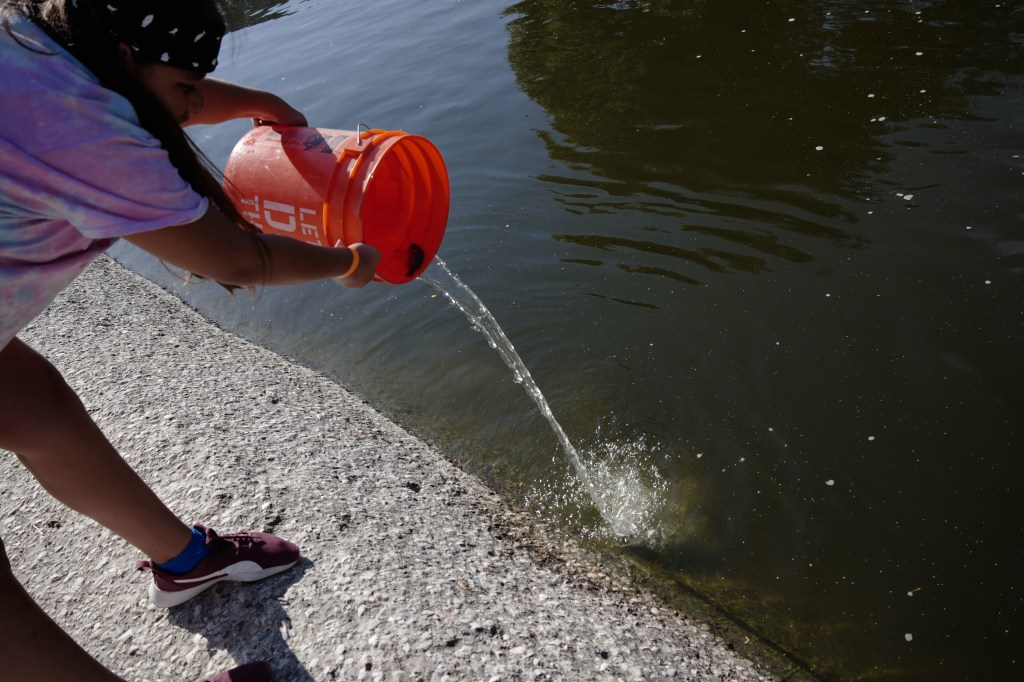
Sept. 4 is one of two yearly license-free fishing days in California, and was the final summer session of South Coast Trout Unlimited’s successful Vamos a Pescar learn-to-fish events. (Credit Miranda Robin)
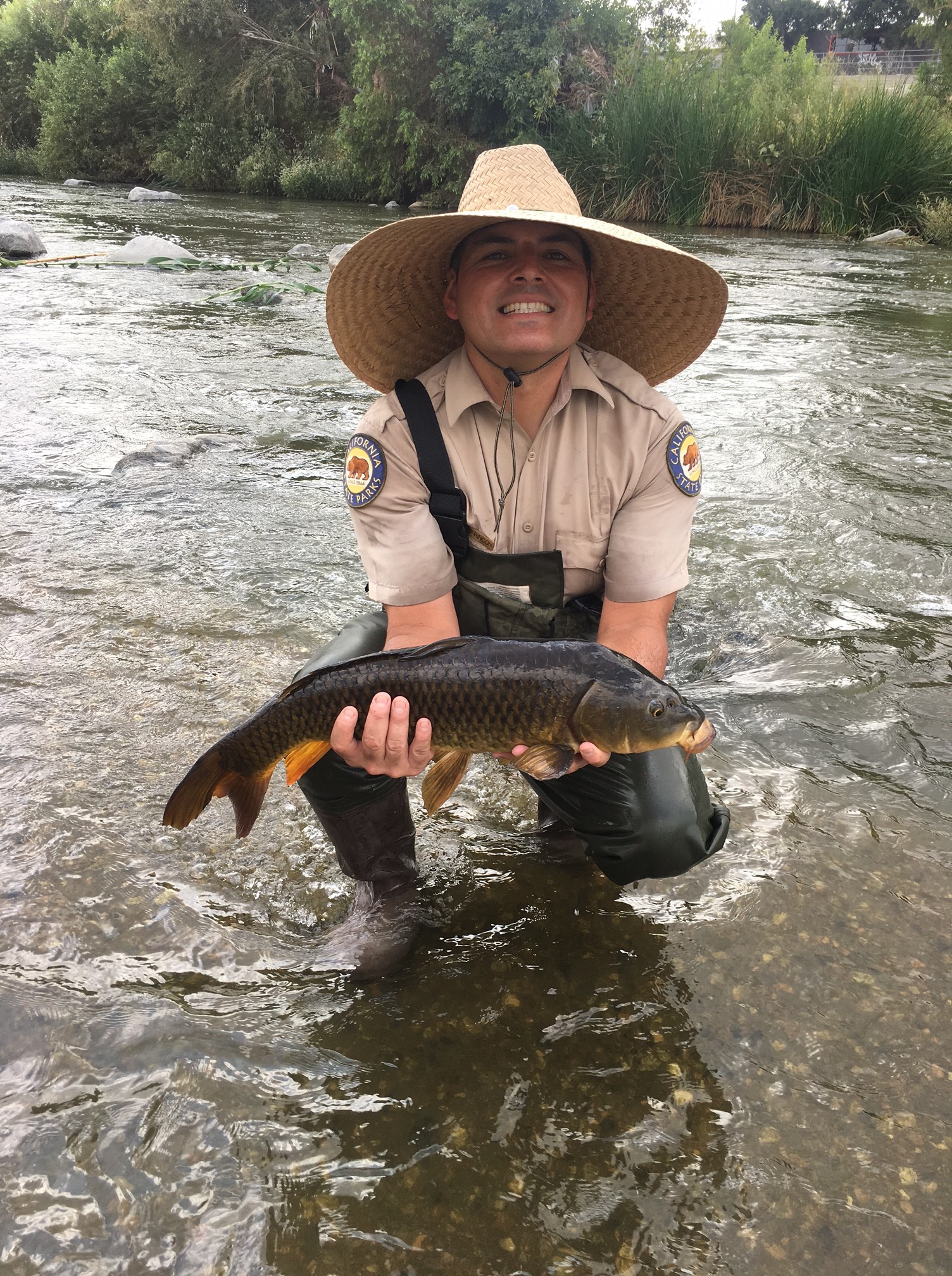
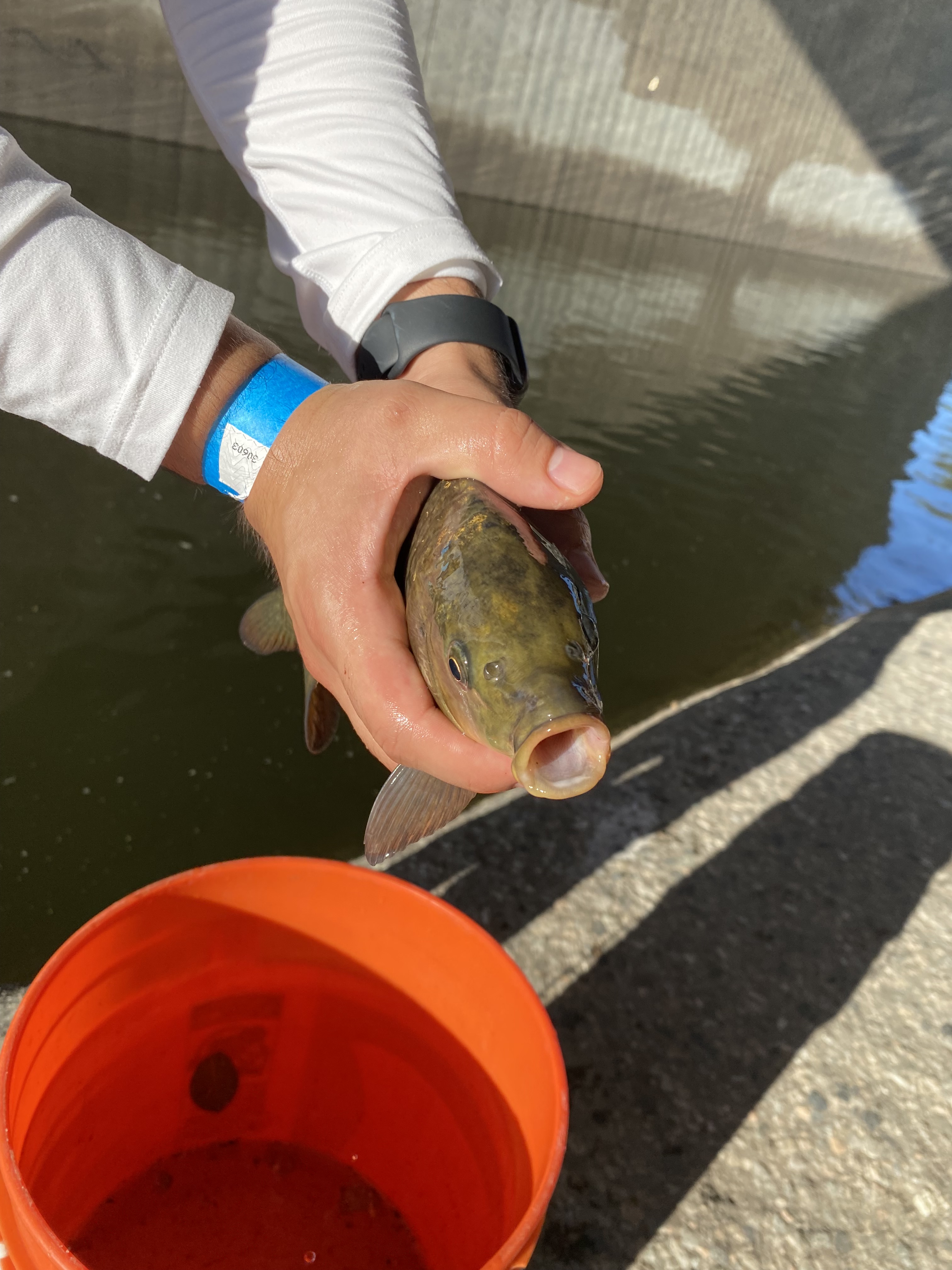
Patricia Perez, who took the Vamos a Pescar course in 2018, returns to catch and release a beautiful carp. (Credit Miranda Robin)
With the help of California State Parks Luis Rincon, this young fisher examines her carp’s gills. (Credit Miranda Robin)
Carp fishing put the LA River in the map, and now Ricardo knows why — hard to catch, lots of fight. (Credit Miranda Robin)













 lariverflyfishing