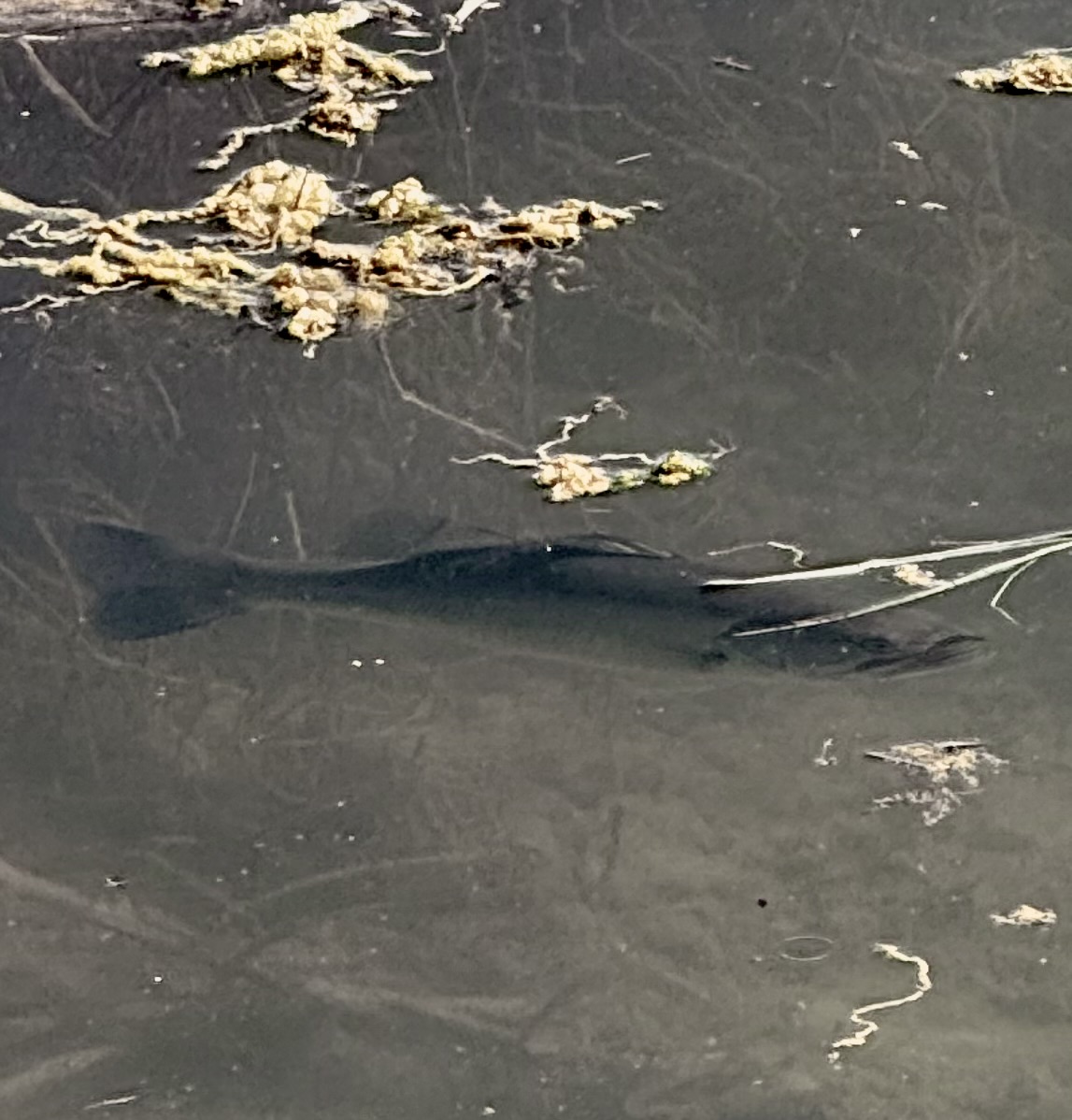
Well … lots of you chimed in about what the heck are the blurry pics in the last post. Could they be what we were all hoping they were–steelhead? There were lots of votes for bass of some sort–I coined the name “torpedo bass,” hoping to be wrong. One noted biologist thought possibly striped mullet, while asking for some better snaps.
Those came from TU South Coast board member Terry Italia.
Based on these better shots, Camm Swift, one of the leading authorities on biology, management and conservation of fresh and brackish water fishes of coastal Southern California, wrote in an email:
“They are bass, probably largemouth, with the jpegs 3117 and 3118 the most distinct. The two dorsal fins are a tip off and a subtle black stripe down the sides on some, often more prominent. Very common and widespread in Southern California. High flows wash them out of local ponds and reservoirs, and these are probably YOY (young-of-the-year) having been hatched in March or so upstream or even locally if the lagoon was large enough and stable. Can prey extensively on natives.”
Great to know the score, but it hurts at least a bit to not see what we hoped for. Kinda like the election.
Big Santa Anita Creek at Chantry Flat–I had heard the tales of rainbows and browns from “back in the day,” but I had never seen this idyllic stretch of incredible trout water for myself. I only took up local fly fishing a year ago, during the four-year fire closure of the area. I was eager to see it for myself last week when they reopened the area.
So, a friend and I spent a day scouting for Chantry Trout. I assume the weirs, across the stream at regular intervals, stamped with the date 1959, were built to control flooding around the 80 or so cabins in the canyon. I also know that these probably very quickly filled up with sediment, rendering them useless, much like the Brown Mountain Dam on the Arroyo Seco above JPL.
I also guessed that these dams would act as fish barriers. So while scouting, we made sure to walk as much of the stream as we could, thinking fish could be localized in one of these runs. We covered a lot of ground, from a half-mile above Sturtevant Falls all the way down to within a half-mile of the reservoir. We hiked seven miles. I am deeply sad to report: we found no fish in the stream.
I put my waterproof video camera in pool after pool, hoping and praying to see a little movement under a rock, a fry tucked up into a crevice. Nope. Nada. Zip. Zilch. We also tried flies, of course. And with ample experience fishing the streams of the Angeles and San Bernardino mountains, I can say with certainty–if there were fish there, we would have caught ’em, or seen ’em.
We did find hundreds, thousands perhaps, of frogs (and tadpoles visible underwater)–another observation that points to the absence of a healthy population of trout.
This was a total bummer, as the stream itself looks “incredible.” There is a surprising amount of water flow for this time of year–pool after pool of deep, cool, aerated water. Just perfect for our native rainbows. The flow was many times what we see this time of year in other creeks that manage to support fish, like the Arroyo Seco.
I had high hopes that with the recent high-water years, maybe some fish had survived the fire and repopulated, perhaps from the reservoir below, but it seems that’s not the case. Now, could there be some survivor fish in the reservoir and perhaps immediately upstream of it? Yes, it is possible, we did not make it all the way to the reservoir. But there are certainly no trout in most of the accessible water.
Perhaps we can convince the CDFW to repopulate the stream, stocking it with wild rainbows from nearby drainages (perhaps a rescue of East Fork San Gabriel fish is in order, before the rains come and destroy that stream?). Our mountain rainbows have their genetic roots in the Southern Steelhead runs of a hundred years ago, and keeping good stocks of those populations may help repopulate the endangered Steelhead if and when we are able to reconnect them to the ocean.
Typically, council meetings for the City of Paramount focus on decreasing street takeovers, ap- proving zoning ordinance changes, or funding the small city’s annual health care fair. But during the most recent meeting of 2023, Mayor Isabel Aguayo personally awarded three certificates of recognition to former students of the city’s Odyssey STEM Academy, explaining, “They provided testimony on behalf of Trout Unlimited to the California Wildlife Conservation Board in Sacramento on a plan to naturalize and revitalize a portion of the L.A. River adjacent to Dills Park.” The plan would remake part of the river into a steelhead oasis, pro- viding these imperiled fish a respite and watershed connectivity on their long journey from the Pacific Ocean to their ancestral home waters in the San Gabriel Mountains some 50 miles away. Indeed, the board funded $4.6 million to the Trout Unlimited South Coast (TUSC) chapter for the plan- ning, design, education, and outreach for the Lower L.A. River project during the next three years, making it the largest grant ever received by any TU chapter in the country.
During the past dozen years, the Los Angeles River has moved from object of dumpster humor to a symbol of urban rewilding. According to the city’s LARiverWorks, there are nine projects worth $500 million in the pipeline, from funded design stage to construction.
Although two fish passages are envisioned, one in downtown Los Angeles, the Lower L.A. River Channel Restoration and Access stands out for conservationists. “The L.A. River restoration effort is not about fishing, and it’s not really about trout,” says Bob Blankenship, of TU’s South Coast Chapter; he, along with another TU board member, Karen Barnett, spear-headed the effort. “It’s about helping local people reimagine their local river, with global exposure that will jump start other restoration efforts.”
Read the rest of the story in this month’s American Fly Fishing. I’ll post a link to it once it’s available.
THIS ADULT STEELHEAD, close to 24 inches long, was detected in Salsipuedes Creek, a tributary of the Santa Ynez River in southern Santa Barbara County, on March 22. Apparently the fish was accompanied by two others, and all were released after taking scale and tissue samples from the photographed fish. (Credit: Mark H. Capelli, National Marine Fisheries Service)
The Topanga Lagoon Restoration Project Draft Environmental Impact Report (DEIR) officially dropped on Feb. 12. The public can provide comments and feedback on the DEIR until April 12 at 5 p.m. Saturday, Feb. 24 from 10 a.m. to noon at the Annenberg Community Beach House, 415 Pacific Coast Hwy, Santa Monica, is the public meeting, which will also be live-streamed on YouTube. Click the pic for more info and to comment.
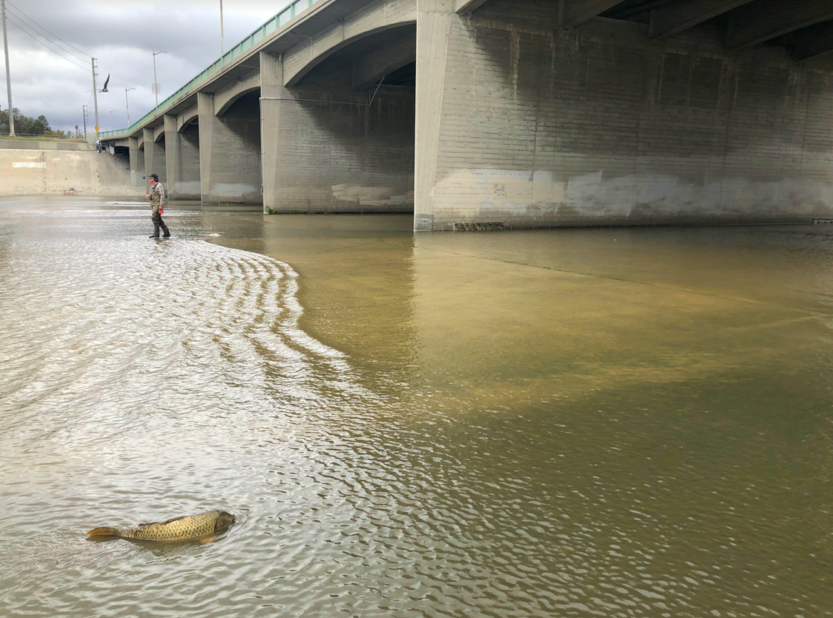
Trout Unlimited’s Bob Blankenship keeps his eye peeled for steelhead after our latest storms. What he did see were spawning carp, this intrepid specimen near Long Beach. (Courtesy William Preston Bowling)
When truly great things happen for wild steelhead recovery, it is important to share the news. We took one of the greatest steps forward in wild steelhead recovery yesterday at the mouth of the Klamath River. Secretary of the Interior Sally Jewell, California Governor Jerry Brown and Oregon Governor Kate Brown signed new amendments to the Klamath Hydropower Settlement Agreement (KHSA) and a related Klamath Power and Facilities Agreement. The revised KHSA will ensure that removal of 4 major dams on the Klamath River takes place as scheduled in the year 2020, opening about 500 miles of wild steelhead habitat. Take a moment to thank Secretary Sally Jewell, California Governor Jerry Brown, and Oregon Governor Kate Brown.
To learn more, read the story by Sam Davidson below.
Major win for one of America’s best coldwater fisheries
By Sam Davidson
Five hundred miles. That’s a pretty significant distance, right? Now, imagine swimming that far.
That’s how many river miles will re-opened to native steelhead in the Klamath River under the terms of a revised agreement between the federal government, the states of California and Oregon, and the utility company PacifiCorp.
The amended Klamath Hydropower Settlement Agreement, and the Klamath Power and Facilities Agreement were signed today at the mouth of the Klamath River by Secretary of the Interior Sally Jewell, NOAA Administrator Kathryn Sullivan, Gov. Edmund G. Brown, Jr., of California, Gov. Kate Brown of Oregon and PacifiCorp CEO Stefan Bird.
Under the new-and-improved KHSA, four old, unproductive hydropower dams on the Klamath River will be removed beginning in the year 2020. This action will open up 500 miles of habitat for steelhead and some 420 miles for salmon.
PacifiCorp and the state of California will pay for the cost of dam removal using existing funds already set aside for this purpose. No federal funds will be required.
“This is a major win for one of America’s greatest coldwater fisheries,” said Chris Wood, president and CEO of Trout Unlimited. “The river restoration called for under the new KHSA will be the largest in U.S. history. TU is proud to have played an important role in the long effort to bring about this restoration and to resolve one of our country’s most intractable water challenges.”
TU California Director Brian Johnson has been closely involved in the many years of difficult negotiations that led to the amended agreement. Johnson attended the signing ceremony today and spoke to the benefits of the agreement for fish—and people.
“The Klamath, historically, has been the third most productive river system for salmon and steelhead on the West Coast,” he said. “Thanks to the leadership of Secretary Jewell, Gov. Brown of California and Gov. Brown of Oregon, and PacifiCorp, we now have a real chance to return it to its former glory.”
At the same time, Johnson added, “TU remains dedicated not only to restoring one of America’s greatest salmon and steelhead fisheries, but also to adoption of durable water-sharing agreements that will provide greater water security for tribes, upper basin agriculture and communities up and down the river.”
TU issued a joint statement today on the signing of the amended KHSA, with the Pacific Coast Federation of Fishermen’s Associations, California Trout, the Northern California Council of the International Federation of Fly Fishers and American Rivers. The statement declares strong support for dam removal on the Klamath and calls for renewed commitment to a “basin-wide solution for water sharing, water supply infrastructure, and habitat restoration.”
Johnson is quoted in advance reports on the KHSA signing ceremony from the Associated Press and the San Francisco Chronicle. An overview of Klamath River water issues and the settlement agreement process can be found here and here.
Sam Davidson is California Communications Director for Trout Unlimited.
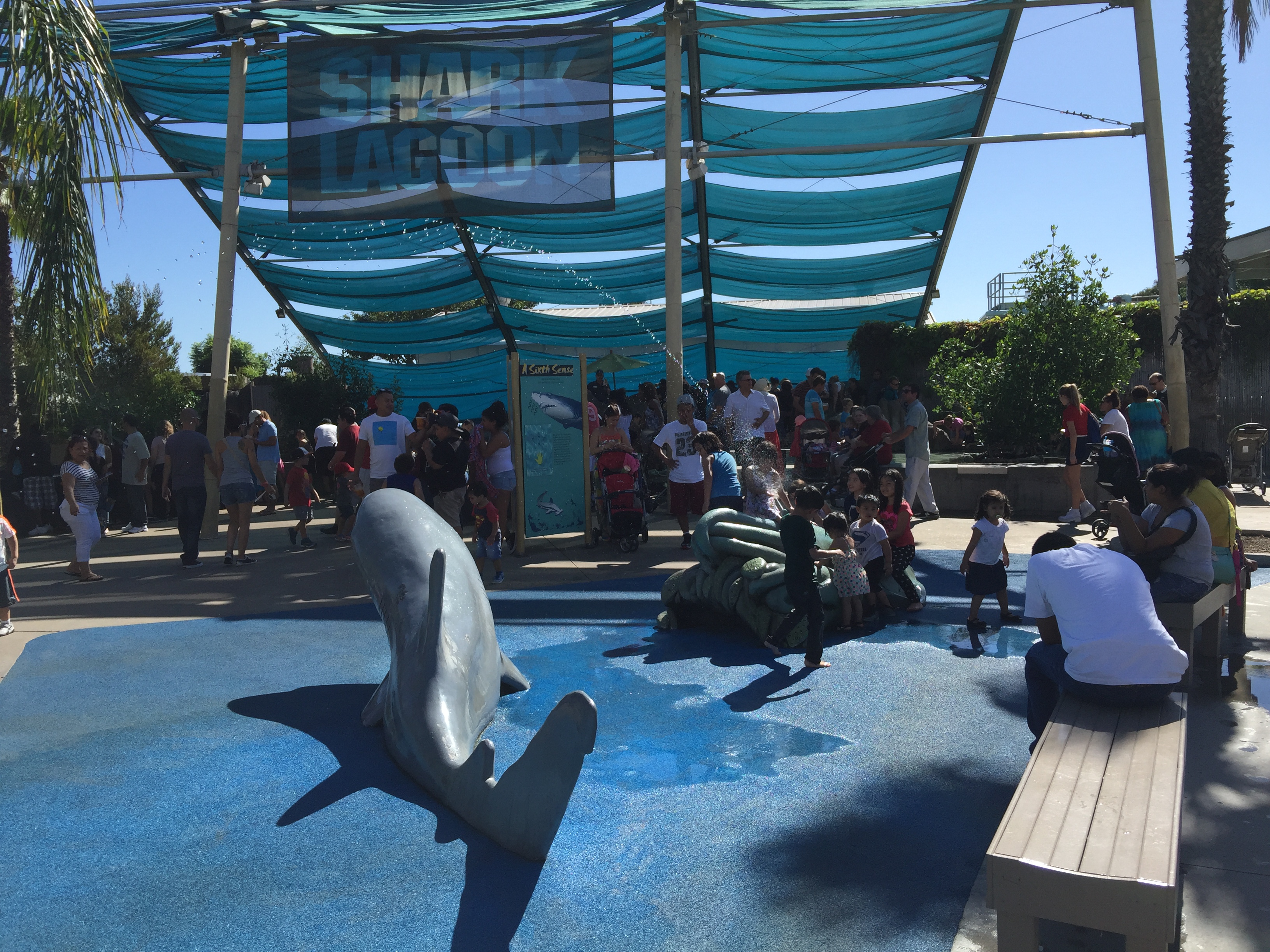
KIDS and their parents take a break in the shade at the aquarium’s Shark Lagoon. (Jim Burns)
You have to ask yourself eventually, after catching only nonnative warm-water fish in the Los Angeles River, if all the talk about the return of native Southern California Steelhead lies somewhere between academic debate and actual pipe dream. After all, after decades of decline, this ocean-going rainbow trout is now on the endangered species list. Looking down mile after long concrete mile of river bed, it seem nearly impossible to return one steelhead to the river, let alone a healthy population.
And you would be correct in your skepticism, yet very short on your optimism, for we live in an area that once robustly supported this unique member of the Oncorhynchus mykiss family.
And optimism — measured, reasoned, for sure, but optimism none the less — was on full display at the Steelhead Science for Anglers event Saturday at the Aquarium of the Pacific in Long Beach.Trout Unlimited, California Trout and Wild Steelheaders United created this must-attend free event, which would have seemed more likely in Seattle, or at least Northern California, than in Long Beach. Yet, here it was, and passing by the aquarium’s steelhead exhibit, full of young O. mykiss, to enter the large classroom for the four-hour event, there was an optimism evident. Biologists, researchers and fisherfolk varied and mixed their presentations, making it engaging to scientist and angler alike.
Both Trout Unlimited’s Drew Irby, and well-known local angler Kesley Gallagher weighed in on how to release big fish, as steelhead can weigh more than 25 pounds and grow to 45 inches in length.
“Keep the fish in the water, gills wet,” said Gallagher, which may seem like simple advice, but a quick perusal of this blog alone shows that most anglers get carried away by their “grip ‘n’ grin” photos. Anglers should avoid “tailing,” as well as grabbing the fish with grip gloves, or injuring its slime covering with a mesh net.
TU’s John McMillan cited steelhead research linking time out of water to reduced spawning capacity in Atlantic salmon. “Two minutes out of the water kills them,” he said.
Mark Capelli, National Oceanic and Atmospheric Administration (NOAA) South Central California Recovery Coordinator, reminded an audience of about 50, that before World War II catching steelhead was a winter industry. During the winter months these hearty fish return from the ocean to spawn, no easy feat. The fish literally have to surf on storm surges to gain access to their ancestral rivers and creeks, only to have to swim through a inch or two of water as conditions dry out moving upstream. His slides, remarkable for those of us used to an entirely different era, one of depletion, underscored the vibrancy in this unique fish to our area.
“Unfortunately, the area memory of steelhead disappeared,” he said.
From 1948 through 1953, the needs of a rapidly increasing population decimated area runs that, according to newspaper accounts in the Los Angeles Times and other publications, ran into the thousands during rainy years. Dams, a prime example being the Devil’s Gate Dam in Pasadena that cuts off the Los Angeles River from its upper headwaters, spelled a near-death knell that would have probably killed off many species — but not this one.
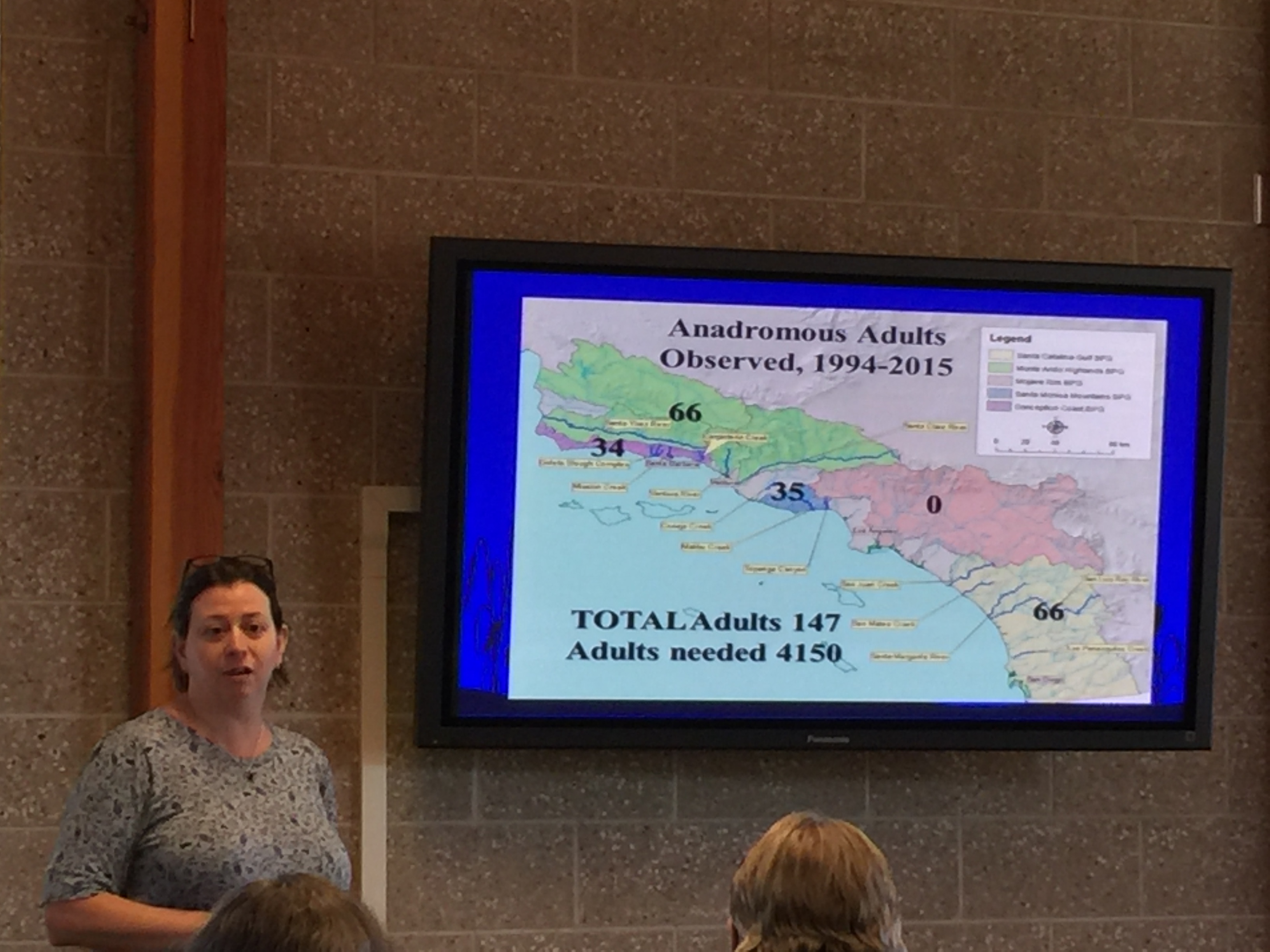
BIOLOGIST Sabrina Drill speaks to the urgency of So. Cal. Steelhead recovery at the Aquarium of the Pacific on Saturday. (Jim Burns)
Viewed as an “indicator species” by the Environmental Protection Agency because its health is linked to its surrounding environment, steelhead thrive in both clean, colder fresh and salt water, and require unfettered access to return from its ocean sojourns to its spawning grounds inland.
As Sabrina Drill, the Natural Resources Advisor for UC Cooperative Extension in Los Angeles and Ventura counties, reminded the audience, between 1994 and today 147 adults steelhead were observed and recorded. Yet only a year after the clean up and restoration of the Malibu Lagoon, a steelhead was spotted in May.
“If you open the door, fish will come,” said Dana McCanne, part of whose job with the California Dept. of Fish and Wildlife is convincing landowners to give steelhead unfettered passage across private property. He recounted how Santa Barbara has successfully removed barriers to fish passage on Mission Creek. And by the end of summer, all of the barriers on Carpinteria Creek will have been removed, opening passage to headwater habitat.
Indeed the NOAA recover plan focuses on “more pristine watersheds” in its five regions in Southern California, home to some 22 million souls. Although its timeline — 75-100 years — is steep according to human standards, in geologic time, it’s barely a heartbeat. Armed with $30 million in restoration money, and piggybacking on the national debate over the right architect for the L.A. River, a lot could happen.
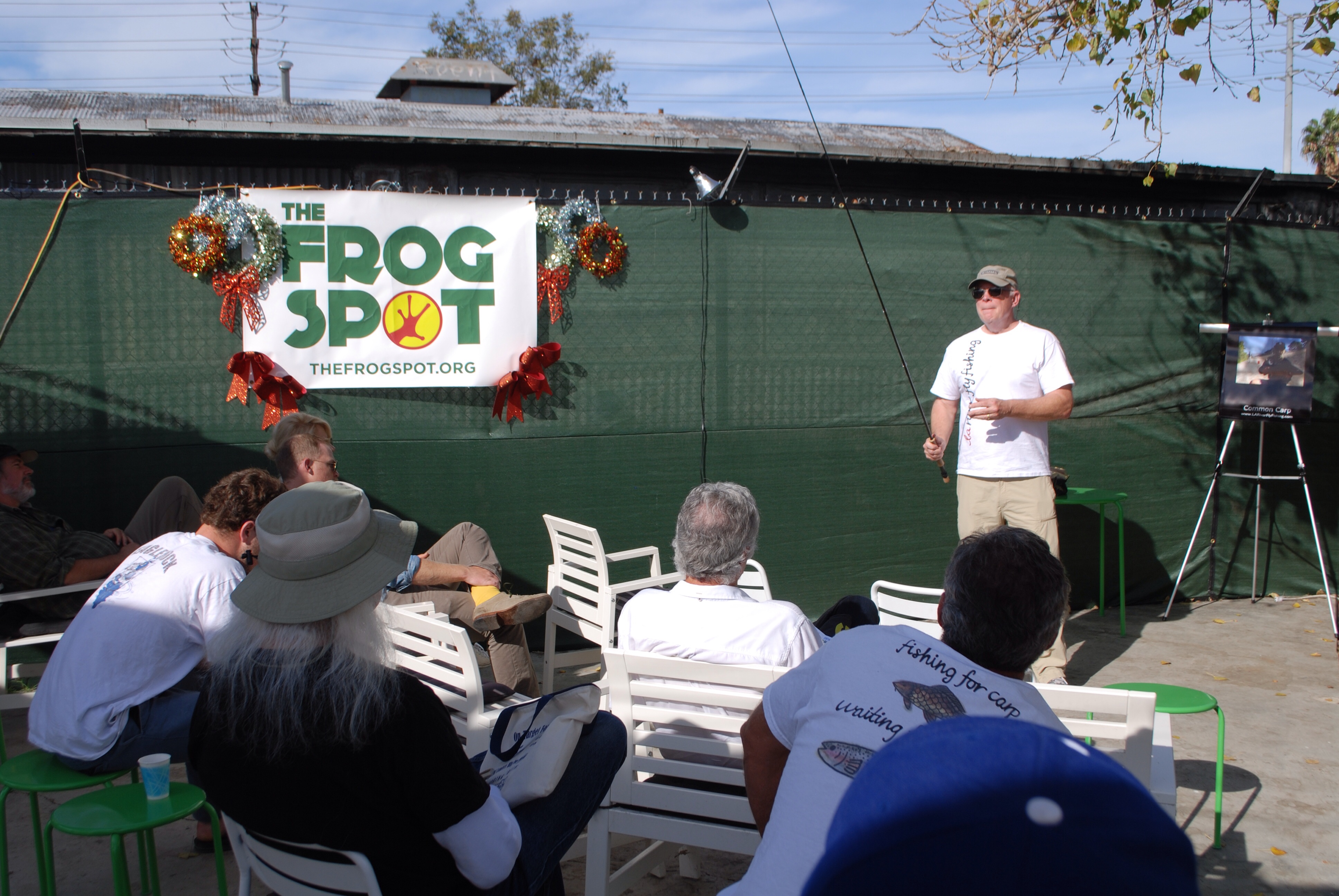
It was a thrill to be one of the presenters at the festive Frog Spot on Sunday. (William Preston Bowling)
Oh, the tall tales fisherfolk tell. As a matter of fact, they say that if you weren’t born with the ability to stretch the truth just a wee bit, spending time on the water will surely school you in that all-too-human trait.
But, at the Frog Spot, sharing and learning more about fishing the L.A. River Sunday, not a tall tale emerged from the gathered fishing fanatics, just a bounty of hard-won knowledge about our river. The weather was perfect; the setting, urban-divine, as bicyclists zoomed along the bike lane, possibly fired up by CicLAvia, while AMTRAK whistled its station arrival not far away.
— William Preston Bowling, who organized the first Off Tha’ Hook fishing derby in September, served as MC, but he also filled in the crowd of a dozen or so participants on Friends of the Los Angeles River (FoLAR) line recovery efforts. Your line has a life of around 5,000 years, so please think twice before tossing that next bird’s nest into the water. Grove Pashley, of LA River Kayak Safari, reminded us of two blue herons separately caught up in bird’s nests of line in the last couple of years. I know one died, but I’m not sure of the other’s fate.
Bowling said that soon there will be line disposal tubes at high-traffic areas along the river. FoLAR will recycle the line by sending it to Berkley, a company that actually re-purposes used line, turning it into new.
— Robert Blankenship from Trout Unlimited turned his darkroom PowerPoint into a daytime handout, and regaled us with tales of Southern California Steelhead recovery efforts. His presentation was made all the more sweet by a guest appearance from Tom Tomlinson, who wrote “Against the Currents: The Unlikely Story of the Southern California Steelhead” this year, published by the Aquarium of the Pacific in Long Beach. If you haven’t read this important book yet, pick it up.
Blankenship showed us how Santa Barbara has re-designed its flood control channels to include holding water for steelhead returning from the ocean. The story of the steelhead here in our truly unwelcoming climes is one of courage, fortitude and grit. There’s actually a self-guided tour that links steelhead art and brew pubs, which sounded like the best of both worlds to many of us. Look for more from TU under the local leadership of Blankenship, a strong advocate for our river.
— Next, Lizzy Montgomery from the Resource Conservation District of the Santa Monica Mountains told us about the INaturalist app, and how to use it. Take a look here for more info. I’m not sure that as a fishing community we’re using this as much as we could/should. The research that comes from fishers out there on the water can greatly aid biologists who can’t use their standard procedures for species and fish counts. As she said, ” I can’t imagine we would use SCUBA gear on this river.” Agreed.
— Ban Luu, who has plied the river since 2007 using traditional tackle, told us he had no idea there were fish in it when he first cast out: He was testing a new rod and reel to get ready for an ocean trip! With each cast, he heard splashing, thudding, all the auditory telltale signs of big fish. “I was hooked,” he said, no pun intended. And Luu is the right guy to get hooked, taking time to keep a detailed fishing journal, perfecting his light tackle gear after much research and trial and error. Also, he has perfected his own masa blend with garlic, after rejecting both bread and tortilla baits, both well regarded by locals.
And … ready for this, Luu said he’s caught over 2,000 fish since 2007! After listening to his presentation, I am sure this isn’t a fish tale.
As for yours truly, I discussed the usual suspects we catch on our river, as well as fly rods and flies that give you the best chance of hooking up. I, too, used old-school photographs from this blog that included fish and the commentators who sent them in to illustrate my talk.Simply put, without the LARFF community, I would have had much less to discuss. Thank you for your support and friendship over the last four years!
Finally, Bowling reminded us that we are all invited to participate in the return to the lower section of the river, Saturday, Jan. 3, from 2 p.m. until dusk. Get in touch with him (wpb@folar.org) to reserve your spot (free), and help to document what fish are in that lower section on WIllow Street.
Who knows, steelhead may yet be waiting for discovery, akin to those spotted on the San Gabriel River. Blankenship shared a wonderful picture from a few years back of a large steelhead hanging out by a discarded TV in a West L.A. flood control channel. It was a renewed call to “bring ’em home,” as FoLAR co-founder Lewis MacAdams would say.








 lariverflyfishing