Tag: Rainbow Trout

Stories keep me coming back

What do you make of it when you see an insect in your man cave? Not much. I spy all kinds of wiggling legs there, spiders (OK, arachnids) maybe a beetle or three, the odd brown ant.

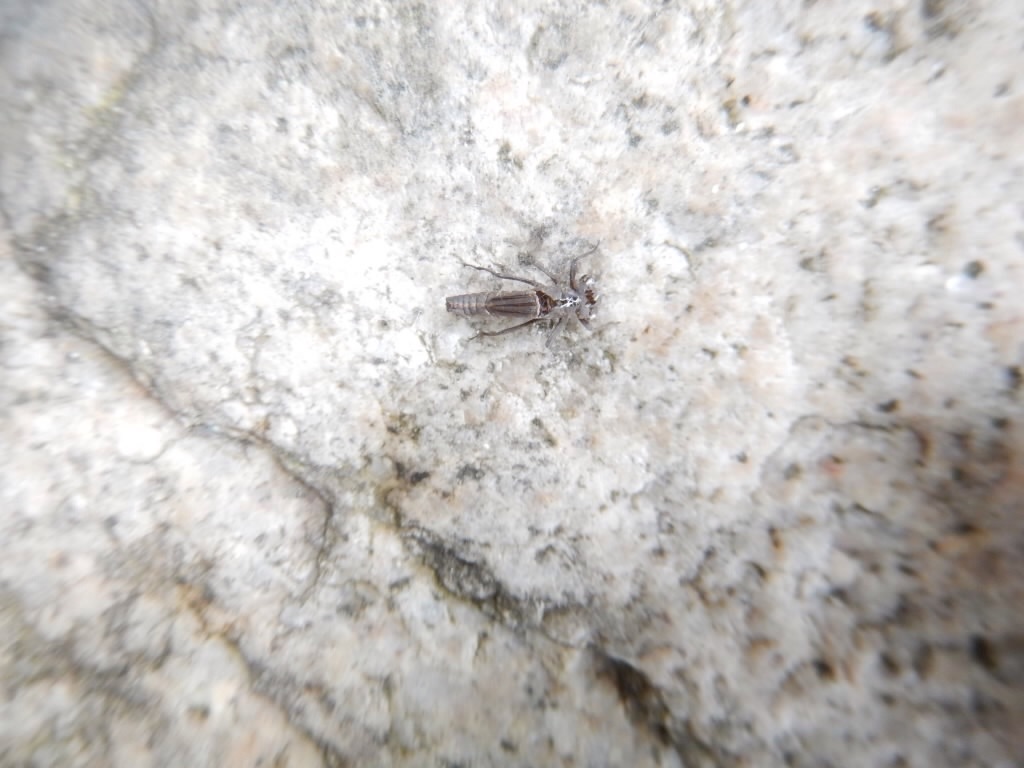
But last night as I looked closer at that speck on the wall, it was … a mayfly! I mean a mayfly in late December when Santa is on his way, how crazy is that? I immediately texted a fishing buddy, who responded “L.A. City of Trout.” I fingered the “haha emoji,” to which he replied, “I’m serious! Spring creeks galore, back in the day.”

His typed words hit me. Back in the day, sure, Octogenarian Robert Richardson who has volunteered in the now-monument since the ’50s — you read that right — regaled me this fall with eyebrow-raising stories about pulling 18-inch trout from the West Fork, when there was a game warden up there who would catch poachers as they emerged from the shore, pitch black of night, waiting for them in his jalopy, necking with his girlfriend. When there was a size limit on keeping trout from Cogswell Dam, bigger than 36 inches (now, no fishing allowed)! His stories are jewels of a time we’ve lost, but then again …

Stories from Bernard Yin, rock-n-roller activist, mountains archivist and fly fisher extraordinaire, will keep you coming back to our steep slopes and deep canyons above the City of Angels, just to get a glimpse of what he sees, what he knows. Another deep source of knowledge, but gleaned from a different time than Robert’s tales. He and Rebecca Ramirez, his co-rocker and wife, put in so many miles scouting trout in our most beautiful wild places, as well as our dumpster dives.

Then, there are the miracles, themselves the making of possibly timeless stories, like the one in my man cave last night. Keep those especially close, for we need the optimism and strength drawn from experiences that skirt the boundaries of mere intellect. These are stories visited upon us, instead of told to us by another.

For I need the energy of miracle when I pick up what seems to be unending amounts of trash on the way to my fav off-the-track spot; I need that unexpected freshness to keep me in a good spot when I contemplate the graffiti spray-painted across rocks raised up more than 6 million years ago. I need it to not despise those who threw out the trash, the ones who defaced the forest, as well as those charged with protecting it, yet do little.

Nature is the key to what we are missing. It’s that simple. Go into it, breath it, embrace it, feel your own soul, calm and serene, as the miracle of peace settles upon you.

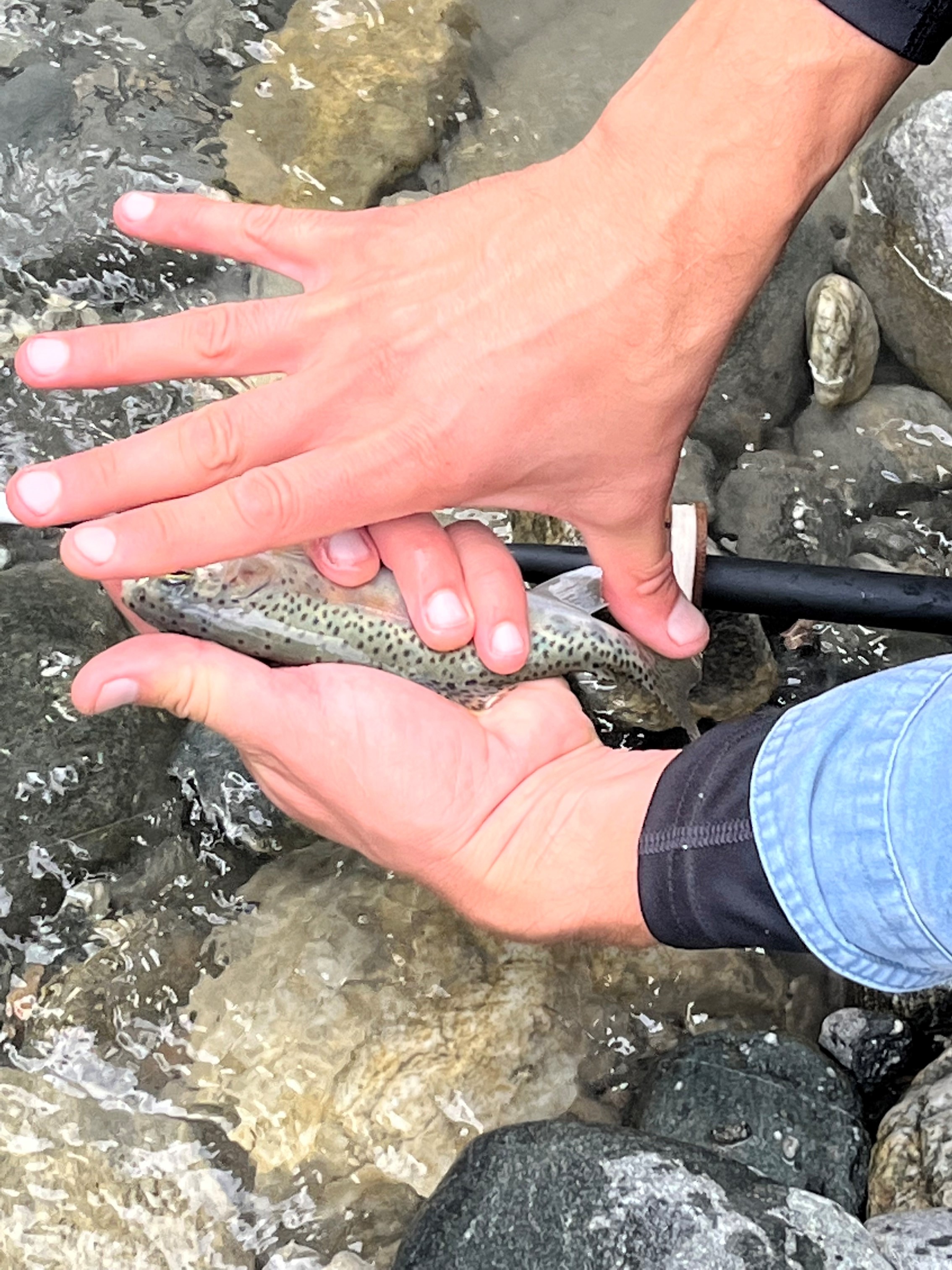
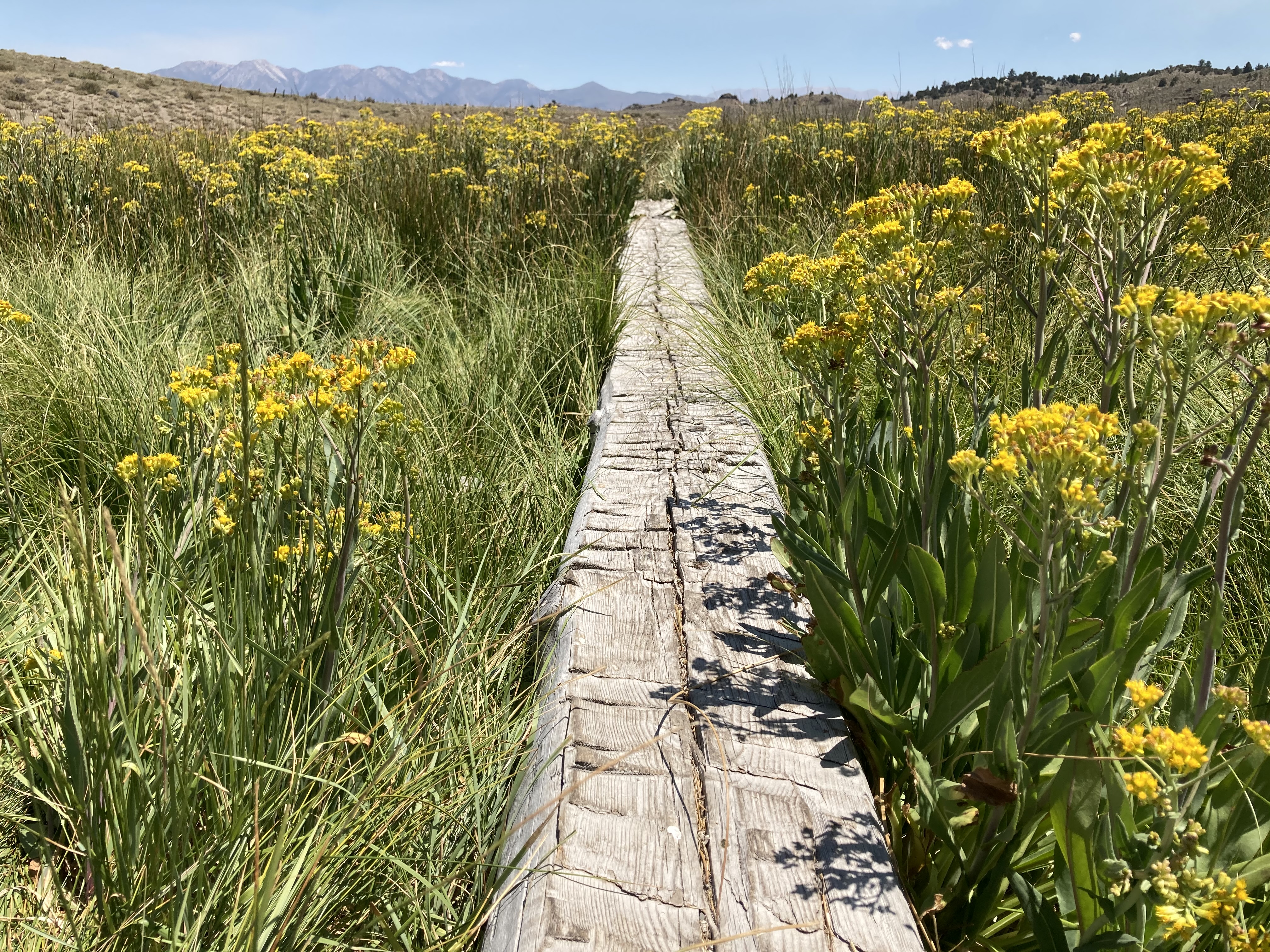
Oh, and don’t forget to fish! At the top, the left shot is from the West Fork and the right, from the East Fork.

See you on the river, Jim Burns


Larry Pirrone

When I first started fishing the West Fork I was returning from a long layoff from fishing local waters. I was just starting a new business and up the street was Alex Seimers fly fishing shop and Ray Bianco who got me back into fly fishing. Life was good. Then it started. A huge flush of mud released from Cogswell. Years later the stream was back and so was I. The Stream Born Fly Fishing club was still alive. I was catching fish on the WF again. I was catching two trout at a time on a two fly rig. Then it happened. The Center for Biological Diversity who could care less about human family fishing recreation helped kill off a load of trout. Who knows how we let this happen or why it happens. I am hoping that the fishing will get and stay healthy for me to recapture some of the good times. At 78 I don’t have a lot of time. How can we protect this great resource?


Jim Burns

Thanks for these great comments, Larry! What was the Stream Born Fly Fishing Club? As for protecting the WF, I think a lot of people have that same idea, but it is the “how” that hasn’t yet come into focus. John Tobin, Pasadena Casting Club’s former Conservation Chair, had this to say: “My big concern is the poor invertebrate recovery so far.  What are these fish eating, besides our flies?  I’ve turned over a few rocks and don’t see much yet.  We need an invertebrate survey.”

Scott Boller

Well said, Jim! Happy Holidays!


lariverboy

Jim,
What an honor to be mentioned. Having Rebecca by my side (and very much enthusiastic about the quest) and the added prod of CalTrout asking me to seek maximum clarity on these SoCal hills and their ever-persistent trout has kept me banging my shins and removing ticks for what seems to be forever and it is far from over. All in the name of locating even a tiny fish in a tiny trickle that has been “smote by God” as someone once said 😉 The Cogswell conversation is always entertaining. It is constantly manipulated and the entire region has these crazy moments of boom and bust. There’s little rhyme or reason except for the obvious one: if there’s some water then there’s some chance. I will bite my tongue with respect to the Bobcat Fire and the following winter’s muddy runoff. Simply mind-blowing how happy the WFSG was before that terrible volley of events. Gosh I could go on. 

As for age, time, etc. you know, a game I very often play is to challenge myself with the humor or irony of finding fish virtually roadside. This includes the access on the WFSG but there are a surprising collection of non-stocked trout populations; legal to fish for; within 500 feet of one’s parked car in So Cal. 

Scott,
I think the concern about invertebrate life as a food source is totally valid however it is not unheard of for a trout to make terrestrial’s a substantial percentage of their diet. Just throwing that out there for the sake of the discussion. Now, in the case of an area that is also denuded by fire then, sigh, yeah, we have very hungry fish and an ecosystem that needs some time to recover.

Larry,
Ray continues to appear from time to time at fly fishing events. His casting skills dazzle me and last time I saw him (less than a year ago) he sported some boots that even the Beatles would envy (with Cuban heel too by the way).

I am not intimately familiar with the center of biological diversity is actions of what you speak. There are a handful of moments in Southern California where they have influence the course of an ecosystem. I would be surprised if a deluge of silt or mud was intentional given how they are so fond of amphibians. Speaking of which, protections initiated by them for a particular So Cal endemic toad has actually done wonderful things to protect a few pockets of wild trout including some with primarily native genetics. * And not always resulting in an angling closure.

In closing …This last wet year has helped several local populations of trout get a breath of fresh water and if we have what amounts to an even “normal” winter, I think next year is going to be glorious in the “locals” and give us all some joy.

– Bernard
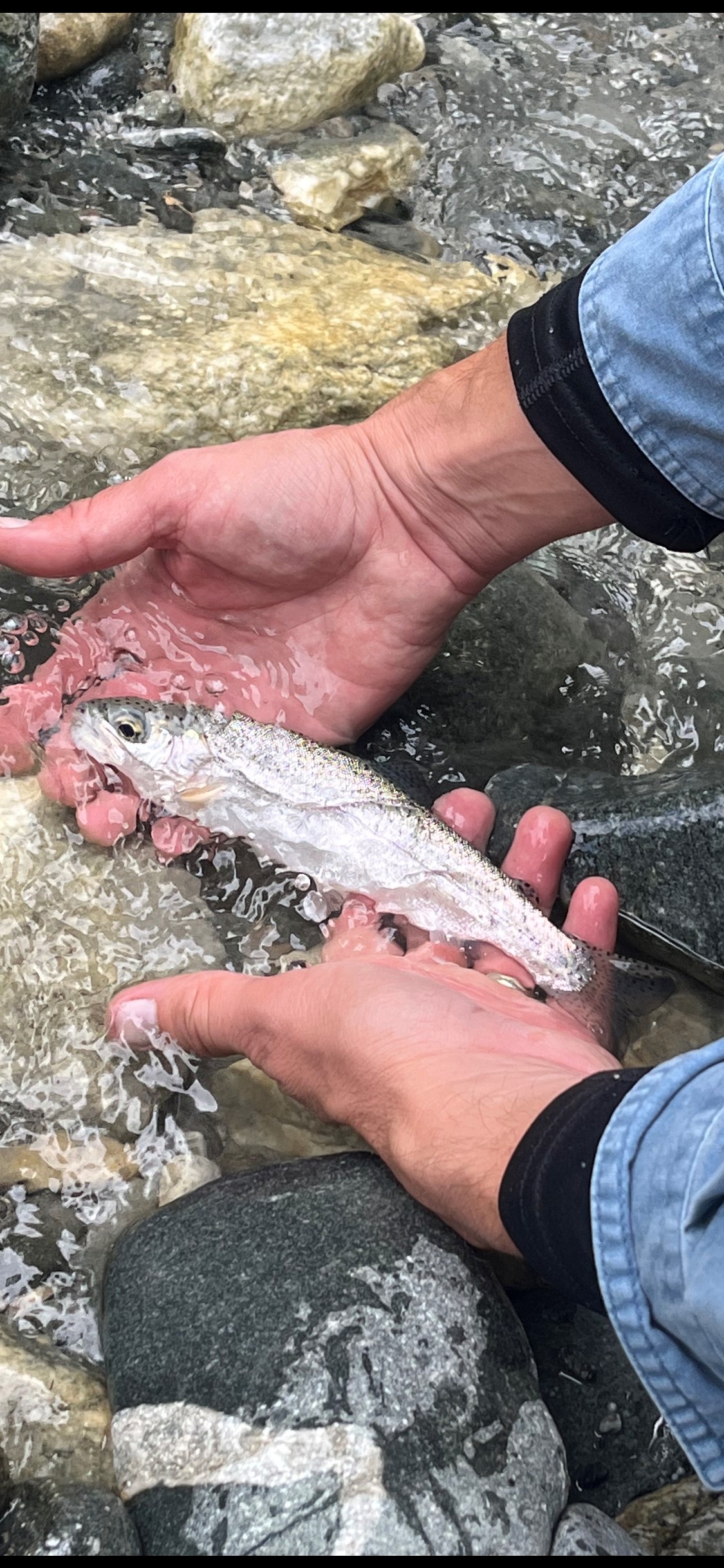
East Fork continues to produce quality ‘bos

CalTrout Photo Contest opens today

Now Accepting Submissions for CalTrout’s 2022 Photo Contest!

Show how you enjoy California’s natural beauty through your lens.

SUBMIT PHOTOS BY AUGUST 31

Join CalTrout’s annual photo contest by sharing your best photos of California’s rivers, wild fish, and your outdoor experiences. Remember to #KeepFishWet. Photos may include fish, anglers or others enjoying California waters, or be more scenic in nature. View the 2021 Photo Contest winners.

Enter today for a chance to be featured on CalTrout’s website and in CalTrout promotions and to win some great prizes. Photos must be submitted by 11:59 pm PDT on August 31, 2022. Give us your best shot, and good luck!

Winners & Prizes:

Featuring prizes from California Trout, Galvan, YETI, Redington, Patagonia, High Camp Flasks, Sunday Afternoons, and Buff.

  • GRAND PRIZE – 1 Winner
    Your photo featured on the CalTrout website and in CalTrout promotions, a one-year CalTrout membership, a CalTrout custom Galvan Torque T5 Reel, a YETI flip-top soft cooler with CalTrout logo, a High Camp Flasks Firelight 375 flask with engraved CalTrout logo, a CalTrout Buff, and a CalTrout fly box ($1,050 value).

Right now, the world needs a small miracle

What are the chances against catching a little Rainbow Trout in Southern California? After this quick pic, he was back in the water, healthy and vigorous. (Credit: Jim Burns)

What are the obstacles against catching/releasing a native Rainbow in our local waters? Let’s list the Big Three:

Ongoing drought since 2001, which tree rings show is the driest 21-year period since at least 800 A.D. when Vikings sailed and Mayans built temples. (San Jose Mercury News)

Frequent forest fires, including 2020’s Bobcat Fire, which devastated the West Fork of the San Gabriel River. Local fly-fishing club members report there are no fish in a stream beloved by us all. I would add the footnote, “for now.”

Beginning in the 1930s, channelization to prevent flooding, dams and development block rainbows from returning to the Pacific Ocean and, conversely, steelhead from returning from the ocean to the San Gabriel Mountains to spawn.

Yet today, there he was, in a flow of cool, clear, crisp water. Small and full of fight, he glimmered like a slim beacon of hope.

In a world of seemingly unrelenting bad news — disease, gun violence, war and now economically crippling inflation — this is why I continue to trek in our local mountains and continue to cast a line into the seemingly impossible. In our waters, there are still possibilities, there is still hope. Remind yourself next time you are on the water that the mere act of continuing what for many of us is a retreating normal, miraculous life remains.

See you on the river, Jim Burns

An Urgent Appeal to the SoCal Fishing Community to Save Arroyo Seco Trout

This small rainbow was caught last year before the Bobcat Fire destroyed the West Fork, closing it into 2022. Several hundred rainbows were transported to the Arroyo Seco for safekeeping. With water levels already very low, this is no time to divert more water for use by the City of Pasadena. (Credit Jim Burns)

UPDATE: The Pasadena City Council hearing has been continued until Monday, July 19, 4:30 p.m.

From Tim Brick, Arroyo Seco Foundation:

We need your help to save Arroyo Seco trout now!

The Arroyo Seco Foundation is working to restore conditions for steelhead in the front range of the San Gabriel Mountains. Yes, steelhead – the anadromous form of Coastal Rainbow Trout. We are collaborating with a variety of agencies and organizations on the LA River Fish Passage Program in downtown Los Angeles and on an assessment of watershed conditions in the mountainous reaches of the Arroyo Seco.

Pasadena has prepared an Environmental Impact Report on the Arroyo Seco Canyon Project (ASCP), which will increase water diversions from the Arroyo Seco stream, a major tributary of the Los Angeles River system that is critical to steelhead recovery prospects. ASCP will build a new five-foot dam and diversion facility to divert additional water from the Arroyo Seco stream for domestic use by the Pasadena Water & Power Department (PWP).

The National Marine Fisheries Service has declared the Southern California steelhead an endangered species and prepared a steelhead recovery plan that includes the Arroyo Seco and the Los Angeles River.

The goal of this recovery plan is to prevent the extinction of southern California steelhead (Oncorhynchus mykiss) in the wild and to ensure the long‐term persistence of viable, self‐sustaining, populations of steelhead distributed across the Southern California Distinct Population Segment (DPS). It is also the goal of this recovery plan to re‐ establish a sustainable southern California steelhead sport fishery.

While the Arroyo Seco was once home to a thriving population of rainbow trout and steelhead, steelhead have been blocked since 1920 from returning to their mountain home in the Angeles National Forest. Native Rainbow Trout have been present since then in the Arroyo Seco, although the Station Fire and the extended drought of recent years have made conditions difficult for those fish.

Based on survey techniques described by the California Department of Fish and Wildlife as inadequate, Pasadena’s ASCP EIR states that there are no fish in the Arroyo. Pasadena’s projections for water availability are based on historical weather and streamflow patterns and do not consider the likely impact of climate change. The design of the new dam and diversion structure do not provide for two-way fish passage around or through those facilities nor for an environmental flow to protect the fish and aquatic species during dry periods as required by CA Fish and Game Code Sections 5901 and 5937.

Throughout the environmental review, the Arroyo Seco Foundation has asserted that Rainbow Trout are still present in the Arroyo Seco and that Pasadena has done an inadequate job of finding and documenting them. The ASCP EIR was tentatively approved by a Pasadena hearing officer on January 6th, but ASF joined with the Pasadena Audubon Society and several individuals to block EIR certification by appealing the decision. The matter was then considered in March by the Pasadena Board of Zoning Appeals, which added a few new conditions to the EIR. ASF and PAS again appealed that decision and forced EIR certification to be considered by the Pasadena City Council. A hearing date for that matter has now been set for next Monday, July 12, 2021.

During the appeal period, the California Department of Fish and Wildlife (CDFW) announced that they had conducted a Rainbow Trout rescue program on the West Fork of the San Gabriel River after the Bobcat Fire last Fall. CDFW personnel translocated 469 native Rainbow Trout into the Arroyo Seco canyon in the area to be impacted by Pasadena’s ASCP program.

Faced with irrefutable evidence of the presence of many Rainbow Trout, Pasadena has not changed its position regarding the design and operation of the new dam and diversion structure that they plan to build. They state that when steelhead passage from the Pacific Ocean is restored, they will evaluate various ways to meet the requirements of the relevant sections of the Fish and Game Code.

The Fish and Game Code requirements for fish and passage and environmental flows, however, are not limited to steelhead trout. They apply to any fish as well as to other aquatic species that would be trapped by the PWP facilities. Clearly it will be difficult and expensive to retrofit the dam and diversion facilities at some distant point in the future when the steelhead return. This is the time to do it to protect the fish that are there now and to establish better conditions for the future.

We are disappointed in Pasadena’s cynical dereliction of its environmental responsibility. We believe that Pasadena and its Water & Power Department must be good stewards of the natural resources they exploit.

Send a Letter to Pasadena Mayor Gordo and the City Council Today

We urge you and your organization to send a letter to Pasadena Mayor Victor Gordo (vgordo@cityofpasadena.net) and the City Council this week urging them to require PWP to alter the design and operation of any new dam and diversion facilities to accommodate fish passage and to provide an environmental flow during critical periods as required by Fish and Game Code Sections 5901 and 5937.

Please contact tim@arroyoseco.org if you have any questions or need any further information.

Information about the Arroyo Seco Canyon Project – https://www.arroyoseco.org/ascp

How to Contact Pasadena Officials –  https://www.arroyoseco.org/tellthecouncil.htm

Translocation of Rainbow Trout to the Arroyo Seco from the Bobcat Fire Burn Area – http://arroyoseco.org/documents/cdfwarroyo.pdf

LA Times Article – http://www.arroyoseco.org/documents/lattrout20210617.pdf

Native Fish in the Arroyo Seco –

Cause Celebre: How a trout rescue on the q.t. ignited a water war in Pasadena

An incredible story of disappearing water, relocated trout and the thirsty needs of Pasadena.
Once known for its fly-fishing close to home, the Arroyo Seco above Pasadena’s Jet Propulsion Laboratory has become an unwilling poster child for all the calamities trout face: devastating fires, ruinous mudslides, parching droughts and , of course, human pressure. (Jim Burns)

An amazing story from the incomparable Los Angeles Times environmental writer Louis Sahagun: “In an era of increasing drought and nearly back-to-back wildfires, state conservationists have been working overtime in the San Gabriel Mountains to rescue frogs, fish and other species facing potential oblivion by rounding up populations of threatened animals and transporting them to safer areas.

While most of these efforts have occurred in obscurity, one recent mission to save hundreds of doomed rainbow trout has touched off a heated battle between humans and fish over the clear waters of Pasadena’s Arroyo Seco. The controversy has also served to highlight the challenges wildlife biologists now face as they search for havens amid Southern California’s patchwork of urban development, wildfire scars and seasonal mudslides.”

Disease halts fish stocking from Hot Creek Trout Hatchery

Hot Creek is known to Southern Californians for its challenging fly fishing and pristine views. (Jim Burns)

UPDATE: As of June 17, the hatchery is once again open.

Thanks to guide and Mammoth local Chris Leonard for this news:

The California Department of Fish and Wildlife (CDFW) has suspended all fish planting from the Hot Creek Trout Hatchery in Mono County as a bacterial outbreak has been detected at the facility.

“Unfortunately, the timing couldn’t be worse with the holiday weekend coming up, Mule Days taking place in Bishop and a lot of people coming to fish the eastern Sierra this time of year,” said Jay Rowan, Acting Fisheries Branch Chief for CDFW. “We don’t yet know the extent of the outbreak at Hot Creek Hatchery, but we do have the advantage of some additional tools in our toolbox now versus a year ago, including recently developed vaccines that we started rolling out to fish at the three previously infected hatcheries earlier this month.”

 The three other CDFW trout hatcheries in Southern California and the eastern Sierra are the Mojave River Hatchery, Black Rock Trout Hatchery and Fish Springs Trout Hatchery. That outbreak ultimately forced the euthanization of 3.2 million trout at those hatcheries.

Volunteer Opportunity: Help stock Hot Creek, electroshock Mammoth Creek, Sept. 26-Oct. 6

Hot Creek
HOT CREEK has been a mecca for fly fishers for decades, and now is in trouble. (Courtesy California Fly Fishing)

Note: This is from Pasadena Casting Club, but has broad appeal to the fly fishing community. — Jim Burns

Dear PCC members,

As you probably know, Hot Creek has essentially crashed over the last year or more: few fish, small fish.  Recent DFW electroshocking bears this out.

Dr. Mark Drew, eastern Sierra CalTrout Headwaters project director, told us at our September meeting that a perfect storm of factors is probably responsible.  He listed the opening of Hot Creek to winter fishing without the promised Department of Fish and Wildlife annual health monitoring, the prolonged drought and the concomitant 50 percent decreased in the flow of the spring that feeds the stream as probable causes.

This year for the first time in memory, Mammoth Creek dried up briefly.

DFW has done a quick study and finds no issues with water quality or food availability.  Under pressure from the community that would suffer economic loss if the fishery does not recover, they have decided to stock HC with diploid rainbow trout, which can mature and reproduce.  CalTrout and DFW are asking for our help.  Here are the details.

Monday, Sept. 26 through Friday, Sept. 30:  help electroshock Mammoth Creek.

Thursday, Oct. 6: help with the placement of 6,000 fish in Hot Creek.  (They plan to place 12,000 per year for several years, and do electroshock surveys to see how the spawn is doing.)

If you can participate in either or part of these scheduled tasks, please contact Dr. Mark Drew at mdrew@caltrout.org

or call him at (760) 709-1492.  He will provide snacks and lunch.

Also please let me know if you are participating.

Thank you.

John Tobin

Conservation Chair

pmd6x@yahoo.com

Spring signals tentative rebirth of So. Cal’s beloved West Fork

By Steve Kuchenski
Guest Contributor

YES! Trout are back, albeit in smaller numbers, on the West Fork. (Steve Kuchenski)

So, I decided to ride my bike up near the base of Cogswell Dam yesterday, just to scout out conditions. As you can see from this YouTube link, the West Fork is as challenging as it is beautiful!

The late morning started out with hazy sun, and by the time I started fishing at 10:30, it was cloudy and cool. I didn’t see any major hatch, though at some places there were plenty of black gnats that were fascinated with my sunglasses. The water upstream seemed slightly cloudy, and the riverbed is still dark (and slippery!)from last fall’s leaf liter, so it is nearly impossible to see the dark shadows of fish amid all the protective structure.

At one pool, I saw no signs of feeding or other activity. I tried various drys and midges without any response,

BUGGY spring comes to the West Fork. (Steve Kuchenski)

but I’ve been told that when nothing else seems to be happening, try a woolly bugger. This approach was immediately rewarded with four-five flashes, each probably between 5-to-8 inches long. I don’t have any significant experience stripping WBs, so it took me awhile to get the hang of it, but eventually this 6-inch rainbow totally gulped the WB.

I stopped at several other pools, riffles and plunges along the way. I saw one fish flip out of the water, but never landed

WITH proper care, this little guy will grow up to make us all proud. (Steve Kuchenski)

anything after that, despite drifting multiple flies and midges. There were stoneflies, ants and other terrestrials out in force, but the fish remained hunkered down, and I don’t know if it was due to the low pressure of the impending storm, or the lack of a hatch, or just my own technique.

You have to bring your best game to the West Fork. I think it’s good that we’ll each spend a concentrated effort on individual segments of the river: It will give us a chance to see what works best for any given riffle or pool.

And, in any case, it will be a beautiful day.

Earth Quotes: Dick Roraback’s ‘In Search of the L.A. River’

Once electric Red Cars delivered passengers all over L.A., which is celebrated in this riverly mural.(Barbara Burns)
Once electric Red Cars delivered passengers all over L.A., which is celebrated in this riverly mural. (Barbara Burns)

Back in the day, Dick Roraback represented the journalist I wanted to become: after being graduated from The Sorbonne, he’d worked on the Herald Tribune in Paris (While on assignment in Africa, he’d somehow bamboozled the desk into publishing his story with the byline “By Ghana Rehah,” which got him suspended.); he was worldly, snide, grouchy, looked very old, and ripped through my fledgling restaurant reviews in a torrent of computer red ink. He seemed to me a refugee on the Los Angeles Times copy desk, a bit of the lion in winter. At the time, I wanted nothing more than to be like him — bold, intelligent and brash, thumbing his nose at the world and having a great time doing it.

I did wonder how this talented writer landed on the copy desk, reading the works of others, but no longer producing himself. Maybe “be brash in moderation,” I thought to myself.

By the time he’d again taken up ink and plume, I’d moved across town to become the travel editor for the Herald Examiner, and I didn’t read his series “In Search of the L.A. River,” published between 1985 and 1986.

In a recent paper entitled “Writing a river: how journalism helped restore the Los Angeles River,” academic Tilly Hinton argues a strong case for Roraback’s contribution to raising awareness about the river, and how this awareness helped to create the political will for change. She credits him alongside poet and FOLAR founder Lewis MacAdams as two pillars of the event.

I think Roraback would feel peeved to think of himself as a pillar of anything, and from what I’ve read MacAdams was none too pleased with the snarky tone Roraback used in his pieces. (For that matter, MacAdams also seems a wholly unlikely pillar, yet that he is, with a recent riverside plaque to prove it.)

For the series, which began at the river’s mouth in Long Beach and moved up to the headwaters, Roraback invented a character named “The Explorer.” At one point, The Explorer visited a man who kept an aquarium of fish captured from the river:

“Up in Atwater Glen on the other side of the channel, Tom Babel, manager of the riverside Port of Call apartments, allows as his community is a peaceful enough place to live –“You just gotta watch your back.” Just north, it seems, is “Toonerville, where anything goes.”

Even so, Babel likes living by the river, though he keeps his RV primed for a quick exit. “There’s been occasions when the rain got heavy and the river got two feet from the top of the bank,” he says. “I’d already started packing my important papers in the RV, ready to head for the high ground. . . . “

Larry Wickline, Babel’s stepson, takes a kinder view of riparian life.

“After the rains,” he says, “there’s rainbow trout this big! Keepers! You get catfish, carp, crayfish. Come up to my apartment. I have something to show you.”

Indeed he does. In Wickline’s flat is an illuminated fish tank holding an amazing variety of fish — gold, brown, white — all taken, he says, from the Los Angeles River.

“Good fishing when the river comes up,” Wickline says, “Except sometimes you can’t take a step for all those tiny snakes.

“It’s not so much the snakes, though, as the gangs. I wouldn’t go down there without a gun. At night, I wouldn’t go down there at all. . . . “

What I find particularly interesting about this passage is that, if true, rainbow trout were still in the river in the mid-80s, contrary to everything I’ve read about their disappearance from the river decades earlier.

The series certainly sparked interesting letters, including this one from Gene Lippert of Hacienda Heights:

“Just a note of appreciation for all the hard work Dick Roraback put in to bring us his fascinating story of the present Los Angeles River (‘In Search of the L.A. River,’ an occasional series.) I am following his tale with great interest.

“You see I lived my Tom Sawyer youth on the Los Angeles River in the area of the Imperial Highway bridge. That was before the ‘big paving extravaganza.’ We skinny-dipped in the pools, caught crawdads by the dozen and boiled them in an old can filled with river water and a dash of vinegar. We always kept supplies such as salt, pepper, coffee, cigarette butts (good for a couple of more puffs) in tin cans buried in the river bank. Small-sized trout were plentiful and easy to catch on a bent pin (had to jerk the fish out of the water and onto the bank the first time he nibbled or away went your bait). We slept overnight in the river bed most of the summers (dry, clean white sand). We were almost ridden over by a bunch of horses one night while sleeping. We had made camp in weeds four or five feet high and the fire had gone out.

“One time we stole redwood from an irrigation flume and built a boat. We got our caulking by digging the tar from between the expansion joints in Imperial Highway and melting it over a bonfire. The boat was a bust — it kept tipping over.”

So now I find Dick’s shadow once again moving across my writing life. Sometimes unlikely people follow you through time in the most unexpected ways.

See you on the river, Jim Burns