With water conditions changing weekly, it’s essential to keep up to date with current reports before heading out on your next fishing adventure.
With three out of the four estimated runoffs complete, the Los Angeles Department of Water and Power is doing a good job at monitoring and controlling these flows thus far.
Hot Creek has been the “hot ticket” lately, with the most consistent and productive fishing. With water conditions looking Fair and showing 318 cfs as of last week, just below the 395 on Mammoth Creek. As long as Mammoth Creek stays clear, Hot Creek is worth fishing.
Crowley Lake has picked up and is much more consistent than in the last few weeks. With the water level lower, due to DWP making room for the runoff, it’s filling up slowly but surely. The best fishing has been late morning before the winds pick up.
The Upper Owens water conditions are starting to clear up and slowly improve. Even though the water is starting to clear, it is still very high, limiting fishing conditions. Better reports are coming from above and below Benton Crossing, where some big Rainbows are heading back to the lake.
The Lower Owens and East Walker have poor water conditions and dangerous fishing. Check back in a couple more months and hopefully by fall, we will see some clear water and fishing areas.
Pleasant Valley Reservoir is open but only from Gorge Road at the upper end. DWP is expecting the campground below the reservoir to flood in the near future
Here are a few tips and words of wisdom from veteran guide Pat Jaeger…
1. When the river flows are massive, go upriver; when it’s little, go downriver.
2. When you fish runoff-affected rivers, start early. The water temperature is the warmest of the day, and water flows, the smallest. (Runoff normally peeks mid- to late- afternoon into the night).
3. Look for reliefs of current (it’s all math). Fish will feed in fast currents, but hold up in calmer.
4. The angler who puts the fly in front of the fish wins. (When fish are up, use dry flies; when fish are down, use nymphs). Big river years, do your best to find the bottom, that’s where the fish are.
Adapted from Bob Marriott’s Fly Fishing Store newsletter
BEFORE AND HEARTBREAKING AFTER pictures of Twin Lakes, above Mammoth Lakes, Calif., from July 21 and today. The Creek Fire, which is not in Mammoth, has burned more than 338,000 acres with full containment expected by Halloween. (Courtesy BiBi Photography)
This summer, we read about some terrible accidents in our outback. In July, three members of a church group went over Vernal Falls in Yosemite and died. According to the L.A. Times, Gov. Jerry Brown said, “It made me shake just looking at him. It’s dangerous. If they slipped, they would have went (sic) right over,” speaking about his reaction to a child standing near the edge of a steep drop-off in the park. This year’s death toll is 14. An estimated 4 million visitors enjoy the park each year.
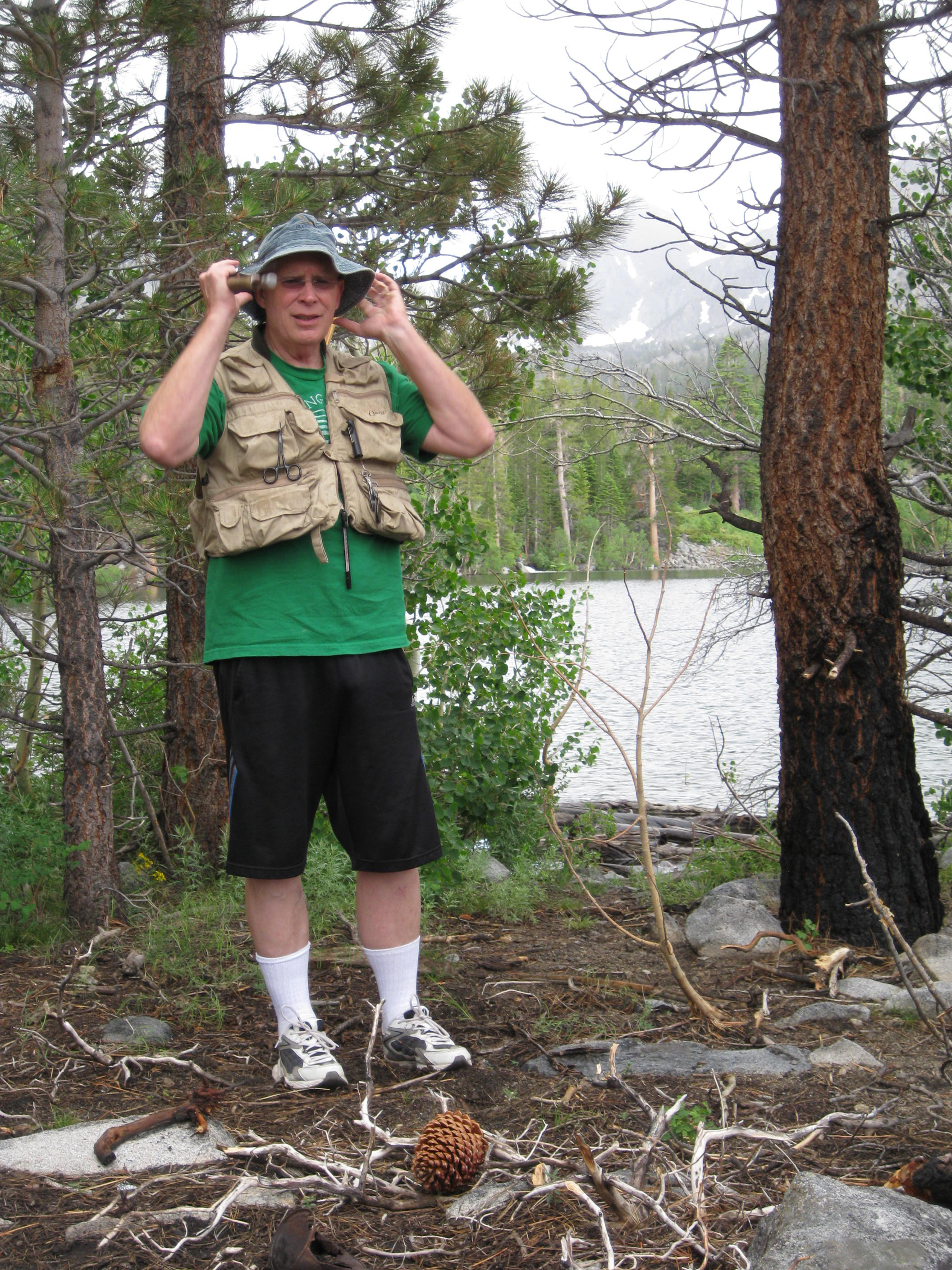
NOT DRESSED FOR SUCCESS: 60 degrees feels mighty cold when you're already wet. (Barbara Burns)
Closer to home, two hikers in separate incidents both died while hiking near the second waterfall at Eaton Canyon in Altadena.
Fly fishing — even car fishing — usually involves a combination of hiking, stream crossing and wading. Unfortunately for me and for those I’m with, I have a reputation as a “cavalier wader.” Swift water has never fazed me. I would only use a wading stick reluctantly, because it makes casting difficult. And these days, it seems like if I can’t go in tennis shoes and shorts for both hiking and “wet wading” (when you forego the protection of breathable waders), I don’t go.
After this summer, however, I’m revising my old game plan.
Swift, swollen streams have been the norm this year, and I can’t stress how important it is not to take chances. Two weeks ago, I looked into the clear, shallow water of the north fork of Washington’s Stillaguamish River and thought “What the hell, I’ll be across in no time.” Although I did get across the several dozen yards to the other side, the round, mossy, river rocks kept me off balance and the current, even in just two feet of water made for a hazardous crossing. Would I do it again? Yes, but not in sneakers and workout shorts.
Earlier in the summer, my wife and I hiked up to a lake in the Sierra. It was so close to Mammoth that we let our guard down by wearing summer clothes, and took off up the trail. One clue that you’re doing something wrong is meeting a stream of hikers returning to the trailhead — and not a soul on the way up.
Within an hour, the sky changed from yummy summer to rain, then to hail, then back to rain, then back to hail. For a bit, we took shelter under a rock ledge. When we finally arrived at the lake, we were wet and the air temperature read 60 degrees on my stream thermometer. As the wind whipped across the water, I froze my ass off and realized that, yes, my own hubris meant that after a strenuous climb, fishing was way out of the question. Double-time back to civilization.
Get wet enough and your body’s core temperature can drop to a point that you’re in trouble. After hearing our Mammoth tale, neighbor and inveterate hiker Jim Cullen recalled a Sierra backpacking trip during which one member went into hypothermia. They stripped off his clothes, put him shivering in a sleeping bag and had another hiker climb in with him. Both were nude. The man recovered after several hours.
So what can you do to hike and wade safely?
First off, get the right shoes or boots. Visit the local R.E.I, Orvis or whatever. Buy something sturdy that will fit your needs. My boot soles include small spikes that help me — mostly — not to slip.
Next, realize that surfaces you encounter will not be like walking on city asphalt. Self-evident — even silly — but it’s so easy to fall and hurt yourself — or worse. Shale, for example is slippery and unpredictable. It was the most probable cause for one of the deaths in Eaton Canyon. If you’re moving down a hill, be sure to check your footing before attempting to descend. And, ask yourself if you can get back up that grade when you’re tired after day’s end (And, of course, can you find your way back to it!).
If you’re in the water, remember that where you think the bottom is may not be where it actually lies. The Pitt River up north is notorious for its fast water and looming pocket holes. That’s one river in which I always using a wading stick. An errant hole caused by rapid water circulation over the years can snap your ankle in a matter of seconds.
Finally, always check the weather report before you go. In So. Cali., that may seem silly, but in the Sierra, weather can rapidly change. If you’re going into the wilderness, dress in layers. Bring an emergency kit with you, even if it’s just extra water, extra energy bars, a poncho and matches.
And always let someone know where you’re going and what your e.t.a. will be. It’s better to get yelled at by your significant other if you’re late because the rise was too good to leave, than to be stuck under a rock outcrop, freezing your behind off, knowing she doesn’t have a clue where you are.


 lariverflyfishing