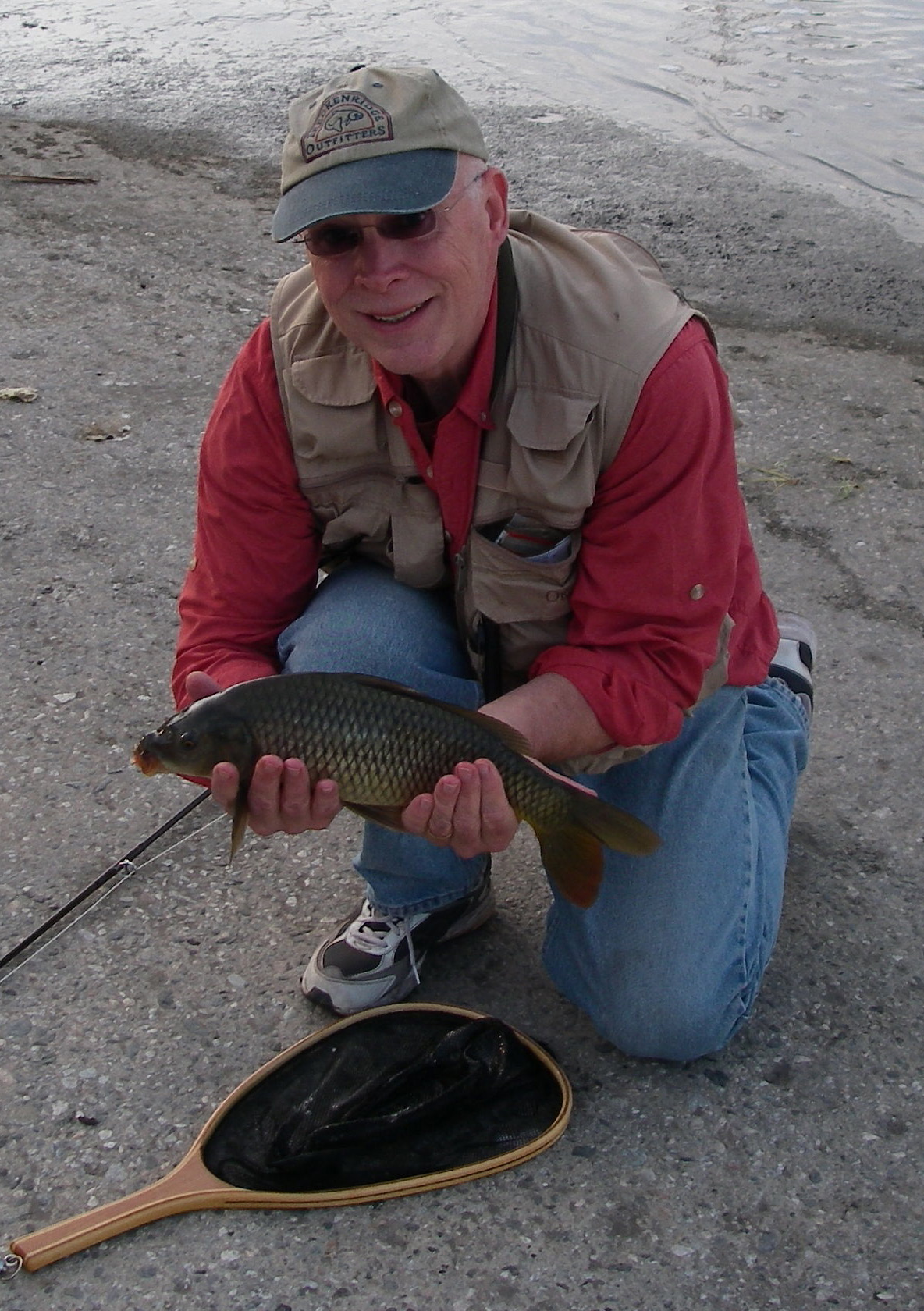
Nothing like catching that first fish on a new reel. (Courtesy David Wratchford)
Update: May 29, 2015. three outings, no carp in the net.
Summer carp journal
Saturday, May 23, 4:30-7:30, overcast, 70, 12 pound tippet. One carp charged and then turned away from a swimming nymph, rust brown dubbing with lighter rabbit tail (size 8).
Tuesday, May 26, 2:30-5:30, overcast, 70, 2X tippet. After rejections on bead head black wooly worm with red yarn tail and bead head swimming nymph with crazy orange dubbing and lighter rabbit tail. (size 8) hooked up on a carp dragon (Orvis). Carp eventually got free because I didn’t set hook deep enough. Saw about 50 pass me in the water, few feeding. Saw the white one again.
Thursday, May 28, 2:30-5:15, clear, 81, 3X tippet. Fish swam up to all of my flies, except the squirmy wormy. That means tortilla fly on red hook, terminator glo bug in chartreuse and orange, all got mighty big looks, but ultimate rejections. Saw the white boy several times, and there were lots and lots of carp. Also, again, “muddling” by one really aggressive fish, but it’s hard to see which way the fish goes through the mud. Also, chummed with two cans of corn to pretty negligible results. The tortilla fly is a dead ringer for canned corn. Didn’t make any difference.
Commenter Steve recently asked me: I’ve been down to the river several times and seen some beautiful and fishy waters, I have had no luck whatsoever hooking up with carp there. Any tips? Should I be sight fishing only, or should I toss my glo-bug in riffles, etc, “trout-like” spots? Are you moving around a lot or focusing on a particular spot for a while?
Great questions. Hope that my response will lead to more catches for more fisherman.
Catching carp on the river is tough, no doubt about it. Your best bet is to spend some time in a section and, yes, look for fish. Once you’ve found them, check out their behavior.
If they’re swimming quickly upstream, they won’t feed. If they’re circling quickly, ditto. If they are jumping out of the water, forgetaboutit. What you want are fish close to the bottom (you’ll be able to see them) that are actively feeding. Throw your Glo-Bug (chartreuse is good) upstream about six feet. The fish are also super-spooky. If the egg passes above their heads, add a bit of weight. You have to basically float it past a two-to-three foot feeding cone. Then — bam — listen to your reel whine!
SEPULVEDA RECREATION BASIN, Calif. — As city councilmen Ed Reyes and Tony Cardenas carefully navigated their footsteps through mud and into strategically positioned kayaks, there seemed nothing particularly momentous about kayaking today in the Los Angeles River. Aside from the digital news cameras and lack of a dock, you’d never know that this paddling event stretched across layers of federal, state, county and city bureaucracies.
AHOY, MATEY: Councilmembers Tony Cardenas, front, with Ed Reyes, far rear, enjoy a day on the river. (Jim Burns)
After all, there has never been a non-motorized boating program in the river. That’s never, as in never. And, for that matter, there has never been anything officially sanctioned and remotely recreational about hanging by — much less in — its perfumed waters. The Army Corps of Engineers had to sign off on the safety of the project, which is hoped to lead to a permanent yearly, seasonal, recreational boating program. (Note, the seasonal part …)
The two influential Los Angeles councilmen kicked off the pilot paddle that continues the progress of revitalizing our river after midday, under a bridge with cars zipping along overhead. An L.A. moment.
Beforehand around 100 listened to speeches with more enthusiasm than is found at the typical ribbon cutting. Environmental organizations, including Friends of the River, The River Project and Mountains Recreation and Conservation Authority, lined one side of the small green park just above the launch site, and handed out fliers, t-shirts, and newsletters about their efforts to turn back the river clock to a time before its concrete channelization in the 1930s. Those efforts by the federal Army Corps of Engineers and local authorities came in the wake of disastrous flooding, which killed Angelinos and destroyed millions of dollars in private property.
The mainstream media, which largely ignores riverly happenings, were there in force, including Spanish language KMEX, with one reporter so busy tweeting from her station aboard a two-person kayak that Cardenas chided her, saying, “you’re supposed to out here enjoying nature.”
Councilperson Reyes said it best: “This is a moment when we get to make Angelinos believers. We are able to make them really believe that they have a river in their city. That there truly exists a whole ecosystem. Birds. Wildlife. Water that connects and drains into the ocean, an ocean that is dying.
“It’s a moment when we can look at a natural asset, set aside our biases, our prejudices, the ‘us vs. them, we live on this side of the tracks, they live on that side of the tracks,’ and talk about one city. And this river will get us there.”
Certainly the Obama administration feels the same way. The recent inclusion of the Los Angeles River — one of seven city waterways — in the Urban Waters Federal Partnership spotlights federal efforts to connect city neighborhoods to the water.
Even the National Park Service was on hand. “I think it’s essential if we are going to make these kinds of properties available to urban folks that we bring it in as close to their communities as possible. And this is a great demonstration of how to make it accessible … because this is where the starting point of building a stewardship ethic begins, right in their communities,” said Charles Thomas, Pacific West Regional Youth Programs Manager.
The pilot program is modest, with Fridays reserved for youth groups, and two public recreation-education trips, Saturdays and Sundays, from Aug. 13 to Sept. 25. Ten paddlers per trip will explore this natural mile and a half section of the river in the Sepulveda Recreation Basin with a ranger/naturalist from the Mountains Recreation and Conservation Authority. Do the math and only 280 folks out of a county pushing 10 million will be able to participate. Tickets are $50, plus a $3.74 handling fee. This covers boat rental, safety equipment and insurance. Scramble for tickets here.
A snarky tweet from Kim Cooper summed up opposition to the plan: “Thinks it’s lame that people are being charged to kayak down the Los Angeles River, a public, navigable waterway. Tom Sawyer wouldn’t pay,” to which we can only reply, true, but it’s also no longer 1876.
The bigger question for readers of this blog: when do we get a pilot program for fly fishing the river? Fly rods and kayaks can make for excellent home water excursions!
SAILING, SAILING: Mayor Antonio Villaraigosa (front of canoe) takes a tour of the L.A. River earlier this year. (Courtesy Sepulveda Basin Wildlife.org)
Well, the Army Corps of Engineers listened to all of the responses from kayakers, environmentalists and just plain folks who love the river, and guess what! If you are lucky enough to buy a ticket (cost unknown to me, but I’ll post it when I find out), Saturdays and Sundays, Aug. 13-Sept. 25, you can explore a mile and a half stretch of the water during this pilot program.
Remember, if was just over a year ago that the Environmental Protection Agency declared the entire river a “traditional navigable waterway,” paving the way for recreational usage. Sign up to get a ticket and check out the digital clock countdown. It’s sure a lot better than getting dizzy trying to watch the debt clock.
Last summer, the Environmental Protection Agency declared all 51 miles of the river navigable. This summer … well, it looks as if beginning July 8 for 50 bucks a person you’ll be able to kayak three miles of the rio through the idyllic Sepulveda Basin. For the full scoop, read Louis Sahagun’s piece in today’s Los Angeles Times.
Sign of the times: Kayaking could be coming to a river near you. (Jim Burns)
A shout out to George Wolfe, who was willing to break the law to get this rolling. Another shout-out to Councilperson Ed Reyes, a champion of the river. And to the many, many others (blogger Joe Linton comes to mind) who have pushed, cajoled, persuaded, informed, and insisted that the Los Angeles River must be transformed from a concrete channel to a natural river, for the people’s use and enjoyment.
This poem by Gary Snyder is from his book “Mountains and Rivers without end.” To me, it epitomizes the feeling I get everytime I’m on the river, fishing or not. See you on the river, Jim Burns
Water words: The poet Gary Snyder. (courtesy University of Illinois)
A few days ago, with a half-hour to kill, I put a line in my favorite spot at the river. With trout, that’s usually enough time to hook up, but not with carp. At least, that’s the way it rolls on our river, and for moi.
California Dreamin’: Could we ever be legally kayaking in the river and watching jumping carp? (Courtesy Weekly Times Now)
But I did get to see one jump way out of the pool, then come down in an inelegant belly flop.
Last year, when I started carping, I’d see this and think “Oh, man, am I ever gonna hook that sucker,” but not anymore. Jumping carp are interested in something, but not eating a fly.
So … why do they jump? Fun? Recreation? Boredom?
I checked the bible — “Carp on the Fly” by Barry Reynolds and friends — to find this passage. Italics are mine:
“Shallow-water hell raisers are exactly that: carp that are making a spectacle of themselves by leaping, splashing, and thrashing in the shallows. These fish seem utterly oblivious to the dangers they may face by drawing attention to themselves.
Often, there is a reason for this, particularly in the spring when carp are spawning. As you might expect, spawning fish are usually not very interested in your fly — they have other things in mind.
True, but this happened in June — no spawn on.
But at other times, these hell raisers are carp that are smashing through schools of baitfish and they’re a very good target for a small streamer.
False for the L.A. River. I’ve never seen a school of baitfish on it.
So … what causes this behavior? Here’s an answer from a carp fishing forum based in Georgia:
“Carp actively break the surface of the water for two reasons. Both reasons are due to water quality/lack of oxygen. If the ph factor is too acidic or the dissolved oxygen count is too low carp come up to seek more comfortable conditions. Carp normally stay and feed and roam on the bottom. When they are on the surface they are almost impossible to catch.”
Sounds good, but who knows (except for that last part, which is true, true!)
I put together this poll from various answers found on the Web. Any fish biologists out there care to clear up this mystery?
This post is “The best of times and the worst of times” for me.
How can you not be happy as a fly fisherman to see the city of Ogden and various players have come together to rebuild this urban river? On the other hand, even with the leverage and political will gaining for our river everyday, we have many, many miles to go before we sleep. To wit:
I want to LEGALLY fly fish our river.
I want to LEGALLY kayak in our river.
I want to LEGALLY walk along its banks.
If you know of other restoration projects that readers of this blog would enjoy, please e-mail me. And thanks to Fly Fishing Frenzy for getting the word out on this wonderful restoration project. Watch the video on the site below.
The Ogden River runs right through the middle of the city. This river has had over 100 years of abuse and neglect and now the city and a host of others are doing something about it.
Andy Dufford of Chevo Studios has been chosen to create a public art piece in conjunction with the river restoration project. His proposal “Water Cycle” is a public plaza with seating and interactive sculptural elements located along the banks of the river. (Courtesy Ogden City Arts)
It was one year ago that Ogden City announced their plans for the Ogden River Restoration Project. The river from Gibson Avenue to Washington Boulevard was not a place you would find many fisherman, let alone families. Abandoned houses, litter and industrial waste kept most people from enjoying this river. But since last January a lot has changed.
“We found trash dated back to the 1870′s,” said engineer Crystal Young, Ogden River Restoration Project. “This is a good example of how the river has been filled by urban development in past practices. And so you can see all of this concrete and cars and trash has filled this native bank and buried these trees and built these banks up to where I’m standing now. All of this is going to be excavated down to the tree level and pulled back as you can see upstream in sections we’ve completed.”
The river bank and the riparian zone has been restored to its more natural state. Thousands of tons of debris has been removed.
They’ve taken out five to seven whole cars, about 14,000 tons of concrete, several car parts, thousands of tons of scrap metal, lots and lots of tires, about 250 cubic yards of shattered glass.
“Up near the brewery, it was a layer about six feet deep,” said Clint Ormond.
But this project is much more than just removing the garbage. Over four thousand tons of boulders have been placed on the river edge to stabilize the banks and put into the river to create habitat for fish. 40 thousand new plants will be planted and these storm water returns have been built to filter the cities storm drains.
“As the storm water drains in here, the plants and the pond itself will capture the garbage and the sediment from the streets. Keep a lot of the salt and oils captured in these ponds and keep it out of the river,” Clint said.
“We’ve tried to make aspects all along this project for everybody. We’ve got some great backdrops here. We’d like to see people playing in the river, fishing, taking pictures. We want to give a little piece of nature right in downtown,” Justin Anderson, Ogden City Engineer.
Fishermen say the restoration project is making a world of difference.
Lee Salazar has been fishing the Ogden river since he was a boy, “Not too bad. Shoot I’ll take them home and fillet them. My wife has been telling me go get me some fish.”
Lee says he’s seen rapid improvements.
“Two months ago, there was beat up houses that people had burned and it looks beautiful now. Compared to the way it used to look, I love it.”
The Ogden River has a good population of brown trout. But last fall, the DWR stocked this portion of the river with thousands of 10 to 12 inch rainbow trout and just last December.
The DWR released an additional 600 18-22 inch rainbow trout some pushing five pounds.
“We have been stocking for a number of years the upper reach of the Ogden River where there is better habitat than there was down here historically. But ever since Ogden City and the other partners have implemented this large scale restoration project there’s actually habitat here in the lower reaches,” said Ben Nadolski, DWR Aquatics Biologist.
“The difference is transformational Adam, it’s a night and day difference. It’s actually transforming a river back into a river,” Nadolski said.
“And those fish is what we want to promote. Hopefully someday we can even call this a Blue Ribbon Fisher. That would be a goal somewhere in the future where we can sustain that growth. We love this river and we are setting it up, it’s expensive, it’s costing a lot of money,” said Bob Geier, Ogden City River Coordinator.
Funding for the $5 million restoration project has come from, Ogden city, the DWR, the Utah Water Quality Board, Trout Unlimited and others. But they still need $1.5 million to complete the project and you can help. To donate, contact the United Way of Northern Utah and designate your donation to the Ogden River Restoration Project.
“The community deserves a place that they can connect with nature again and have a place where they can come and recreate in the outdoors,” said Crystal. “I just think it’s going to be the greatest community asset to Ogden.
Question: exactly how much time have you wasted this week (it’s not over yet …) “browsing” the Web?
I’d have to answer “lots.” Always on the snoop for info about our river, I came across the new (to me, and copyrighted this year) The LA River. According to a press release, “The Los Angeles River Revitalization Corporation (LARRC), set up by the City of Los Angeles and funded through the Community Redevelopment Agency, has launched a comprehensive, state-of-the-art website at http://www.thelariver.com. It contains hundreds of maps, user guides, photos, development activities, information about the Corporation, a store, and more.”
There apparently is no limit on the number of carp you can take from the L.A. River. But ... who determined this? Certainly not the California Dept. of Fish and Game. (Courtesy http://www.thelariver.com)
Fair enough. Take a look and you’ll see that the site breaks the river into three fishing spots: Lake Balboa, Glendale Narrow and the Long Beach Estuary. Earlier this year, fisher-friend David Wratchford and I wondered about the estuary, and what might lurk to be caught there. Then, we wondered about the legality of fly fishing those waters.
Now we read on this new site:
“Today, although fishing in the river is not an officially-sanctioned activity, since it is currently illegal to walk in the river channel below the bike paths, officials rarely cite the many anglers regularly seen along the soft-bottom sections where fish are to be found.”
True, it’s a far cry from the infamous days when the Duckman had the Griffith Park rangers on speed dial, and would not hesitate to contact them when he saw folks with poles angling the perfumed waters.
Yet, you have to wonder how any elected official can have his cake and eat it, too. How can fishing not be officially sanctioned (in fact, illegal, according to a release given out to the press earlier this year from Councilperson Ed Reyes office), yet turn up on a publicly funded Web site under “Fishing the L.A. River?”
Access to the river means just that. It’s time to officially saction fishing in designated areas of the river. No more double speak!
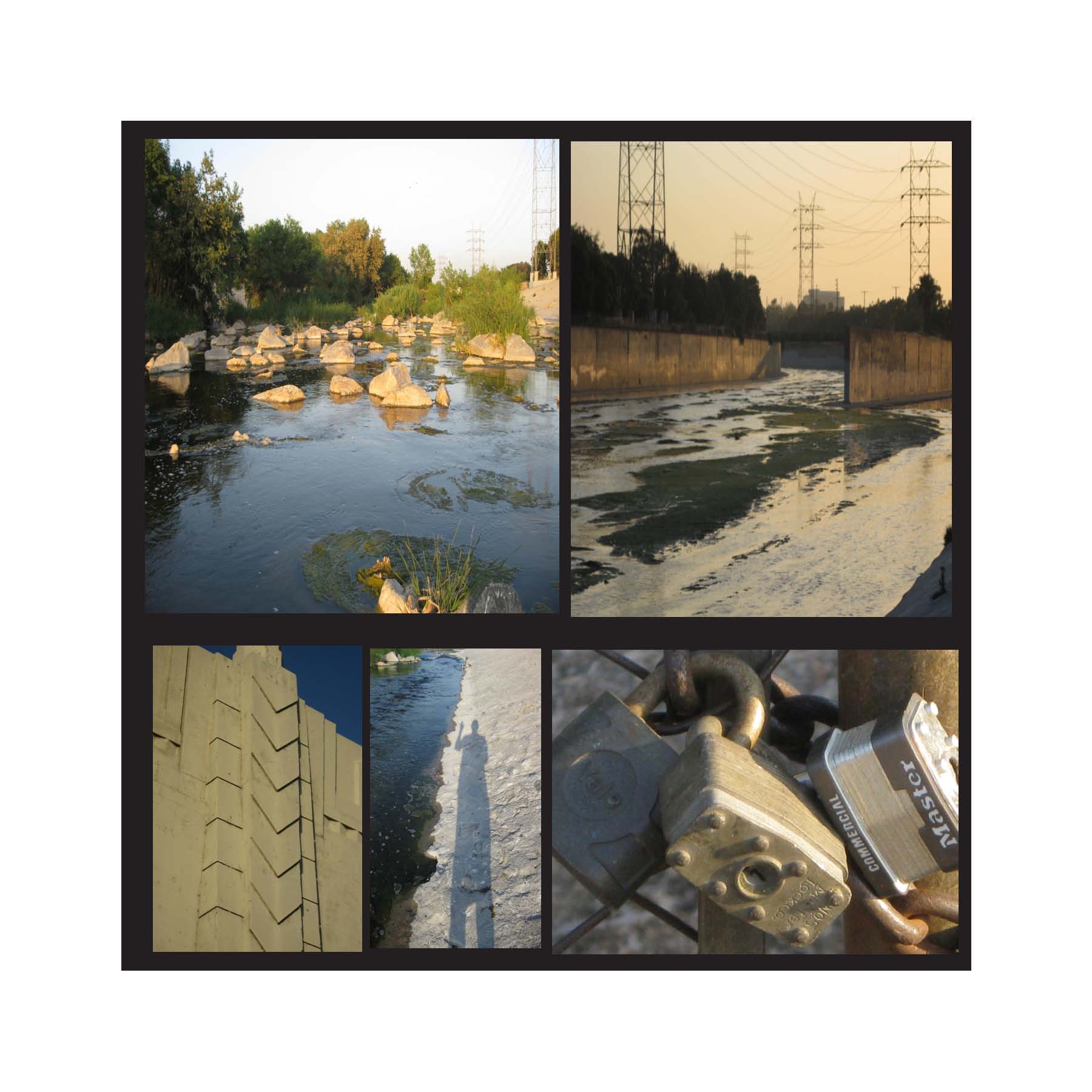
From top left, clockwise, the tranquility of carp-filled pools, at the beginning of Glendale Narrows. Once you get past the city locks, you can see self-shadows and nifty bridge architecture. (Jim Burns)






 lariverflyfishing