The Arroyo Seco Foundation will host the Pasadena Mayoral Candidates Forum on the Environment to be held in the Donald Wright Auditorium of the Pasadena Central Library, 285 E. Walnut St. in Pasadena on Tuesday, January 14, 2020 from 6:30 p.m.-8:30 p.m. The theme of the event will be “How Green Should Pasadena Be?” Topics to be covered will include climate change, the Arroyo Seco, trees and other issues of local concern.
The program will begin with a brief opening statement from each of the four candidates on their environmental record and views. The candidates include Jason Hardin, Victor Gordo, Major Williams and current Mayor Terry Tornek. Following the initial statements, there will be a panel of local environmental leaders who will ask questions of the candidates. The public will also be invited to ask questions of the candidates. The event will conclude at 8:30 pm.
The discussion is a timely event since the primary election for the Mayor’s race will be held on March 3, 2020.
“We are pleased that all four candidates have confirmed their participation,” said Tim Brick, Managing Director of the Arroyo Seco Foundation, “and look forward to a lively discussion of critical environmental concerns and solutions.”
At its recent quarterly meeting, the Wildlife Conservation Board approved approximately $28.7 million in grants to help restore and protect fish and wildlife habitat throughout California, including one for the Los Angeles River, according to its website.
A $1.4 million grant to the Council for Watershed Health for a cooperative project with the city of Los Angeles, the Southern California Coastal Water Research Project, the Friends of the Los Angeles River and the Arroyo Seco Foundation for a planning project to provide designs, permits and environmental review for addressing impaired mobility for southern steelhead trout and other native fish along more than four miles of the Los Angeles River in downtown Los Angeles.
The trout are back! After a long dry spell recent rains have created excellent conditions for trout recovery. We want to document the presence of native Rainbow Trout in the Arroyo Seco. It will build a good case for improving stream and habitat conditions in the Arroyo Seco, a key tributary of the Los Angeles River.
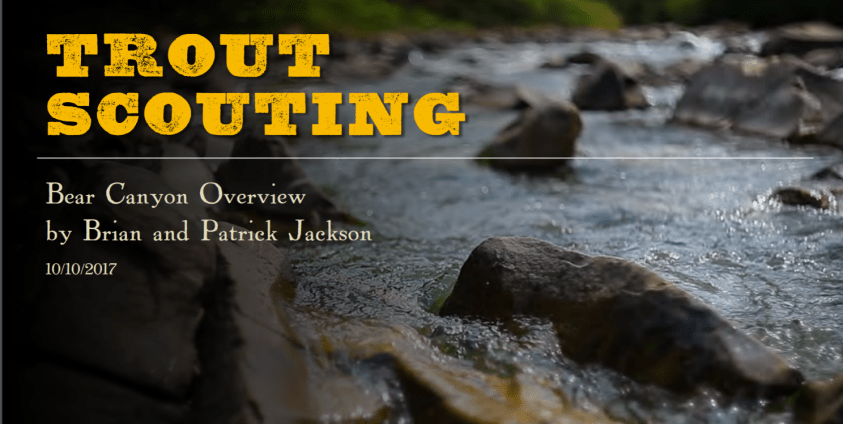
We would like to enlist some enthusiastic scouts to search the upper reaches of the Arroyo Seco stream to find native trout there. The upper stream is accessible from trails off of Angeles Crest Highway. ASF can provide information about likely sites and proper procedures.
This will be a very signifcant and exciting project for fishers and Arroyo lovers to participate in. If you are interested or want to report a sighting, please send a message to fish@arroyoseco.org.
Despite all the talk about revitalization and restoration of the Los Angeles River, native fish have often been forgotten, yet they are critical to the long-term health and resilience of the river.
The Native Fish in the Los Angeles River Forum, to be held at the Los Angeles River Center on Wednesday, Aug. 29 from 4-6 p.m., will focus on the status of native fish in the Los Angeles River and on some interesting work going on to protect and restore them.
Featured presenters include:
Nathan Holste — U.S. Bureau of Reclamation
Nathan Holste has been studying the Los Angeles River to determine if ecosystem services can be improved in order to foster native fish as an integral part of urban stream restoration projects. He will report on the status of his study, which includes concepts for redesigning the riverbed and 2D hydraulic modeling results.
Mark Capelli — National Marine Fisheries Service
Mark Capelli has served with the National Marine Fisheries Service, since 2000 as the Steelhead Recovery Coordinator for South-Central and Southern California. He is the lead author for both the Southern California and South-Central California Steelhead Recovery Plans.
Wendy Katagi — Stillwater Sciences
Wendy Katagi, Senior Manager, Watershed and Ecosystem Restoration Services for Stillwater Sciences, will moderate the discussion. Wendy has participated in many of the most important fish recovery programs in Southern California.
A. J. Keith — Stillwater Sciences
A. J. Keith, Senior Aquatic Ecologist with Stillwater Sciences, will report on work Stillwater is doing with various partners, including the Arroyo Seco Foundation, for native fish recovery in the LA River system.
Scott Cher — Arroyo Seco Foundation
Scott Cher will discuss ASF’s Rainbow Trout Restoration program and native fish recovery in the Arroyo Seco.
Presenters will participate in a panel discussion featuring questions and answers from the audience. The program will last from 4 p.m. to 6 p.m. with light refreshments following the presentations and discussion. It is directed to LA River activists, organizations and agencies. The goal of the event is to focus more attention on native fish and habitat restoration as part of the LA River program and the importance of the tributaries such as Tujunga Canyon and the Arroyo Seco to restoring the health of the river ecosystem.
Just over a year ago, 48 FedEx Cares volunteers did their part for the Native Trout Restoration Project in the San Gabriel Mountains. (Courtesy Arroyo Seco Foundation)
Greetings Trout Scouts!
We will to be scouting Lower Dark Canyon Trail next Tuesday morning and welcome you to join us. The trail follows one of the Arroyo’s tributaries that we suspect may provide rainbow trout habitat. It will be our first visit to this site, and at the very least we want to record barriers to fish passage and take photos of the creek. We may use other methods covered in the workshop depending on what we find.
With proper care, this little guy will grow up to make us all proud. (Courtesy Steve Kuchenski)
Greetings Trout Scouts!
As a reminder, the Arroyo Seco Foundation will be hosting a free trout habitat survey workshopthis Sunday.
The workshop will feature Ken Jarrett, a fisheries biologist with Stillwater Sciences, and cover key methods for professional stream assessment. This is a great opportunity for anyone interested in river restoration and native fish!
There are still spots left. Please RSVP to me (scott@arroyoseco.org) if you can make it.
Date & Time Sunday, May 20, 9AM – 2PM (includes a lunch break)
Location Hahamongna Native Plant Nursery in Hahamongna Watershed Park (The nursery can be hard to find. Click here for directions.)
Parking and restrooms are available at the nursery. From there we will take a short walk over to the stream channel and learn stream surveying methods for the assessment of native trout habitat. Be prepared for insects and uneven/slippery terrain. Some activities (such are measuring the stream gradient) will be done in the water, and closed toe shoes are required.
What to Bring
• Water
• Sun protection
• Sack lunch
• Note-taking materials
• Closed toe shoes (ideally water shoes or rubber boots if you have them)
By Tim Brick
Managing Director
Arroyo Seco Foundation
Friends:
It’s time to head to the upper watershed in search of native trout. It has been another disappointingly dry year, but there is water in the stream, and some chance of spotting native fish. The flow in the upper Arroyo stream is now about 2 cubic feet per second, compared to the historic average of 5-6 cfs for this time of year, but 2 cfs is better than it’s been for a while.
WHERE TO LOOK: The most likely place to find native trout would be in the pools up around Switzer’s Falls and in nearby Bear Canyon, but trout sometimes go as far as the mouth of the Arroyo near Jet Propulsion Laboratory. (Btw, the Mount Wilson Bicycling Association has been doing monthly trail restoration work in the stretch of the Gabrielino Trail between Oakwilde and Switzer’s Camp.)
No one that I know of has claimed to see any native trout since the Station Fire nine years ago. I recently went with Wendy Katagi of Stillwater Sciences to visit the Riverside Corona Resource Conservation District, which has an excellent native fish program. They are willing to help us restore native fish in the Arroyo Seco, but first we need to document their current status, so we need your help now.
Take a hike! It’s always enjoyable in the upper Arroyo, particularly this time of year. Let me know what you find, and thanks for caring!
Hi Tim
So does it have to be below Switzerland Falls or above or anything in that drainage?
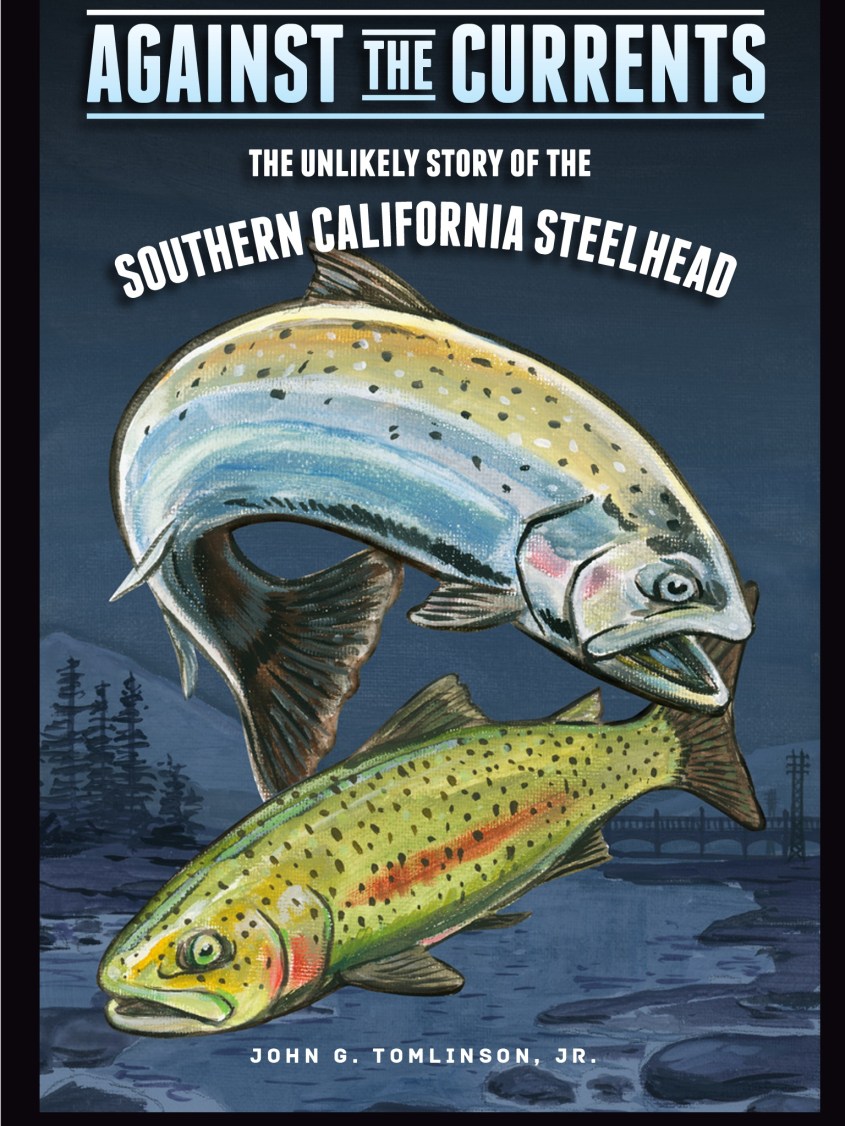
The first book published by Aquarium of the Pacific in Long Beach details the struggles of the endangered Southern California Steelhead. (Courtesy Aquarium of the Pacific)
Tim Brick, the foundation’s managing director, adds:
“We’re still look for trout, but the stream is below 1 cubic feet per second again. We need to identify the pools and resting spots where the trout are hiding. Probably Bear Canyon is the most likely spot. Anyone care to go on a trout scout adventure?”
Finally, to get a taste of what fishing used to be like here, I’m rerunning my 2014 review of historian Tom Tomlinson’s excellent book, ““Against the Currents: The Unlikely Story of the Southern California Steelhead” below.
***
If you think you’ve finished your summer reading list, stop! Consider one more book, please.
“Against the Current, The Unlikely Story of the Southern California Steelhead” could not, in truth, be a more unlikely tale. Author Tom Tomlinson takes the reader on an environmental roller coaster ride that matches our region’s boom-or-bust water supply, and throws in plenty of human Greek drama.
Beautiful color on this trout, which was released, unharmed, back to the water. (Jim Burns)
What just over a 100 years ago was a region so pristine that Easterners came here to mend their health, through hunting, fishing and soaking up the sunshine, quickly turned into what we have today. As someone who has lived here for over 30 years with no plans of leaving, I’m not complaining, but when you read this book and realize what it once was — especially if you enjoy fly fishing the San Gabes — well, get our your handkerchief.
Sob.
One fact to prime the tears: In the early 1900s, the then-equivalent of the California Dept. of Fish and Wildlife set the limit of fish taken at … 100. If you’ve ever put boots to dirt and fly to water in our mountains, this should give you a chill. Guests at the local fishing camps regularly hauled in lots of rainbows, and, yes, steelhead. And they hauled, and they hauled and they hauled. Think buffalo in the plains states.
How we got from those abundant fishy beginnings to where we are today is a story of good intentions gone to greed, it’s about that simple.
As for the steelhead once again taking center stage as we enter the Great Los Angeles River Rebuilding, well, this magnificent creature needs our help to get off the endangered species list.
When Congress approves the billion bucks for a river makeover early next year (Update: As of this writing three years later, the federal money hasn’t arrived), I hope every politician, every engineer and every investor gets a copy of this book. They should look up the section on one Henry O’Melveny, lawyer, fishing advocate, Creel Club founder, ice plant owner and, sadly, leader of the pack that done the natural inhabitants of our erratic rivers and streams in. Indeed, he is a figure as defining of Greek tragedy as Oedipus or Agamemnon.
Fast forward to today, and a mayor who is bringing in major bucks from Washington for the river as well as public transportation. I hope that Mayor Eric Garcetti reads this slim volume. It is the most compelling work to date on why the natural habitat can’t take a backseat to our own urban comfort zone. That story already happened.


 At its recent quarterly meeting, the Wildlife Conservation Board approved approximately $28.7 million in grants to help restore and protect fish and wildlife habitat throughout California, including one for the Los Angeles River, according to its website.


 Mark Capelli has served with the National Marine Fisheries Service, since 2000 as the Steelhead Recovery Coordinator for South-Central and Southern California. He is the lead author for both the Southern California and South-Central California Steelhead Recovery Plans.
 Wendy Katagi, Senior Manager, Watershed and Ecosystem Restoration Services for Stillwater Sciences, will moderate the discussion. Wendy has participated in many of the most important fish recovery programs in Southern California.
 A. J. Keith, Senior Aquatic Ecologist with Stillwater Sciences, will report on work Stillwater is doing with various partners, including the Arroyo Seco Foundation, for native fish recovery in the LA River system.
 Scott Cher will discuss ASF’s Rainbow Trout Restoration program and native fish recovery in the Arroyo Seco.

 By Tim Brick

 lariverflyfishing
Hi Tim
So does it have to be below Switzerland Falls or above or anything in that drainage?