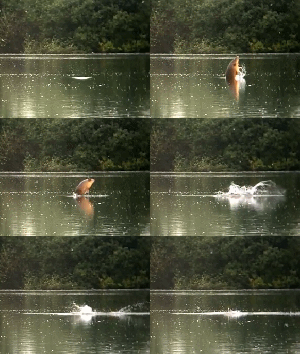
California Killifish surprise catch for fish study

I don’t know how biologist Rosi Dagit does it but every time she calls a meeting of the fishing-for-science clan, the mercury breaks another record. Today was no exception, as around 25 sweating volunteers traveled to Willow Street in Long Beach for the last effort to see what could be caught in this important area where the Los Angeles River runs into the ocean.

We saw a dozen or so mullet, as they danced around our side of the lagoon, bobbing and weaving to invisible underwater music. Four of us tried everything in the flybox, from San Juan worm, to topside stimulator. What goes into the record book is but a shadow of what’s really in the water.

The kayak crew, pulling a net, came up empty, a disappointment.

John Tegmeyer fashioned his own boilies — like the Brits do, but with a dose of Tapatio Sauce thrown in for color — and came very close to landing a large carp.

Meanwhile, Zino Nakasuji fooled a 7-pound common carp with a pale egg pattern.

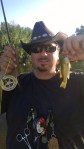
But Dabin Lee of Los Angeles handscooped the most important catch of the day — a tiny California Killifish, which is a native and lives in brackish water.

“I do it all the time,” Lee said, referring to her habit of catching small fish in her hands. It made for a remarkable end to four attempts over the last year and a half to document exactly what lives in this part of the river.

The great hope is to spot a steelhead.

“I just recently  got a picture of one from Cabrillo Pier,” Dagit said.

And, of course, that is the lofty dream of so many of us, that the Southern California Steelhead, currently an endangered species, will make its comeback in tandem with the river renewal. With the anticipated El Niño this winter, we may yet get that opportunity, when fish return from the ocean, hoping to ride high water in to their inland spawning grounds.

And if you missed this part of the survey, you’ll have another opportunity. Next year, Dagit is targeting the Sepuveda Dam area in the San Fernando Valley.

Meanwhile, I hope you enjoy this silly video from the day.


See you on the river, Jim Burns


Second annual Off Tha’ Hook fishing derby returns Sept. 5

image

Registration is now open for the second annual FoLAR fishing derby, Off Tha Hook. It’s slated for Saturday, Sept. 5, one of the Dept. of Fish and Wildlife free days, no license is required. The event in north Atwater Park is for both fly fishers and spin casters. catch and release ($50 registration, limited spots). The one-hour event is followed by a free “kids fish,” in which anglers teach children how to spin cast, as well as good stewardship on the water. Anglers who want to help out in this second event will have their registration fee discounted. You can register and get more details here.

What makes this event different from typical competitions is that it actually serves as an addendum to FoLAR’s 2008 Fish Study, an important species benchmark, especially as the river gets ready for its closeup and makeover. Biologists will weigh, measure and catalog every fish prior to releasing them back to the river.

If you missed last year, here’s what it was like. Think fun. Very fun.

Full disclosure: LARFF is a sponsor for this event.

Press Conference 8:30 a.m.

Scheduled to appear, FoLAR Founder/President Lewis MacAdams and members of local government

Catch & Release 9 a.m.- 10 a.m.

Fishing Contest for the Experienced

Two categories: Weight & Rarest Species!

Family Fish 10 a.m.

Adult supervised children

Learn to fish with morning angler volunteers

Awards 11:00 a.m.

Blue Ribbons given to registered child anglers


See you on the river, Jim Burns

LA Times reveals Frank Gehry as river renewal architect

The river's landmarks are changing. (Peter Bennett)
The look of the river will undoubtedly change under Frank Gehry’s influence. (Peter Bennett)

UPDATE: from the Aug. 11 Letters section of the Los Angeles Times

Others’ plans, please

Re “Gehry’s waterfront vision,” Aug. 8

Having fly-fished the L.A. River for five years, I know that miles of it are a wilderness now. There are so many fish and birds.

When it rains in the mountains, there are giant waves of water that flow into the river. The waves last for a few days, and then there’s finding the fish again — the bass, bluegill, carp and crappie. The Los Angeles River used to be a natural steelhead salmon run — as did Malibu Creek and other waterways south of us. This part of the Los Angeles River is mighty and dangerous, verdant and lush, not to be tamed easily. It is a flood channel.

The embodiment of Gehry’s work is artistic juxtaposition, a life work that stands out from the environment, not integrated with it. The revitalization of the Los Angeles River has produced a wilderness in our midst. Gehry’s participation is odd.

I would like to see proposals other than Gehry’s.

LESLIE RILEY

Culver City
——

Thank you for this story demonstrating that the era of the star architect has yet to sunset. While Frank Gehry, who will draft the master plan for the redevelopment of the Los Angeles River, is certainly one of the most talented and revolutionary architects of our time, Mayor Eric Garcetti’s comparison of him to the greatest landscape architect in North America — and yes, this is a separate credentialed profession — is nearsighted.

Perhaps the best indication of the mayor’s misplaced focus is that although the team of Olmsted and Vaux developed the design for New York’s Central Park, it is Frederick Law Olmsted, the landscape architect, whose work has remained timeless and a model for all other major civic parks. The seamless orchestration of natural systems and infrastructure make Olmsted’s work genius.

If the mayor really believes that we need a sexy star capable of creating a master vision to complement and elevate the work previously accomplished, I would recommend studying this list of the next possible Olmsteds: James Corner, Laurie Olin, George Hargreaves, Adriaan Geuze and Michael Van Valkenburgh. Not only are these landscape architects capable, they also have all accomplished similar work and seen it built in their lifetimes.

ESTHER MARGULIES

Venice

The writer is a lecturer in the USC School of Architecture.
———–
Has anyone told Gehry that the continuous flow of the L.A. River in this time of serious drought is about 23 million gallons per day of treated water?

Enough to serve about 85,000 homes, this water originally was intended to replenish the aquifer beneath the San Fernando Valley. We pay for the water, we pay to have it treated, and we dump it into the river.

Why not reduce the dumping until the drought ends and use it as originally planned?

ROY W. RISING

Valley Village

——–

Here’s the biggest story since $1 billion Alt. 20 got the nod earlier this summer: Rock star architect, father of the undulating Disney Hall downtown — arguably the highest-profile living American architect — is at the helm of the river renewal. Read about it here.

And check out the L.A. Times architecture critic’ interview with Gehry here.

See you on the river, Jim Burns

Second annual LA River Boat Race tomorrow

To register, visit http://www.lariverexpeditions.org

Guess who’s back?

'BASS-A-NOVA': Yup, they're bacl! (John Tegmeyer)
‘BASS-A-NOVA’: Yup, they’re b-b-b-ack! (John Tegmeyer)

Last summer, there were bass — lots and lots of bass — as well as aggressive tilapia. And as just about anyone who has fished the L.A. River will tell you, both species are a heck of a lot easier to catch than our crafty carp. Targeting bass, you can do dumb things like muff your cast or take some drag on your line, and still recover and hook up. With carp, mostly, it’s one and done.

Then “poof.”

After last season’s first rain, all the bass disappeared. Because our river is currently more of a causeway without significant structure, what was solid fact one day vanished the next, as uneven flows swept away everything in their paths, including the bass that many of us watched grow to healthy sizes. That’s one of the beauties of catch and release: you can actually watch the fish mature through the season.

“Wonder where they went?” asked John Tegmeyer, which was truly said in hindsight, as yesterday he found a new Motherlode.

Maybe we can all file our “what the heck happened?” under the line from an old Joni Mitchell song, “Big Yellow Taxi”:

“Don’t it always seem to go
You don’t know what you got
Till it’s gone
They paved paradise
And put up a parking lot”

In the case of our river, the opposite will hopefully be true: our paved parking lot will gradually become something entirely more heavenly.

So, until fall’s predicted El Nino teaches us what rain really feels like, and the bass once again go missing, get out there.

Roland Trevino has been consistently hooking up on prince nymphs, instead of his usual fav, white poppers.

See you on the river, Jim Burns
Next FoLAR citizen scientist event slated for Aug. 15

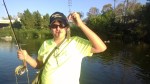
Nick Faught of Corona snagged this 8-pounder, his first carp on the fly. (Jim Burns)

Happy summer all!

We are hoping to have a dinghy to help pull a small trawl net in addition to working the banks. 
Kayaks, floating fishing chairs are welcome!  Please spread the word.
Hope to see you on the river in August!
Thanks, Rosi
Rosi Dagit
RCD of the Santa Monica Mountains
540 S. Topanga Canyon Blvd
Topanga, CA 90290

Calling all Citizen Scientists!!!

We are looking for a few good people – a few means 30 – to help Friends of the Los Angeles River (FoLAR) in Partnership with the Aquarium of the Pacific, Resource Conservation District of the Santa Monica Mountains & the University of California Cooperative Extension to help in the Fish Study @ Long Beach.

This event will take place at 7:30 a.m. at the Willow Street Bike Path Entrance on 25th & De Forest in Long Beach – Saturday, Aug. 15.

We are looking for anglers with their own gear and non-anglers to help assist our biologists on shore identify, weigh and measure caught species, before returning them into the river.

RSVP to wpb@folar.org

Until then…

Check out what FoLAR is doing to help curb wildlife injury from discarded fishing line along the L.A. River…

http://folar.org/fishing-line-recycling-program/

Attention Anglers – Don’t miss the SECOND ANNUAL – L.A. River Cath & Release Fishing Derby – “Off tha’ Hook” – Register now – Limited Spots Available – KIDS FREE

http://folar.org/event/off-tha-hook-fishing-event/

Mayor’s blast email celebrates US Army Corp revitalization approval

20140103-101346.jpgJim —
It’s been a long fight but the restoration of the LA River just won its largest victory yet! Today, the US Army Corps of Engineers unanimously endorsed the most comprehensive revitalization plan to open parks, bike lanes, and community space along 11 miles of our river.

Join me in celebrating this great news by sharing it with your friends:

Share on Facebook
Share on Twitter
This would not have been possible without you and the tens of thousands of Angelenos who came to public meetings, signed petitions, and took action to build a more beautiful Los Angeles.

Thank you!

Eric Garcetti
Mayor

FoLAR debuts fishing line recycling program

RECYCLING: FoLAR has place three tubes along the river as part of a pilot program. (Jim Burns)
RECYCLING: FoLAR has placed three tubes along the river as part of a pilot program. (Jim Burns)
In another first, the advocacy group Friends of the Los Angeles River has installed three tubes for fisherfolk to safely discard used line in selected spots along the river’s upper banks. Trout Unlimited provided the funding, while both Councilperson Mitch O’Farrell (13th District) and the Atwater Village Neighborhood Council provided their political imprimatur.

“We support FoLAR taking a stance on discarded fishing line, while educating anglers who are new to fishing the L.A. River as well as the anglers who have fished the river for decades,” wrote AVNC co-chairs Torin Dunnavant and Courtney Morris in their letter of support.

Both the AVNC and O’Farrell’s office cited a trigger event for better line management, the death of a Great Blue Heron, called Fred by locals, who was caught in fishing line, seriously injured and subsequently died as marine biologists attempted to nurse him back to health.

Monofilament may seem harmless enough, but it represents both an eco-hazard as well as a possible deadly ensnarement for the wildlife so abundant on the river. According to FoLAR, birds can be attracted to the fishy smell on used line, then become hopelessly ensnared while digging for it in convention trash cans. Also, monofillament does not degrade over time leaving what amounts to an ageless hazard if not dispossed of properly.

As awareness has increased among state agencies, fishing clubs and individual anglers, these recycling tubes have become more common on streams. For example, a tube sits next to the angler survey box at the beginning of the catch and release section of the West Fork of the San Gabriel, a popular area for local flyfishers.

Each week, the tubes’ contents will be sent to the Berkley Conservation Institute in Iowa. The company, which produces conventional fishing line, recycles used line into 4-foot cubicle fish habitats it calls “Fish-Habs.” According to the company’s website, since 1990, BCI has recycled more than 9 million miles worth of fishing line. That’s enough line to fill two reels for every angler in America.

At the close of recreational zones on Labor Day, the program results will be re-evaluated to measure impact and the tubes could become a permanent fixture on the river.

Currently, the tubes are located at the Glendale Narrows Dover Street river entrance in the yoga pocket park, Acresite Street and FoLAR’s own Frog Spot. Future rollouts include the Bowtie Parcel and Marsh Park, if the Mountains Recreation and Conservation Authority that patrols the area agrees.

Fishing has only recently become legal on the river, during a certain time — Memorial Day through Labor Day — and within certain places, the carefully defined recreational zones below Fletcher Bridge, the so-called Elysian Valley River, and in a stretch in the Sepulveda Basin River in the San Fernando Valley. The fact that the pilot line recycling tubes lie outside these boundaries speaks to the growing number of anglers who search for the best places to fish, regardless of geographic boundaries.

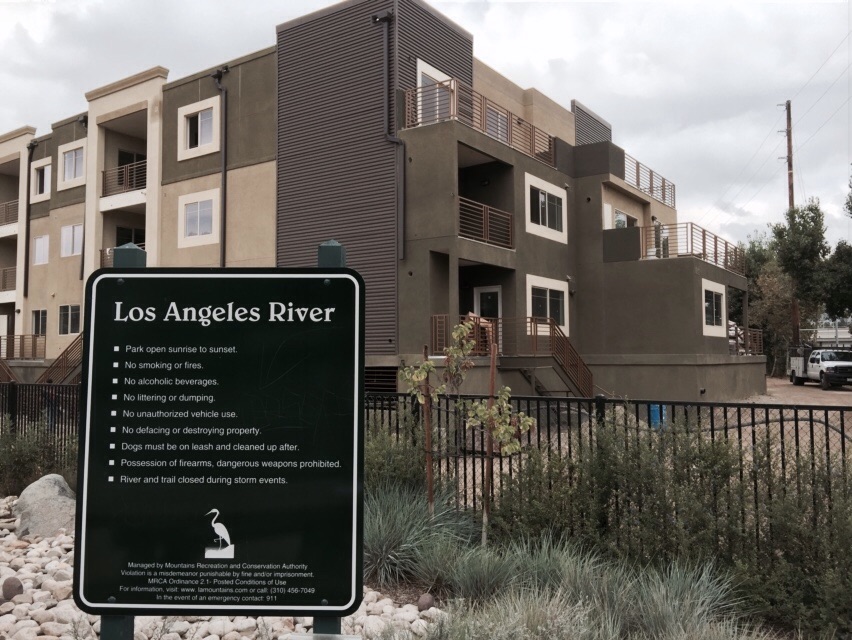
SIGNS OF CHANGE: A new condo complex abutts the very spiffy Marsh Park within the rec zone. (Jim Burns)
“As the LA River is reborn, it needs the help of a variety of river huggers: fisherfolk, bird watchers, dog walkers, nature strollers.  It’s important that everyone who has a particular interest respects the interests of others, and lost or discarded fishing line can ensnare the birds and other creatures that call the river home,”” Robert Blankenship, president of Trout Unlimited’s south coast chapter, said. “We encourage all fishermen to discard used line in the collectors, and would appreciate anyone who sees old fishing line in the river area to please use the collectors as well.”

See you on the river, Jim Burns

West Fork S.O.S.: Comment period extended to Nov. 1, 2016

On a whim, I visited the West Fork very recently. The sun was hot in the mid-morning sky; a group of local teens pulled up alongside the parked mighty Prius and one asked me if I ‘biked much?” I said no, which is true, because I almost never take that rickety garage-sale contraption out of my garage, unless it’s to come here.

The rust on the chain tells the tale and could have answered the lad’s question before I ever did.

In the few hours I spent in the catch/release section, above the second bridge, two marvelous items happened: I spotted a pair of young foxes, and I caught a small trout on a size 16 hi-viz Parachute Adams after about 10 minutes casting to a shadowy hole.

Upon my return, I told my incredulous son I’d hooked up. I beamed, even as he questioned, “But, isn’t that pretty bad? Didn’t we used to hook up at least a dozen times up there.”

Yes, Will, yes, we did.

And that’s why I hope everyone who reads this will click this link and let the powers that be at the Angeles National Forest know your thoughts, for ANF is seeking public comments on a “Need to Change” analysis for the San Gabriel Mountains National Monument. Trout Unlimited has launched a campaign to get fishers to comment before the comment period ends July 27.

Why is there a “need to change” recreational policies on the West Fork?  As the advocacy website Friends of the River explains the 44 miles of stream within the national monument are designated a “wild & scenic river.”

“The West, North and East Forks .. drain the largest watershed in the mountain range and provide thirsty downstream residents with clean drinking water. The West Fork National Scenic Bikeway Trail provides easy access to one of the few catch and release trout streams (bold added) in the region, while the upper West Fork is traversed by the Gabrieleno National Recreation Trail. The East Fork provides trail access to the Sheep Mountain Wilderness.”

As it stands, when you come upon the survey box at the beginning of the West Fork’s c/r area, it makes even the most obstinately optimistic fishers scratch their heads. I mean what kind of comment does a thinking person leave?

“Dear Ranger,

Fishing has plummeted on this wild & scenic river to levels probably never seen before. Help.

Sincerely,

A very concerned citizen and angler”

I’m not sure if the well-intentioned West Fork San Gabriel River Conservancy is still functioning, but much of its website dates to early 2014.

Anyway, to bone up on the problems this area faces from our 4 million brethren, there’s a load of information and reporting on the Internet, which means at least some of it is actually true.

The best way to refresh your political ire is to visit, yourself, put your $5-a-day Adventure Pass on your dashboard, bring your $47.01 valid fishing license, a few flies and a 2 weight. Grease up the chain on your aging bike, ride past the swimmers to the second bridge, and angle. This area is our area, and it is in desperate need of attention. At least, that’s what I’m writing to ANF.

See you on the river, Jim Burns