Editorial: Let’s not forget, the river must come first

Screen Shot 2017-08-13 at 11.52.32 AM
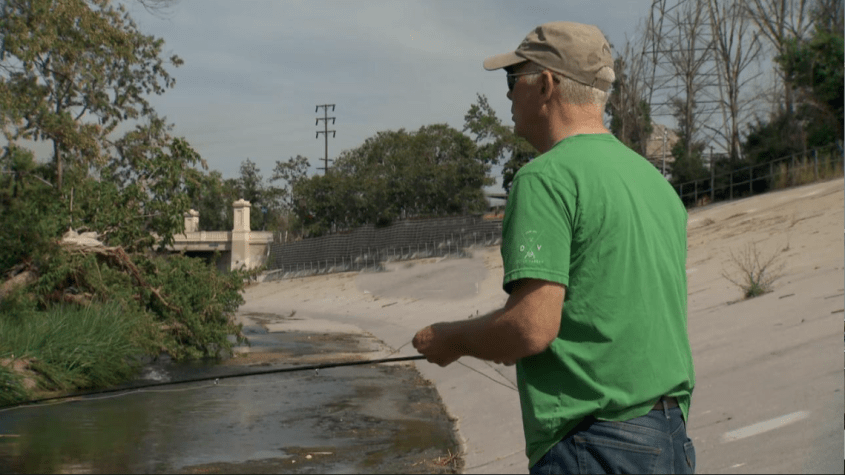
Click above to watch a clip from KCET’s ‘A Concrete River: Reviving The Waters of Los Angeles.’ (Courtesy KCET)

In our all-too-human rush to progress, unexplored, poorly researched goals can lead to more problems than the fix solves.

How about the car? Sure, it got rid of those messy horses and fly-infested dung piles messing up the roads, but, in turn, we got smog, gridlock and a woeful public transit system from our embrace of the “horseless carriage.”

Or old-school refrigeration? Sure, your ice doesn’t come in blocks anymore, and your meat isn’t spoiled, but CFC refrigerants had to be reinvented to combat a growing hole in the ozone. And that reinvention, hydrofluorocarbons (HFCs), turned out to be worse than carbon dioxide as a greenhouse gas.

The Los Angeles River no longer has winter flooding, thanks to the work of the Army Corps of Engineers, but we no longer have an actual river running through Los Angeles, nor the ecosystem it supported. And now is the time to ask what kind of solution we will get to the one that fixed the original problem,

In recent years, the river has become a money magnet enabling politicians from Los Angeles, to Sacramento, to Washington. This comment after a July press conference post about the river receiving $100 million in bond funds hit home for readers of this blog.

Mark Gangi says:
July 7, 2017 at 5:08 pm Edit
Just hope they don’t screw up the fishing by confusing what a park is with what a river is.
At first, Mark’s comment seemed so straightforward to me that I missed his point. But it became clear as I listened to this interview with Tim Brick, managing director of the Arroyo Seco Foundation with A. Martinez on KPCC public radio.

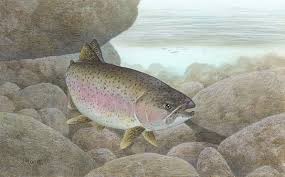
Brick wants to restore the ecosystem, so that steelhead can return from the ocean to their mountain home. Is a plan that far-reaching anywhere in the planner notes?

This was also the rallying cry of co-Friends of the Los Angeles River founder Lewis MacAdams. “When the steelhead come home, we’ll know we’ve done our jobs” he would remind basically everyone who would listen. But since his retirement, that lofty goal seems to have slipped past advocacy groups that once rallied around his vision.

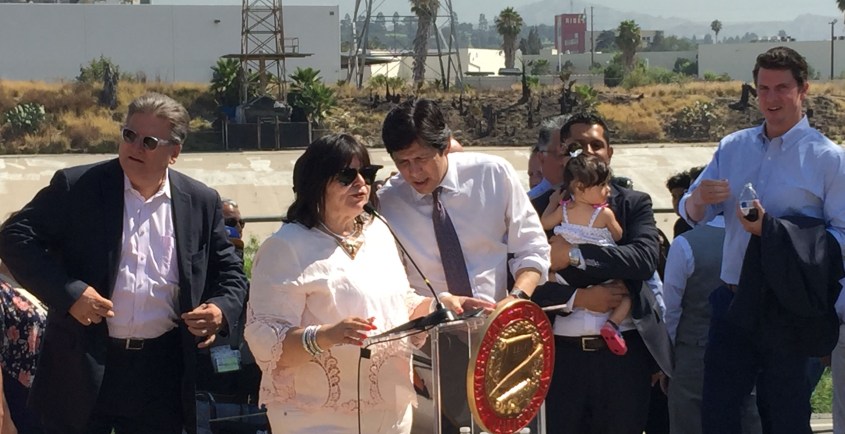
At that July press conference, California Senate President Pro Tempore Kevin de Leon (D-Los Angeles) proudly announced that he’d chosen this location, Marsh Park, because it was his first legislative victory. And, good on him. We need to have more public spaces for our underserved communities. But as I listened to one after another of the elected and appointed officials at the press conference, not one mentioned the steelhead trout, or creating an environment for its plausible return.

One hundred million dollars is quite a large sum of money and, as I understand it, the cash will be divvied up through grants chosen by two public agencies, each tasked with creating more green space along the river. That’s all good, but what about the river, itself?

As I say in the clip above, I’ve never caught a cold-water fish in the LA River because they’re aren’t any. The habitat that once supported thousands of steelhead is now so hot only intrepid warm-water fish can survive.

IMG_1621
(Credit Jim Burns)

In 2011, I asked city officials and river advocates about this same topic in “Will steelhead ever return to the L.A. River?”

“The southern steelhead Distinct Population Segment goes from the Santa Maria River in San Luis Obispo County down to the Border.  Say 50-75 years ago, the size of that population run was about 30,000 adults,” said Trout Unlimited’s Chuck Bonham, who will be the new director of the Department of Fish and Game, if his appointment is confirmed by the state senate. If you pull out a map and take a look at the enormous area he’s talking about, it’s obvious that even during the heyday, there weren’t a lot of fish.

Today, those numbers have plummeted in the area and are at zero in the river, itself. Southern California Steelhead have been on the Endangered Species list since 1997. To be put on it, a species must be viewed by scientists as imminently in danger of becoming extinct.”
As select administrators for both the city and the Army Corps huddle over what the redesign should look like, one that will bring more than $1 billion to river restoration one this decade and beyond,  let’s hope that a habitat worthy of steelhead trout is at the top of their agenda, before parks, before soccer fields and before condo developments.

Is it too crazy to ask for a fish passage through all of the concrete up to and including Devil’s Gate dam in Pasadena, the gateway to historical steelhead spawning grounds?

Is it too crazy to give the Los Angeles river mascot “Steelhead Fred” an opportunity to return to his historic home water?

This time we need to take the sober, long view before our “rush to progress” clouds our vision, one in which we return to nature — and to ourselves — what was taken away.

See you on the river, Jim Burns

p.s. Can you find the flaw in the KCET video? Let me know. 
“p.s. Can you find the flaw in the KCET video? Let me know.”

Looks like a steelhead SALMON to me……


Ignore the looks, don’t forget the waders

(Courtesy jrabold.net)

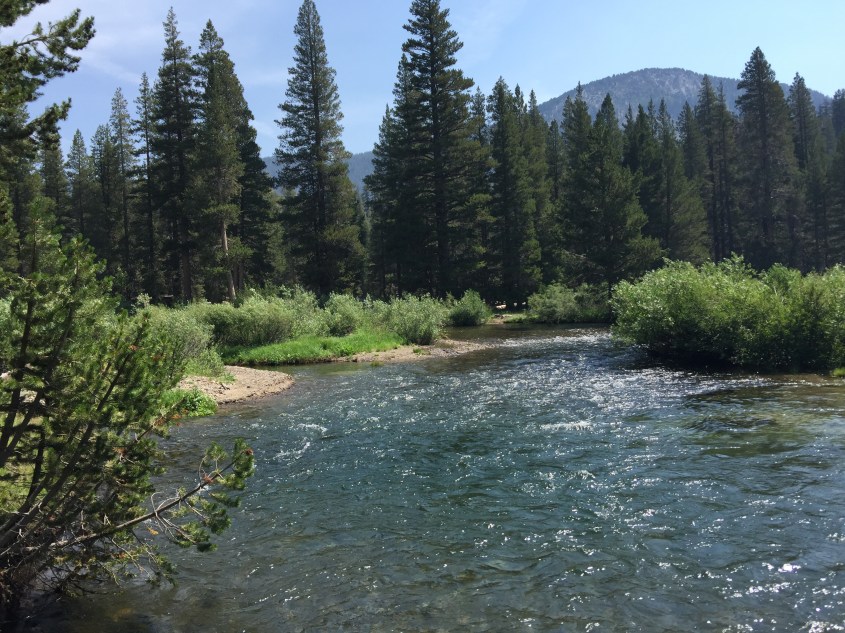
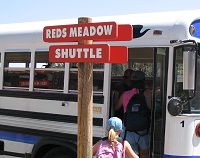
MAMMOTH LAKES, Calif. — It’s hard to get psyched about a shuttle ride to go fishing, especially when it’s mandatory. I’ll hike to fish, drive to fish, bike to fish, oh yeah, all of those, but taking public transport to cast a dry, it just seems odd.

For one thing, do you or don’t you wear your waders while on public transport? Showing up with a rod is odd enough, but trudging past Old Joe collecting tickets in your Simms just seems weird.

But there I was descending on the mandatory Reds Meadow Road shuttle to wet a fly in the middle fork of the San Joaquin, a section of the longest river in Central California. I’d heard it was fast, because of a monster snow that had skiers loving slopes this very morning. That’s right Mammoth is still cooking with only 93 days to go until the next opening day!

As we descended into the Devils Postpile National Monument, I surveyed my companions, including the family from St. Augustine, Fla., dressed out for three days of wilderness mountaineering —  dad, mom and four kids all sporting shiny new ice axes attached to their equally first-trip backpacks.

The standing-room-only bus featured all manner of mountain couture, that cowboy hat that’s shrunk and in tatters, a badge of many successful trips; thick-soled boots showing all manner of soles, from new to gnarly; serious eye protection; poles and packs and approach shoes; over-flappy safari hats and their owners all taking in the wonder of 4 million years of mountain uplift. All the words by all of the writers don’t even begin to capture the view.

And there was a fair amount of trepidation as our driver exited the vehicle to coax an overly cautious Range Rover driver around the bus. True, it was several hundred feet down over the Rover side. Parking brake, please.

But for all the thousands of dollars of gear, new and not so, I didn’t spot a single pair of waders, and I applauded my own stick-to-it-ness as I left the bus, hiked a tad, and entered  the intense current of the San Joaquin. Oh, make that the cold, intense current.

IMG_1601
Only a few feet deep, the flow of this water will still put you down hard. Wading staff recommended. (Jim Burns)

I’d brought both floating and sinking lines, expecting this quickly moving cornucopia of water. Because the real joy of fly fishing is casting a dry, I gently unfolded 6x to deliver a size 16 hi-viz caddis in usual suspect water, a simmering pocket edge. Pleasantly, a very small rainbow found it irresistible. My freezing feet were done at that point, but my mind was not.

Switch to the sinking line and two nymphs, one much bigger with rubber legs. Casting into water with this level of intensity was a thrill, as was watching the line unfold around a couple of river bends. A strike. Was it? Nothing.

Later, I realized I’d left my water bottle on the bank some 10 feet up, so I put my rod down with the nymphs still in shallow, currentless water. When I came back, there was pleasant surprise No. 2, another small rainbow wondering where he’d gone wrong. So much for the expertise of fly fishing!

IMG_1605
The current literally unzipped the bottom half of my pants! (Jim Burns)

My toes told me they were happy for this surprise, but it was time to go. But I told them how it was. Once you get a couple of small fish, you just know that there’s a bigger one out there someplace.

They tried to dissuade me by pretending to go numb. Oh, and the river schemed to get me home early by literally unzipping my left pant leg. I looked down wondering why the river drag had suddenly gotten so much worse and — wow, that’s a new one on me.

But there was really no other solution than to find a welcoming log pile, hop on and get zipped up. I kept thinking about my waders, those comfy, nicely fitted, warm, yummy, waders that I’d left behind, so as not to embarrass myself on the bus.

What do men say to themselves in these tender moments?

I admit to struggling with that zipper atop my precarious perch. I admit to muttering certain epithets to my former self, the fussy one who knows a thing or two about bus-riding fashions.

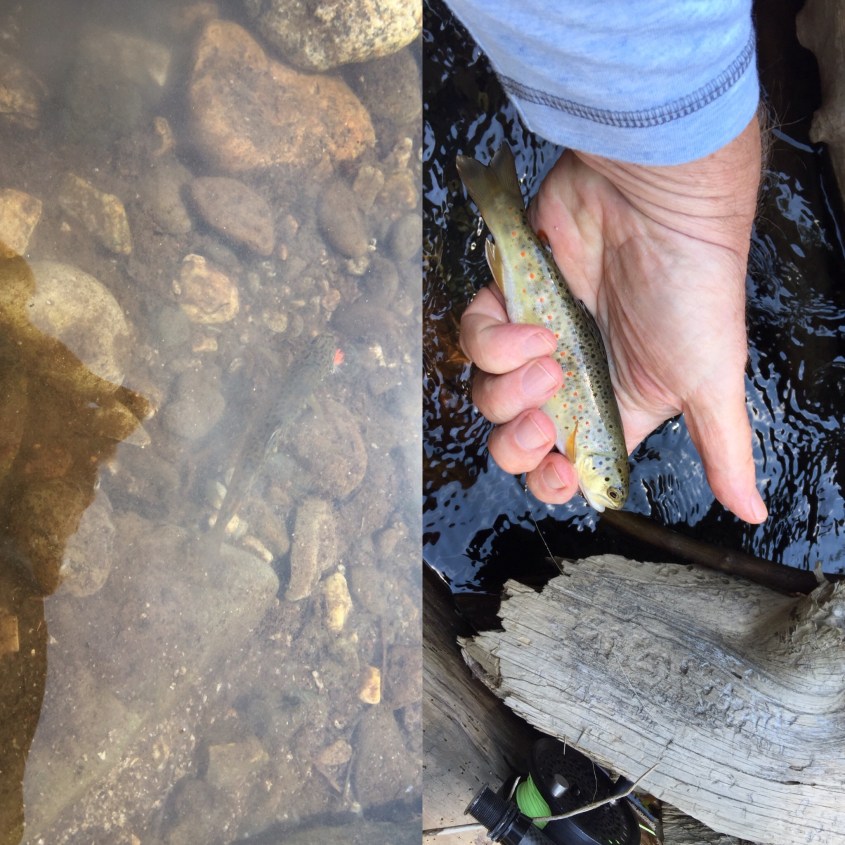
More or less safely zipped up, I couldn’t resist placing my nymphs under and down from the log pile. And there it was — the bigger trout.

See you on the river, Jim Burns

Check out the beautiful colors on this native trout, right, bigger than his cousin. (Jim Burns)


Arroyo Seco Foundation receives $50,000 for trout study

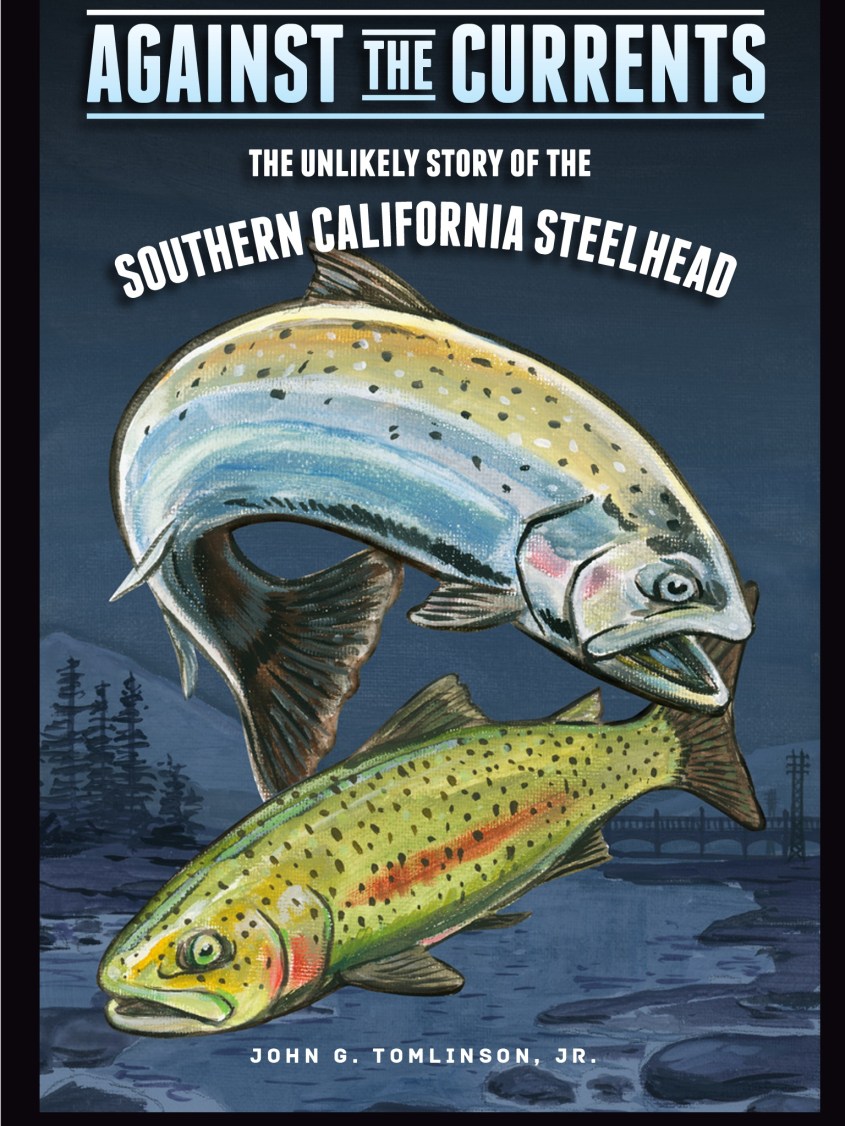
The first book published by Aquarium of the Pacific in Long Beach details the struggles of the endangered Southern California Steelhead. (Courtesy Aquarium of the Pacific)

The Arroyo Seco Foundation has received a $50,000 grant from the National Fish and Wildlife Foundation to determine the best stream conditions for introducing trout, according to the Pasadena Star-News. 

Tim Brick, the foundation’s managing director, adds:

“We’re still look for trout, but the stream is below 1 cubic feet per second again. We need to identify the pools and resting spots where the trout are hiding. Probably Bear Canyon is the most likely spot. Anyone care to go on a trout scout adventure?”

His email is tim@arroyoseco.org.

Finally, to get a taste of what fishing used to be like here, I’m rerunning my 2014 review of historian Tom Tomlinson’s excellent book, ““Against the Currents: The Unlikely Story of the Southern California Steelhead” below.

***

If you think you’ve finished your summer reading list, stop! Consider one more book, please.

“Against the Current, The Unlikely Story of the Southern California Steelhead” could not, in truth, be a more unlikely tale. Author Tom Tomlinson takes the reader on an environmental roller coaster ride that matches our region’s boom-or-bust water supply, and throws in plenty of human Greek drama.

Beautiful color on this trout, which was released, unharmed, back to the water. (Jim Burns)

What just over a 100 years ago was a region so pristine that Easterners came here to mend their health, through hunting, fishing and soaking up the sunshine, quickly turned into what we have today. As someone who has lived here for over 30 years with no plans of leaving, I’m not complaining, but when you read this book and realize what it once was — especially if you enjoy fly fishing the San Gabes — well, get our your handkerchief.

Sob.

One fact to prime the tears: In the early 1900s, the then-equivalent of the California Dept. of Fish and Wildlife set the limit of fish taken at … 100. If you’ve ever put boots to dirt and fly to water in our mountains, this should give you a chill. Guests at the local fishing camps regularly hauled in lots of rainbows, and, yes, steelhead. And they hauled, and they hauled and they hauled. Think buffalo in the plains states.

How we got from those abundant fishy beginnings to where we are today is a story of good intentions gone to greed, it’s about that simple.

As for the steelhead once again taking center stage as we enter the Great Los Angeles River Rebuilding, well, this magnificent creature needs our help to get off the endangered species list.

When Congress approves the billion bucks for a river makeover early next year (Update: As of this writing three years later, the federal money hasn’t arrived), I hope every politician, every engineer and every investor gets a copy of this book. They should look up the section on one Henry O’Melveny, lawyer, fishing advocate, Creel Club founder, ice plant owner and, sadly, leader of the pack that done the natural inhabitants of our erratic rivers and streams in. Indeed, he is a figure as defining of Greek tragedy as Oedipus or Agamemnon.

Fast forward to today, and a mayor who is bringing in major bucks from Washington for the river as well as public transportation. I hope that Mayor Eric Garcetti reads this slim volume. It is the most compelling work to date on why the natural habitat can’t take a backseat to our own urban comfort zone. That story already happened.

See you on the river, Jim Burns

Oh, snap! Enter the CalTrout Photo Contest

CT_webpage_1080x273

The 2017 California Trout Photo Contest is accepting submissions now through August 31! Share your best photos of California’s rivers, streams and creeks and your angling experiences. Photos can include fish, anglers or others enjoying California waters or be more scenic in nature. Enter today for a chance to win some great gear and be featured on the CalTrout website, social media channels, and in issues of The Current.

Eleven winners total will be selected. One Grand Prize Winner, one People’s Choice Award and nine Best Photo winners.

Prizes awarded:

GRAND PRIZE – 1 Winner
Photo featured on home page of CalTrout website, one-year CalTrout membership, Limited Edition CalTrout-engraved Abel Classic Reel ($625 value)

PEOPLE’S CHOICE AWARD – 1 Winner
Photo featured on home page of CalTrout website, one-year CalTrout membership, CalTrout neck gaitor, Tenkara USA Fly Rod Kit complete with all the essentials to get started tenkara fishing: Tenkara rod, 11’6″ Nylon Tapered Line, the keeper, 3 flies, tippet, and forceps & nippers. ($279 retail value)

BEST PHOTOS – 9 Winners
Photo included on Caltrout.org photo contest page, one-year CalTrout membership, CalTrout Patagonia Refugio backpack, and Smith polarized sunglasses ($189 value)
Contest Rules and Guidelines:

Once the submission period has ended, CalTrout will select 25 finalists. From those finalists, our members and social media followers will vote to determines the People’s Choice Award winner and 9 best photo winners. CalTrout judges will select the grand prize winner.

Judging Criteria: Photos will be judged on how well they depict the spirit of California waters and/or the sport of fly-fishing as well as overall artistic merit (lighting, color, composition, etc).

All photos must in some way be related to California rivers, creeks, or streams and the activities around them. Ideally, photos should have a horizontal format.
Maximum number of entries: 10 per individual.

All submissions must include a contest entry form.

Photographs must be in digital format.

Only online entries will be eligible. No print or film submissions will be accepted.

The photograph need not be taken with a digital camera; scans of negatives, transparencies, or photographic prints are acceptable.

Digital files must be high resolution, 300ppi, file size 3MB or larger (at close to actual size) and must be in .jpg format.

All entries must be received by midnight PST, August 31, 2017.

All entries require a signed model release for all people depicted in the image.

Please read our Full Contest Rules before entering. If you have further questions please email photos@caltrout.org. Photos must be submitted using our online form. Photos emailed to photos@caltrout.org will not be considered.

CLICK HERE TO ENTER

Photo: Jonathan Matthews, 2017 Finalist

Calendar Item: Find out the latest ‘trout scout’ news on Wednesday

steelhead
(Courtesy Arroyo Seco Foundation)

Update: The Arroyo Seco Foundation has recently received a $50,000 grant from the National Fish and Wildlife Foundation to determine the best stream conditions for introducing trout, according to the Pasadena Star-News . 

Tim Brick, the foundation’s managing director, adds:

“We’re still look for trout, but the stream is below 1 cubic feet per second again. We need to identify the pools and resting spots where the trout are hiding. Probably Bear Canyon is the most likely spot. Anyone care to go on a trout scout adventure?”

His email is tim@arroyoseco.org.

Finally, to get a taste of what fishing used to be like here, check out historian Tom Tomlinson’s excellent book, ““Against the Currents: The Unlikely Story of the Southern California Steelhead.”

See you on the river, Jim Burns

Did the trout survive the drought?
What is the history of fish in the Arroyo?
What is the potential for native fish restoration?
What is the current restoration program?
Fish or Concrete — What’s the Future?

Wednesday, July 12, 7 p.m.

Donald Wright Auditorium
Pasadena Central Library, 285 E. Walnut St., Pasadena

Update: 2.5 million support national monuments

Katahdin-Woods-and-Waters-National-Monument.-Image-courtesy-of-Elliotsville-Plantation-Inc.-1-1024x682
(Courtesy: Theodore Roosevelt Conservation Partnership)


From Politico:

MONUMENT COMMENTS FLOOD IN: The comment period on Interior’s review of nearly two dozen national monuments closed Monday and environmentalists and public lands advocates are boasting of millions submitted comments in support of keeping the monuments exactly as they are. The Center for Biological Diversity said a survey of “dozens” of organizations found 2.5 million comments in favor of the monuments, while the Center for Western Priorities released an analysis claiming a random sample of 1,000 comments showed 98 percent in favor of existing monuments. Many organizations appear to have submitted comments on each individual national monument under review, such as the Sierra Club’s here. More than 200 outdoor business leaders asked Interior Secretary Ryan Zinke to “maintain the national treasures Presidents of both parties have protected” and “defend the integrity of the monument-making process.”

See you on the river, Jim Burns

Action Opportunity: Comment deadline Monday, July 10, to say ‘hands off our national monuments’

(Courtesy Sequoia Vistors’ Guide)

I received this email from Jessica Strickland, Trout Unlimited’s Field Coordination here in California:

I’m sure you’ve heard of the Monument issue that’s going on and how San Gabriel NM is one of the ones under review.  TU has a huge campaign out right now.  We are working hard to protect the National Monuments being reviewed by the Executive Order to analyze all monuments designated after 1996.  There are six here in California under review, and we’ve been told the most at risk are Giant Sequoia and Cascade-Siskiyou National Monuments.  Giant Sequoia is being reviewed to decreased by 2/3’s in size, which would remove the current protections for many waterways (Upper Kings River, Tule River, and the headwaters of the North Fork Kern River).”

Trout Unlimited has a couple things going on:

National campaign form letter that’s sent to the Dept of the Interior found here: http://www.tu.org/action-center?vvsrc=%2fcampaigns%2f52695%2frespond

OR you can send your comment directly to the DOI here:

https://www.regulations.gov/comment?D=DOI-2017-0002-0001

*****

wrote about the efforts by TU and other conservation organizations back in May and asked readers  to write a letter. Here’s our last chance to voice an opinion. Check out this strong letter that appeared today as inspiration for your own letter.

*****

Re “Trump can topple national monuments,” Los Angeles Times Opinion, July 6

I’m a scientist and not a lawyer, so I won’t argue the legal claims made by attorneys from a conservative think tank. But the real “magical thinking” is to believe President Trump’s claims that he’s acting in the public interest by opening up dozens of national monuments for “review.”

Nothing could be further from the truth. This is a blatant attempt to industrialize these magnificent places, with the oil, gas, private water and logging industries as the beneficiaries.

The public is not calling for clear cutting in Giant Sequoia National Monument. It has not asked for drilling or fracking in Carrizo Plain or pumping underground water from underneath Mojave Trails. National monuments in California and other states enjoy devoted, widespread local support.

Ileene Anderson is public lands director and senior scientist at the Center for Biological Diversity in Los Angeles.

See you on the river, Jim Burns


Politicians and river advocates make it official: $100 million coming to LA River revitalization

California Senate President Pro Tempore Kevin de Leon, at the podium, confers with Irma Munoz, of the Santa Monica Mountains Conservancy, before the beginning of today’s press conference in Marsh Park. Sen. Robert Hertzberg, left, Congressman-elect Jimmy Gomez holding his daughter, center, and Sen. Henry Stern all took turns to laud $100 million in new state budget funding to restore and revitalize the Los Angeles River. Although restoration details remained sketchy, the focus will be on creating parks and open spaces along its banks for the city’s most disadvantaged communities. (Jim Burns)


Press Release: Legislature passes $100 million in funding for LA River

Update: Below is a joint press release from Friends of the LA River and River LA, two advocacy groups. Here is a news story for a better perspective on what this money could mean, if Gov. Brown signs off on the funding. 

See you on the river, Jim Burns


Friends of the LA River and River LA congratulate California Assembly Speaker Anthony Rendon and Senate President Pro-Tem Kevin de León for their leadership and support for the Los Angeles River. Today, $100 million in Prop 1 funding passed the legislature and is on its way to the governor.

“We want one great 51-mile river and greenway,” said River LA‘s Executive Director Omar Brownson. “Having Pro-Tem de León and Speaker Rendon lead the way to bring together the various local agencies and stakeholders, along with the financial resources to make a difference is huge. There are 2,100 acres of land within the flood control channel that we want to unlock for increased public benefit. This investment is key to moving this vision forward.”

This is a momentous occasion that demonstrates the state’s commitment to partner with Southern California in transforming this vital resource to truly serve the needs of our region. These leaders, along with Mark Stanley and Joe Edmiston, Executive Directors of the Rivers and Mountains and the Santa Monica Mountains Conservancies respectively, are helping to empower the community to create a healthy, more accessible, and vibrant public resources for all.

“This is a historic moment for the Los Angeles River,” said Marissa Christiansen, Executive Director of Friends of the Los Angeles River. “Pro-Tem de León and Speaker Rendon have demonstrated the type of unified, collaborative leadership that will ultimately lead to a thriving natural resource for all Angelenos. This funding comes at a pivotal moment in the river’s history and will truly make a meaningful impact in its progress forward. As we say, River restoration ‘takes a Friend.’ Today, we are thrilled to have a Friend in both these leaders.”

Friends of the LA River and River LA are working together towards the revitalization of the Los Angeles River. For almost a century, management of the river has been singular in focus: to protect the residents of the river basin from rare but potentially devastating floods. Now, the region is looking to transform this river of concrete into a healthy, resilient resource for all.

Calendar Item: Pack your bags for Livingston and the 2017 International Fly Fishing Fair

Screen Shot 2017-06-12 at 5.09.53 PM