Category: The fisherman’s life

Bourbon, cigars and more.

Stories keep me coming back

What do you make of it when you see an insect in your man cave? Not much. I spy all kinds of wiggling legs there, spiders (OK, arachnids) maybe a beetle or three, the odd brown ant.

But last night as I looked closer at that speck on the wall, it was … a mayfly! I mean a mayfly in late December when Santa is on his way, how crazy is that? I immediately texted a fishing buddy, who responded “L.A. City of Trout.” I fingered the “haha emoji,” to which he replied, “I’m serious! Spring creeks galore, back in the day.”

His typed words hit me. Back in the day, sure, Octogenarian Robert Richardson who has volunteered in the now-monument since the ’50s — you read that right — regaled me this fall with eyebrow-raising stories about pulling 18-inch trout from the West Fork, when there was a game warden up there who would catch poachers as they emerged from the shore, pitch black of night, waiting for them in his jalopy, necking with his girlfriend. When there was a size limit on keeping trout from Cogswell Dam, bigger than 36 inches (now, no fishing allowed)! His stories are jewels of a time we’ve lost, but then again …

Stories from Bernard Yin, rock-n-roller activist, mountains archivist and fly fisher extraordinaire, will keep you coming back to our steep slopes and deep canyons above the City of Angels, just to get a glimpse of what he sees, what he knows. Another deep source of knowledge, but gleaned from a different time than Robert’s tales. He and Rebecca Ramirez, his co-rocker and wife, put in so many miles scouting trout in our most beautiful wild places, as well as our dumpster dives.

Then, there are the miracles, themselves the making of possibly timeless stories, like the one in my man cave last night. Keep those especially close, for we need the optimism and strength drawn from experiences that skirt the boundaries of mere intellect. These are stories visited upon us, instead of told to us by another.

For I need the energy of miracle when I pick up what seems to be unending amounts of trash on the way to my fav off-the-track spot; I need that unexpected freshness to keep me in a good spot when I contemplate the graffiti spray-painted across rocks raised up more than 6 million years ago. I need it to not despise those who threw out the trash, the ones who defaced the forest, as well as those charged with protecting it, yet do little.

Nature is the key to what we are missing. It’s that simple. Go into it, breath it, embrace it, feel your own soul, calm and serene, as the miracle of peace settles upon you.

Oh, and don’t forget to fish! At the top, the left shot is from the West Fork and the right, from the East Fork.

See you on the river, Jim Burns


Larry Pirrone

When I first started fishing the West Fork I was returning from a long layoff from fishing local waters. I was just starting a new business and up the street was Alex Seimers fly fishing shop and Ray Bianco who got me back into fly fishing. Life was good. Then it started. A huge flush of mud released from Cogswell. Years later the stream was back and so was I. The Stream Born Fly Fishing club was still alive. I was catching fish on the WF again. I was catching two trout at a time on a two fly rig. Then it happened. The Center for Biological Diversity who could care less about human family fishing recreation helped kill off a load of trout. Who knows how we let this happen or why it happens. I am hoping that the fishing will get and stay healthy for me to recapture some of the good times. At 78 I don’t have a lot of time. How can we protect this great resource?


Jim Burns

Thanks for these great comments, Larry! What was the Stream Born Fly Fishing Club? As for protecting the WF, I think a lot of people have that same idea, but it is the “how” that hasn’t yet come into focus. John Tobin, Pasadena Casting Club’s former Conservation Chair, had this to say: “My big concern is the poor invertebrate recovery so far.  What are these fish eating, besides our flies?  I’ve turned over a few rocks and don’t see much yet.  We need an invertebrate survey.”

Scott Boller

Well said, Jim! Happy Holidays!


lariverboy

Jim,
What an honor to be mentioned. Having Rebecca by my side (and very much enthusiastic about the quest) and the added prod of CalTrout asking me to seek maximum clarity on these SoCal hills and their ever-persistent trout has kept me banging my shins and removing ticks for what seems to be forever and it is far from over. All in the name of locating even a tiny fish in a tiny trickle that has been “smote by God” as someone once said 😉 The Cogswell conversation is always entertaining. It is constantly manipulated and the entire region has these crazy moments of boom and bust. There’s little rhyme or reason except for the obvious one: if there’s some water then there’s some chance. I will bite my tongue with respect to the Bobcat Fire and the following winter’s muddy runoff. Simply mind-blowing how happy the WFSG was before that terrible volley of events. Gosh I could go on. 

As for age, time, etc. you know, a game I very often play is to challenge myself with the humor or irony of finding fish virtually roadside. This includes the access on the WFSG but there are a surprising collection of non-stocked trout populations; legal to fish for; within 500 feet of one’s parked car in So Cal. 

Scott,
I think the concern about invertebrate life as a food source is totally valid however it is not unheard of for a trout to make terrestrial’s a substantial percentage of their diet. Just throwing that out there for the sake of the discussion. Now, in the case of an area that is also denuded by fire then, sigh, yeah, we have very hungry fish and an ecosystem that needs some time to recover.

Larry,
Ray continues to appear from time to time at fly fishing events. His casting skills dazzle me and last time I saw him (less than a year ago) he sported some boots that even the Beatles would envy (with Cuban heel too by the way).

I am not intimately familiar with the center of biological diversity is actions of what you speak. There are a handful of moments in Southern California where they have influence the course of an ecosystem. I would be surprised if a deluge of silt or mud was intentional given how they are so fond of amphibians. Speaking of which, protections initiated by them for a particular So Cal endemic toad has actually done wonderful things to protect a few pockets of wild trout including some with primarily native genetics. * And not always resulting in an angling closure.

In closing …This last wet year has helped several local populations of trout get a breath of fresh water and if we have what amounts to an even “normal” winter, I think next year is going to be glorious in the “locals” and give us all some joy.

– Bernard

Weather’s cool, water’s high

What looks to be a Pale Evening Dun from last night on the East Fork. (Credit: Issac Brown)

Life has come roaring back on our local rivers, given up for dead just six months ago. If you love angling, there are fish to be caught (and released), trout that had been hiding out way up canyon top are now eating in our lower reaches. They are bigger, fatter than I’ve seen in some time. And these rainbows are busy gorging themselves on multiple hatches.

Do be careful of the high flows. As a fisher prone to swimming and wading stick averse, I told myself this twice recently, trying to get across fast water to that yummy section just out of reach. You know the one: There have got to be trout in that pocket water, the reasoning goes, but how to reach it? In a word, “carefully.” Lots of us fish solo, and taking a swim now means you’ll be holding on to breath and an increasingly curb-rashed bottom for a while, hoping a convenient fallen tree limb within reach might come to the rescue.

Meanwhile, this from intrepid angler Larry Pirrone

4 days ago

I had a successful day last week on WF. Not going to be specific where, but encountered three fish. One was a tap,tap,tap. One was a full on take and I landed a healthy and feisty 6 incher and released it. One was a full on take and he threw the hook. About three hours and I waded a lot of river. My wading staff got a workout. Used a two fly rig with a 16 Prince Nymph on point and a 16 Hornberg on dropper but fished wet. The one I landed ate the Hornberg. I saw no rising fish. There are fish there. I am encouraged.

Just remember the West Fork is still closed weekdays, apparently through December. This is our local water, incredible as that statement may seem. You’ve heard the mantra “fish locally,” right? Well, there is no time like the present.

So get out there and love all the forks of the San Gabriel (yes, even the North) before the summer rush of swimmers bums your wah. After what our mountains, our fish, ourselves have endured these last few years, it’s a friggin’ miracle.

ALL SMILES ON OUR LOCAL WATER. Can ‘beer-thirty” be far behind? ( Credit: Jim Burns)

See you on the river, Jim Burns

Renewal

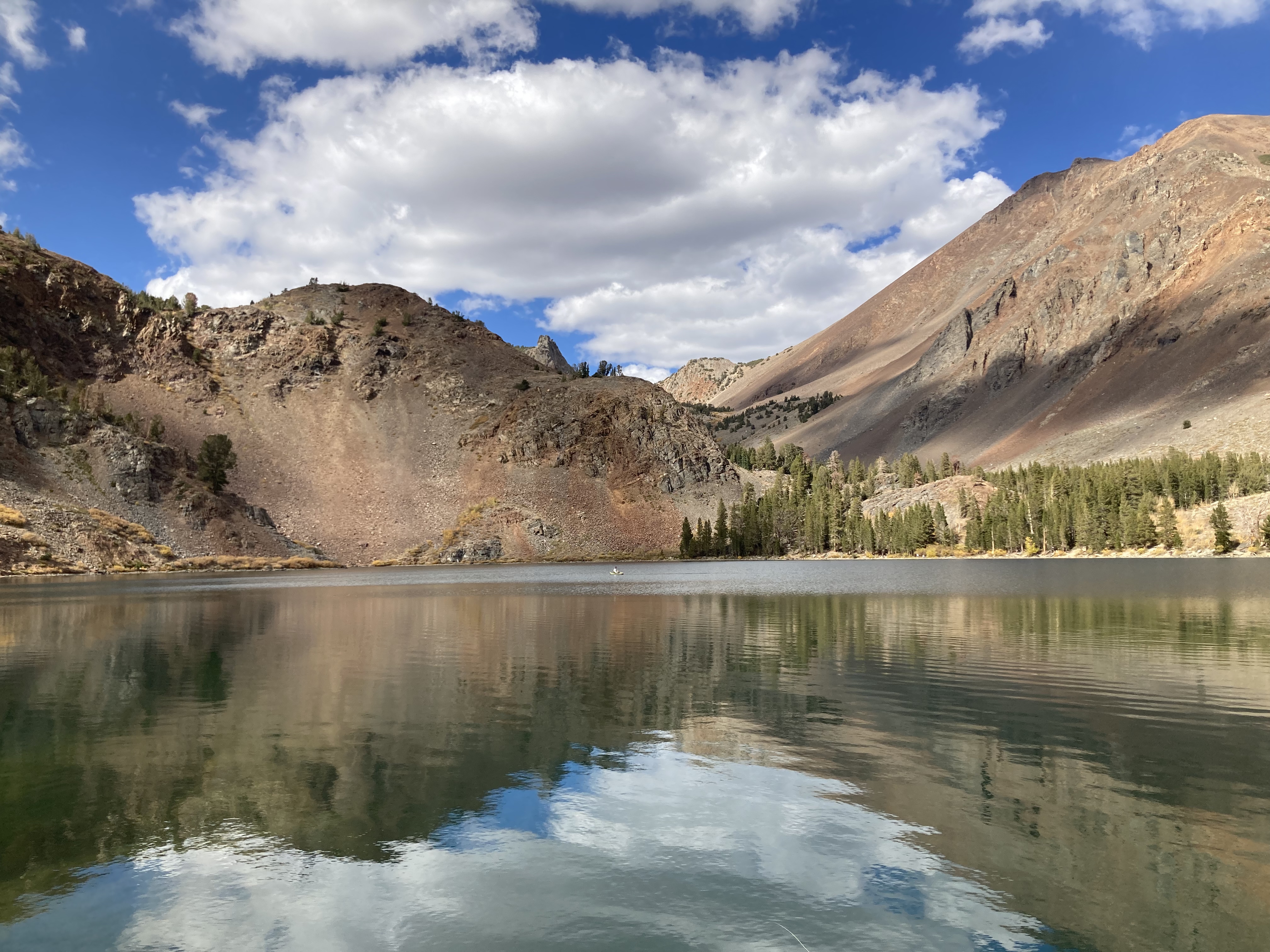
VIRGINIA LAKES: Actually a basin of lakes, their clear waters can hold elusive trout. (Credit: Jim Burns)

On the East Walker River a few days back, fishing with a bunch of longtime and new TU friends, I waited as a downstream drift effortlessly moved my tippet toward me, big Caddis on top, zebra midge below. Moving water takes on its own life when you wait. Cast. Wait. Cast. Wait, attention so focused, an electric spark of attentiveness.

Three days of fishing had yielded only meager results: Day One, skunk; Day Two, two brownies so small they both went through the holes in my net; now the last day was upon us. Late morning on one of the Virginia Lakes yielded spectacular scenes of granite majesty, made us think about geologic time, not human digital.

A lone cutty with beautiful red cheeks held so close to that lake bank, I grabbed my cell to take a shot, then, wondering what I was doing, raced to get my rod, cast the fly back in the water. No dice. The whole morning was like that, cruising fish, with no takers. My fishing bud, Rick, got so frustrated he slapped his rod tip in the water at a cruising fish, who didn’t even acknowledge the impact, so he tried again on trout’s next pass with the same result. He’d caught four-pounders at this very spot. He was generous enough to share it with me.

Late afternoon brought me back to the West Walker, as low, hot sun baked me to sweat and glare made me double blink. Enchanted by the music of singing water, no waders, yet I couldn’t help but submerge my boots on slippery rocks, just to satisfy that trout fever.

Don’t slip; set each foot down like balancing on a bowling ball; watch the bank-side scrub brush try to grab that airborne fly for its own.

CALIFORNIA FALL COLOR: A stand or group of aspen trees is considered a singular organism with the main life force underground in the extensive root system, according to the National Forest Foundation. (Credit: Jim Burns)

The guy in the town fly shop told us the “football trout,” rainbows who gorge themselves on plentiful bugs below the dam and into the Miracle Mile, were all gone. Too hot. He, himself, also thought about becoming a goner and moving out to North Dakota, tired of fire and endless drought.

In a watery burst, what draws so many of us to fishing happened to me: a flash of majesty and a solid hungry grab. A 12-inch or so football-shaped trout gleamed silver in that brutally reflective water, hooked and reluctantly riding the current toward me.

“Net!” I pleaded to another fishing bud, Bob, as I guided the trout in current to the bank. Bob was right there and then — just like that — the rainbow fatty was off my barbless hook and swimming freely away.

Over in a minute, what had consumed three days of my life, just like that.

Relief.

No matter what, the skunk needs to go.

Fly fishing is certainly about catching trout, but maybe more about renewal, is it not? It’s about connecting with nature in a special way, a hunting way, a caring way that yanks us from our cocooned lives and into the present moment, maybe, into that geologic time where we can see more clearly that we are small, but our impact on nature is increasingly outsized, like that caldera spewing lava some 700,000 years ago, altogether changing the landscape that was.

As a mostly solo fly fisher, usually that burst of calm knowing called renewal comes from water, fish, weather, skill, lack of skill, patience, flashes of angry frustration and a rhythm removed from my urban life. My spiritual battery turns out to be blessedly rechargeable.

SIZE DOES MATTER: And this little Brown slipped through a hole in my net! (Credit: Jim Burns)

Yet on this trip, renewal came from group experience, new and old friends. Collectively, we laughed, got bored, got pissed, got frustrated, learned new things, forgot the old. We hiked in, we ate out, we wondered where in the hell the trout were, caught them on occasion, and tipped our hats to their elusive, wily nature. Everything, just right. We marveled together at the majesty of the Sierra, but I think secretly we marveled at how wonderful it is to be human in a time when honesty, generosity and compassion illuminate our best outcome, our path forward through the dark.

See you on the river, Jim Burns

Fallon’s Angler releases the melodic ‘Landmark – Fishing the Dorset Stour for chub, perch and dace’

What’s up with the cutty squeeze?

flyfishjournal
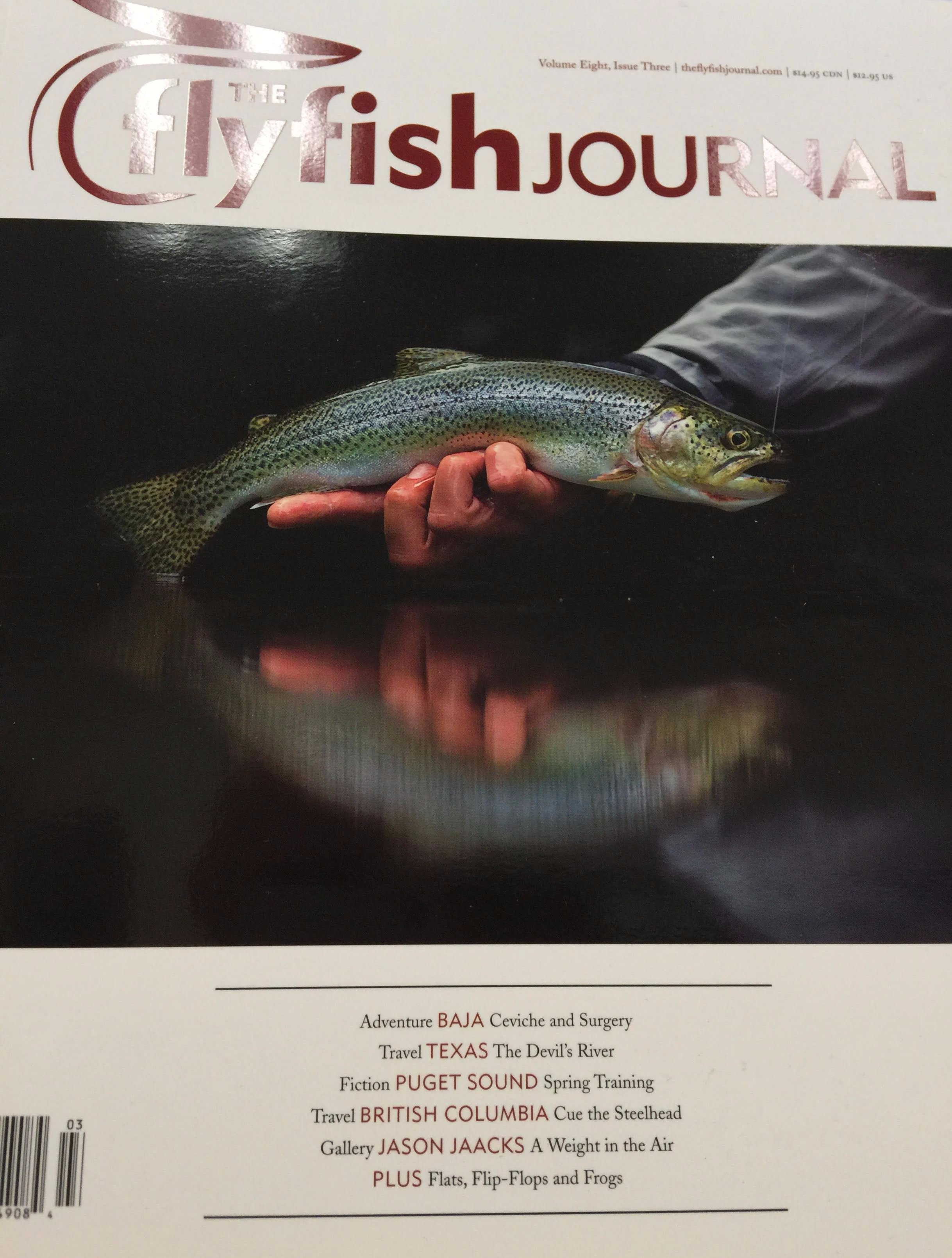
(Courtesy The Flyfish Journal)

Two years ago, I got pretty excited by the cover of The Drake, showing the ultimate in fish handling: this salt-water fav actually stayed totally submerged, with the fisher’s hands and rod in the background. I thought that was a model for handing catch-and-release fish, and one that made me question some of my own fish wrangling, especially when taking that all-important beauty shot.

Over the weekend, I received the latest The Flyfish Journal with the above cover. Doesn’t it look like this cutthroat trout is getting squeezed? The magazine features a bunch of excellent pictures from fishers in a photo article called “Rises,” but to promote this kind of fish handling on the cover I find questionable.

From that 2015 piece, something to ponder from Gordon M. Wickstrom, the author of “The History of Fishing for Trout with Artificial Flies in Britain and America: A Chronology of Five Hundred Years, 1496 to 2000,” who wrote about six periods in fly fishing for the Orvis News blog in 2011:

“In closing, allow me to play the prophet: I think that, in this New Period of angling, we are part of an important cultural shift toward a deeper humanity and mercy of the good Earth. We may find ourselves living quite differently, living better with less, with a greater delicacy, clarity, balance and honestly. Fishing a fly on a clear, cold stream may well serve as a working model and inspiration for what we want. It shows forth qualities — environmental, psychological, social, economic and political — that we need to incorporate into the future.”

See you on the river, Jim Burns

Wickstrom was right. We’re entering an age where understanding environment is the key to survival. Those who have a reverence for nature will have to set a template for the future. To what degree we learn the hard way remains to be seen.

Keepemwetfishing


‘Selfie-evident’: the one that got away

IMG_1048
Notice, there’s no carp in the net. (Jim Burns)

The Drake shoots for ultimate catch and release cover

IMG_0983 2
Could this cover from The Drake’s winter, 2015, effort be the ultimate beauty shot? (Courtesy The Drake)

When this image confronted me through its plastic-wrap encasing in the mail, all I could do was marvel — and possibly feel a bit dismayed. Undoubtedly, this is the ultimate 21st Century hero shot, in which the angler completely disappears in favor of the fish, and, apparently, the fish never leaves the water. Conversely, it takes two to create this image : fly fisher and media wrangler. (Maybe better three, including the fish), not the “me, myself and I” team most of us fish.

Gone are steps most useful in careful catch and release: no dipping net and hands in water; no reviving the fish before release, in favor of total angler immersion.

Gordon M. Wickstrom, the author of “The History of Fishing for Trout with Artificial Flies in Britain and America: A Chronology of Five Hundred Years, 1496 to 2000,”  wrote about six periods in fly fishing for the Orvis News blog in 2011. He pegged catch and release to 1960-2008, his Trout Unlimited Period, and reminded us of “Lee Wulff’s famous 1939 statement that ‘game fish are too valuable to be caught only once’ that became the basis for the catch and release movement that took hold over the last two decades of the 20th Century.”

The Drake cover reminded me of an art history prof I took once upon a time who said that American painter Albert Bierstadt’s depiction of human beings in his later-1800s landscapes represented people dwarfed by the habitat in which they traveled and were no longer the center of the story. Epic nature took center stage.Screen Shot 2016-01-16 at 10.28.18 AM

There’s much evidence that catch and release fishing tends to keep native fish populations healthy, especially in high-pressure areas. Who knows People for the Ethical Treatment of Animals (PETA) might even grudgingly endorse this image. The organization is vehemently opposed to sport fishing.

It’s a sure bet that until GoPro invents an underwater camera on a selfie stick, not many of us will be repeating this beauty shot anytime soon. For most, the trophy mentality is still there and we document our hunt with a photo instead of going to the taxidermist or the dinner table with our catch. We are, after all, still fishers fishing, but there may come a time when we join the ancient Taoist philosopher Lao Tzu by fishing along a stream with just the pole and no line. That may be the next step after Tenkara removed the reel.

Jokes aside, it is impossible to fly fish without becoming acutely aware of the environment in which you ply your passion. After all, this blog began after years of wondering what the hell was happening to the Southern California no-kill areas I’d come to love. When the fish is the star — not the gear, or the outfit, or even the destination, I see hope.

Back to the resonating words of Wickstrom:

“In closing, allow me to play the prophet: I think that, in this New Period of angling, we are part of an important cultural shift toward a deeper humanity and mercy of the good Earth. We may find ourselves living quite differently, living better with less, with a greater delicacy, clarity, balance and honestly. Fishing a fly on a clear, cold stream may well serve as a working model and inspiration for what we want. It shows forth qualities — environmental, psychological, social, economic and political — that we need to incorporate into the future.”

See you on the water, Jim Burns


Five years and 75,000 views later, thank you, LA

Earth Quotes: Garrett Fallon

The UK’s Fallon’s Angler is the sharpest magazine about fishing and writing to come out since Gray’s Sporting Journal in 1975. After all, it takes some braveness to bankroll a print magazine in this digital century. As he says, “Some of my friends think I’m two sandwiches short of a picnic to launch my own angling magazine.”

The writing includes some of the brightest young urban angling writers, including Dominic Garnett of the “Crooked Lines” blog, and Theo Pike, who published the highly regarded “Trout in Dirty Places” in 2012.

Each quarter, Garrett’s writers take readers to the intriguing and the far off, such as fishing for Atlas trout in Morocco’s mountains of the same name; or catching dorado by catamaran in Cuba. And I’m happy to say you can read my piece about carping in our river in this latest issue. It’s not available online, which makes it even more exotic. It’s worth a deep dive if you love longform journalism about fishing places you may only get to dream on. Better still, many of these stories may inspire you to actually pack up and go. Currently, mine would be to catch giant trout on Hottah Lake on the edge of Canada’s Artic Circle.

Here, an excerpt from Garrett’s 1994 musings:

     “I like to take my fishing very seriously, planning everything down to the last detail and hoping in the process to catch some fish. Yet occasionally, for reasons unknown, the fish just don’t bite, and so I am consigned to hours of fruitless labour. But during these times I have earned some of my fondest angling memories, as I find myself lapsing into a state of closeness with the environment around me. I have sat there, on the banks of the canal, watching my float and wondering why on earth it has not dipped or slid under the surface in the past hour or so, when suddenly my eyes catch something moving at my feet, and a field mouse makes its way across my shoes. Once, when I was sure there wasn’t a fish within a mile of me, the biggest tench I had ever seen cruised from the depths to browse for offerings beneath my feet.

     “The English writer Tom Fort has a theory about fishing, believing that somehow (using some super sixth sense), the fish waits for a lapse in the angler’s concentration, and in this moment of weakness, bites, removing the bait from the hook. There isn’t an angler alive who, during a fruitless session, hasn’t left his rod fishing by itself in order to empty his bladder in the local shrubbery, only to turn around and witness his (fishing) tackle sliding away into the depths, pulled by a great fish.

     “I find sinking into the background of my surroundings deeply satisfying, but you only reach this point if you’re not thinking about it. Izaak Walton ended his later versions of The Compleat Angler with the words “Study to be quiet,” and surely these resonate with all anglers? The fact he was quoting Thessalonians 4.11 shouldn’t be held against him. He successfully makes his point with all the effort of a gentle kiss blown from the lips of a milkmaid.”

See you on the river, Jim Burns

Quick Mends: Tales of the ‘tijuana trout’