California environmental groups are urging a federal court to intervene amid a “dramatic increase” in the deaths of threatened steelhead trout at pumps operated by state and federal water managers.
Since Dec. 1, more than 4,000 wild and hatchery-raised steelhead have been killed at pumps in the Sacramento-San Joaquin River Delta, according to public data for the State Water Project and the federal Central Valley Project. The agencies are now at about 90% of their combined seasonal take limit, which refers to the amount of wild steelhead permitted to be killed between January and March under the U.S. Endangered Species Act. Read the whole story from the Los Angeles Time >>HERE.
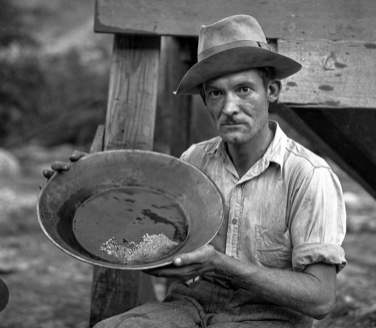
Get this. The East Fork of the San Gabriel River is closed because of zealous miners and the Forest Service trying to mitigate any hassles between them and the general public. Apparently, the rain brings out better gold mining conditions. Also note, it is illegal to mine within the National Monument!
I imagine that the miners blame the fishermen for putting pressure on the forest service. I think the EF may be a very dangerous place right now.
Update: Malachi Curtis reports, “I ended up heading up to see the east fork and it wasn’t or was no longer shut down. The bungee jumping company had a full group of people they were taking to the bridge. I fished there for an hour or so and landed two fish.”
There is a certain subset of the fly-fishing community, hopefully a sizable one, who pay extra attention to the fascinating heritage of California’s native fishes. The California Heritage Trout Challenge, recognizes those who have sought out six of the 11 cutty and rainbow qualifiers within the state’s borders.
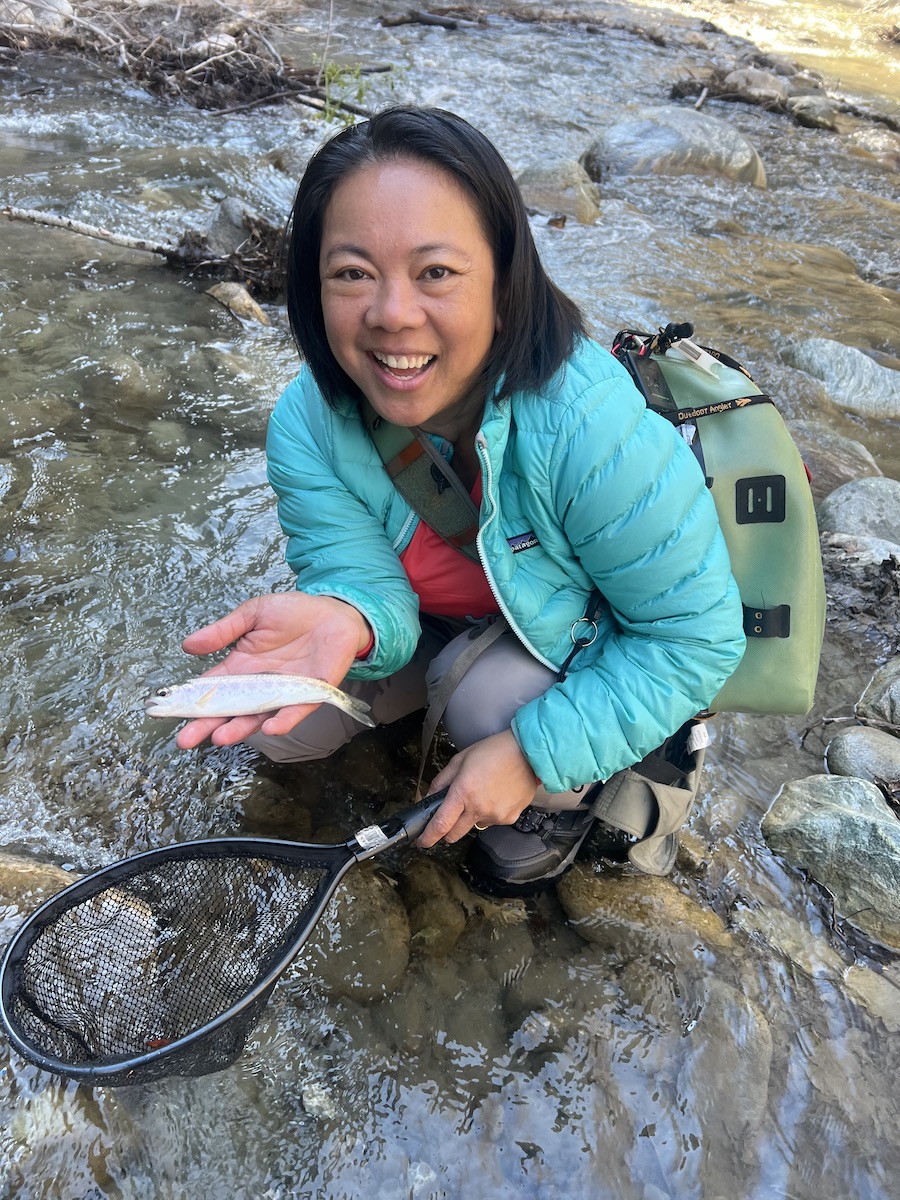
Analiza del Rosario on the East Fork San Gabriel River
You have to log your catch diligently with the Department of Fish and Wildlife to receive a well-earned acknowledgment in the form of a colorful, personalized certificate featuring the art of renowned fish illustrator, Joseph Tomelleri. Your certificate will show six full-color images representing the trout you caught, along with the dates and locations. It is sized to fit in a standard 16×20-inch matted frame. Ah, trout geekery at its finest.
Up until now, the submission process has been antiquated and required some effort. Recognizing this, the department recently updated its website to include an interface that allows for online submissions. What makes this all the more exciting is that here in So. Cal., there are actually waters that qualify. And rejoice, the challenge’s founder, Roger Bloom, spent years cutting his teeth in our trout waters, seeking out native fish and studying them for the CDFW. In other words, the challenge’s founder truly has local stream cred.
Here’s a hot-off-of-the-press statement from a Department of Fish and Wildlife representative per my inquiry:
“For Coastal Rainbow Trout any watershed that flows, or used to flow, into the ocean will count. All the rivers you mentioned and their tributaries (East Fork San Gabriel, West Fork San Gabriel, North Fork San Gabriel, Arroyo Seco) will count. Piru is another good spot. The next closest species for someone in Southern California would be the Kern Watershed. They can get Ca Golden Trout out of the South Fork Kern or Golden Trout Creek, Little Kern Golden Trout out of the Little Kern River, and the Kern River Rainbow Trout out of the mainstem Kern River.”
The idea of a road trip is also echoed by So. Cal.-based author James Pogue, who has completed the challenge four times.
“There is no way for a SoCal angler to get six (legal) species without making at least one trip up to the top of the state,” Pogue wrote in an email, “so combining the HTC with a trip to explore the North Coast or the high reaches of 395 is a necessity.”
But, he also noted, once up in the Jefferson area you can easily get a new species per day, every day, if it’s the right time of year and you plan well.
What more encouragement does one need? All this lies a shopping cart’s throw from, well, the LA River – nudge nudge wink wink.
Should any of you reading this already have accomplished the challenge, please leave a comment. It would be great to know of which species was the most challenging or interesting to find; whatever you feel like sharing.
Tight lines and safe travels!
Editor’s Note: The CDFW reports the Paiute region and the entire area, including the Paiute’s native range, is closed to fishing at this time into the foreseeable future.
Guest contributor – Bernard’s passion for fly fishing goes back over 40 years having started as a junior member of the Diablo Valley Fly Fishing Club and working in the legendary Creative Sports Fly Shop in Northern California. He has since guided in the Sierra Nevada, worked at the Fishermens Spot in Van Nuys, and managed social media for the Southwest Council Fly Fishers International. His “blue lining” exploits in the So Cal mountains are renown. Currently, Bernard and his wife Rebecca also serve as CalTrout’s “eyes on the ground” in Southern California. Both also serve as conservation co-chairs for the Southern Sierra Fly Fishers Club and a Patagonia Fly Fish Ambassador. – and this is the short version folks.
The Los Angeles River is again raking in grant money for its makeover, a boon to us Angelenos, as well as to the species who depend on the river for survival.
First off, Trout Unlimited South Coast chapter received $4.6 million late last year from the California Wildlife Conservation Board for the planning, design, education and outreach for the Lower L.A. River project over the next three years. It includes creating riparian habitat, slower currents and shady rest areas for steelhead migrating back home to the San Gabriel Mountains. That is the largest grant ever received by any TU chapter in the country. Emphasis on the Lower River and Dills Park, as well as the city of Paramount, is a hopeful sign that communities long neglected by LA’s power players will begin to get their due.
Meanwhile, the Bowtie, the former headquarters of Southern Pacific Railroad, was recently awarded $5,896,000 in funding for remediation and construction. In 2003, California State Parks bought the property called G-1, which is now referred to as “the Bowtie” (due to its shape), with the intent of transforming the currently undeveloped industrial land into a safe and clean, vibrant public green space, according to California State Parks. The makeover will focus on nature conservation and restoration, education and providing opportunities for passive recreation.
In all these two projects join:
— LA River & Caballero Creek Confluence Park (MRCA) – Construction
— LARiverWay Bike Path Segment 1&2 project (City of LA) – Design, partially-funded
— LARiverWay Bike Path Segment 8 (City of LA) – just became funded
— LA River East Bank RiverWay (City of LA, along Atwater Village) – Design, funded
— LA River Bike Path Improvements (City of LA, along Elysian Valley) – Design, funded
— Paseo del Rio project at Taylor Yard (City of LA, MRCA, State Parks) – Early design, partially-funded
— LA River Ecosystem Restoration and Recreation project Reach 1 (US Army Corps of Engineers, north side of Griffith Park) – Design, funded
— LA River Path Project (Metro, through Downtown LA and Vernon) – Design, funded (mega-project)
— Fish passage in the Downtown LA area, which is also in design but needs to find implementation funding.
The list totals nearly $500 million in project investments.
So, here’s a question for you: How much money does South Dakota have for conservation project in a year?
According to Ballotpedia, $23,650,008, which was the most recent available figure was for 2015. Now that sounds like a truckload of cash until you look at the figure for California, $9,108,000,000, you read that right.
On the high end, three states spent more than $1 billion on environmental and natural resources departments in fiscal year 2015 — Cali, Florida and New York. And just for the record, California spent more — way more — than both Florida and New York combined.
While on the low end, four states spent less than $30 million on environmental and natural resources departments in fiscal year 2015— Oklahoma, Nebraska, South Dakota and Connecticut.
Since passage of the Endangered Species Act 50 years ago, more than 1,700 plants, mammals, fish, insects and other species in the U.S. have been listed as threatened or endangered with extinction, according to the Los Angeles Times. And just like the big the states, there are winners and losers. Guess which species are the biggest winners of federal environmental bucks.
Of the roughly $1.2 billion a year spent on endangered and threatened species, about half goes toward recovery of just two types of fish: salmon and steelhead trout along the West Coast. Meanwhile, the tiny Virginia fringed mountain snail had $100 spent on its behalf in 2020 after only being seen once in more than three decades. There are also species — more than 200 imperiled plants, animals, fish and other creatures, according to the article — that had nothing spent on their behalf.
This sign near the Pasadena Bait Club House, didn’t survive the Bobcat Fire, but it still say it all. Next sign, let’s scratch “fishermen” in favor of “fisher folk.” (Credit: Jim Burns)
Just when the SoCali fly fishing community thought it could relax and put the wet boots up, turns out that’s not the case. Word on the stream-street is that the weekday closures will begin again in March for more silt removal that could last another two to three years! Yup, that means all the heavy equipment comes back, the guy at the gate will most likely be shooing folks away and — you will be trying to fish your weekend way through the inevitable growing spring and summer crowds.
So, enjoy this wonderful winter quietude while you can. It ain’t gonna last.
The old adage, “all the news that’s fit to print” might be changed in the future to “all the bad news that never seems to end.”
First you read or watch the bad news — never good news — then you hardly ever hear what happened later. Weeks, months, years may go by with nary an update.
Well, this is one of those few and far between “what happened later” stories, about a cause celebre, at least one for those who love rainbow trout and their cousins, the “steelies.”
It was September, 2020, and God smote the San Gabriel mountains with his fury, namely an ongoing, record-breaking drought and the Bobcat Fire, one of the largest in L.A. County history. The fire broke out near Cogwell Dam at the top of the beloved West Fork of the San Gabriel River bike path. As it happened, a story I wrote about the WF had just come out in California Fly Fisher. A letter to the editor put it succinctly: “Unfortunately, shortly after the issue came out, much of that river’s watershed was reduced to charcoal and ash by the Bobcat Fire.”
The letter writer went on to predict what anyone who has lived here a while realizes: without vegetation to hold back mud and debris from our steep hillsides during even a moderate rain, streams quickly get hammered, creating sediment that kills fish and makes hard for those remaining to spawn.
Shortly after the fire, the Forest Service predicted as much greenlighting a rescue effort to save the rainbow trout population in the West Fork. As an influential genetics study put it, “The WFSGR coastal rainbow trout population is recognized as a valuable genetic resource for Southern California Steelhead and native coastal rainbow trout.”
In other words, the trout swimming in our local mountains could eventually become steelhead trout, tragically few in number and endangered.
According to Joseph Stanovich, an environmental scientist with the California Department of Fish and Wildlife, “Over a period of four electrofishing efforts, 1,365 coastal rainbow trout were rescued, 469 of which were translocated to Arroyo Seco Creek on Nov. 24 and Dec. 1.”
Since then, CDFW biologists have snorkeled Arroyo Seco Creek the last three years to see if this bold rescue worked. And, fellow fishers, here’s that good news to come out of a tragedy — it has.
The numbers vary by year, but Stanovich’s team found a total of 657. Here’s what the data look like:
Why the overall drop from 2022 to this year? What’s interesting to me is the precipitous decrease in fry (under 2.9 inches) and the increase of the last three categories.
“Most of the population’s size is less than 2.9 inches. This could be attributed to the fact that drought conditions i.e., thermal shifts, low DO, and minimal water availability, may have stunted growth in fish or caused mortality in larger fish,” Stovich said. “Furthermore, prey availability may also be a contributing factor to the concentration of smaller size fish. Lastly, based on the results of size class distribution there appears to be successful recruitment across all size classes.”
So dream with me for a minute. We have two fish passages, one close to downtown, the other near Paramount down river, that eventually could help steelhead return to spawn in our mountains. Slower currents, resting areas and shade are all on the drawing board. Now, there could be a third piece to the puzzle.
According to Natalie Ouwersloot, the Engineering Manager with Pasadena Water and Power, the $15 million Arroyo Seco Canyon Project, a bypass fishway is also in the works, about a half-mile into the canyon behind Jet Propulsion Laboratory.
“We will remove the existing concrete structure and in its place construct an operable gate that will be lowered to bypass sediment and raised to take in water to the infiltration basins. Here is also where we are working with the California Department of Fish and Wildlife (CDFW) on a bypass fishway for the rainbow trout,” Ouwersloot said in an email. “We are currently working on finalizing designs, applying for grant funding, and applying for CDFW permits.”
The project, which was halted and revised because of a lawsuit from the Arroyo Seco Foundation and Pasadena Audubon, could be completed by 2027.
In other words, the dream of Lewis MacAdams, co-founder of Friends of the LA River, to see steelhead freely swimming from ocean berms to mountain tops, is a little closer today, thanks to the efforts of the smart, dedicated people you never hear about in the news. More on this story soon.
AND THEY ALL COME TUMBLING DOWN, to quote Humpty Dumpty. The first of four dams on the Klamath, Copco II teardown began in late June. (courtesy KRRC. Photo copyright Swiftwater Productions)
By the end of next year, all four dams of the Lower Klamath Project will be completely removed. Salmon and steelhead will once again be able to reach nearly 400 miles of historic spawning and rearing habitat in this remarkable watershed. In the late summer of 2025, we could see the first waves of returning salmon. Read the rest of this remarkable environmental success story from Trout Unlimited’s Sam Davidson >>HERE.
I am writing to inform you of a recent cybersecurity incident that involved recreational fishing license data. This notice provides information about the incident, what information may have been exposed, and what you can do to protect yourself.
WHAT HAPPENED
On March 30, the California Department of Fish and Wildlife (CDFW) was made aware of a cybersecurity breach within the network of a third-party vendor who uses fishing license information to conduct the Automated License Directory Online Survey (ALDOS) necessary to produce recreational ocean fishing catch and effort estimates.
WHAT INFORMATION WAS INVOLVED
The following fishing license information may have been included within the documents saved on the compromised network:
Last Name
First Name
Middle Name
Suffix
Age In Years
Gender
Email Address
Primary Phone Number
Secondary (Evening) Phone Number
Mobile Phone Number
GO ID (Fishing/Angler License #)
Information about the license, such as license type and sales date.
WHAT WE ARE DOING
Upon notification of the incident, CDFW ceased sharing any additional license data with the vendor. CDFW is considering a suite of options to better protect the license data from future incidents. We are also taking the additional step, out of an abundance of caution, to alert you to the fact that your personal information may have been viewed by an unauthorized person so that you can determine what further actions you would like to take to prevent any potential personal harm.
WHAT YOU CAN DO
If you have concerns about any potential harm, please consult the resources below; these websites have helpful information to protect you from potential identify theft, including how to receive a free copy of your credit report either through the Fair Credit Reporting Act or as a result of placing a fraud alert on your credit files:
If you suspect you may be a victim of identity theft, you should place a fraud alert on your credit file. You can also place a security freeze on your account to help prevent unauthorized access to your credit reports. Fraud alerts and security freezes must be initiated at each of the three credit bureaus:
When you receive your credit reports, carefully look them over for the following:
Accounts you did not open;
Inquiries from creditors that you did not initiate;
Personal information, such as your home address and Social Security number, that is not accurate.
If you see anything you do not understand, call the credit reporting agency at the telephone number on the report. If you do find suspicious activity on your credit reports, call your local police or sheriff’s office and file a report of identity theft. Get a copy of the police report as you may need to give copies to creditors to clear up any issues.
We offer our sincerest apology that this unfortunate incident occurred. Please be assured that protecting and safeguarding your personal information is one of our highest priorities. Please send any questions or concerns regarding this matter to ALDOS.Help@wildlife.ca.gov.
Sincerely,
Craig Shuman Marine Regional Manager California Department of Fish and Wildlife
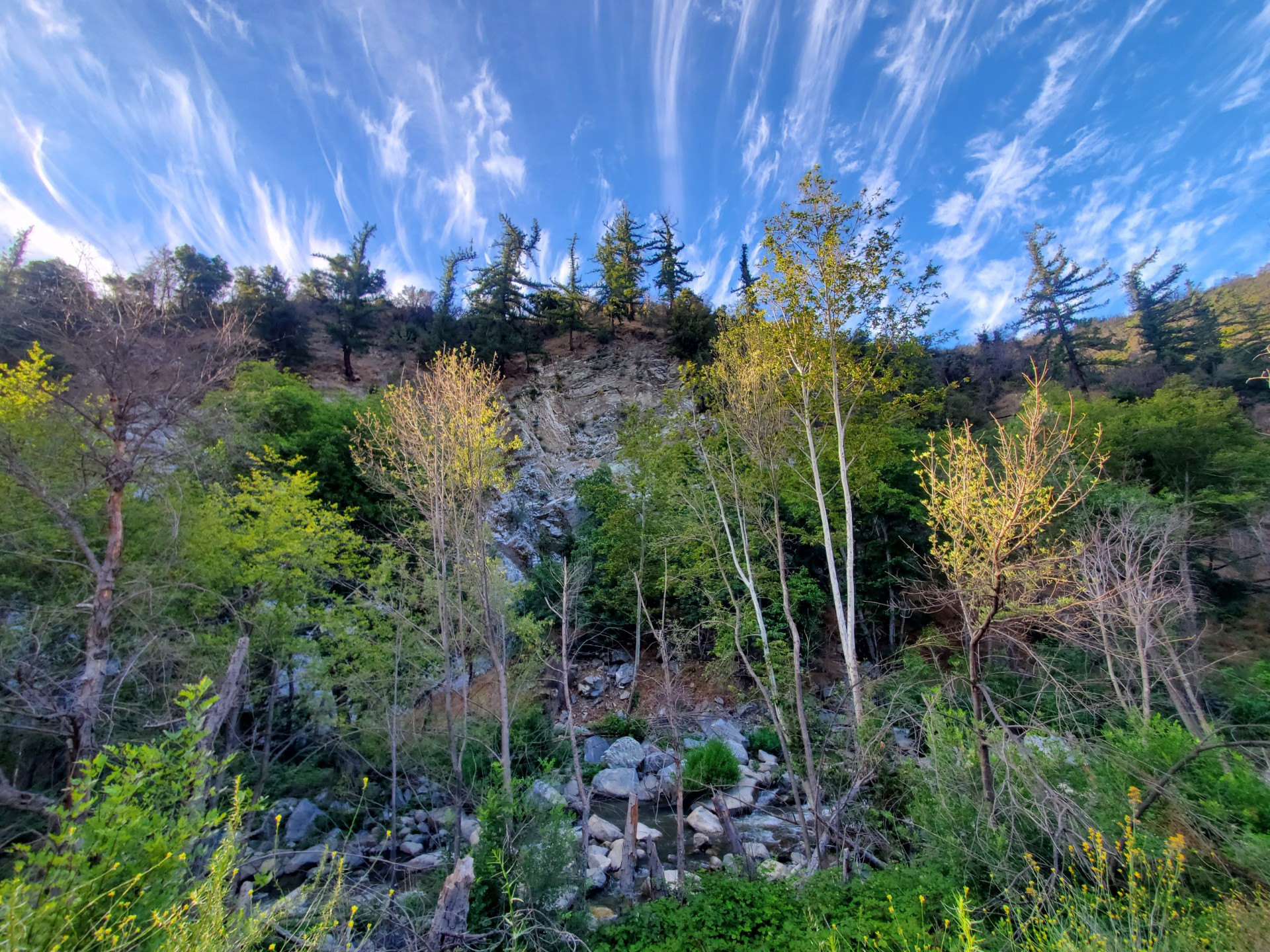
BIG CONE DOUGLAS FIR trees are found only in Southern California, these above the trail to the rejuvenated West Fork.
Los Angeles Times writer Louis Sahagun continues to cover important stories for our area. At 73, he’s certainly had his fair-share of “Page 1, above the fold” stories and has apparently survived the latest editorial purge of more than 70 staff.
A few weeks ago, we spoke at length about the disappointment many of us old-time LA River advocates feel about the billion dollars recommended by the feds in 2014 that has yet to show up and be put to use on our river. Even with lots of proposed projects and activities, no central environmental leader has appeared to take the reins from the now-deceased co-founder of Friends of the L.A. River, Lewis MacAdams. Read Sahagun’s excellent reporting >>HERE.
And he recently reported on an effort to urge President Biden to sign an Executive Order to expand our National Monument. by almost 110, 000 acres. We’ll see how this goes, but for me personally I got almost as excited about parts of the San Gabriel Mountains receiving monument status under President Obama, as I did when the Army Corp recommended the big restoration bucks, essentially green-lighting a massive effort to rewild 14 miles of the LA.
The problem with both is — money, or rather, “Show me the money!” as Cuba Gooding Jr. demanded in “Jerry Maguire.” In the first instance, Alternative 20, we’re still waiting; in the second, monument status doesn’t come with any additional funding. Read Louis’s story >>HERE.
Stay tuned and see you on the river, Jim Burns
I WAS AFRAID to go back to the West Fork, but last weekend it was full of water, bugs and beautiful trout. If you’re looking for a restorative miracle, visit before the summer swimming begins.
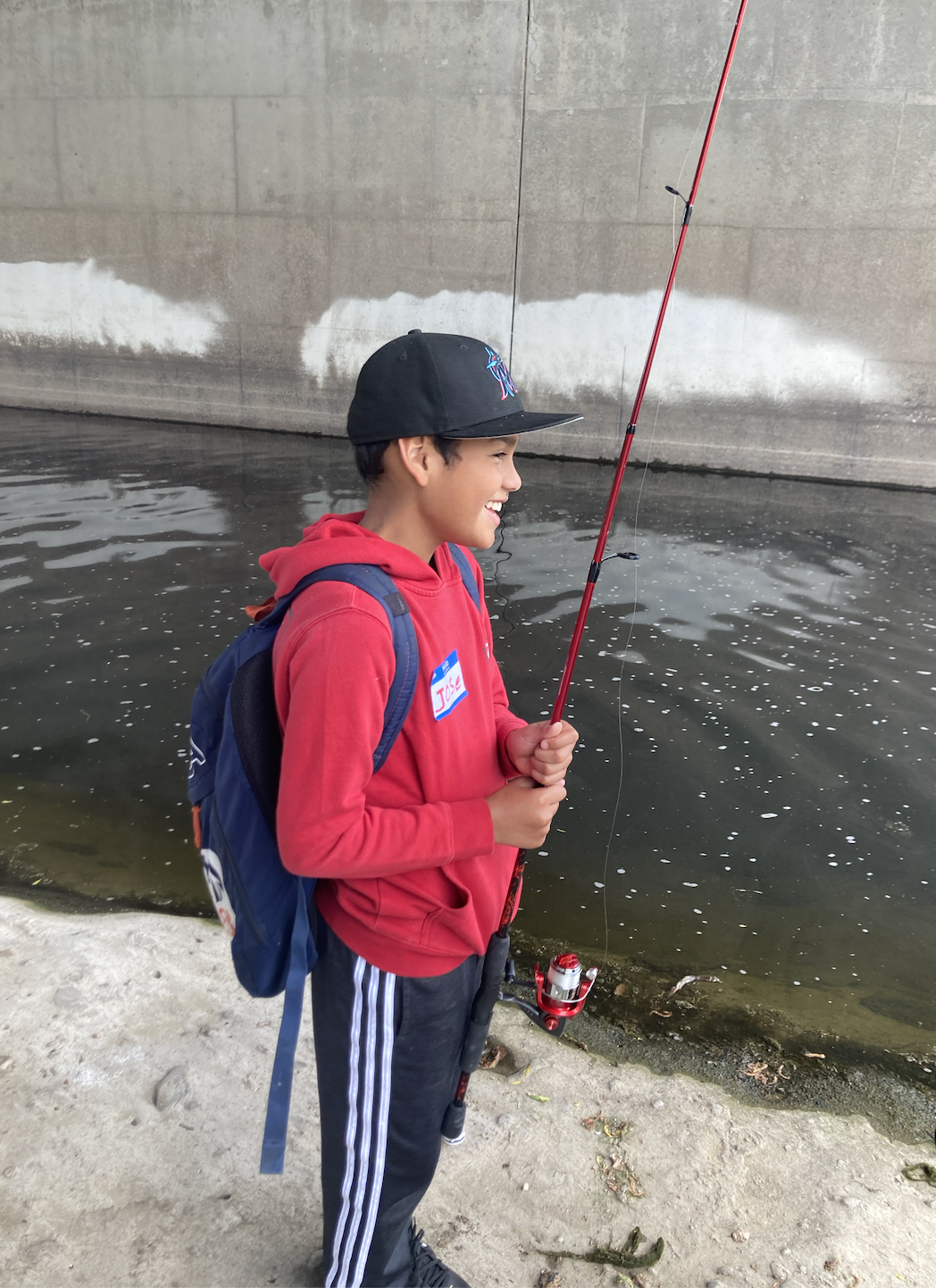
One of four dozen freshly minted fishers who attended Trout Unlimited ‘s LA River Fishing Workshops over the holiday weekend. (Credit: Jim Burns)
Sometimes miracles happen, especially when you give them a nudge.
Way back in November, 2010, I met a couple of boys on bikes, who at first unnerved me, under a bridge in a part of Los Angeles, forgotten and unloved. A part of Los Angeles that could be dangerous, definitely was dirty and made me wonder why. I wrote this:
I met Mario and his friend as they rode their bikes under the Hyperion Bridge. When he called to me, at first I felt unnerved. Then, looking around, I felt foolish to think that this bright-faced boy might be up to no good.
“Fly fishing?” he asked with a knowing smile.
“Got a good spot?” I answered in return.
And off we went, two kids who might have been Tom and Huck from earlier days, and an older gentleman, two on bikes, one on sneakers, plying the waters of the Glendale Narrows.
WINNER Issaih Salgago, 15, of Palmdale (left) hangs with event organizer Bill Bowling at the second “Off Da’ Hook” in 2015. (Credit: Jim Burns)
That very day, I vowed to myself, angry and standing under dozens of plastic bags hanging from a tree, that I would find a way to add something positive to the lives of the young people of Los Angeles, and, at least in part, that’s why I’ve continue to pen this blog for so many years.
Highlights of helping to get youngsters off their screens and into green urban environs include, three years with Friends of The LA River’s “Off Da Hook” fishing derby; helping out with FoLAR’s river fish studies, and years now of Trout Unlimited’s annual fishing workshops.
There simply is nothing like giving back to our city’s youth. Nothing like being a volunteer. Nothing quite like watching as a young person catches their first fish out of the LA, then helping them to throw it back.
So, hats off and hearts out to all those who volunteer their precious time to a worthy cause. We live in a time of tremendous cynicism and mistrust, a time of soul-gripping fear, a time when our young people are more susceptible to fear and depression that in years past.
I don’t claim to have any solutions other than to lean into whatever faith you practice and to practice the easy compassion that comes naturally from the human spirit. Especially on this day when we honor those who have selflessly served us, think about giving some time to our youngsters. If you kayak, teach a kid to kayak as well; if you birdwatch, take them along to see some new species and marvel at the beauty right here in our ruined river; if you bike, you know where I’m going with the argument. As we age, we realize it’s an imperative to help others and to give whatever we can. Start today. With your help, it only gets better — not worse — from here.
See you on the river, Jim Burns
SMILES and a big wave defined this year’s LA River Fishing Workshops, as many wetted a line for the first time, with hopefully many outings to come. (Credit: Jim Burns)







 lariverflyfishing