
Category: Fishing


Eastern Sierra Fishing Update
With water conditions changing weekly, it’s essential to keep up to date with current reports before heading out on your next fishing adventure.
With three out of the four estimated runoffs complete, the Los Angeles Department of Water and Power is doing a good job at monitoring and controlling these flows thus far.
Hot Creek has been the “hot ticket” lately, with the most consistent and productive fishing. With water conditions looking Fair and showing 318 cfs as of last week, just below the 395 on Mammoth Creek. As long as Mammoth Creek stays clear, Hot Creek is worth fishing.
Crowley Lake has picked up and is much more consistent than in the last few weeks. With the water level lower, due to DWP making room for the runoff, it’s filling up slowly but surely. The best fishing has been late morning before the winds pick up.
The Upper Owens water conditions are starting to clear up and slowly improve. Even though the water is starting to clear, it is still very high, limiting fishing conditions. Better reports are coming from above and below Benton Crossing, where some big Rainbows are heading back to the lake.
The Lower Owens and East Walker have poor water conditions and dangerous fishing. Check back in a couple more months and hopefully by fall, we will see some clear water and fishing areas.
Pleasant Valley Reservoir is open but only from Gorge Road at the upper end. DWP is expecting the campground below the reservoir to flood in the near future
Here are a few tips and words of wisdom from veteran guide Pat Jaeger…
1. When the river flows are massive, go upriver; when it’s little, go downriver.
2. When you fish runoff-affected rivers, start early. The water temperature is the warmest of the day, and water flows, the smallest. (Runoff normally peeks mid- to late- afternoon into the night).
3. Look for reliefs of current (it’s all math). Fish will feed in fast currents, but hold up in calmer.
4. The angler who puts the fly in front of the fish wins. (When fish are up, use dry flies; when fish are down, use nymphs). Big river years, do your best to find the bottom, that’s where the fish are.
Adapted from Bob Marriott’s Fly Fishing Store newsletter

What are the obstacles against catching/releasing a native Rainbow in our local waters? Let’s list the Big Three:
Ongoing drought since 2001, which tree rings show is the driest 21-year period since at least 800 A.D. when Vikings sailed and Mayans built temples. (San Jose Mercury News)
Frequent forest fires, including 2020’s Bobcat Fire, which devastated the West Fork of the San Gabriel River. Local fly-fishing club members report there are no fish in a stream beloved by us all. I would add the footnote, “for now.”
Beginning in the 1930s, channelization to prevent flooding, dams and development block rainbows from returning to the Pacific Ocean and, conversely, steelhead from returning from the ocean to the San Gabriel Mountains to spawn.
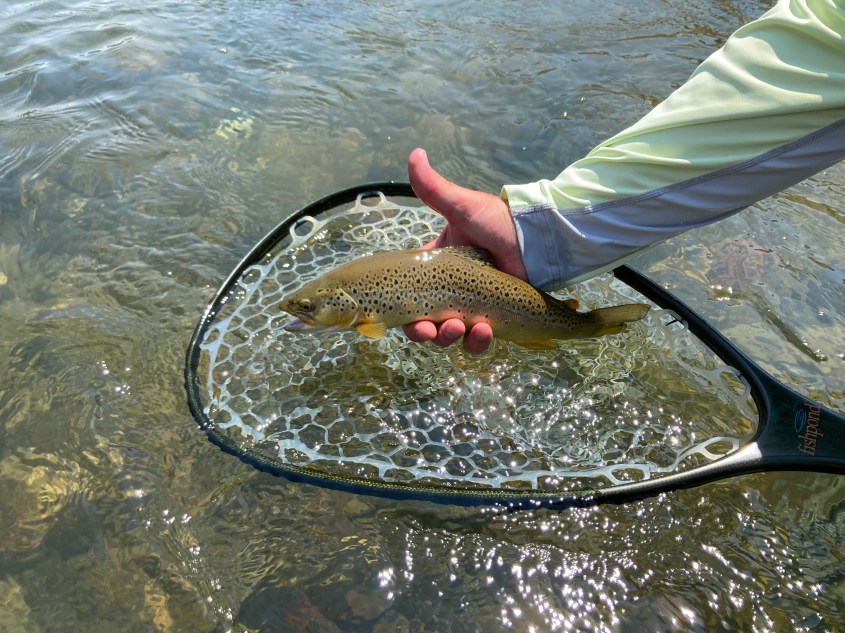
Yet today, there he was, in a flow of cool, clear, crisp water. Small and full of fight, he glimmered like a slim beacon of hope.
In a world of seemingly unrelenting bad news — disease, gun violence, war and now economically crippling inflation — this is why I continue to trek in our local mountains and continue to cast a line into the seemingly impossible. In our waters, there are still possibilities, there is still hope. Remind yourself next time you are on the water that the mere act of continuing what for many of us is a retreating normal, miraculous life remains.
See you on the river, Jim Burns


Those of a certain age will remember Porky Pig’s sign off, “ba-dee, ba-dee, ba-dee, that’s all folks,” as the 2021 fishing season ends on many of our rivers today. And if you remember the joys of Porky Pig and his friends Donald Duck, Bugs Bunny and hapless Elmer Fudd, you probably hope for another year, instead of taking it for granted. I certainly know I do.
If 2020 was our COVID year, 2021 has been all about reentry, and it’s hard to figure. Everybody seems to be mad and raging about something. I have opinions, but my posts, all 635 of them, are not political here on LA River. I just began my 11th year, which is hard to believe.

Also, as readers have noticed, I don’t write nearly as much as I used to. I’ve trimmed back on traditional print as well, so you won’t see my byline in California Fly Fisher, but I’ll continue for Fallon’s Angler. At this point in my life, I get to be choosy.
Back to the year. From Western press reports, I expected overrun river conditions along the likely suspects, where new anglers would resemble a herd of raging bulls in Pamplona. Heat, passion and too much flask time can lead to inconsideration for your fellow anglers. So can just plain etiquette ignorance. One of the beautiful things about fly fishing is how much respect we have for each other on the water, as well as for fish and their habitats. Let’s not lose that beautiful part of our sport as our numbers increase. “Share the water.”

I still mourn the loss of the West Fork of the San Gabriel because of the Bobcat Fire, which, as it turns out, is irreplaceable as a beauty spot within a short drive from L.A. that had lots of small rainbows, a bike lane, shade and happy times. When it will actually return to those conditions, is anyone’s guess, but the stream is slated to reopen April 1, 2022. I hope that date isn’t another sign of things to come.
I was lucky enough to fish the nearest good water from L.A., the Kern, in winter and spring with no other anglers in sight on the 20-Mile Stretch. I went out with Rob Buehler of Buehler Brothers fame, on each occasion. Great guide and great guy.
Spring became summer with the drought tightening a dry, dusty grip across the West. Did you know Elko, Nevada, still has a fly shop and a weekly fishing column? The columnist and shop owner, Joe Doucette, even calls you back when you’re trying to find a spot to catch a Bonneville Cutthroat Trout in Nevada’s Great Basin National Park. For lots of reasons, that didn’t happen (yet), but my chats with Joe led me to a beaver pond in Nevada’s Ruby Range, full of small, radiant cutties. My wife and I missed a mountain lake, but even with a sky dirty gray from persistent Western wildfires, those small fish were a wonder to behold.
Next, I skipped Idaho’s Henry’s Fork out of agoraphobia, and instead went desert fishing on the awesome Owyhee River in Oregon at the Idaho border. Andrew Catt and I left Boise at 4:30 in the morning to beat the unrelenting summer heat. After an hour’s drive, we found very cold water and very active browns, even as the temperature soared into the high 90s.


The end of the season found me on the Western side of the Sierra last month with Trout Unlimited South Coast friends and new friends. The water levels at Edison and Henderson were heart-bracingly low, as was the drive into the back country through acres and acres of Camp Fire burn. We’d cancelled our trip with Jimmie Morales last year because of COVID, so it was pretty amazing to have Pat from Seattle, Jack, the nomad, and Rocky from Texas come join in. Several of our group without all-wheel drive vehicles got snowed in and had to spend an extra day. (Some have all the luck … .)
As for the LA River, it continues to be the source of crazy stories, like the one my friend, Bob, told me recently about the opera singer who enjoys the same carp honey hole. Only in LA, right? Earlier in the year, Bob and I couldn’t figure out what the mysterious raindrops in a forlorn pond were all about, until with a net he and his fiancée, Karen, discovered lots of large bullfrog tadpoles coming up for air. At first, I was madly casting to them, thinking they were blue sunfish rises!
So, readers, my fishy advice? Enjoy getting outdoors; enjoy the camaraderie of those of like mind; put yourself on a social media diet; show the ones you love how much you actually do love them and keep a little in reserve for those who come off cranky, but probably just need a hug. Keep it light and easy streamside, our refuge. This year I fished with guys who have wildly different political views from mine, and guess what – we all enjoyed each other’s much-needed company.
What will next year bring us all? As Porky Pig might stutter, “Stay tuned, folks … .”
See you on the river, Jim Burns
PRESS RELEASE: The California Department of Fish and Wildlife (CDFW) is asking recreational anglers to voluntarily change how, when and where they fish to minimize stress and mortality among fish populations suffering from drought conditions.
CDFW is advising anglers not to fish past noon on certain inland waters as even catch-and-release angling during the hottest parts of the day can greatly increase fish stress and mortality.
“Many of our inland fisheries that rely on cold water habitat will likely be significantly impacted in the short and long term,” said CDFW Inland Fisheries Manager Roger Bloom. “California’s drought cycles have required us to learn to manage fisheries with extreme variations in water flows. The last drought resulted in significant effects to fisheries that took years to recover from. We hope the self-imposed Hoot Owl restrictions by anglers will help mitigate those effects.”
Coldwater species such as trout, salmon and steelhead have the greatest likelihood of being affected by the drought this year but low water levels and high-water temperatures can potentially affect all inland aquatic species.
CDFW has introduced a series of voluntary angling recommendations – so-called “Hoot Owl” Restrictions – that directs anglers to focus their fishing during the cooler “hoot owl” periods of the day when water temperatures are lowest. A watchlist of specific waters anglers should avoid fishing past noon is included and will be updated as conditions change. Sustained afternoon water temperatures exceeding 67 degrees Fahrenheit for trout fisheries could trigger addition to the list.
Currently, the list of waters include:
- Lower Owens River (Pleasant Valley Dam downstream to Five Bridges) in Mono County
- Hot Creek in Mono County
- Mill Creek (Walker Basin) in Mono County
- Lower Rush Creek (Grant Lake to Mono Lake) in Mono County
- Bridgeport Reservoir in Mono County
- Deep Creek (San Bernardino County)
- Crowley Lake (Mono County)
- Truckee River (Lake Tahoe to the Nevada state line) in Nevada, Placer and Sierra counties
As conditions change, CDFW will post the updated list on the “Hoot Owl” Restrictions page.
Elevated water temperatures, lower oxygen levels, disease, low flows and low water levels are among the drought-related effects impacting many of California’s coastal waters and inland fisheries.
CDFW offers a number of other angling tips to reduce fish stress during the drought:
- Minimize the time you spend “fighting” the fish and any hands-on handling.
- Use rubber or coated nylon nets to protect a fish’s slime layer and fins.
- Quickly remove the hook with forceps or needle-nosed pliers.
- Minimize the amount of time the fish is exposed to air, especially when the weather is warm.
- Keep your hands wet when handling the fish.
- If the fish is deeply hooked, do not pull on the line. Instead, cut the line as close as possible to where it is hooked and leave the hook so it can dissolve.
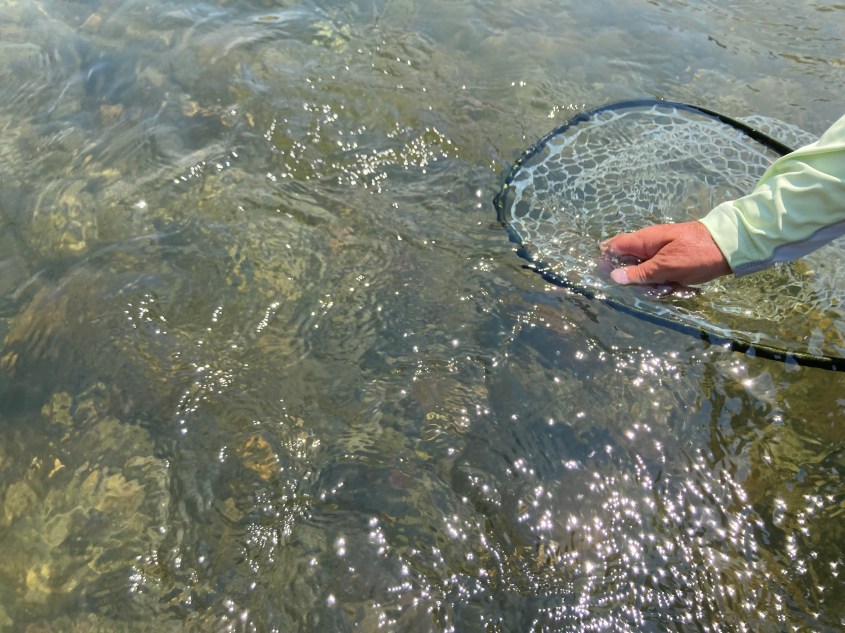
- Allow the fish to recover in the net before you release it.
- If the fish does not stay upright when you release it, gently move it back and forth.
- Avoid fighting fish from deeper, cooler waters and bringing them into warmer waters at the surface if your intention is to release them.
- Target fisheries that have stable water levels and species that are more resilient to elevated temperatures.
While theses best practices may not all apply to anglers interested in harvesting their fish to eat, mortality may result from non-targeted species caught and released or fish outside of legal size limits that must be returned to the water.
This video brought back soooo many memories for me: Fishing the Upper Sac, hanging out in Dunsmuir with my friend, Dave, at the Ted Fay Fly Shop, and learning to high stick on the Pit River. (A river with the motto, “If you’re not currently swimming, you will be soon!)
I love how Matt weaves the story of current euro nymphing to high sticking back in the day. Fun watch.
See you on the river, Jim Burns
 lariverflyfishing