How to protect wild spaces in urban places is mandate of Urbanwild Network. (Courtesy Urbanwild Network)
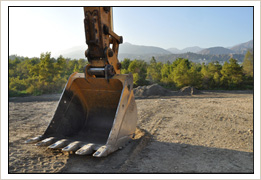
How do we protect and preserve some of the last remaining urban wilderness areas in Southern California? That’s the objective of the recently formed Urbanwild Network, which has its roots in the unnecessary destruction of a pristine oak woodland in Arcadia.
Two representatives of this new organization, Christle Balvin and Mary Barrie, will make a presentation on the lost Arcadia woodland and show other rural sites that are threatened by L.A. County’s need for additional sediment dumps.
All are welcome. Beverages, plates and utensils will be provided. Bring a dish serving 6-8 people.
Gather Saturday, Sept. 10, at 5:30 pm; dinner at 6 p.m.; program at 7 p.m., at Eaton Canyon Nature Center, 1750 North Altadena Drive in Pasadena.
Directions: From the 210 Fwy in Pasadena, take Altadena Drive north 1.5 miles to theintersection with New York Drive. About 500 feet after the intersection, turn right at the sign intothe park.
SEPULVEDA RECREATION BASIN, Calif. — As city councilmen Ed Reyes and Tony Cardenas carefully navigated their footsteps through mud and into strategically positioned kayaks, there seemed nothing particularly momentous about kayaking today in the Los Angeles River. Aside from the digital news cameras and lack of a dock, you’d never know that this paddling event stretched across layers of federal, state, county and city bureaucracies.
AHOY, MATEY: Councilmembers Tony Cardenas, front, with Ed Reyes, far rear, enjoy a day on the river. (Jim Burns)
After all, there has never been a non-motorized boating program in the river. That’s never, as in never. And, for that matter, there has never been anything officially sanctioned and remotely recreational about hanging by — much less in — its perfumed waters. The Army Corps of Engineers had to sign off on the safety of the project, which is hoped to lead to a permanent yearly, seasonal, recreational boating program. (Note, the seasonal part …)
The two influential Los Angeles councilmen kicked off the pilot paddle that continues the progress of revitalizing our river after midday, under a bridge with cars zipping along overhead. An L.A. moment.
Beforehand around 100 listened to speeches with more enthusiasm than is found at the typical ribbon cutting. Environmental organizations, including Friends of the River, The River Project and Mountains Recreation and Conservation Authority, lined one side of the small green park just above the launch site, and handed out fliers, t-shirts, and newsletters about their efforts to turn back the river clock to a time before its concrete channelization in the 1930s. Those efforts by the federal Army Corps of Engineers and local authorities came in the wake of disastrous flooding, which killed Angelinos and destroyed millions of dollars in private property.
The mainstream media, which largely ignores riverly happenings, were there in force, including Spanish language KMEX, with one reporter so busy tweeting from her station aboard a two-person kayak that Cardenas chided her, saying, “you’re supposed to out here enjoying nature.”
Councilperson Reyes said it best: “This is a moment when we get to make Angelinos believers. We are able to make them really believe that they have a river in their city. That there truly exists a whole ecosystem. Birds. Wildlife. Water that connects and drains into the ocean, an ocean that is dying.
“It’s a moment when we can look at a natural asset, set aside our biases, our prejudices, the ‘us vs. them, we live on this side of the tracks, they live on that side of the tracks,’ and talk about one city. And this river will get us there.”
Certainly the Obama administration feels the same way. The recent inclusion of the Los Angeles River — one of seven city waterways — in the Urban Waters Federal Partnership spotlights federal efforts to connect city neighborhoods to the water.
Even the National Park Service was on hand. “I think it’s essential if we are going to make these kinds of properties available to urban folks that we bring it in as close to their communities as possible. And this is a great demonstration of how to make it accessible … because this is where the starting point of building a stewardship ethic begins, right in their communities,” said Charles Thomas, Pacific West Regional Youth Programs Manager.
The pilot program is modest, with Fridays reserved for youth groups, and two public recreation-education trips, Saturdays and Sundays, from Aug. 13 to Sept. 25. Ten paddlers per trip will explore this natural mile and a half section of the river in the Sepulveda Recreation Basin with a ranger/naturalist from the Mountains Recreation and Conservation Authority. Do the math and only 280 folks out of a county pushing 10 million will be able to participate. Tickets are $50, plus a $3.74 handling fee. This covers boat rental, safety equipment and insurance. Scramble for tickets here.
A snarky tweet from Kim Cooper summed up opposition to the plan: “Thinks it’s lame that people are being charged to kayak down the Los Angeles River, a public, navigable waterway. Tom Sawyer wouldn’t pay,” to which we can only reply, true, but it’s also no longer 1876.
The bigger question for readers of this blog: when do we get a pilot program for fly fishing the river? Fly rods and kayaks can make for excellent home water excursions!
SAILING, SAILING: Mayor Antonio Villaraigosa (front of canoe) takes a tour of the L.A. River earlier this year. (Courtesy Sepulveda Basin Wildlife.org)
Well, the Army Corps of Engineers listened to all of the responses from kayakers, environmentalists and just plain folks who love the river, and guess what! If you are lucky enough to buy a ticket (cost unknown to me, but I’ll post it when I find out), Saturdays and Sundays, Aug. 13-Sept. 25, you can explore a mile and a half stretch of the water during this pilot program.
Remember, if was just over a year ago that the Environmental Protection Agency declared the entire river a “traditional navigable waterway,” paving the way for recreational usage. Sign up to get a ticket and check out the digital clock countdown. It’s sure a lot better than getting dizzy trying to watch the debt clock.
And, this just in from Wilson Lau, Watershed Coordinator at the Arroyo Seco Foundation:
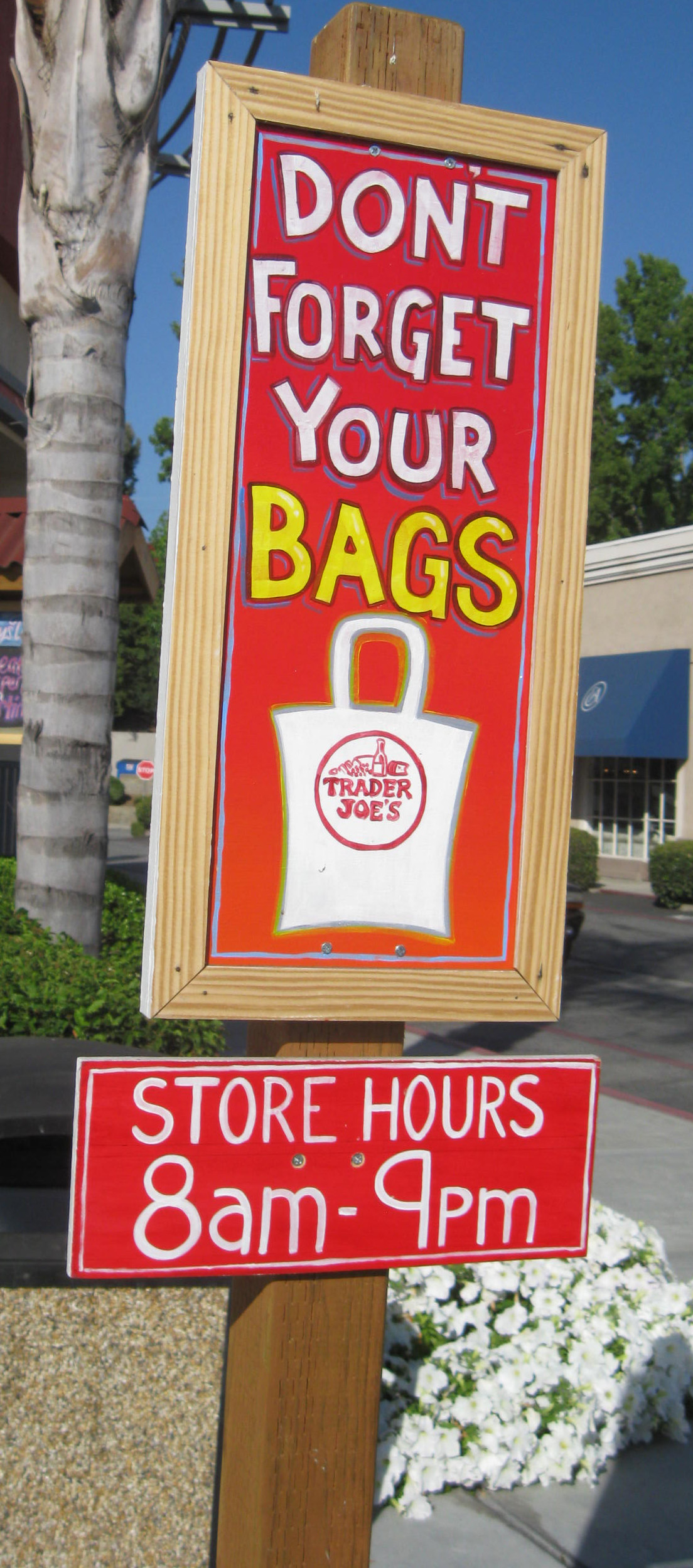
Bag Man: Now that you can be nicked a dime for a paper bag at grocery stores in unincorporated areas in L.A. County, it pays to bring your own. (Barbara Burns)
The City of Pasadena is having a Special Meeting of the Environmental Advisory Commission (EAC) Tueday at 6 p.m. to receive comments on a recommendation for a proposed ordinance that would ban plastic carryout bags, impose a 10-cent charge on paper carryout bags, and require affected stores to provide reusable bags to customers for sale or at no charge. The stores that would be affected by the proposed ordinance includes large grocers (gross annual sale of $2 million or more), retailers (at least 10,000 square feet of retail space and has a licensed pharmacy) as well as farmer’s markets, drug stores, pharmacies, supermarkets, grocery stores, convenience food stores, food marts, liquor stores, vendors participating at City-sponsored special events, and events held at City facilities or on City property.
Pasadena is committed to forging policies in support of increased environmental stewardship in partnership with the business community. Pasadena’s Green City Action Plan, adopted in 2006, identifies the development of a plastic bag reduction program to support its goal of achieving zero waste to landfills by 2040.
Questions? Contact Ursula Schmidt, Sustainability Affairs Manager, at (626) 744-6729.
Comments will be heard in Pasadena City Hall, Council Chambers, S246, 100 N. Garfield Ave. Street parking is available on Garfield Avenue and Ramona Street, adjacent to City Hall. A public parking lot is located at the Paseo Colorado Shopping Mall just south of City Hall at 280 East Colorado Blvd.
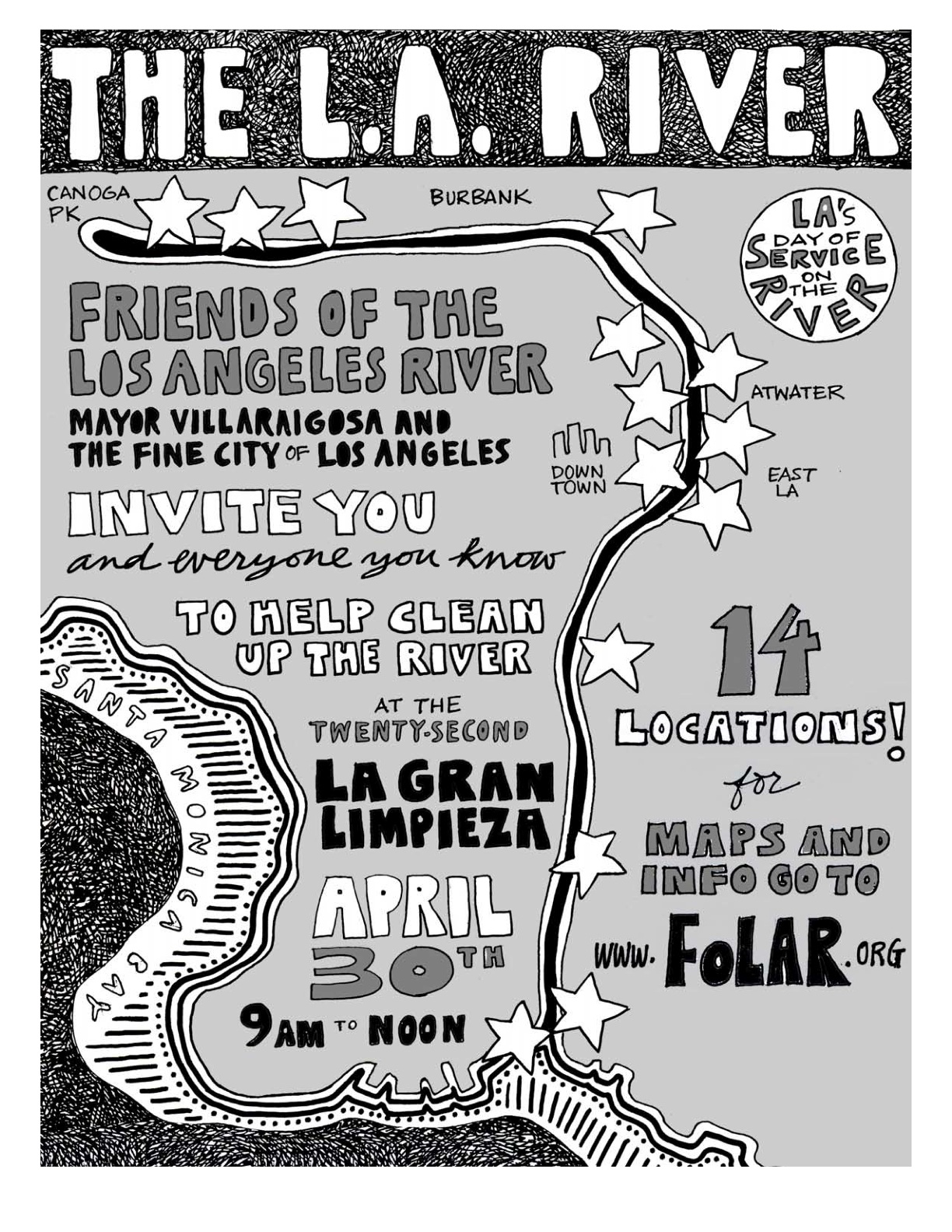
Stake out a site from this nifty cleanup flier (Courtesy Friends of the Los Angeles River).
How can sturdy shoes, a pair of work gloves and sunscreen magically turn into a free T-shirt?
Well, April 30 from 9 a.m. until noon, it’s time to clean up the river, sponsored by Friends of the Los Angeles River and Mayor Antonio Villaraigosa. Check out this link for the deets.
See you on the river wearing my sturdy shoes, Jim Burns
Last night at sunset, a host of city and environmental group dignitaries dedicated Confluence Plaza. The crowd of some 75-to-100 people cheered and applauded, as the first jets of water shot from ground level high into the air, to a brass fanfare of “Rigaudon.”
The fountain shoots water into the air for eight minutes at the top of the hour, from 9 a.m.-6 p.m. (Jim Burns)
The scene was nothing, if not surreal — and jubilant.
A more unlikely spot for this landmark probably couldn’t be found. To the north lies the netherworld of the Cypress Park Home Depot parking lot, under the I-5 freeway. Day workers milled around, waiting for that last hourly job, items for purchase sat on a blanket in a spontaneous bazaar, and the roar of rush-hour traffic reached shout-out levels.
Yet, the speakers put this latest addition to the L.A. River Revitalization Master Plan in perspective.
“It means a connection to the environment,” said Romel Pasqual, L.A.’s deputy mayor for environment, from the podium.
His words echoed those of the previous speaker, City Councilmember Ed P. Reyes., who talked about the meager 55 percent high school graduation rate and the fact that “unfortunately, gangs are winning” our youth, instead of education. According to his Web site, in the past Reyes, vice-chair of the Public Safety Committee, has secured funds for neighborhood clean-ups, gang prevention programs and safe route school maps.
Of course, the confluence of the Los Angeles River and the Arroyo Seco is city history at its best. The actual spot is covered in concrete, inaccessible except to the hearty. If you look on a map, it’s basically at the intersection where the I-5 and the 110 meet.
Careful! Park rangers, from left, Kevin Perrine, David Aceves and Fernando Gomez, get their feet wet as the fountain jets were inaugurated. (Jim Burns)
“It’s a beachhead,” Jenny Price, who gives well-regarded tours of the river, said of the plaza.
Indeed, it is the first part of the multiphase Confluence Park project.
The river’s poet laureate wrote a piece for the inauguration and one line probably best summed up the event.
“I prophetize our happiness …” Lewis MacAdams intoned from the podium.
“Mad as a March hare,” that’s how the old saying goes.
College basketball fanatics anticipate March Madness; Catholics, the beginning of Lent and, for everyone, the last big-gulp gasp of Mardi Gras: “Laissez les bons temps rouler.”
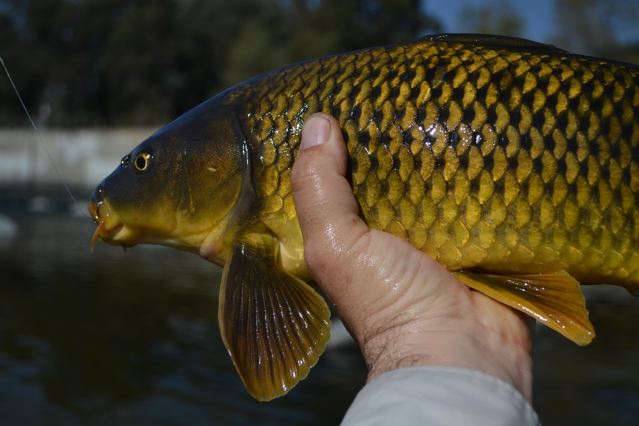
Check out the vivid color on this beauty. (courtesy David Wratchford)
Crafty fly tyers may litter their vises with March Browns to celebrate the beginning of spring.
And for those of us plying urban waters, it’s time for the semi-annual parade of the carp.
“I think they end up in Balboa Lake. I’ve spotted some huge fish in there,” guide David Wratchford told me yesterday at the Fisherman’s Spot. That would be miles, and miles, and miles upstream from where they begin the migration, probably in the Glendale Narrows.
Earlier in the week, he’d left me a voicemail — with some urgency — that the spawn was on.
My question: why now?
Turning to the bible of carp fishing, “Carp on the Fly” by Barry Reynolds and friends, I found the following water chart:
Water Temperature Remarks
39 degrees Carp begin active feeding.
41 degrees Carp begin pre-spawn move to shallows.
61 degrees Sustained temp lethal to carp eggs.
63 degrees Probable lower limit for spawning.
66 degrees Optimal temp for carp.
72 degrees Metabolism increases rapidly.
75 degrees Probable upper limit for spawning.
79 degrees Sustained temps lethal to carp eggs.
90 degrees Metabolism at a high rate.
97-106 degrees Lethal temp limit for carp.
So, once Mother Nature’s spring water thermometer hits the correct temperature, the carp are off and running. And do they ever run, up into the shallows, and the concrete steps that dot the semi-natural surface of Glendale Narrows and beyond.
Wow, a spawning carp, in all its mightiness, moves upstream. (courtesy David Wratchford)
If the March hare’s madness springs from its wacky mating behaviors — including jumping into the air for no apparent reason — the same holds true for carp.
“I saw sea gulls attacking a whole group of them. The fish were almost completely out of the water. I don’t know. It looked like they were trying to pluck out their eyes,” said one old timer I met yesterday.
Another younger guy, dressed in surgeon’s scrubs, told me he thought he’d seen a rock on one of the concrete flats. That rock, of course, turned out to be a monster carp.
“Its back was completely dry,” he said, and added that he couldn’t resist picking it up, then setting it back down in the water. I met him and his two friends with poles in hand, hoping to find more spawning carp.
What does this mean for you? Get fishing before the weather turns. Take advantage of this fine spring weekend. Heck, you might even exchange your normal Glo-Bug for a Mad March Hare’s Ear.
If you haven’t taken a river tour with Jenny Price, consider it. My wife and I toured with her several months ago, and it was an eye opener. Example: Think we live in a desert? Nine out of 10 would answer, “Of course,” but not if they’d taken this marvelous tour. Details below:
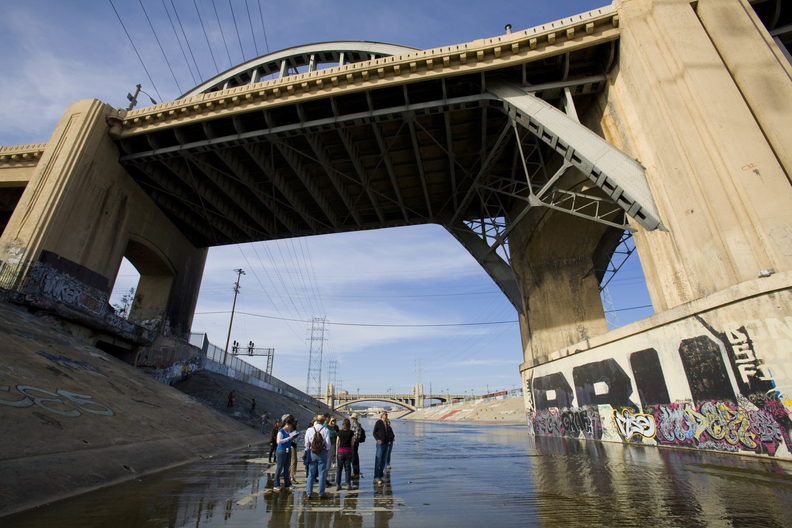
Get to know the river, up close and personal, like this shot under the Sixth Street Bridge. (Courtesy FoLAR)
Carpool Los Angeles River Tour
Elysian Valley to Long Beach
Special Water Edition
Follow docent, Jenny Price, to the Glendale Narrows, Arroyo Seco Confluence,
Downtown, Maywood Riverfront Park, Dominguez Gap Wetlands, and
Long Beach Harbor.
Saturday, March 12, 2011
9:00AM – 5:00PM (option to leave midday)
Featuring speakers from Santa Monica Baykeeper, Food & Water Watch, and
Browsing through the latest copy of Richard Anderson’s marvelous mag, “California Fly Fisher,” I recently spied an advertisement for the 2011 Fly Fishing Show in Pasadena, Calif. (Full disclosure. I’ve written a couple of pieces for him.)
This is as far as the writer got to visiting the 2011 Fly Fishing Show in Pasadena.
Wow, I thought, what a great place to corral a bunch of stories for this ol’ hungry blog! Especially of interest, two seminars, “Sight Casting to Carp, the Golden Ghost of Southern California,” and “Fly Fishing Warm Water — Bass, Like, Carp.”
Because, as my industrialist daddy used to say, “time is money,” I went to the show’s site, only to find out that it’s a road show, with the next stop in Stockton later this month. But, unfortunately, there was no schedule of what was going on, and when.
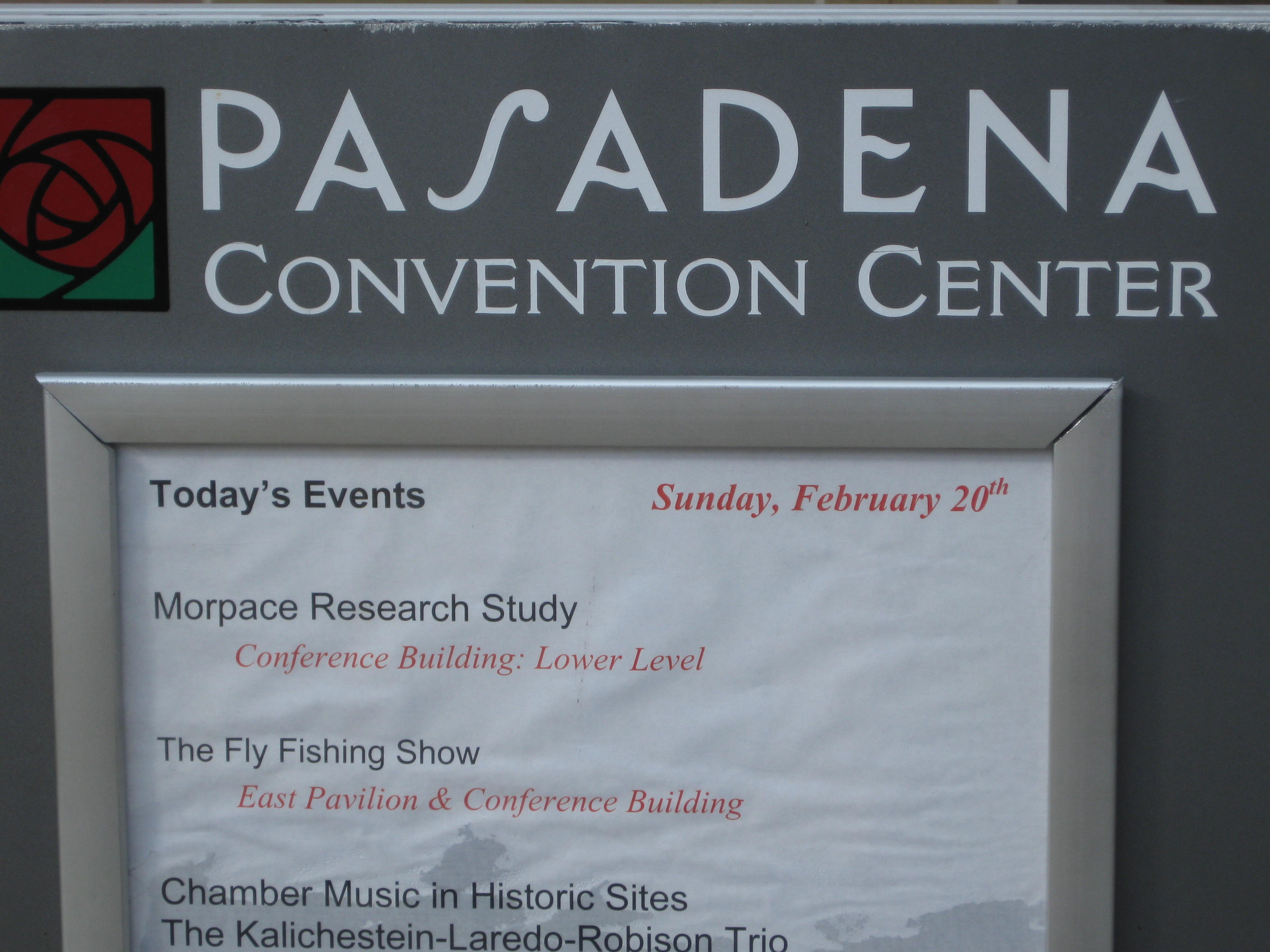
So, I procrastinated and found myself asking the ticket lady inside her little portable booth outside the Pasadena Convention Center if, at 3:15 p.m. on a chilly Sunday afternoon, I could get a discount. Fifteen bucks is pretty dear these recessionary days.
Oh, and did I mention that the show closed at 4:30?
“No,” she said bluntly, and even in the dim light reminding of a confessional, I could see she wasn’t going to budge on the budget.
I ask you, isn’t $5 better than nothing?
So … my report on the show is zippo, nada, not a note taken, nor a voice recorded.
I guess that’s the beautiful thing about blogging and not getting paid for it. If you blow it, well, there’s always tomorrow.
One thing I did notice during my time peering in the picture windows and watching a newbie casting demo, the demographic for the show is basically mine — and older. Lots older. When our lot gets to pounding on tables at the bar and other likely spots, we like to opine on the lack of youthfulness in the sport. And by youthfulness, I don’t mean the bad-ass contingent that looks to be refugees from snowboarding. (Don’t get indignant … Anyone for a snowboarding/ice fishing combo?)
Anyway, getting “the youth” involved means getting off our older behinds, going to schools, casting ponds, derbies, whatever, to turn on the truly young to the wonders of nature. Neal Taylor was genius in doing it, and his obit ran today in the Los Angeles Times, paleolithic edition. Four thousand children a year come to Lake Cachuma, near Santa Barbara, and possibly many heard a tale spun by Taylor. Among his more notable students, presidents Carter, Reagan and Eisenhower.
After all, how can you miss with a spiel that begins, “”At Lake Cachuma, we have seeds that walk, spiders that fly, plants that catch fish and trees that predict rain.”
Yes, once again under the “shameless promotion” category, this time KCET Departures Story Share allowed me to tell my tale about fly fishing on the river.
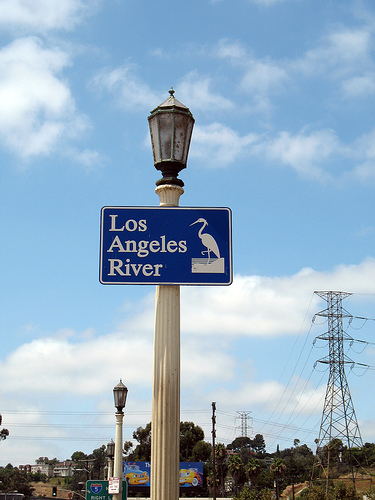
Even if you can't see the river, these bird-loving signs point the way.
Question: is all black the best look for a happy, early afternoon interview?






 lariverflyfishing