Free webinar – Learn how to safely backup and protect your photo collection
The Los Angeles Center of Photography and I will be partnering up to offer a free webinar titled Preserving your legacy: how to safeguard and begin archiving your photo collection.
It will be held on Wednesday Feb. 5, 5 p.m. PST
In light of the recent wildfires that have ravaged our city, we thought of offering this webinar as a public service to the photographic community and anybody else looking to preserve and protect their photo and visual assets.
The webinar is free, but donations are encouraged for LACP‘s gear drive to support affected victims of the southern California fires.
I hope you can attend. I will be offering some very specific steps you can take immediately to protect your photos as well as outlining a long-term plan for archiving and safeguarding them for the future.
Start the day with the five-person team tournament on the mighty Kern River. Check-in will be at the Kern River Fly Shop at 7 a.m. You can pick up any last-minute fly-fishing supplies, scorecards and listen to general tournament announcements.
Turn in the scorecard at the shop by 2 p.m. sharp and head over to Rivernook Campground for the afternoon and evening festivities starting at 3 p.m.
This year there will be ticket sales, for a nominal price, for the post tournament festivities.
The evening festivities will have raffles galore, vendors, team parade, fly fishing games, tournament awards, and beverages & LIVE MUSIC from Par Avion and the Stoneflys.
Everyone in attendance will be eligible to play Heads or Tails for a custom fly rod build by Chiaki Harami.
COST / FEES benefitting Casting for Recovery So.Cal & Kern Valley Search & Rescue
$250 for a 5 person team or $50 per person. Includes dinner, concert & festivities.
$20 for non-participant dinner, concert & festivities.
$10 for non-participant concert & festivities.
Start the day with the five-person team tournament on the mighty Kern River. Check-in will be at the Kern River Fly Shop at 7 a.m. You can pick up any last-minute fly-fishing supplies, scorecards and listen to general tournament announcements.
Turn in the scorecard at the shop by 2 p.m. sharp and head over to Rivernook Campground for the afternoon and evening festivities starting at 3 p.m.
This year there will be ticket sales, for a nominal price, for the post tournament festivities.
The evening festivities will have raffles galore, vendors, team parade, fly fishing games, tournament awards, and beverages & LIVE MUSIC from Par Avion and the Stoneflys.
Everyone in attendance will be eligible to play Heads or Tails for a custom fly rod build by Chiaki Harami.
Check out FoLAR‘s free evening of LA River fun and film at River Fest 2022 on Sunday, 5 p.m.-9 p.m.,https://www.eventbrite.com/e/river-fest-2022-tickets-381235745377?aff=ebdsoporgprofile celebrating LA River’s deep connection to art, environmental justice, community health, and climate adaptation. This open-air festival will be hosted at the scenic LA State Historic Park, bringing together the best of LA’s food truck scene, environmental films (on a 45-foot screen) and booths.
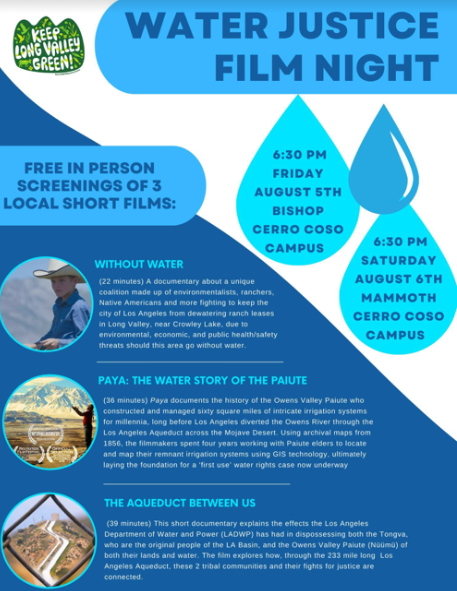
The general public is invited to join the Owens Valley Indian Water Commission and the Great Basin Water Network via webinar on Wednesday, Aug. 3, from 9 a.m. to 5 p.m. Pacific Time, for the first ever Great Basin Water Justice Summit, a FREE event that is bringing together communities fighting for water justice in the Great Basin.
The Summit will feature virtual panels and discussions with the organizers as well as representatives from various other groups and entities, including the Keep Long Valley Green Coalition, of which Friends of the Inyo is a leading member, the Sierra Club, Mono Lake Committee, Big Pine Paiute Tribe Environmental Department, Confederated Tribes of the Goshute, Great Basin Resource Watch, and others.
“The Great Basin Water Justice Summit will enable communities and individuals to share information on water and the environment while building relationships to tackle important water, energy, and climate issues together,” said Teri L. Red Owl, Executive Director of the Owens Valley Indian Water Commission. “The collaborative relationships and strategies that emerge from the Summit will help build on the work that is ongoing and evolving. The Owens Valley Indian Water Commission encourages everyone interested in these important topics to attend the summit to learn more, to share, and to get involved.” Friends of the Inyo’s Executive Director, Wendy Schneider, said, “This Water Justice Summit is a very important event. It is high time that the water protectors in Inyo and Mono Counties join forces to push back against water extraction.” The public can register to attend the Summit virtually: tinyurl.com/WaterSummitD1. For more information about the Great Basin Water Justice Summit, please refer to the Summit flier above or contact Teri@oviwc.com.
The Great Basin extends through most of Nevada, half of Utah, and sections of Idaho, Wyoming, Oregon and California in the United States, and Baja California in Mexico. According to the Eastern California Museum in Independence, this inland region is one from which water does not flow outward to any ocean. The area is dominated by a series of mountain ranges trending north-south and separated by long, narrow valleys. The Eastern Sierra and the Owens Valley are at the westernmost edge of the Great Basin.
According to the National Park Service, the terms Great Basin and Great Basin Desert are sometimes used interchangeably. The Great Basin Desert is the only “cold” desert in the United States, where most precipitation falls as snow. Until about 10,000 years ago, water was abundant here as glaciers advanced and retreated in a climate that was cooler than today, and numerous large lakes formed. Then, the weather started getting warmer and many of the lakes within the Great Basin dried up. As glaciers melted, the water seeped into the gravel subsurface and remained protected from evaporation. These reservoirs of groundwater, known as aquifers, remain beneath old lake beds. Aquifers are recharged from surface precipitation, typically snowmelt. In the Great Basin Desert, however, with less than 10 inches of annual precipitation, there is little to no recharge of these aquifers.
The Eighth Annual drew more than 100 volunteers who pulled a a dumpster’s worth of trash from the Owens River, north of Bishop, California. (Credit Chris Leonard)









 lariverflyfishing