Month: October 2024

But are they Steelhead?

A HERO’S RETURN for this fall-run Chinook Salmon spotted on Oct. 16, in a tributary of the Klamath River after removal of four dams marking the first fish to return since 1916. (Photo by Mark Hereford, Oregon Department of Fish Wildlife, Courtesy: ODFW)
MEANWHILE, ARE THESE fish endangered Southern California Steelhead in Orange County? (Courtesy William Preston Bowling)

Were they steelhead? That was the question a group of environmentalists and scientists asked themselves as they watched a group of large fish navigate the urban waters close to Orange County’s San Juan Creek Estuary.

Ironically, the group was there on a site visit for Trout Unlimited’s San Juan Creek Estuary Restoration Project, led by longtime advocate George Sutherland, who with help from the California Department of Fish and Wildlife wrangled a 30-plus inch steelhead from estuary waters back into the Pacific Ocean. He’d been tipped of the fish’s inability to reach the ocean by a local shopkeeper. That was in the early 2000s.

Fast forward to 2024 and TU is pursuing grants to improve the area’s habitat for native fish, wildlife and plants, restoring the health of this important water.

Even though Sutherland spearheaded signage about steelhead in this area, the group was amazed to sight what could be the almost mythical Southern California Steelhead, an endangered species, once caught in the thousands in local rivers.
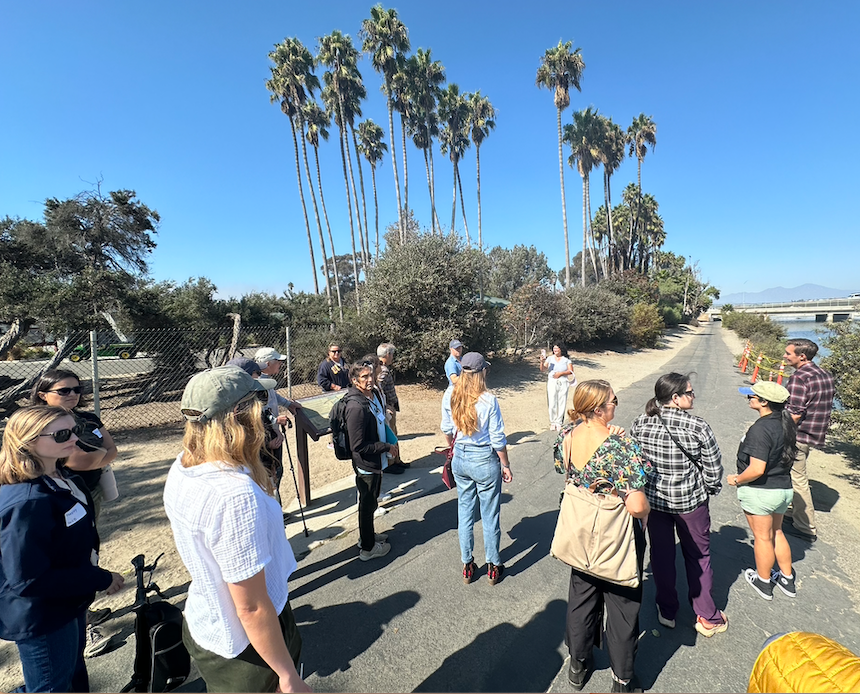
“It was a sign, as we walked past our sign–The Trout Unlimited Steelhead lifecycle–that a hard look is needed in the San Juan Creek Estuary as a place that needs to be restored for the animals that use this area,” ” said William Preston Bowling, President of Trout Unlimited South Coast Chapter. “Evidence of Steelhead Trout and other fish species with an osprey in a palm tree to balance out the circle of life.”

But, the biologists weren’t completely convinced that these fish were steelies, focusing on the shape of the dorsal fins, as well as what they characterized as larger mouths.

Ironically, at least according to one participant, these biologists admitted they’d never actually seen a steelhead in the wild.

The mystery continues until a positive ID is confirmed.

See you on the river, Jim Burns

Chantry Trout Scout heartbreak: lots of frogs, weirs, but nary a fish

(Photos by Keegan Uhl)

By Keegan Uhl

Guest Contributor

Big Santa Anita Creek at Chantry Flat–I had heard the tales of rainbows and browns from “back in the day,” but I had never seen this idyllic stretch of incredible trout water for myself. I only took up local fly fishing a year ago, during the four-year fire closure of the area. I was eager to see it for myself last week when they reopened the area.

So, a friend and I spent a day scouting for Chantry Trout. I assume the weirs, across the stream at regular intervals, stamped with the date 1959, were built to control flooding around the 80 or so cabins in the canyon. I also know that these probably very quickly filled up with sediment, rendering them useless, much like the Brown Mountain Dam on the Arroyo Seco above JPL. 

I also guessed that these dams would act as fish barriers. So while scouting, we made sure to walk as much of the stream as we could, thinking fish could be localized in one of these runs. We covered a lot of ground, from a half-mile above Sturtevant Falls all the way down to within a half-mile of the reservoir. We hiked seven miles. I am deeply sad to report: we found no fish in the stream.

I put my waterproof video camera in pool after pool, hoping and praying to see a little movement under a rock, a fry tucked up into a crevice. Nope. Nada. Zip. Zilch. We also tried flies, of course. And with ample experience fishing the streams of the Angeles and San Bernardino mountains, I can say with certainty–if there were fish there, we would have caught ’em, or seen ’em.

We did find hundreds, thousands perhaps, of frogs (and tadpoles visible underwater)–another observation that points to the absence of a healthy population of trout. 

This was a total bummer, as the stream itself looks “incredible.” There is a surprising amount of water flow for this time of year–pool after pool of deep, cool, aerated water. Just perfect for our native rainbows. The flow was many times what we see this time of year in other creeks that manage to support fish, like the Arroyo Seco.

I had high hopes that with the recent high-water years, maybe some fish had survived the fire and repopulated, perhaps from the reservoir below, but it seems that’s not the case. Now, could there be some survivor fish in the reservoir and perhaps immediately upstream of it? Yes, it is possible, we did not make it all the way to the reservoir. But there are certainly no trout in most of the accessible water.

Perhaps we can convince the CDFW to repopulate the stream, stocking it with wild rainbows from nearby drainages (perhaps a rescue of East Fork San Gabriel fish is in order, before the rains come and destroy that stream?). Our mountain rainbows have their genetic roots in the Southern Steelhead runs of a hundred years ago, and keeping good stocks of those populations may help repopulate the endangered Steelhead if and when we are able to reconnect them to the ocean. 

Here’s hoping all that comes to pass.


Don’t forget your ‘bat bag’ on San Antonio Creek

(Credit: Derek Flor)

By Derek Flor

Guest Contributor

I was on San Antonio Creek this morning after a podiatry appointment for a sore heel, and this is what I hauled out of the creek from the washed out bridge down to the Fire Station interpretive area.

I take a little bat bag for carrying an extra flyrod and for carrying trash out. Water temps were 57.2 degrees when I got there; air temp was 65 degrees and the water was flowing very well. Sure, it’s all “dammed up” by the weekend crowd, but actually it was cleaner than I expected. I did not haul out a big cardboard box, nor the 15 empty Modelo’s. I just didn’t have room for them in the bat bag.

I carried my Rocky Mountain Tenkara “Chico” rod and fished a wet fly upstream with no results for the area most heavily trafficked and affected by the weekenders, and had no results fishing, even in the fishiest of spots.

Up above the bridge, there is a spot I have caught fish before, but in much skinnier water when we were still drought affected, and when I caught the little 5-inch trout there. I wasn’t surprised. Once I caught a trout, I stopped. It told me as much as I needed to know.

Trout are still in there. I saw no evidence of dead trout in any of the areas you’d expect them, trapped by debris. The water was clear, and there was no fire debris in this lower area.

I decided to stay down from the Baldy Village area given the earlier concerns about fire. Everything goes downstream and I thought I’d learn all I needed down where I was. I was on the water for just shy of two hours and covered about a third of a mile of water. as the crow flies, maybe a little bit more. Lots of raspberries, but I left them for the birds and other wildlife, meaning perhaps, the weekenders.

I neglected to take my phone with me so the little guy didn’t get to pose for photos. I don’t like to keep them out of the water much anyway.