Steve Kuchenski, a friend of the blog (as well as my friend!), suggested this podcast.
“Your regular readers may be familiar with much of this, but (for example) I was unaware of the original Fredrick Law Olmsted plan for parks all along the river in lieu of 100% concrete channelization,” he wrote in an email.
The description of this episode follows. If you would like to listen, >>CLICK HERE.
When you hear the word “river,” you probably picture a majestic body of water flowing through a natural habitat. Well, the LA River looks nothing like that. Most people who see it probably mistake it for a giant storm drain. It’s a deep trapezoidal channel with steep concrete walls, and a flat concrete bottom. Los Angeles was founded around this river. But decades ago it was confined in concrete so that, for better or worse, the city could become the sprawling metropolis that it is today. All these years later the county is still grappling with the consequences of those actions. Reported by Gillian Jacobs, guest hosted by 99PI producer, Vivian Le.
Hey, fishers, the East Fork area and East Fork Road are closed today, so it’s a good idea to stay off Highway 39. Last night, although Camp Williams wasn’t evacuated, area hikers and campers were, so the situation is once again very hot and dire for our mountains, the visitors who frequent them, our firefighters, the fish we all love and hopefully, not for homes and residents. News reports, as I write, say 300 acres have burned so far, CalFire has called in air support, and containment is at zero.
Don’t we all dread these times? Biologists say that fire is natural and a good thing, but that the burn cycle is 20 years between events. Ash fertilizes the ground for seeds to grow, Giant Sequoias have a natural fire retardant in their bark and the jack pine depends on fire to release their seeds, according to the National Forest Foundation.
If an area continues to burn, say every three or four years, the habitat becomes less able to support the rich land and aquatic life we all enjoy. Wildlife die or flee in search of better habitat and food. Even worse in long term, grasses and shrubs colonize what used to be a forest of trees. Invasives can then get a leg up as well.
If you’ve been to the WF recently, you’ve noticed that the flow is way down because of construction efforts to control the Bobcat Fire debris in Cogswell Dam. The water clarity is not great, and it is way hot.
We are in the fourth year of a five-year emergency debris clean-up project, and because of the turbidity, the California Department of Fish and Wildlife’s surveys on the West Fork in the last two years haven’t been completed.
“CDFW has just recently completed a 2024 annual survey of the WFSGR and results are still pending,” CDFW Environmental Scientist Joseph Stanovich said in an email. “There has been internal discussion regarding the status of the wild trout populations and plans to help it rebound, but with the current conditions and keeping the wildlife resources in mind, it doesn’t seem to be feasible right now.”
I know we’re all anxious to take a look at that report when it is released.
You can keep an eye on local flows >>HERE. I’m not sure if the West Fork gauge is broken or what, but taking a look at the flow, it ain’t good.
I’ve been hearing much better things about fishing the EF, so let’s all hope that firefighters get the Fork Fire out soon and that these precious habitat treasures for wild trout and all our animals come out of this all right.
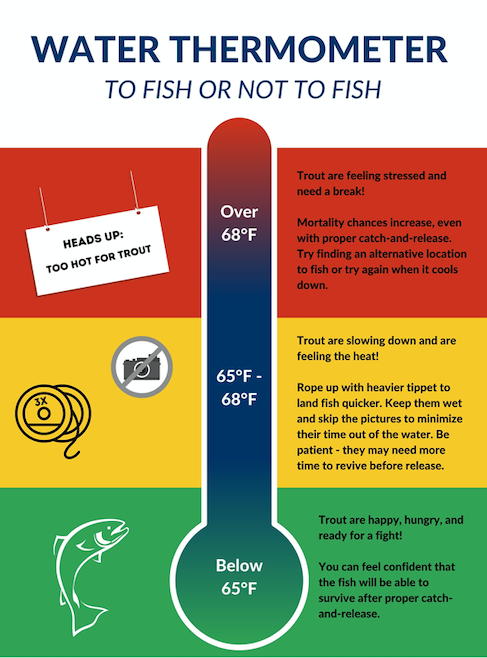
When a good fisher friend texts you that the water temperature is 68 degrees at 7 a.m., you know it’s July in the San Gabes. Dawn Patrol is a great way to get into lots of our beautiful, wild trout before the summer hordes descend. But, remember the limit for safe fish handling is 70 degrees.
I broke my water thermometer and need to buy a new one. For those who care about our local waters’ health in summer, it’s as important a piece of equipment as a leader billfold or a hemostat.
Many of you savvy anglers already know what “hoot owl” restrictions are. I first heard about them on Montana’s Big Hole River, a waterway that struggles each summer with allocating enough water for ranchers, fishers and trout. They’ve done an amazing job over the years, sharing their watershed and keeping it alive and healthy.
Hoot Owl restrictions recommendations, according to CDFW, mean being active as an angler during times of day when owls can still be heard hooting. These times are typically earlier in the day when weather conditions are cooler.
Keep Fish Wet goes farther with its “No Fish Dry July” campaign .
“No Fish Dry July encourages anglers to rethink their interactions with fish during hot summer months and challenges everyone to make a month-long commitment to “do better”. Whether it is by not taking a single photo of fish for July, using best practices for each fish we catch, or by only targeting warm water species each angler can find a way to participate.”
Whatever you decide to do, remember that once the water hits 70 degrees, it’s better to hang up the rod for a bit, grab a cold one and wait to hear that hoot owl. The trout will thank you and so will your fellow conservation-minded fishers.



 lariverflyfishing