Month: January 2024

Heritage and Wild Trout Challenge just got easier to enter

By Bernard Yin

Guest Contributor

There is a certain subset of the fly-fishing community, hopefully a sizable one, who pay extra attention to the fascinating heritage of California’s native fishes. The California Heritage Trout Challenge, recognizes those who have sought out six of the 11 cutty and rainbow qualifiers within the state’s borders.
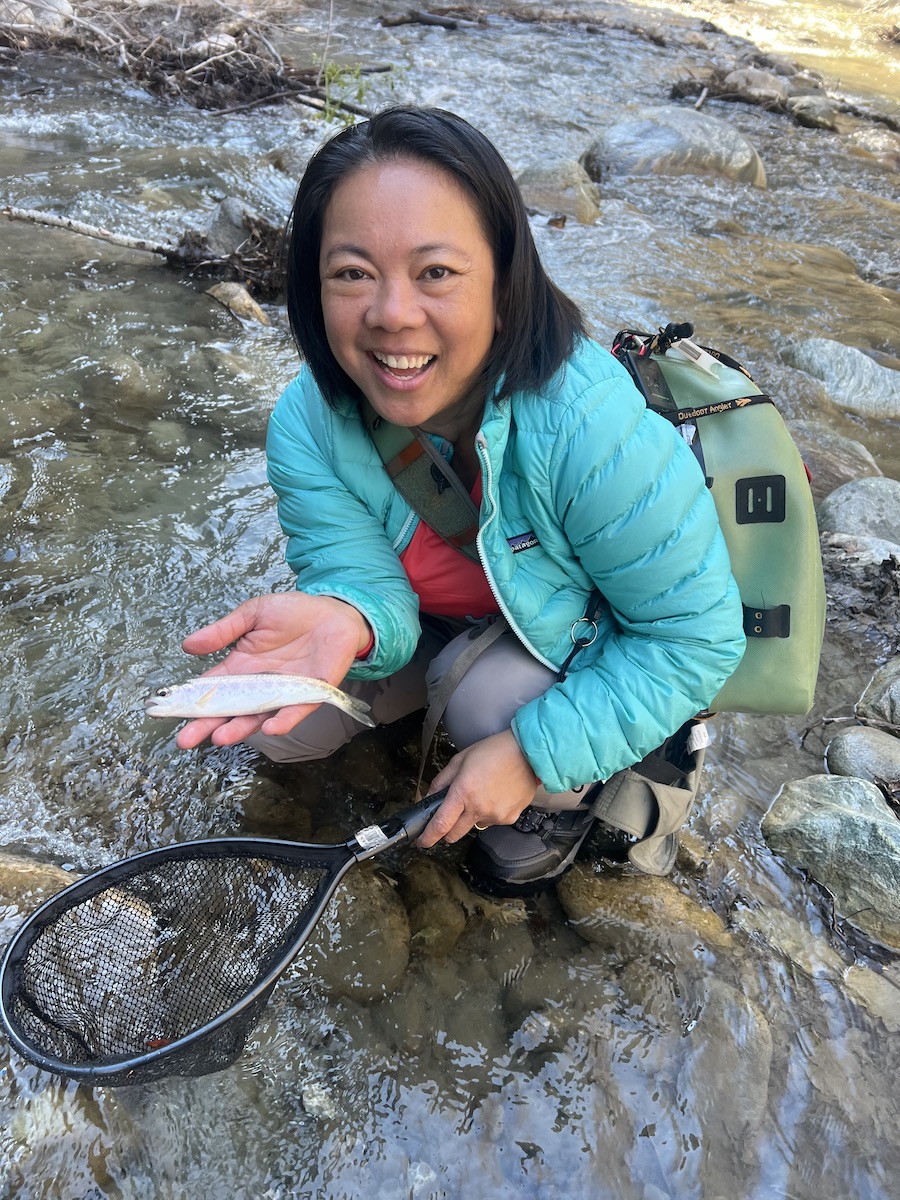
Analiza del Rosario on the East Fork San Gabriel River

You have to log your catch diligently with the Department of Fish and Wildlife to receive a well-earned acknowledgment in the form of a colorful, personalized certificate featuring the art of renowned fish illustrator, Joseph Tomelleri. Your certificate will show six full-color images representing the trout you caught, along with the dates and locations. It is sized to fit in a standard 16×20-inch matted frame. Ah, trout geekery at its finest.

Up until now, the submission process has been antiquated and required some effort. Recognizing this, the department recently updated its website to include an interface that allows for online submissions. What makes this all the more exciting is that here in So. Cal., there are actually waters that qualify. And rejoice, the challenge’s founder, Roger Bloom, spent years cutting his teeth in our trout waters, seeking out native fish and studying them for the CDFW. In other words, the challenge’s founder truly has local stream cred.

Here’s a hot-off-of-the-press statement from a Department of Fish and Wildlife representative per my inquiry:

“For Coastal Rainbow Trout any watershed that flows, or used to flow, into the ocean will count. All the rivers you mentioned and their tributaries (East Fork San Gabriel, West Fork San Gabriel, North Fork San Gabriel, Arroyo Seco) will count. Piru is another good spot. The next closest species for someone in Southern California would be the Kern Watershed. They can get Ca Golden Trout out of the South Fork Kern or Golden Trout Creek, Little Kern Golden Trout out of the Little Kern River, and the Kern River Rainbow Trout out of the mainstem Kern River.”

The idea of a road trip is also echoed by So. Cal.-based author James Pogue, who has completed the challenge four times.

“There is no way for a SoCal angler to get six (legal) species without making at least one trip up to the top of the state,” Pogue wrote in an email, “so combining the HTC with a trip to explore the North Coast or the high reaches of 395 is a necessity.”

But, he also noted, once up in the Jefferson area you can easily get a new species per day, every day, if it’s the right time of year and you plan well. 

What more encouragement does one need? All this lies a shopping cart’s throw from, well, the LA River – nudge nudge wink wink.

Should any of you reading this already have accomplished the challenge, please leave a comment. It would be great to know of which species was the most challenging or interesting to find; whatever you feel like sharing.

Tight lines and safe travels!


Editor’s Note: The CDFW reports the Paiute region and the entire area, including the Paiute’s native range, is closed to fishing at this time into the foreseeable future.

Resources

An Overview: https://bit.ly/heritagetroutchallenge

The current list of waters statewide: https://bit.ly/wildandheritagetroutwaters

The Angler’s Guide (Truly informative): https://bit.ly/troutchallengeanglersguide

The new web-based form: https://bit.ly/heritagetroutchallengeapplicationandverificationform

Great interview with Roger Bloom by Guy Jeans: https://bit.ly/rogerbloominterview

Guest contributor – Bernard’s passion for fly fishing goes back over 40 years having started as a junior member of the Diablo Valley Fly Fishing Club and working in the legendary Creative Sports Fly Shop in Northern California. He has since guided in the Sierra Nevada, worked at the Fishermens Spot in Van Nuys, and managed social media for the Southwest Council Fly Fishers International. His “blue lining” exploits in the So Cal mountains are renown. Currently, Bernard and his wife Rebecca also serve as CalTrout’s “eyes on the ground” in Southern California. Both also serve as conservation co-chairs for the Southern Sierra Fly Fishers Club and a Patagonia Fly Fish Ambassador.  – and this is the short version folks.

@bernardyingram

___________________________

Joel Stewart

A Fly Rod in My Sea Bag

This is great! I was hoping to do a HTC trip before I retire and move out of CA. This is definitely moving that plan towards reality.

____________________________

Randy Skidgel

President, Southern Sierra Fly Fishers

Carole and I did this two years ago. The planning and research were epic as the

adventure. Dismal Creek will always remain one of our favorite spots. Amazing

adventure, everyone who fishes in California should do this. We are currently

getting prepared for Nevada Heritage Trout Challenge.

‘Show me da money!’

The Los Angeles River is again raking in grant money for its makeover, a boon to us Angelenos, as well as to the species who depend on the river for survival.

First off, Trout Unlimited South Coast chapter received $4.6 million late last year from the California Wildlife Conservation Board for the planning, design, education and outreach for the Lower L.A. River project over the next three years. It includes creating riparian habitat, slower currents and shady rest areas for steelhead migrating back home to the San Gabriel Mountains. That is the largest grant ever received by any TU chapter in the country. Emphasis on the Lower River and Dills Park, as well as the city of Paramount, is a hopeful sign that communities long neglected by LA’s power players will begin to get their due. 

Meanwhile, the Bowtie, the former headquarters of Southern Pacific Railroad, was recently awarded $5,896,000 in funding for remediation and construction. In 2003, California State Parks bought the property called G-1, which is now referred to as “the Bowtie” (due to its shape), with the intent of transforming the currently undeveloped industrial land into a safe and clean, vibrant public green space, according to California State Parks. The makeover will focus on nature conservation and restoration, education and providing opportunities for passive recreation.

In all these two projects join:

LA River & Caballero Creek Confluence Park (MRCA) – Construction

LARiverWay Bike Path Segment 1&2 project (City of LA) – Design, partially-funded

LARiverWay Bike Path Segment 8 (City of LA) – just became funded

LA River East Bank RiverWay (City of LA, along Atwater Village) – Design, funded

LA River Bike Path Improvements (City of LA, along Elysian Valley) – Design, funded

Paseo del Rio project at Taylor Yard (City of LA, MRCA, State Parks) – Early design, partially-funded

LA River Ecosystem Restoration and Recreation project Reach 1 (US Army Corps of Engineers, north side of Griffith Park) – Design, funded

LA River Path Project (Metro, through Downtown LA and Vernon) – Design, funded (mega-project)

Fish passage in the Downtown LA area, which is also in design but needs to find implementation funding.

The list totals nearly $500 million in project investments.

So, here’s a question for you: How much money does South Dakota have for conservation project in a year?

According to Ballotpedia, $23,650,008, which was the most recent available figure was for 2015. Now that sounds like a truckload of cash until you look at the figure for California, $9,108,000,000, you read that right.

On the high end, three states spent more than $1 billion on environmental and natural resources departments in fiscal year 2015 — Cali, Florida and New York. And just for the record, California spent more — way more — than both Florida and New York combined.

While on the low end, four states spent less than $30 million on environmental and natural resources departments in fiscal year 2015— Oklahoma, Nebraska, South Dakota and Connecticut.

Since passage of the Endangered Species Act 50 years ago, more than 1,700 plants, mammals, fish, insects and other species in the U.S. have been listed as threatened or endangered with extinction, according to the Los Angeles Times. And just like the big the states, there are winners and losers. Guess which species are the biggest winners of federal environmental bucks.

Of the roughly $1.2 billion a year spent on endangered and threatened species, about half goes toward recovery of just two types of fish: salmon and steelhead trout along the West Coast. Meanwhile, the tiny Virginia fringed mountain snail had $100 spent on its behalf in 2020 after only being seen once in more than three decades. There are also species — more than 200 imperiled plants, animals, fish and other creatures, according to the article — that had nothing spent on their behalf.

See you on the river, Jim Burns

West Fork weekday fishers — enjoy it while it lasts

This sign near the Pasadena Bait Club House, didn’t survive the Bobcat Fire, but it still say it all. Next sign, let’s scratch “fishermen” in favor of “fisher folk.” (Credit: Jim Burns)

Just when the SoCali fly fishing community thought it could relax and put the wet boots up, turns out that’s not the case. Word on the stream-street is that the weekday closures will begin again in March for more silt removal that could last another two to three years! Yup, that means all the heavy equipment comes back, the guy at the gate will most likely be shooing folks away and — you will be trying to fish your weekend way through the inevitable growing spring and summer crowds.

So, enjoy this wonderful winter quietude while you can. It ain’t gonna last.

See you on the river, Jim Burns

The eagle has landed?

As first reported in 2016, then again in 2019, bald eagle sightings are the celebrities in 2024, bringing muscular telephoto lenses to bear on Highway 39. The last time I saw this many outdoor photographers was in Rocky Mountain National Park during the fall Elk bugle. (Credit: Jim Burns)